_1751731246795-BygAaJJK.png)

Staff Augmentation vs. Fixed-Scope: Pick One Before You Sign

 Published by CodeNicely, the product studio founded by Meghal Agrawal and Ujjwal Agrawal in 2017
For: A seed-to-Series A founder in Dubai who has received two proposals for the same build — one quoting a monthly retainer for augmented engineers, one quoting a fixed-price deliverable — and cannot tell which contract model protects them better before they wire the first payment
In this guide
If you can write a detailed, testable acceptance-criteria document for the build today — go fixed-scope. If you cannot, go staff augmentation. That is the whole decision. Everything else — hourly rate comparisons, vendor pitches about 'predictability,' promises of 'flexibility' — is secondary to this one question, because a fixed-scope contract prices the vendor's exposure to your unwritten requirements. If your requirements are unwritten, you pay for that exposure twice: once in the risk premium baked into the original quote, and again in change orders when reality meets the spec.
This post is for a seed-to-Series A founder in Dubai staring at two proposals for the same product. One quotes a monthly retainer for two or three augmented engineers. The other quotes a lump sum against a scope document. Both vendors sound competent. Both have case studies. You cannot tell which contract model protects you better, and nobody is going to tell you honestly because each vendor is pitching the model that protects them.
Define the decision crisply
Staff augmentation means you rent engineers by the month. They work to your direction, in your tools, on your backlog. You own the roadmap, the priorities, the definition of done. The vendor's commercial obligation is to supply qualified people and replace them if they underperform. The vendor is not on the hook for whether the product ships.
Fixed-scope delivery means you buy an outcome. The vendor commits to deliver a defined artefact — a mobile app with these screens, this API, these integrations — for a fixed sum by a fixed date. The vendor owns the plan. You own acceptance. Any deviation from the signed scope triggers a change order, which is a new mini-contract with its own price.
Those are the two models. Everything else — 'managed team,' 'dedicated squad,' 'milestone-based' — is a marketing wrapper around one of the two, usually with the risk subtly shifted toward you.
The five axes that actually decide it
1. How well you can specify today
This is the dominant axis. Steve McConnell's Cone of Uncertainty puts estimation error at the concept stage at roughly 4× in either direction — a 16-fold range from best case to worst — meaning any vendor quoting a fixed price before detailed design is knowingly absorbing a 2–4× error margin. They absorb it by adding a risk premium. Industry practice puts that premium at 15–30% of actual cost — money you pay whether problems materialise or not.
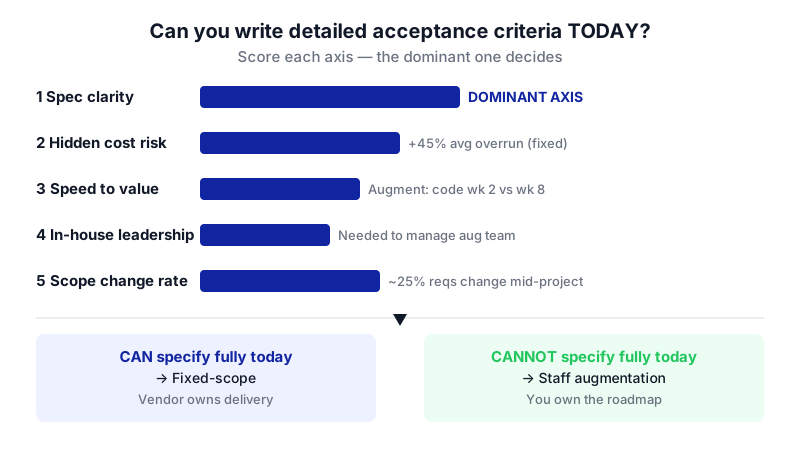

If you can hand a vendor a spec that says 'tapping this button sends this payload to this endpoint and the response is rendered thus,' fixed-scope works. If your spec is 'users should be able to request a service and get matched to a provider,' it does not. Scope creep is not a vendor conspiracy — requirements change about 25% during a typical software project, and PMI's 2024 Pulse of the Profession found 52% of projects experienced uncontrolled scope changes, up from 43% five years earlier. Fixed-scope contracts have no mechanism to absorb that except change orders, each of which is priced with less competitive pressure than the original.
2. Total cost of ownership, including the hidden parts
The sticker price of a fixed-scope quote is almost never the final price. A McKinsey and Oxford study of 5,400 large IT projects found the average ran 45% over budget, 7% over time, and delivered 56% less value than predicted. 17% became 'black swans' — overruns of 200–400%. The Standish Group's CHAOS data has shown for 30 years that only around 29% of software projects finish on time and on budget.
Staff augmentation has its own hidden costs: your senior engineer's time on code review, your product manager's time on tickets, onboarding ramp (typically two to four weeks before an augmented engineer is net-positive), and the overhead of managing a team you did not hire. If you lack in-house technical leadership, these costs balloon. If you have a competent CTO or lead engineer, they are modest.
Rough rule: fixed-scope looks 10–20% cheaper on paper and often ends up 20–40% more expensive in practice once change orders and the risk premium are counted. Augmentation looks more expensive on paper and tends to land close to the quote — if you can manage the team.
3. Speed to first value
Augmentation starts faster. In Dubai, standard permanent tech recruitment runs 3–6 months versus 2–4 weeks for augmented staff, and 90% of UAE companies report being unable to find required skills locally. An augmented team can be writing code in week two. A fixed-scope engagement typically spends four to eight weeks in discovery, design, and contracting before the first commit — because the vendor has to specify the work tightly enough to price it. That discovery phase is not wasted; it often surfaces problems that would otherwise bite you in month four. But if your market window is narrow, augmentation gets you to a demo faster.
4. Key-person risk and knowledge retention
Under augmentation, the knowledge lives in your repo, your tickets, your Slack. If a vendor engineer rolls off, their replacement reads the codebase and the PRs. Painful, but recoverable. Under fixed-scope, the vendor's internal team holds the knowledge, and your contract rarely requires them to hand over architectural decisions, test coverage philosophy, or the reasoning behind trade-offs. When the project ends, so does their obligation to explain anything. If you plan to run the product internally after launch, fixed-scope creates a cliff.
5. What happens if you change your mind in month six
This is the question founders underweight most. Under augmentation, changing direction costs you the sprint you abandon. The team pivots. Under fixed-scope, changing direction means renegotiating the contract — and the vendor now has leverage, because you are mid-build with sunk costs and no competitive tension. The second quote is always worse than the first.
If you are pre-product-market-fit and your roadmap genuinely might rotate 90 degrees after user interviews, fixed-scope is the wrong instrument. If you are building a known commodity — a KYC flow, a payments integration, a WordPress migration — fixed-scope is fine, because the chance of a rotation is near zero.
Score the options honestly
When staff augmentation wins
- You have a technical founder or lead who can run the team day-to-day
- Requirements are evolving and will keep evolving through launch
- You need to start this month, not next quarter
- You intend to keep the product in-house after launch and want the knowledge to settle in your repo
- You are hiring permanently but the local market cannot deliver in your timeframe — the global IT staff augmentation market, valued at roughly $299 billion in 2024 and projected to reach $857 billion by 2032, exists largely because this situation is the norm, not the exception
When fixed-scope wins
- You can produce a detailed acceptance-criteria document today, with testable pass/fail conditions on every feature
- The work is a well-understood category — a payment gateway integration, a Shopify theme build, a migration from Platform A to Platform B
- You have no in-house technical leadership and cannot acquire any before the project ships
- You are reporting to a board or investor committee that needs a single number against a single deliverable for governance reasons
- The vendor has shipped this exact pattern three or more times — their risk premium should be low because their uncertainty is low
When neither wins — the case against hiring an agency at all
Sometimes the right answer is 'wait a quarter and hire two senior engineers directly.' If the product is your core differentiator, if you expect to iterate on it for five years, and if you can tolerate a 3–6 month hiring runway, in-house usually beats both outsourcing models on a 24-month TCO basis. UAE tech salary inflation of 15–25% annually and 89% of Dubai CIOs citing the skills gap as a critical barrier make this harder than it should be, but 'harder' is not 'impossible.' If the product is non-core — the internal tool, the one-off migration, the pilot that may never go to v2 — do not hire for it. Buy it or rent it.

The illustrative worked example
Take a two-sided marketplace MVP: iOS app, Android app, admin panel, two third-party integrations (one payments, one SMS), no existing data to migrate, no regulatory audit requirement. A fixed-scope vendor will typically price this against a 60–80 page spec they help you write during a paid discovery phase of three to five weeks. The quote they produce includes the 15–30% risk premium noted earlier.
An augmentation vendor will quote you a monthly rate for, say, two full-stack engineers, one mobile engineer, and a part-time designer, with a two to four week ramp. You run the backlog. You decide what gets built this sprint. If the integration takes three weeks instead of one, you absorb that in your runway; the vendor's invoice does not change.
If your spec is solid, fixed-scope lands cheaper. If your spec is a wishlist, augmentation lands cheaper — because you only pay for what you actually asked for, in the order you actually asked for it. This is illustrative; your situation will differ on team size, stack, integration count, and whether you need production support after launch.
What turns a range into a real quote
Three specifics collapse the uncertainty on either model: the depth of your acceptance criteria (one paragraph per feature versus one page per feature changes the risk premium meaningfully); whether you have in-house technical leadership to manage augmented engineers or review vendor deliverables; and your tolerance for a mid-project pivot. If any of those three is unresolved, you are not ready to sign either contract — you are ready for a scoped discovery conversation. For teams in the region, our Dubai software development team can run that scoping with you, and the offerings page lays out how the engagement models map to different build types.
If you're in situation A, do X
If you can produce testable acceptance criteria today, the work is a known pattern, and you need a fixed number for your board → sign the fixed-scope contract. Insist on a change-order rate card in the master agreement, not negotiated per-change. Insist on source code, documentation, and a two-week handover built into the deliverable, not sold as an add-on.
If your requirements are still evolving, you have a technical founder, and you need to start this month → sign the staff augmentation retainer. Insist on a 30-day exit clause, named engineers (not 'equivalent resources'), and the right to interview replacements. Budget for 10–15% of your own senior engineer's time on code review and direction.
If you are honestly not sure which situation you are in → that is the answer. You are in the augmentation situation. Fixed-scope punishes uncertainty; augmentation absorbs it. Pay the small premium for optionality and revisit the question in three months when the spec is clearer. You can always consolidate into a fixed-scope phase two once the uncertainty has been retired. You cannot un-sign a fixed-scope contract once the risk premium is paid.
Frequently Asked Questions
Is staff augmentation always more expensive than fixed-scope?
On the invoice total, often yes by 10–20%. On total cost including change orders, hidden management overhead, and the vendor's risk premium, frequently no. The McKinsey/Oxford data showing an average 45% budget overrun on large IT projects suggests the 'fixed' price is rarely final. The honest answer is: fixed-scope is cheaper when your spec is airtight, more expensive when it is not.
Can I start with staff augmentation and switch to fixed-scope later?
Yes, and this is often the right pattern for a startup. Use augmentation through discovery and MVP, when requirements are still moving. Once you have a stable spec and a known pattern — a v2 feature, a platform migration, a specific integration — carve it out as a fixed-scope phase. The reverse (fixed-scope first, augmentation later) is harder because the vendor has an incentive to lock you in.
What should I look for in the contract itself, beyond the commercial model?
Four clauses matter more than price: IP assignment (you own all code and artefacts, not 'licensed to you'), source code access during the build not after, a defined exit clause with a knowledge-transfer obligation, and a change-order rate card agreed in the master, not negotiated per change. Have a UAE-qualified lawyer review the specifics — this is a contract question, not a technology one, and the above is general guidance, not legal advice.
How do I write acceptance criteria good enough for a fixed-scope quote?
For each feature, write what the user does, what the system does in response, and how you would test that it worked. 'Users can reset their password' is a wishlist item. 'User submits email on /forgot-password; system sends a reset link valid for 60 minutes to that email if it matches an account; clicking the link lets the user set a new password of at least 10 characters; test passes if the user can log in with the new password and fails with the old one' is acceptance criteria. If writing that for every feature feels impossible, you are not ready for fixed-scope.
Does the Dubai market favour one model over the other?
Augmentation is the default for a reason. The combination of a 45% rise in tech job postings between 2023 and 2024, 3–6 month permanent recruitment timelines, and 90% of UAE companies reporting a skills gap means most Dubai startups cannot staff a build in-house on their actual timeline. Fixed-scope still makes sense for well-defined, bounded projects, but for exploratory product work the local market pushes founders toward augmentation whether they planned on it or not.
Sources & further reading
- IT Staff Augmentation Service Market Report: Size, Growth, Trends & Forecast (2025–2033) — Verified Market Research
- Software Project Cost Overruns: The Data (McKinsey/Oxford 5,400-project study) — DEV Community
- Why Time and Materials Contracts Deliver Better Outcomes for Custom Software Projects — decode.agency
- Fixed Price vs Time and Materials: Scope Decides It (Cone of Uncertainty, PMI 2024) — tappable.co.uk
- How to Manage Scope Creep in Software Projects (PMI scope creep stats) — wondermentapps.com
- Guide: Fixed Price vs Time and Materials for Modern Projects (risk premium 15–30%) — faberwork.com
- IT Staff Augmentation Services in Dubai — Exalogic (Dubai CIO survey, 45% job posting growth)
- IT Staff Augmentation UAE: Costs & Hiring Models 2026 — jumpgrowth.com
Get one practical guide a week
Costs, AI tools, partner selection — written for people who make the decision. No spam, unsubscribe anytime.
Thanks — you're on the list. One practical guide a week, nothing else.
That didn't work — please check the email address and try again.
Building something in Technology?
CodeNicely partners with founders and tech teams to ship AI-native products that move metrics. Tell us about the problem you're solving.
Talk to our team Book a 30-min call