_1751731246795-BygAaJJK.png)

Building a WMS: Where Your Budget Actually Goes

 Published by CodeNicely, the product studio founded by Meghal Agrawal and Ujjwal Agrawal in 2017
For: A Series A D2C or B2B commerce founder in India who has outgrown spreadsheets and a basic inventory plugin, is running 2–4 warehouses, and is trying to decide whether to buy an off-the-shelf WMS or commission a custom build before their next funding round
In this guide
- The shape of the number, and why it is a range
- The hidden line item: GST-compliant e-way bill generation
- Where the budget actually goes
- An illustrative worked example
- What pushes it up, what pulls it down
- Timeline, honestly
- Build vs. buy, briefly
- What the market is telling you about timing
- Three questions that turn a range into a quote
- Frequently Asked Questions
A custom warehouse management system built in India typically lands somewhere between ₹8L and ₹80L, and the reason that range is so wide is almost never the inventory logic — it is the integrations, the GST e-way bill flow, the number of warehouses, and whether you want the thing to run your 3PL partners or just your own racks. If you are a Series A founder trying to compare three vendor quotes, the useful question is not what does a WMS cost, it is which five decisions move my quote by ₹10L each way. This post walks through those decisions in the order they actually hit the budget.
We will stay in the custom-build lane. Off-the-shelf WMS products (Unicommerce, Increff, Vinculum, EasyEcom) have their own pricing logic — usually per-order or per-SKU-per-month — and the build-vs-buy question deserves its own treatment. Here we assume you have already decided a custom WMS is on the table, usually because your SKU mix, 3PL arrangement, or channel integrations do not fit a packaged product.
The shape of the number, and why it is a range
Industry survey data on India's WMS market and implementation benchmarks from IMARC put custom WMS development in India at roughly ₹8L–₹15L for a basic single-location build, scaling to ₹40L–₹80L+ for enterprise or 3PL-grade systems, with each additional ERP, e-commerce, or TMS integration typically adding ₹1.5L–₹4L. That is a 10x spread. It exists because a WMS is really five systems stapled together — inventory ledger, pick-pack-ship workflow, hardware/scanner layer, integrations, and compliance — and the ratio between them changes dramatically with scope.
The three variables that move the number the most, in order:
- Number of warehouses and whether they share stock. One warehouse with a single location code is a different system than four warehouses with inter-warehouse transfers, consolidated available-to-promise, and route-based fulfilment logic.
- Integration surface. Shopify + one ERP + one courier is a weekend. Shopify + Amazon + Flipkart + Myntra + two 3PLs + Tally + three courier aggregators + an e-way bill provider is a quarter of the project by itself.
- GST compliance depth. This is the one nobody quotes properly, and it is the subject of the next section.
The hidden line item: GST-compliant e-way bill generation
Here is the thing most WMS quotes understate. Every outbound movement from an Indian warehouse where consignment value exceeds ₹50,000 requires an e-way bill generated on the GST portal before the goods move, under Section 68 read with Rule 138 of the CGST Rules. The bill has to carry the transporter's GSTIN, vehicle number, invoice reference, and HSN-wise breakdown. It expires on a per-km basis. And it has to reconcile with your GSTR-1 return.
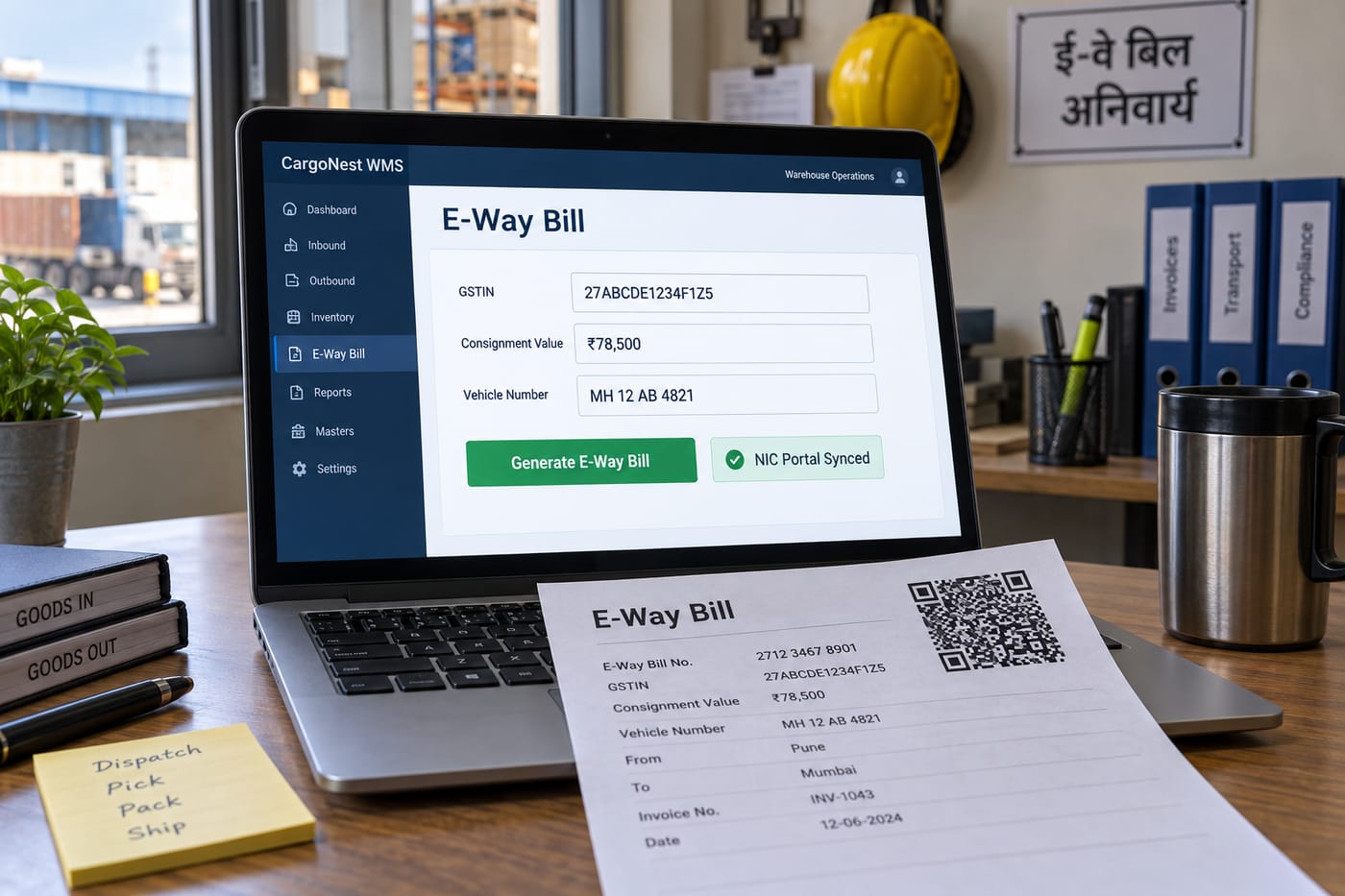
Volume gives you the shape of the problem: GSTN recorded 10.54 crore e-way bills in August 2024 alone, the fourth straight month above 10 crore, with cumulative generation since inception crossing 3,053 crore bills on the GSTN portal. If you are doing even 500 outbound shipments a day across four warehouses, you are generating e-way bills at industrial scale — and each one has to be matched back to a tax invoice, a dispatch event, and a vehicle.
When a WMS does not own this flow natively, the warehouse manager generates e-way bills manually on the GST portal (or via a third-party tool like ClearTax or IRIS) and pastes the number back into the dispatch note. That workaround costs 15–25 minutes per shipment at best, and it creates the exact failure mode GST auditors now hunt for: e-way bill vs. GSTR-1 mismatches, which routinely trigger ITC denial for the buyer and penalties for the seller. Under Section 122(1)(xiv) of the CGST Act, moving goods without a valid e-way bill is a minimum ₹10,000 penalty or the full tax evaded (whichever is higher); if the vehicle is intercepted, the penalty is 200% of the tax payable.
Building e-way bill generation properly into the WMS — API integration with the GSP (GST Suvidha Provider), auto-population from the sales order, vehicle allocation at the dock, Part-B update when the transporter is assigned, auto-extension logic, and nightly reconciliation against GSTR-1 draft data — is typically a ₹3L–₹6L module on its own. It almost never appears as a line item in the first quote. Ask explicitly.
Where the budget actually goes
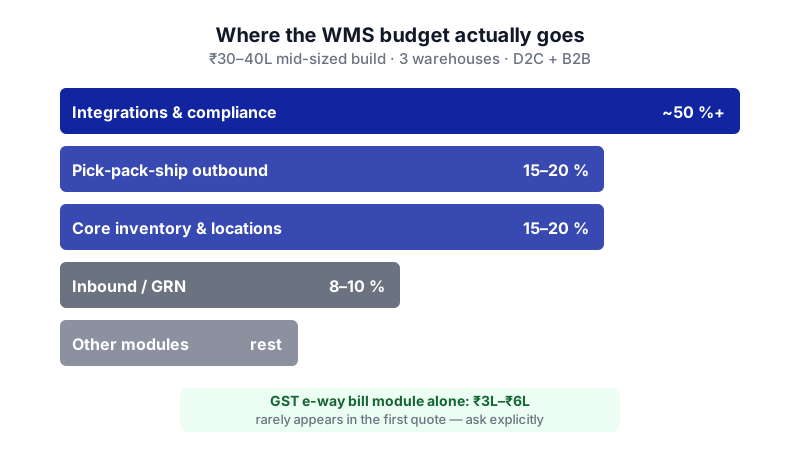
For a mid-sized custom WMS build (3 warehouses, D2C + B2B channels, roughly ₹30–40L of total project cost), a typical allocation looks like this:

| Module | Approx. share of budget | What it covers |
|---|---|---|
| Core inventory + location management | 15–20% | SKU master, bin/rack hierarchy, batch/expiry, stock ledger, cycle count |
| Inbound (GRN) workflow | 8–10% | PO receipt, QC, putaway rules, vendor returns |
| Outbound (pick-pack-ship) workflow | 15–20% | Wave planning, pick lists, pack verification, manifest, dispatch |
| Channel + ERP integrations | 20–25% | Marketplaces, D2C storefront, Tally/SAP/Zoho, courier aggregators |
| GST + e-way bill compliance | 10–15% | GSP integration, auto-generation, reconciliation, GSTR-1 export |
| Hardware layer (scanners, printers) | 5–8% | Zebra/Honeywell scanner integration, label printing, Android PDA app |
| Reporting + dashboards | 5–8% | Stock aging, fill rate, pick accuracy, dock-to-stock time |
| Deployment, testing, training | 8–10% | UAT, warehouse rollout, ops team training, hypercare |
Note what is not on this list and is often sold separately: barcode hardware itself (₹8K–₹25K per handheld scanner, ₹15K–₹60K per label printer), warehouse Wi-Fi upgrade, UPS/power backup, and ongoing GSP subscription fees for e-way bill API calls (typically ₹0.50–₹2 per bill after a free tier).
An illustrative worked example
This is one hypothetical scenario to show how the drivers compose. Your number will differ.
Assume a Series A D2C beauty brand running three warehouses (Bhiwandi, Bangalore, Delhi NCR), roughly 1,200 SKUs, 2,500 orders/day across Shopify + Amazon + Nykaa + Myntra, dispatched through Delhivery, Shiprocket, and one dedicated 3PL. They want a custom WMS because Unicommerce's returns workflow doesn't match their QC process and they are planning to add a Tier-2 city dark-store network in 12 months.
A plausible scope: core WMS + 4 marketplace integrations + 3 courier integrations + 1 ERP (Zoho Books) + full e-way bill module + Android PDA app + reporting layer. No data migration from a prior WMS (they are on spreadsheets + a Shopify plugin). Domain expert supplied by the client — their head of ops sits with the build team two days a week.
In the ₹35–45L range, roughly 5–7 months end-to-end, with the first warehouse live at month 3–4 and the other two rolled out in months 5–7. The e-way bill module alone is ~₹5L of that, the four marketplace integrations are ~₹8–10L combined, and the PDA app is ~₹3L. If the same brand also wanted a 3PL-facing portal (so their external 3PL in Delhi can log into the same WMS and operate against it), add ₹6–10L and a month.
Change one assumption — say, they are migrating from Unicommerce with two years of historical stock ledger and open orders — and the number moves 15–20% up and the timeline stretches by 4–6 weeks. Change another — say, they drop two of the four marketplace channels — and it drops 10–15%.
What pushes it up, what pulls it down
| Pushes budget UP | Pulls budget DOWN |
|---|---|
| More than 3 warehouses with inter-warehouse transfers | Single warehouse, single state (simpler GST, no stock transfer e-way bills) |
| 3PL partners who need their own login + SLA tracking | Own warehouses only, same ops team |
| Serialized inventory (IMEI, batch-expiry, cold chain) | Non-serialized, single UOM, long shelf life |
| Multi-channel: 4+ marketplaces + D2C + B2B | Single channel (D2C only, or Amazon only) |
| Data migration from existing WMS with open orders | Greenfield — moving off spreadsheets or basic plugin |
| Native mobile PDA app with offline-first sync | Browser-based scanner app on cheap Android handhelds |
| Returns QC with photo evidence + grading workflow | Returns treated as reverse pickup, re-received at inbound |
| Custom reporting + BI integration (Metabase, Looker) | Standard operational dashboards only |
| Enterprise ERP (SAP, Oracle, MS Dynamics) integration | SMB ERP (Tally, Zoho Books, Vyapar) |
| You want to own and run the GSP relationship directly | Use a reseller GSP (ClearTax, IRIS, Masters India) via wrapper API |
Timeline, honestly
Custom WMS timelines in India track budget pretty closely because warehouse software is sequential — you cannot test outbound until inbound works, you cannot test e-way bill flow until outbound works, and you cannot roll out to warehouse #2 until #1 is stable. A ₹10–15L single-warehouse build runs 10–14 weeks. A ₹30–45L multi-warehouse build runs 5–7 months. An ₹60L+ 3PL-grade system with multi-tenant isolation and full ONDC/marketplace coverage runs 8–12 months.
Two things reliably break timelines, both on the client side: (1) the warehouse SOP is not documented, so the build team is reverse-engineering the pick process from WhatsApp screenshots, and (2) the ERP integration is blocked because the ERP vendor's API team takes six weeks to respond. Neither is the WMS vendor's fault, and neither shows up in the Gantt chart. Build 20% slack for both.
Build vs. buy, briefly
If you are genuinely stuck on the build-vs-buy WMS India question, the short version: buy if your SKU count is under 2,000, your channels are standard (Shopify, Amazon, Flipkart), you don't run 3PLs, and your returns workflow matches the packaged product's assumptions. Build if any one of those is false, or if your WMS is going to be a competitive moat (quick commerce, cold chain, controlled substances, high-value serialized goods).
The hybrid most Series A commerce companies actually end up at: buy the WMS for 18 months, build the custom layer around it (returns QC, 3PL portal, dark-store module), then rebuild the core when the packaged product becomes the bottleneck. That is a legitimate path and often the cheapest total cost of ownership over three years — though it does mean you pay for the migration twice.
What the market is telling you about timing
The Indian WMS market is growing at 20–25% CAGR, and the demand pull is coming from D2C and quick-commerce expansion — the same forces that are stretching your spreadsheet. Packaged WMS vendors are consolidating and raising prices per order; custom build economics in India are improving as AI-assisted development compresses the integration layer, which historically ate 20–25% of the budget. If you are going to build, the window for doing it cheaply (relative to buy) is probably better now than it will be in 18 months.
For a sense of how similar logistics-stack builds get scoped and sequenced, our work with Vahak on a logistics marketplace walks through similar integration and reconciliation decisions. Teams going through this exercise for the Indian market usually also want to look at how the operations-modernization stack maps onto their current ERP and compliance surface.
Three questions that turn a range into a quote
- What integrations, exactly, and who owns each API relationship? List every marketplace, courier, ERP, payment, and GSP the WMS will talk to. For each, note whether you have a working sandbox account today, who at the counterparty will respond to API questions, and whether there is an existing wrapper the vendor can reuse.
- How many warehouses in year 1, and do they share stock? A single-warehouse MVP that you plan to replicate four times is one build; a true multi-warehouse system with ATP across locations and inter-warehouse transfers is a different build. Decide which you want on day one.
- What is your e-way bill volume today, and who handles it currently? If you are generating 200+ e-way bills a day manually on the GST portal, the compliance module is non-negotiable and should be scoped as a first-class deliverable, not an afterthought.
Get clean answers to those three before you ask for the final quote, and the ₹15–80L range will collapse to a ₹5–8L band you can actually defend to your board. For founders working through this scoping exercise in detail, a short conversation with a team that has shipped WMS and logistics stacks for Indian commerce — including the GSP integration — is worth more than another vendor demo. That is the point at which it makes sense to talk to a build partner about your specific numbers.
Frequently Asked Questions
How much does it cost to build a custom WMS in India?
Published industry benchmarks put custom WMS development in India at roughly ₹8L–₹15L for a basic single-warehouse build and ₹40L–₹80L+ for enterprise or 3PL-grade systems, with each additional integration adding ₹1.5L–₹4L. The spread is real — it is driven mostly by number of warehouses, integration count, and GST compliance depth. The three questions at the end of this post will narrow a quote range to within ~20%.
How long does a custom WMS take to build?
Timelines track budget closely because warehouse software is sequential. A single-warehouse build typically runs 10–14 weeks; a multi-warehouse D2C build with 4–6 integrations runs 5–7 months; a 3PL-grade multi-tenant system runs 8–12 months. The two things that reliably stretch timelines are undocumented warehouse SOPs and slow ERP vendor API teams — budget 20% slack for both.
Is it cheaper to buy an off-the-shelf WMS like Unicommerce or build custom?
Buying is cheaper upfront and usually cheaper for the first 18 months if your SKU count is under 2,000, you run standard channels, and you don't operate 3PLs. Custom becomes cheaper on a 3-year TCO basis if you have non-standard workflows (returns QC, cold chain, dark stores), high order volume where per-order SaaS fees compound, or if WMS is a competitive moat. Many Series A teams buy first and build the custom layer around it, then migrate the core later.
Why is GST e-way bill integration such a big cost driver in Indian WMS builds?
Every outbound shipment above ₹50,000 requires an e-way bill generated on the GST portal before the goods move, with transporter GSTIN and vehicle details, and it has to reconcile with your GSTR-1. Without native WMS integration, warehouse staff generate bills manually (15–25 minutes per shipment) and create mismatches that trigger ITC denial and penalties under Section 122 of the CGST Act. Building the GSP integration, auto-generation, and reconciliation properly typically costs ₹3L–₹6L and is often missing from the first vendor quote.
What should I ask a WMS vendor before accepting their quote?
Ask them to list every integration with its current API status, whether e-way bill generation is included or outsourced to a third party, how multi-warehouse stock allocation works, who handles data migration, and what the hardware (scanner, printer, PDA) scope is. Ask for a line-item breakup, not a single number. If the quote doesn't itemize the e-way bill module separately, that is a red flag — it means either they haven't scoped it or they are assuming you'll handle it manually.
Sources & further reading
- India Warehouse Management System (WMS) Market Size, Share, Trends, Growth Analysis Report, 2030 — MarketsandMarkets
- India Warehouse Management Systems Market Size, 2034 — IMARC Group
- August 2024 Sees All-Time High E-Way Bill Generation at 10.54 Crore — N J Jain & Associates
- GST System Statistics (E-Way Bill cumulative count) — GSTN Official Portal
- Penalty Provisions on E-Way Bill under GST — TaxGuru
- GST E-Way Bill Audits & Penalties: What You Must Know — Binary Semantics / IRIS GST
- E-Way Bill vs GSTR-1: GST Audit & Penalties Explained — CA Club India
- E-Way Bill under GST: Rules, Applicability, Limit and Generation Process — ClearTax
Get one practical guide a week
Costs, AI tools, partner selection — written for people who make the decision. No spam, unsubscribe anytime.
Thanks — you're on the list. One practical guide a week, nothing else.
That didn't work — please check the email address and try again.
Building something in Logistics and Supply Chain?
CodeNicely partners with founders and tech teams to ship AI-native products that move metrics. Tell us about the problem you're solving.
Talk to our team Book a 30-min call