_1751731246795-BygAaJJK.png)

Budgeting a Two-Sided Marketplace Before You Brief Anyone

 Published by CodeNicely, the product studio founded by Meghal Agrawal and Ujjwal Agrawal in 2017
For: A UK-based pre-seed or seed founder who has validated a two-sided marketplace idea, has a rough budget in mind, and needs to walk into a development conversation — or a board meeting — knowing whether £80K buys a real product or just a prototype
In this guide
- The honest one-paragraph answer
- The six cost drivers, in order of impact
- Illustrative worked example (read the assumptions)
- What pushes the number up, what pulls it down
- What is bad about this approach
- The three questions that turn a range into a quote
- How CodeNicely can help
- The bottom line
- Frequently Asked Questions
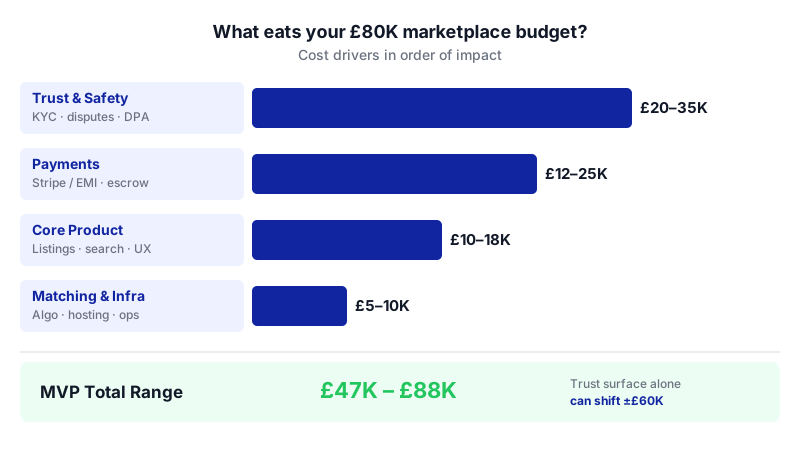
An £80K budget for a two-sided marketplace in the UK buys you either a credible launch or a well-dressed prototype, and the deciding factor is almost never the matching engine. It is the trust and safety surface: who holds the money, who verifies identity, and whose data processing contract sits underneath the whole thing. Get those three decisions wrong before you brief a studio and no amount of budget discipline downstream will save you.
This post is the budget model a UK pre-seed or seed founder needs before walking into a quoting conversation. It will not give you a single number — anyone who does is either guessing or pricing in their fear of your indecision. It will give you the shape of the number, what moves it, and the questions that convert a £60K spread between two proposals into a defensible choice.
The honest one-paragraph answer
UK agency benchmarks put a lean marketplace MVP at £15k–£30k, a payments-heavy multi-vendor platform with disputes and payouts at £30k–£75k+, and enterprise builds at £75k–£150k+. That means £80K sits exactly on the seam between the middle and upper tier. Whether it buys you a serious product depends on four things: how much of the trust surface you keep (versus outsource), how many payment flows you support, whether you ship native mobile from day one, and whether you need a true escrow licence or can live with Stripe Connect's delayed payout approximation.
For context, the median UK seed round in 2025 was around £600,000, so an £80K build commits roughly 10–13% of a typical raise to initial engineering — before hosting, KYC per-check costs, or compliance tooling. That is a defensible allocation only if the build gets you to a transacting, revenue-generating product rather than a demo.
The six cost drivers, in order of impact
1. The trust and safety surface (the one nobody line-items)
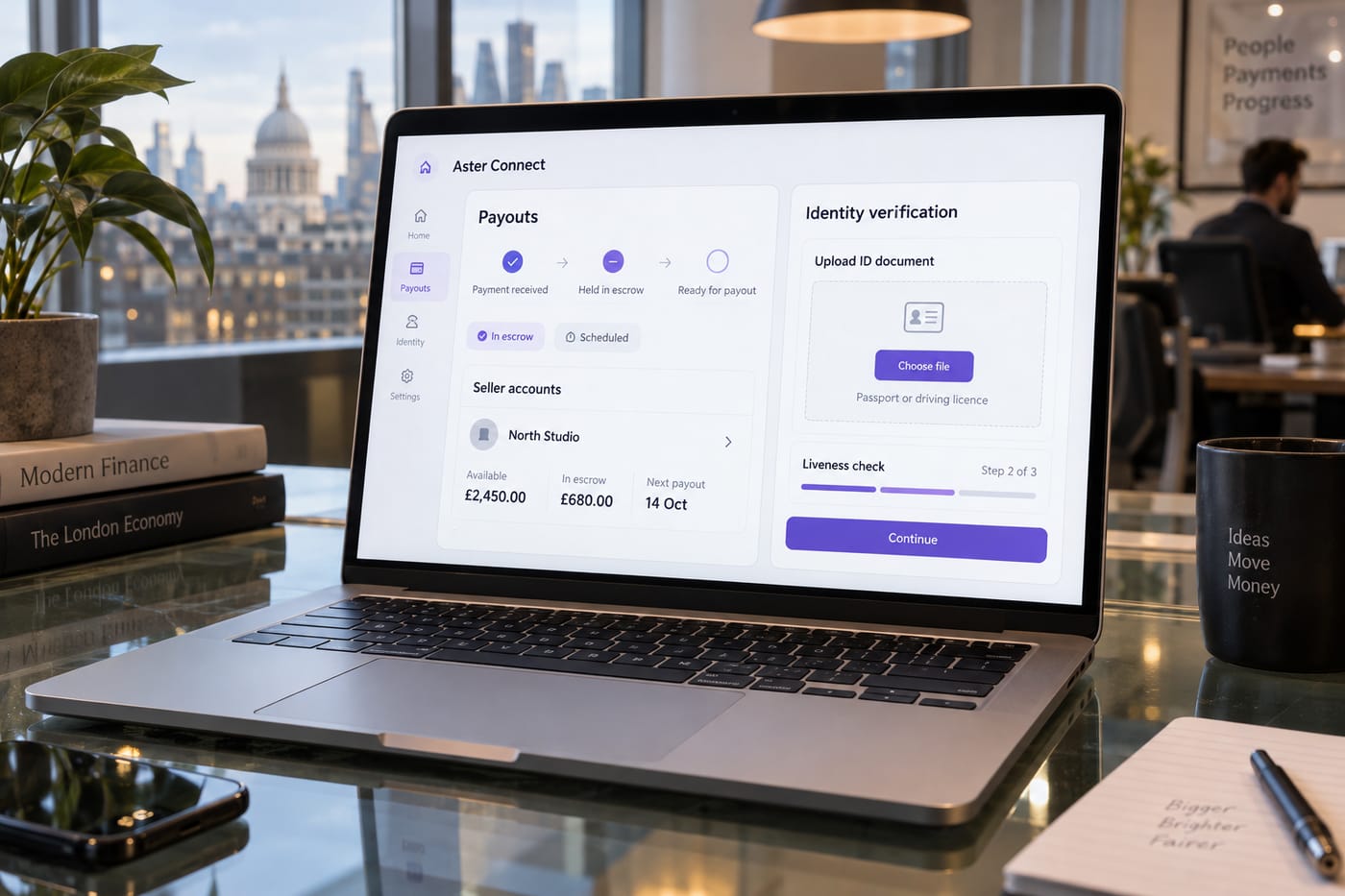
This is the largest hidden driver and the reason two honest quotes can differ by £60K. A two-sided marketplace that holds buyer funds before releasing them to a seller is not just a product — it is a regulated money-handling operation. In the UK, PSD2/FCA rules require those funds to sit in a designated safeguarding account, separate from the platform's own operating funds. If your studio quote does not mention safeguarding, assume it has not been designed in.
Three sub-components drive the trust surface cost:
- Identity verification (KYC) for sellers. Basic ID plus liveness and face match runs around $0.33 per check, while premium providers like Onfido or Jumio sit at $2–$5 per check. That is a variable cost, not a build cost, but it compounds with your supply-side liquidity target. Onboard 5,000 sellers in year one at $3 per check and you have spent $15,000 before anyone transacts. Agency quotes almost never surface this.
- Dispute resolution workflow. This is a product surface — chargeback handling, evidence collection, mediator UI, SLA timers, refund state machine — not a feature. Build it properly and it is 3–5 weeks of engineering. Skip it and your first disputed transaction becomes a founder's full-time job.
- Data processing architecture. The ICO requires a written Article 28 contract any time a controller uses a processor to handle personal data. For a three-party marketplace (platform, supplier, consumer), each processing relationship — and each sub-processor like your KYC vendor, your payments provider, your email provider — must be separately contracted. This is legal work, not engineering, but it blocks launch. Budget £3K–£8K for a specialist solicitor to paper the DPA stack correctly; a general commercial lawyer will cost you more by learning on your invoice.
The regulatory context matters here. UK Finance recorded £722 million in unauthorised fraud in 2024, with over 109,000 identity theft cases. Regulators and card schemes treat marketplaces as the control point. Underinvest in this surface and you are not saving money — you are deferring it to a chargeback crisis in month nine.
2. The payments architecture decision
This is the single biggest timeline lever. A production two-sided marketplace with mobile apps, escrow, and advanced trust mechanics takes 16–22 weeks versus 8–12 weeks for an MVP, and Stripe Connect integration alone adds 3–4 weeks, with custom payment routing or multi-jurisdiction compliance adding 8–12 weeks on top.
You have three realistic paths:
- Stripe Connect with delayed payouts. Fastest, cheapest, works for most launch-stage marketplaces. The catch: Stripe Connect does not hold an official escrow licence — it approximates escrow via delayed payouts. For many models this is fine. For high-value goods, services with long delivery windows, or anything a regulator might view as true fund-holding, it is not.
- Licensed EMI provider (Ryft, Mangopay, OPP). Slower to integrate, higher per-transaction fees, but gives you a provider with a dedicated Payment Institution licence that handles safeguarding on your behalf. Add 2–4 weeks over Stripe Connect.
- Your own licensed infrastructure. Do not do this at pre-seed. It is a £500K+ regulatory project before you ship a line of product code.
Pick the wrong one and you will replatform payments inside 18 months, which costs more than the original build.
3. Native mobile vs responsive web
A responsive web build is roughly 60% of the cost of web plus native iOS and Android. The honest question is not "do our users want mobile" (they always say yes) but "does the first transaction happen on mobile". For services marketplaces, logistics, and anything time-sensitive, yes. For B2B procurement, high-value goods, or anything with a long consideration window, web-first ships you to revenue faster and you add mobile post-PMF.
4. Supply-side tooling
The seller side of a marketplace is usually underestimated by a factor of two. Sellers need: onboarding flow with KYC, a listing manager, inventory or availability management, order management, payout dashboard, tax document generation, support contact, and performance analytics. On a bare MVP you can collapse several of these into email and a shared Google Sheet. That works until roughly seller #50, then it does not. Decide upfront which seller tools are launch-blocking and which are month-six problems.
5. Matching, search, and recommendations
Counterintuitively, this is often the smallest line item on a competent quote. Postgres full-text search plus a few filters gets most launch-stage marketplaces to Series A. Algolia or Elasticsearch add roughly 1–2 weeks of integration and £100–£500 a month in hosting. AI-driven matching or recommendations are a post-PMF investment unless matching quality is literally your core differentiator.
6. Who supplies the domain expertise
If the development studio has shipped a UK marketplace with escrow before, you are paying for engineering. If they have not, you are paying for their learning curve plus engineering. The difference is usually 20–30% on timeline and a non-trivial regulatory risk you cannot see until you are mid-build.
Illustrative worked example (read the assumptions)
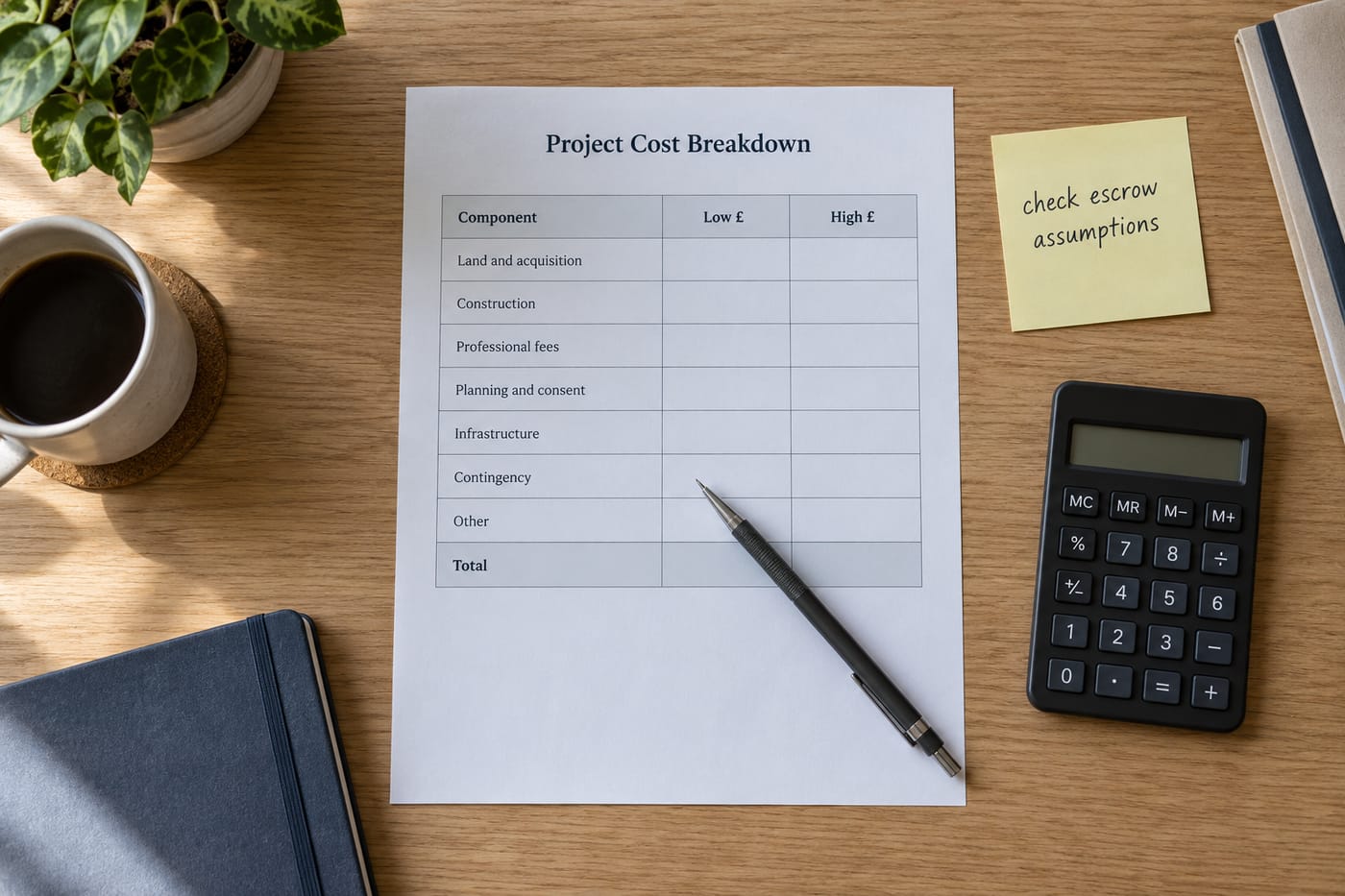
To make this concrete — and this is illustrative only, not a quote — consider a services marketplace connecting UK consumers with vetted suppliers, with the following assumptions stated plainly:
- Responsive web only at launch, native mobile deferred to post-PMF
- Stripe Connect with delayed payouts (not a licensed EMI)
- Onfido-tier KYC for sellers only, not consumers
- In-app messaging, dispute flow with a 7-day evidence window, manual mediation by the founding team
- Postgres search with filters, no Algolia
- Seller dashboard with listings, orders, payouts, and basic analytics
- Standard DPA architecture reviewed by a specialist solicitor
- No existing data to migrate; greenfield build
- 12–14 week engineering window
That specification sits in the £30k–£75k payments-heavy multi-vendor band in the UK benchmark, likely in the upper half. Add £3K–£8K for legal, £2K–£5K for first-year KYC variable costs at modest supply-side volume, and £300–£800/month hosting and tooling. An £80K budget covers this with contingency. The same spec with native iOS and Android from day one, Mangopay instead of Stripe Connect, and Algolia search pushes toward £100K–£130K and lands outside the budget.
What pushes the number up, what pulls it down
| Decision | Pushes cost up | Pulls cost down |
|---|---|---|
| Payments | Licensed EMI, multi-currency, split payments across jurisdictions, true escrow | Stripe Connect with delayed payouts, single currency, single country |
| Mobile | Native iOS and Android from day one | Responsive web, PWA, mobile deferred |
| KYC | Premium provider, consumer-side verification, ongoing monitoring | Mid-tier provider, seller-side only, one-time verification |
| Disputes | SLA-bound, automated evidence collection, tiered mediation | Manual, founder-mediated, email-based for first 100 cases |
| Search | Algolia or Elasticsearch, AI recommendations, personalisation | Postgres full-text, static filters, no personalisation |
| Seller tooling | Full self-serve dashboard, tax docs, analytics, API access | Minimal dashboard, manual onboarding support, Sheets for ops |
| Admin & ops | Full back-office with roles, audit logs, bulk actions | Retool or Forest Admin on top of your database |
| Compliance | SOC 2, ISO 27001, formal DPIA, dedicated DPO | Standard ICO-compliant DPA, informal risk register |
What is bad about this approach
Being honest: the lean path above has real downsides. Manual dispute mediation does not scale past roughly 20 cases a week — plan to automate before you hit that. Stripe Connect's delayed payout model will constrain you if you ever want to hold funds for more than 90 days or operate in jurisdictions Stripe does not fully support. Deferring native mobile loses you some share of users who will only transact on apps. Postgres search will feel limiting around 10,000 listings. These are deliberate trades, not oversights — but you should name them in your board deck so they do not get rediscovered as surprises.
The three questions that turn a range into a quote
Before you ask a studio for a number, you need defensible answers to three things. Without them, every quote you get is a studio pricing in your indecision.
- Do you need true escrow, or does delayed payout work? This determines Stripe Connect vs a licensed EMI, which drives 3–8 weeks of timeline and a meaningful ongoing fee delta. Answer this by writing down the longest acceptable gap between buyer payment and seller payout, and whether a regulator looking at your flow would call it fund-holding.
- What is your supply-side onboarding target for year one, and at what KYC tier? This converts "KYC" from a feature into a line item. 500 sellers at $0.33 per check is a rounding error; 10,000 sellers at $3 per check is a serious budget line. The answer also tells your studio whether to build a manual review queue or trust the vendor's automated decisioning.
- Web-first or app-first at launch? This is a 40% swing on build cost. The answer is not a preference — it is a function of where the first transaction happens in your category.
Walk into a quoting conversation with those three answered and the spread between two honest studios will collapse from £60K to under £15K.
How CodeNicely can help
The closest analogue in our work is Vahak, India's largest logistics marketplace, where we built the two-sided platform connecting truck owners and transporters including the matching, verification, and transaction surface. The relevant lessons for a UK founder are not geographic — they are structural: how seller verification scales when supply-side liquidity is your core unlock, how dispute flows get designed so the founding team is not the first-line mediator past month three, and how to sequence what ships at launch versus what waits for post-PMF revenue to fund.
For UK founders specifically, the KYC and payments architecture decisions sit alongside work we have done on compliance-heavy flows for Cashpo (lending, KYC, credit scoring) — the same discipline of designing identity verification as a product surface rather than a vendor integration applies directly to UK marketplace builds under PSD2. If you want a scoping conversation that produces a defensible budget rather than a single number, that is the shape of what we do for pre-seed and seed startups. You keep full IP, and there is no vendor lock-in on anything we build.
The bottom line
£80K buys a real UK marketplace if you make deliberate trades on payments architecture, mobile, and seller tooling, and if you treat the trust and safety surface as a first-class product line rather than something to retrofit. It buys a prototype if you do not. The deciding factor sits upstream of any studio quote — in the three questions above, which only you can answer, and which will do more for your budget than any amount of agency comparison.
Frequently Asked Questions
How much does it cost to build a two-sided marketplace in the UK?
UK benchmarks put a lean MVP at £15k–£30k, a payments-heavy multi-vendor platform at £30k–£75k+, and enterprise builds at £75k–£150k+ (Code23). The band you land in is driven mostly by payments architecture, whether you ship native mobile at launch, and how much of the trust surface you build versus outsource. To turn a range into a quote, you need firm answers on escrow requirements, year-one seller volume, and web-vs-app sequencing.
How long does it take to build a marketplace MVP?
Industry benchmarks put a marketplace MVP at 8–12 weeks and a production build with mobile apps and advanced trust mechanics at 16–22 weeks (RaftLabs). The largest variable is payments: Stripe Connect adds 3–4 weeks, while custom routing or multi-jurisdiction compliance can add 8–12 weeks on top. KYC vendor selection, DPA review, and native mobile each add further weeks that are rarely flagged in initial quotes.
Do I need an FCA licence to run a marketplace in the UK?
Not usually — but any platform that holds buyer funds before releasing them to sellers triggers safeguarding requirements under PSD2/FCA rules, which means the funds must sit in a designated account separate from your operating money (Ryft). Most launch-stage marketplaces avoid holding their own licence by using a provider with an EMI or Payment Institution licence (Stripe Connect, Mangopay, Ryft). This is a question for a specialist financial services solicitor, not a developer.
Is Stripe Connect enough for a UK marketplace, or do I need true escrow?
Stripe Connect does not hold an official escrow licence — it approximates escrow via delayed payouts (Sharetribe Academy). For most launch-stage marketplaces with short delivery windows and modest transaction values, that is sufficient. For high-value goods, long delivery windows, or anything a regulator might classify as true fund-holding, you need a provider with a dedicated EMI licence such as Ryft, Mangopay, or OPP. Get a solicitor to review the specifics before committing to an architecture.
What is the biggest hidden cost in marketplace development?
Identity verification variable costs and the data processing agreement architecture are the two most frequently omitted line items in agency quotes. KYC runs from roughly $0.33 to $5 per check depending on provider tier (Didit), which compounds with your supply-side onboarding targets. The DPA work — contracting the platform, supplier, consumer, and every sub-processor under ICO Article 28 requirements — is legal rather than engineering work but blocks launch, and should be budgeted at £3K–£8K with a specialist solicitor.
Sources & further reading
- How Much Does It Cost to Build an Online Marketplace? — Code23
- Online Marketplace Development: Cost, Timeline, Build — RaftLabs
- A Guide to PSD2 in 2026: How Marketplaces Manage Multiparty Payment Compliance — Ryft
- Stripe Connect Marketplace Payments Overview — Sharetribe Academy
- OPP vs. Stripe Connect: Escrow, Split Payments & Compliance — Online Payment Platform
- Identity Verification Pricing: What KYC Costs in 2026 — Didit
- Best KYC Providers UK Post-Brexit: FCA Compliance Guide — Didit
- KYC Cost Calculator Insights for Higher ROI (citing UK Finance 2024 fraud data) — ComplyCube
Get one practical guide a week
Costs, AI tools, partner selection — written for people who make the decision. No spam, unsubscribe anytime.
Thanks — you're on the list. One practical guide a week, nothing else.
That didn't work — please check the email address and try again.
Building something in Marketplace?
CodeNicely partners with founders and tech teams to ship AI-native products that move metrics. Tell us about the problem you're solving.
Talk to our team Book a 30-min call