_1751731246795-BygAaJJK.png)

What Does a Custom ERP Actually Cost to Replace NetSuite

 Published by CodeNicely, the product studio founded by Meghal Agrawal and Ujjwal Agrawal in 2017
For: Series B SaaS or operations-heavy startup founder who is paying $80K–$180K/year in NetSuite licensing and per-module fees, has hit the ceiling on customization, and is actively asking whether a custom-built internal ERP would cost less over three years than renewing the contract
In this guide
- The shape of the number, and why it is a range
- The cost driver nobody puts in the quote
- The seven cost drivers, in order of impact
- An illustrative worked example
- What pushes the number up vs. down
- Why the quotes you are getting vary by 3x
- When the decision is clearly "stay on NetSuite"
- How CodeNicely can help
- The three questions that turn a range into a quote
- Frequently Asked Questions
Replacing a mid-market NetSuite deployment with a custom-built ERP typically runs $250,000 to $550,000 in total cost of ownership over a comparable period, versus $380,000 to $700,000 for a Dynamics-class SaaS alternative, with the crossover point where custom becomes genuinely cheaper landing around year four to year six, per aggregated ERP benchmark data. That is the honest answer. The dishonest part — the part that makes every fixed-price build quote you have received untrustworthy — is that the single largest variable in that range is not the ledger, not the UI, and not the integrations. It is the number of approval workflows and exception-handling rules currently living undocumented in the heads of two or three people in finance and ops.
This post breaks down what actually drives the number, why the quotes you are getting vary by 3x, and the three questions that turn a range into a real estimate.
The shape of the number, and why it is a range
A custom ERP replacing a 40–60 user NetSuite deployment is not a single project. It is roughly five projects stacked together: a general ledger and sub-ledger core, a procure-to-pay or order-to-cash workflow engine, an inventory or revenue-recognition module (depending on your business), integrations with everything that currently writes to NetSuite, and a historical data migration. Each of those has its own cost curve, and the cost curves do not compound linearly — a second integration costs roughly 60% of the first, but the eighth integration costs almost as much as the first because by then you are solving conflicts between source systems.
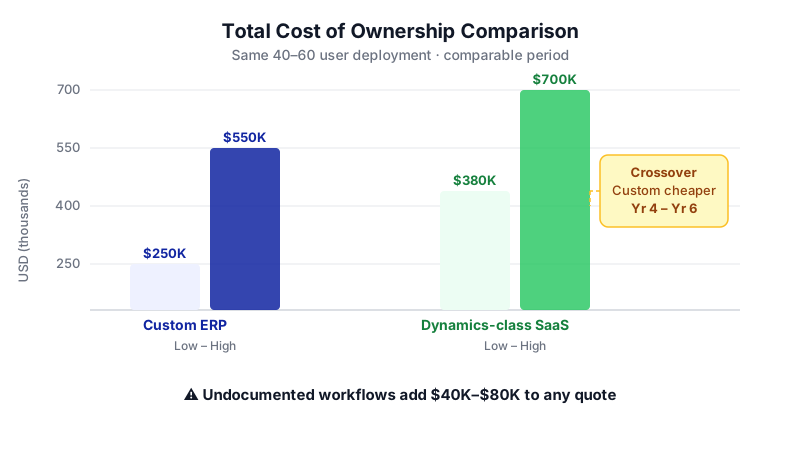
The result: honest ranges for a serious replacement land somewhere in a $250K–$550K build envelope for a reasonably standard operations-heavy SaaS business, based on published TCO benchmarks. Add 20–30% if you have revenue recognition under ASC 606 that is doing anything other than straight-line monthly. Add another 15–25% if you are multi-entity or multi-currency. Subtract 15–20% if you are willing to use an open-source accounting core (think ERPNext or a Ledger-style double-entry library) rather than build the GL from first principles.
And then there is the number almost nobody prices correctly, which is the discovery cost.
The cost driver nobody puts in the quote
Your controller approves AP invoices over $10K differently depending on vendor, GL account, and whether the PO was raised before or after the quarter cutoff. Your ops lead has a mental rule about which inventory writedowns go to COGS versus a reserve. Your head of RevOps knows that three specific enterprise contracts bill on a schedule that does not match the SOW because of a side letter from 2022. None of this is in NetSuite. It is in their heads, encoded as judgment, and it is the actual business logic of your company.

A custom ERP cannot ship without encoding those rules. SaaS ERPs do not force you to confront this because they ship with 80% of the rules pre-decided and you simply absorb the mismatch as process debt. Build the ERP yourself and the mismatch becomes code — which first has to be discovered, documented, validated with the person whose head it lives in, and then implemented.
This routinely adds four to ten weeks of discovery and $40K–$80K of scope to a build that looked fixed at contract signing. It is also the single most common source of the overruns reported in Panorama Consulting's 2026 ERP Report, which identified unexpected technology needs — teams discovering fatal misfits late and resorting to additional scope and custom builds — as the leading cause of budget overruns. Industry-wide, 68% of ERP projects exceed their original budget, with overruns averaging 189% of the initial estimate.
If a build quote does not have a line item for a discovery phase that produces a written workflow catalog before any production code is scoped, the quote is wrong. Not low — wrong. It is pricing a project that cannot be built as described.
The seven cost drivers, in order of impact
1. Workflow and exception complexity (highest impact)
The count that matters is not users or transactions per month. It is: how many distinct approval paths exist across AP, AR, expense, procurement, and journal entries, and how many of those have conditional branches (dollar thresholds, department, vendor type, GL account)? A business with 8 clean approval paths costs materially less than one with 30 branching ones, even at identical revenue. Range impact: ±$120K.
2. Integration surface
Every system that currently reads from or writes to NetSuite has to keep working. Count them honestly: your CRM, your billing platform, your payment processor, your bank feeds, your expense tool, your HRIS for payroll journal entries, your warehouse system, your tax engine, your BI stack. Each integration is $8K–$25K depending on whether the target system has a decent API and whether you need bidirectional sync or one-way. Range impact: ±$80K.
3. Revenue recognition and multi-entity
Straight-line monthly subscription revenue is a weekend. Usage-based with tiered pricing, mid-period upgrades, and contract modifications under ASC 606 is a quarter of engineering effort. Multi-entity consolidation with intercompany eliminations is another quarter. Range impact: ±$90K.
4. Historical data migration
Migrating three years of transactional history with full audit trail, reconciled trial balances, and preserved document attachments is not a data dump. It is a reconciliation project where every variance has to be investigated and signed off by your auditor. Budgeting one month for migration and testing is typical; it usually takes two. Range impact: ±$40K.
5. Compliance surface
SOC 2 Type II on the new system, audit-grade immutability on the GL, role-based access with segregation of duties, change management logging — none of this is optional for a Series B company, and all of it adds engineering time. If you also need SOX readiness because an IPO is on the roadmap, add another layer. Range impact: ±$60K.
6. Who supplies the domain expert
If your controller can spend 30% of their time for six months in workshops, review sessions, and UAT, your build cost drops meaningfully because the vendor is not paying a fractional CFO consultant to translate. If your finance team cannot spare the hours, the vendor has to bring that expertise and bill for it. Range impact: ±$50K.
7. How much of NetSuite stays running during cutover
A parallel-run cutover where both systems process transactions for a full close cycle is safer and roughly 20% more expensive than a hard cutover. A phased cutover (AP first, then AR, then GL) stretches the project but reduces risk. These are real line items, not implementation details. Range impact: ±$35K.
An illustrative worked example
This is illustrative — not a quote. Numbers below assume: a Series B SaaS company, 55 NetSuite users, straight-line subscription revenue with modest usage overages, single entity in one currency, 6 integrations (Salesforce, Stripe, Ramp, Gusto, a data warehouse, and one bank feed), three years of historical data to migrate, SOC 2 Type II required, and a controller who can commit roughly 25% of their time for six months.
| Phase | Illustrative range | Duration |
|---|---|---|
| Discovery & workflow cataloging | $45K–$75K | 6–10 weeks |
| GL core + AP/AR modules | $95K–$140K | 12–16 weeks |
| Revenue recognition module | $35K–$55K | 5–7 weeks |
| Six integrations | $55K–$95K | parallel |
| Historical data migration + reconciliation | $30K–$50K | 4–8 weeks |
| SOC 2 engineering + audit prep | $25K–$45K | parallel |
| Parallel run + cutover | $20K–$35K | one close cycle |
| Build subtotal | $305K–$495K | ~10–14 months |
| Year 1 hosting, monitoring, ongoing engineering (10–15% of build) | $30K–$75K/year | ongoing |
Against this, the NetSuite baseline for the same company looks roughly like: $90K–$150K/year in licenses for 55 users on the mid-tier plan, $15K–$29K/year in module fees for CRM, Advanced Inventory, and Revenue Management, plus any implementation or re-implementation partner costs when you expand, based on 2025 NetSuite pricing analysis. First-year total for a mid-market deployment can land near $268,000 all-in.
Over three years, straight NetSuite renewal at 7–10% annual uplift lands around $330K–$560K. Custom build with year-one implementation plus two years of ongoing engineering lands around $365K–$645K. The custom build is usually more expensive at the three-year mark and cheaper at the five-year mark. If you are confident you will still exist and still be running this ERP in five years, the math favors building. If either is uncertain, it does not.
What pushes the number up vs. down
| Pushes it up | Pulls it down |
|---|---|
| Multi-entity, multi-currency consolidation | Single entity, single currency |
| Usage-based or contract-modification revenue | Straight-line subscription revenue |
| More than 8 integrations, or integrations with legacy systems that have no modern API | Fewer than 5 integrations, all with REST APIs |
| Full historical migration with audit sign-off | Opening-balance migration only, keep NetSuite read-only for history |
| Hard cutover with no parallel run (adds remediation cost later) | Phased cutover by module |
| Finance team cannot commit workshop time | Controller or FP&A lead available 20–30% for six months |
| SOX readiness required within 18 months | SOC 2 Type II is the ceiling for compliance |
| Building the GL from scratch | Starting from an open-source double-entry core |
| Fixed-price contract with no discovery phase (overruns are near-certain) | Time-and-materials with a capped discovery phase that produces a written scope before build begins |
Why the quotes you are getting vary by 3x
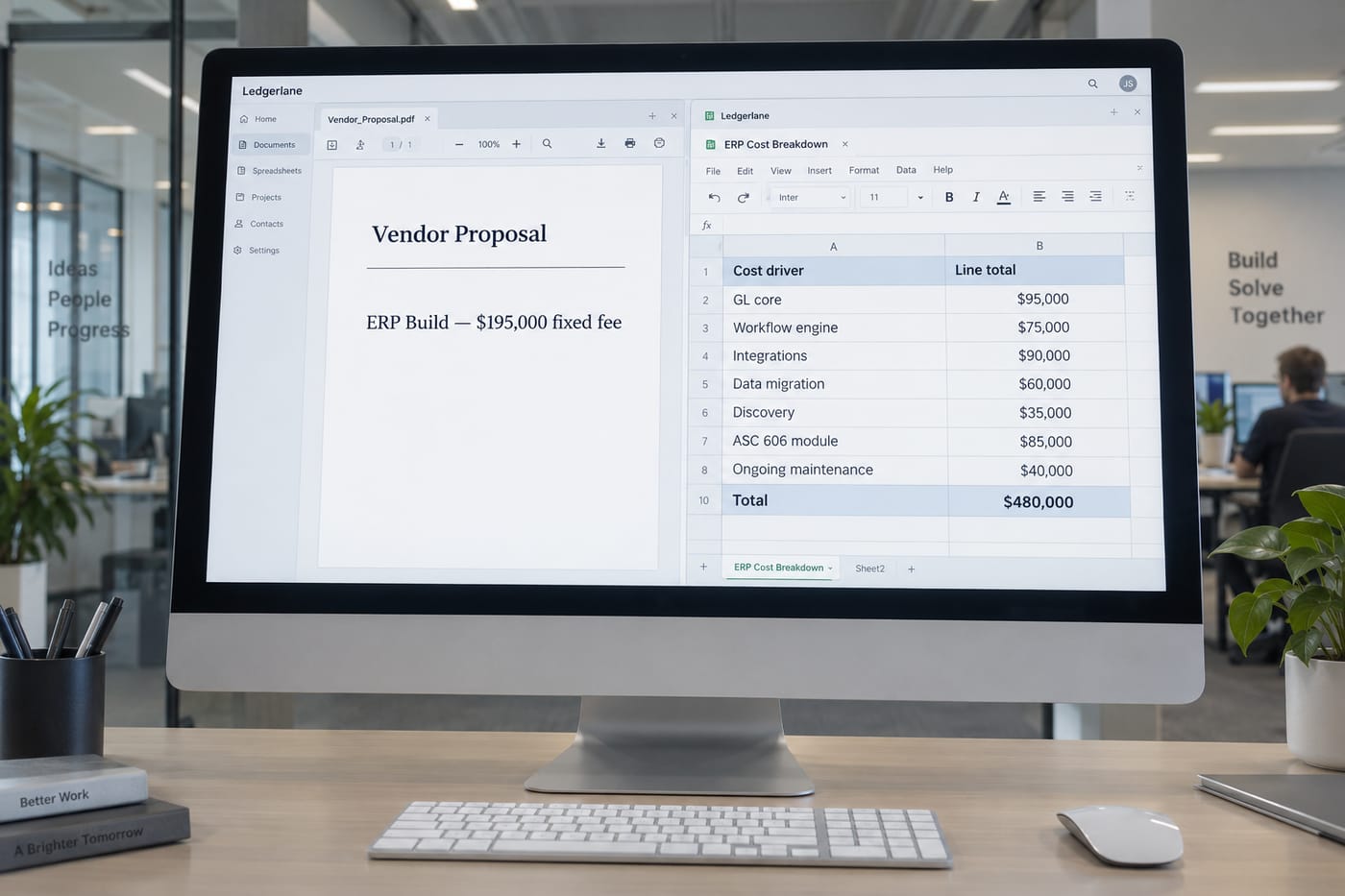
If you have asked four firms to quote this and received $180K, $320K, $470K, and $710K, here is what is actually happening. The $180K quote is pricing the happy path with no discovery, no revenue rec complexity, and three integrations. It will come in at $400K and ship late. The $710K quote is pricing the worst case with a full consulting bench loaded in. The $320K and $470K quotes are probably the honest ones, and the difference between them is almost entirely about scope assumptions you have not clarified.
This is not a vendor problem. It is a scope problem. Organizations without a clearly defined scope document experience 23% more change orders, and scope creep accounts for 40% of ERP timeline overruns, per Panorama. The fix is not finding a better vendor. It is paying for a discovery phase before you sign a build contract — a paid two-to-four-week engagement where someone walks your finance and ops team through every workflow, writes it down, and produces a scope document you can hand to three vendors to get genuinely comparable quotes.
Expect to pay $15K–$40K for that discovery. It is the best money you will spend on this project. It is also the fastest way to discover that you do not actually need to replace NetSuite — you need to clean up two modules and renegotiate your contract.
When the decision is clearly "stay on NetSuite"
Build quotes are seductive because they are bounded. The renewal is not. But some situations clearly favor staying:
- You are under 25 users and growth is linear, not exponential
- Your workflows are mostly standard and the pain is specific modules, not the core
- You do not have a technical co-founder or VP Eng who will own this system for the next five years
- You are 18 months from a liquidity event — auditors will not love a self-built GL mid-diligence
- Your finance team is already at capacity and cannot commit workshop hours
And some clearly favor building: you are over 60 users with a non-standard revenue model, module fees are growing faster than headcount, you have engineering capacity in-house to maintain the system, and you are confident about your five-year horizon. Everything in between is a judgment call that depends on the discovery output.
One sobering benchmark: Gartner forecast in 2024 that by 2027, more than 70% of recently implemented ERP initiatives will fail to fully meet their original business case goals, with as many as 25% failing catastrophically. That number applies to both SaaS implementations and custom builds. The decision is not "which option works" — it is "which option fails in ways you can recover from."
How CodeNicely can help
We built the accounting and compliance core for GimBooks, a YC-backed accounting SaaS serving over a million small businesses — which means we have shipped double-entry ledger systems, tax-engine integrations, and audit-grade transaction logs as production software, not as consulting deliverables. That matters here because the hard parts of replacing NetSuite are not CRUD screens; they are the GL correctness, the reconciliation workflows, and the compliance surface. Teams that have only built B2B SaaS dashboards tend to underprice those parts because they have not had to defend them to an auditor.
If you are at the "we have three quotes and we cannot tell which one is honest" stage, the useful conversation is a paid discovery engagement that produces a written workflow catalog and a scope document — something you can take to any vendor, including ones that are not us, to get comparable quotes. More on how we structure these in digital transformation and the broader offerings overview.
The three questions that turn a range into a quote
Before any firm — us or anyone else — can give you a credible fixed number, you need defensible answers to three things:
- How many distinct approval workflows exist across AP, AR, procurement, expense, and journal entries, and how many have conditional branches? Not an estimate. A written list, reviewed by the controller and the ops lead who actually run them.
- Which systems currently read from or write to NetSuite, and for each one, is the integration one-way or bidirectional, and does the target system have a modern API? This single answer moves the integration budget by $80K.
- What is your required cutover model — hard, parallel, or phased — and who on your finance team will own the parallel-run reconciliation? If the answer is "we have not decided" or "nobody," the project is not ready to scope.
Nothing in this post is accounting, tax, or audit advice — your controller and your external auditor need to sign off on any GL replacement and any revenue recognition logic before it goes to production. That review is not optional and should be scoped into the project from day one.
Frequently Asked Questions
Is it ever cheaper to build a custom ERP than to stay on NetSuite in year one?
Almost never. The year-one cost of a custom build is dominated by implementation effort, and even an efficient build runs materially higher than a year of NetSuite licensing plus modules. The crossover where custom becomes cheaper is typically year four to six, per published ERP TCO benchmarks. If your horizon is shorter than that, the math rarely works.
What is the single biggest reason custom ERP builds overrun their budgets?
Undocumented business logic. The approval workflows, exception rules, and judgment calls that live in your finance and ops team's heads have to be discovered and encoded before they can be built. Panorama's 2026 ERP Report identifies late-discovered misfits and resulting scope expansion as the leading cause of overruns across both SaaS and custom builds.
How long does a custom ERP replacement typically take?
For a mid-market SaaS company replacing a 40–60 user NetSuite deployment, honest timelines run roughly 10 to 14 months from kickoff to go-live, assuming a proper discovery phase upfront. Only 32% of ERP implementations complete on schedule, per Panorama, and the ones that do almost always had a written scope document before build started. The specific timeline depends on workflow complexity, integration count, and whether you do a parallel or phased cutover.
Should we hire a fractional CFO or ERP consultant before talking to build vendors?
Usually yes, if your in-house finance team has not been through a system replacement before. A good independent consultant costs $15K–$40K for a scoping engagement and will save you three times that in avoided scope changes. The consultant should produce a written workflow catalog and a vendor-agnostic scope document — if the output is just a slide deck recommending a specific vendor, you hired the wrong person.
What happens to our historical NetSuite data if we migrate?
Three options, in order of cost: keep NetSuite running read-only for seven years at a reduced user count (cheapest, but you keep paying Oracle), export everything to a data warehouse for query access and shut NetSuite down (middle cost, loses the UI), or do a full historical migration into the new system with reconciled trial balances (most expensive, cleanest audit trail). Your external auditor should weigh in on which option works for your retention requirements before you decide.
Sources & further reading
- Market Share: Enterprise Resource Planning, Worldwide, 2024 — Gartner (May 2025)
- NetSuite Pricing (2026): Real Costs From $999/mo to $10K+ — BrokenRubik
- NetSuite Pricing 2026: Cost Per User, Modules & TCO — Epiqinfo
- NetSuite ERP Pricing 2025: What You Actually Pay vs What Oracle Quotes You — Software Pricing Guide
- ERP Implementation Failure Statistics: 2026 Research — Godlan
- ERP Implementation Failure: Why Projects Really Collapse — Cudio
- 2026 ERP Report — Panorama Consulting Group (primary PDF)
- ERP Implementation Failure Statistics & Success Rates — Flectic (cites Gartner 2024 forecast)
Get one practical guide a week
Costs, AI tools, partner selection — written for people who make the decision. No spam, unsubscribe anytime.
Thanks — you're on the list. One practical guide a week, nothing else.
That didn't work — please check the email address and try again.
Building something in Enterprise Software?
CodeNicely partners with founders and tech teams to ship AI-native products that move metrics. Tell us about the problem you're solving.
Talk to our team Book a 30-min call