_1751731246795-BygAaJJK.png)
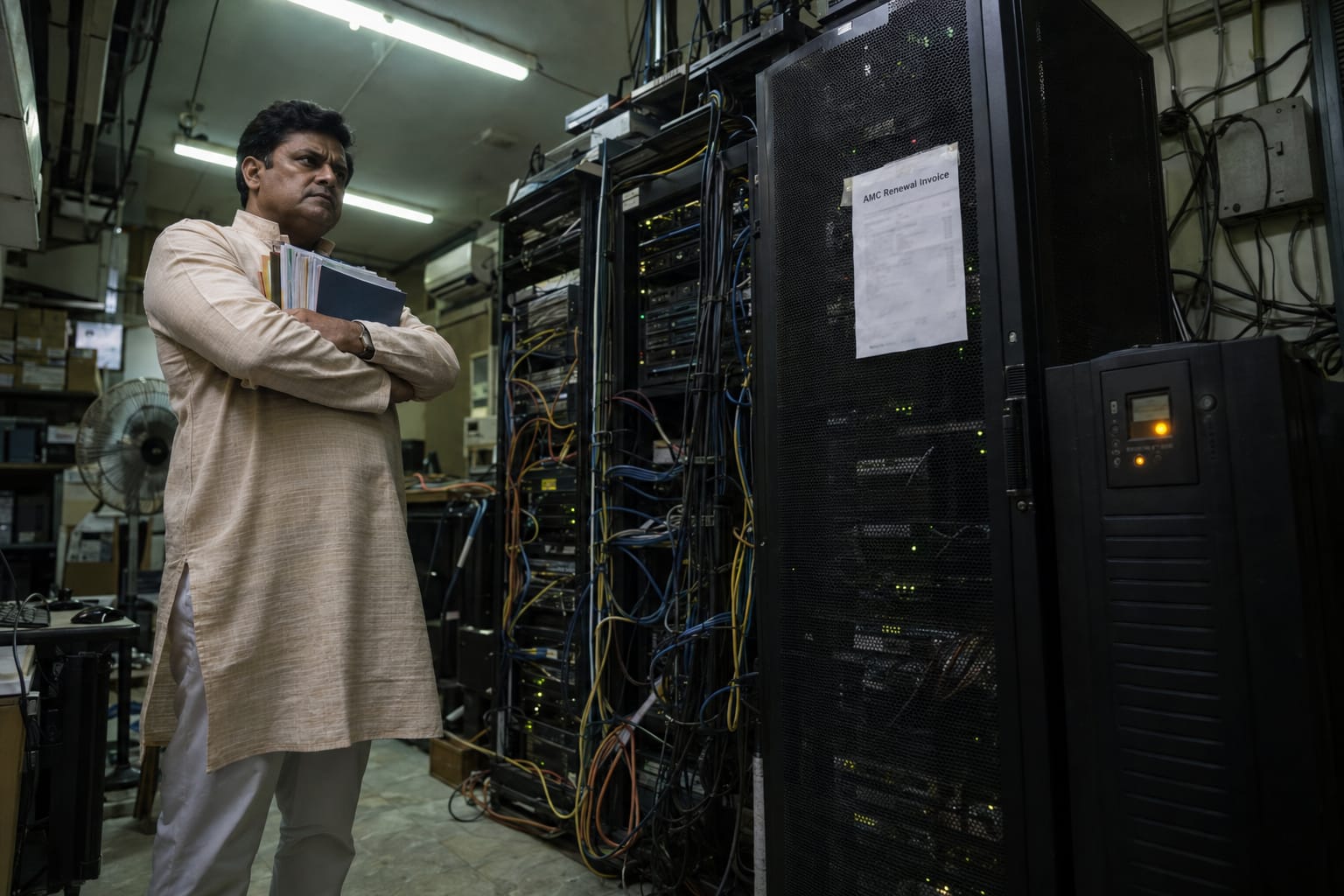
Your On-Premise Server Is Costing More Than Your Cloud Bill Would

 Published by CodeNicely, the product studio founded by Meghal Agrawal and Ujjwal Agrawal in 2017
For: Owner or COO of a 50–500-person Indian business running a physical server room or co-location setup, who has received a cloud migration quote and cannot tell whether the ₹30–80 lakh price tag is cheaper or more expensive than staying put once hardware refresh cycles, AMC contracts, IT headcount, and RBI or CERT-In compliance exposure are factored in
In this guide
If you are running a server room or co-location rack for a 50–500-person Indian business, your true on-premise cost is almost certainly 1.5–2x what shows up in the IT budget line — and the moment to prove it to your CFO is the week a hardware refresh quote lands on the desk. That is the only window where a three-year cloud TCO comparison beats on-premise on slide one, and it is the only window where the CFO will sign the migration budget without a six-month fight. This post gives you the argument.
The problem with every cloud migration quote you have seen is that it prices the migration. It does not price staying put. So the number looks like net-new spend against a baseline of zero, when the actual baseline is a slow bleed of AMC renewals, refresh capex, absorbed headcount, downtime risk, and — increasingly — contracts you are no longer eligible to bid for.
The cost of doing nothing, in CFO language
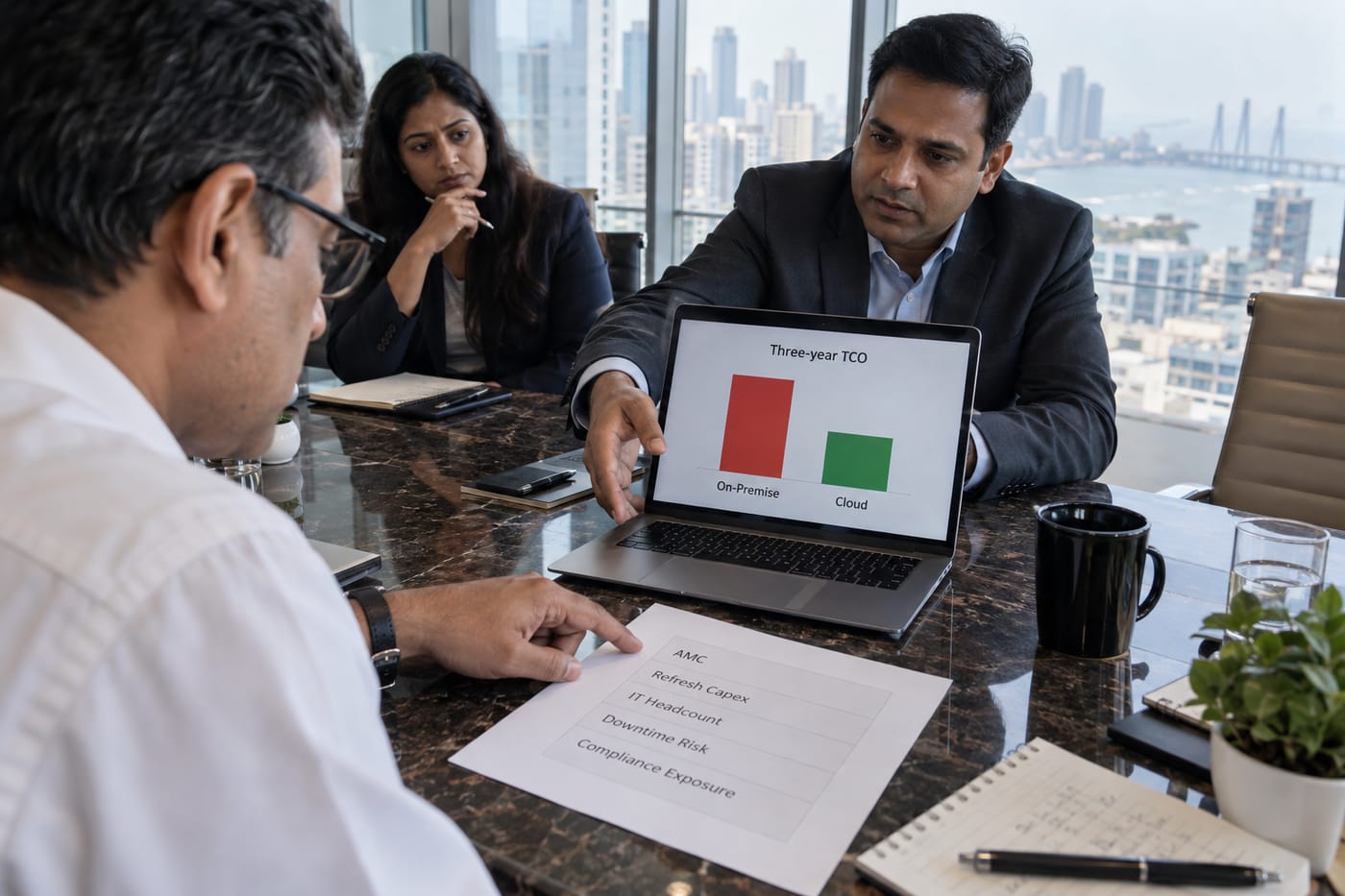
Your CFO does not care about latency, elasticity, or auto-scaling. They care about five line items. Walk in with these five, with your own numbers filled in, and the conversation changes.
1. AMC and extended support contracts
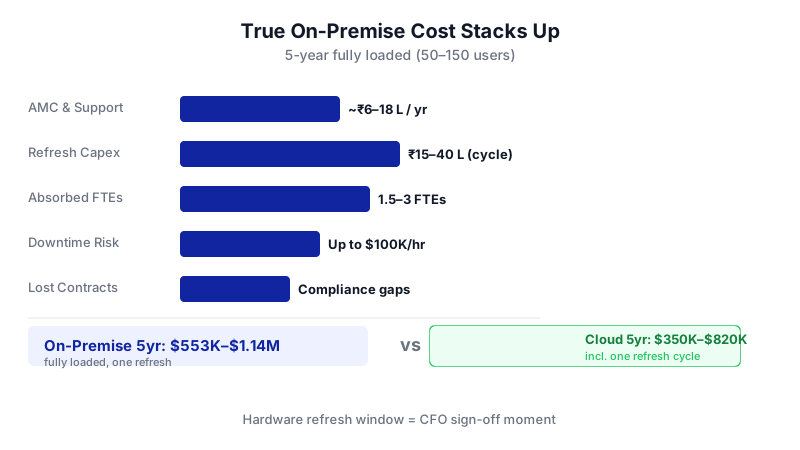
Server annual maintenance in India runs roughly ₹1,500–₹5,000 per server per month for comprehensive on-site cover, and ₹18,000–₹54,000 per rack server per year. Hardware vendors separately charge 10–15% of original purchase price annually for firmware, parts and support contracts once the standard warranty expires. For a modest 8-server rack, that is a recurring six-figure annual spend that most finance teams book under 'IT operations' and never aggregate.
Pull three years of AMC invoices. Add the storage AMC, the UPS AMC, the backup software renewal, the firewall subscription, the switch support contract, and the hypervisor licensing. The number is almost always larger than the IT head thinks.
2. The refresh cycle no one has told the CFO about
A production server has a useful life of 3–5 years. After that, warranty extensions get expensive, spares get scarce, and the hypervisor vendor drops support for the generation. This is not optional capex — it is a hard forcing function.
If your rack was commissioned in 2021 or 2022, you are in the refresh window right now. A full replacement — servers, storage, switches, UPS top-up, migration labour — for a mid-sized on-premise setup typically runs ₹15–40 lakh of fresh capex. This is the slide-one moment. Any five-year cloud TCO comparison that includes this refresh looks dramatically different from one that does not. Independent 5-year TCO analysis for 50–150-user organisations puts cloud at roughly $350,000–$820,000 against $553,000–$1,138,000 fully loaded on-premise, specifically once one refresh cycle is included.
3. Headcount absorbed by keeping the lights on
Count the fractions. A sysadmin who spends 40% of their week on patching, backups, capacity planning, and firefighting. A DBA who babysits a single on-prem database. The AC technician visit, the diesel for the generator, the vendor coordination when a disk fails on a Saturday. The security person who manually pulls logs for the quarterly audit because there is no SIEM.
For a 50–500-person business, this is typically 1.5–3 fully-loaded FTEs. In cloud, most of this work either disappears (managed databases, managed backups, patch automation) or shrinks to a fraction. The FTEs do not get fired — they get redeployed to work that moves revenue.
4. Downtime exposure, priced honestly
The ITIC 2024 Hourly Cost of Downtime Survey found that 57% of SMBs with 20–100 employees said one hour of downtime cost up to $100,000. Your number is probably lower, but it is not zero, and it compounds. A single UPS failure, a cooling incident on a Mumbai May afternoon, a ransomware event on an unpatched Windows Server 2012 box — any of these can take the business offline for a day. On-premise, your RTO is 'as fast as the vendor engineer can get to the DC with a spare part'. Cloud does not eliminate downtime, but it moves the recovery model from heroics to runbooks.
Ask the CFO: what is a day of order processing worth? That is the number that belongs in the risk column.
5. The contracts you can no longer win
This is the one most IT heads miss. Enterprise procurement teams and government tenders in India increasingly require ISO 27001, SOC 2, or CERT-In-aligned hosting as a baseline tick-box. The CERT-In Directions of 28 April 2022 apply to 'service providers, intermediaries, data centres, body corporates, and government organisations' — language broad enough to catch almost every incorporated digital business — and mandate a 6-hour cyber-incident reporting window. Meeting that window from a server room with no SIEM and no 24/7 SOC is, in practice, impossible.
If you sell to banks or NBFCs, the RBI Master Direction on IT Governance (effective 1 April 2024) requires your buyer to conduct formal ISO 27001 / SOC 2 / CSA STAR due diligence on your hosting before onboarding you. A hyperscaler region inherits most of those certifications. Your rack in the office basement does not. Count the deals you have lost or not bid on because of this. That is revenue the on-premise setup is actively blocking.
(Compliance language varies by sector and shifts year to year — have your legal counsel or an empanelled auditor confirm what applies to your specific business before you quote any of this to a buyer.)
What the market is actually doing
India's cloud market was valued at USD 37.11 billion in 2025, projected to reach USD 266.90 billion by 2034 at 24.51% CAGR. More importantly for this conversation: SMEs accounted for 61.40% of India's cloud adoption in 2025, growing at 23.40% CAGR. This is not a large-enterprise story anymore. The procurement and compliance baselines are shifting because the mid-market is already there.
At the same time, Indian medium-sized businesses allocate ₹8–10 lakh annually to cloud hosting while SMBs overall still spend only 3–7% of revenue on digital. The gap between what mature cloud TCO looks like and what underfunded on-premise shops are spending is where most of the pain hides.
The two realistic sequencing options
Once the CFO is open to the conversation, the next argument is how. There are two defensible paths. Pick deliberately.
Option A: Strangler-fig migration (lower risk, longer timeline)
You keep the on-premise setup running and migrate workloads one at a time, starting with the lowest-risk, highest-visibility candidate — usually email, file storage, or a non-critical internal tool. Each workload is moved, validated, and run in parallel for a defined cutover window before the on-premise instance is decommissioned.
Good at: protecting business continuity, letting the IT team learn cloud operations on low-stakes workloads first, spreading capex into opex gradually, giving the CFO visible proof points before the next tranche is approved.
Bad at: you pay for both environments during the overlap, the total elapsed timeline is longer, and if leadership attention wanes halfway through you end up with a hybrid estate that is more expensive than either pure option. Discipline on the decommission step is everything.
Option B: Big-bang re-platform (higher risk, forced by the refresh clock)
You cut over the entire estate in a single planned event, usually over a long weekend, and never bring the on-premise rack back up. This is the right choice when the refresh capex is unavoidable and imminent — you are not spending ₹15–40 lakh on hardware you intend to retire in 18 months.
Good at: clean break, no dual-run cost, the refresh capex is diverted straight into migration, the organisational focus is sharp because there is a date.
Bad at: if the cutover fails, rollback is painful and expensive. Requires significantly more upfront design, dependency mapping, and rehearsal. Not appropriate for workloads with unknown integrations or undocumented customisations — and most ten-year-old on-premise estates have more of those than the IT head realises.
Most successful mid-market migrations in India are a hybrid: strangler-fig for the known-unknown workloads (custom apps, legacy ERP, bespoke integrations), big-bang for the commodity ones (email, file shares, standard SaaS replacements).
What the business has to supply
This is where migration projects quietly stall, so flag it to the CFO upfront:
- A current asset and dependency inventory. Not the one in the CMDB that was last updated in 2019 — a real one. Every server, every database, every integration, every scheduled job, every certificate, every hardcoded IP.
- An application owner for each workload. Someone who can say 'yes this can go down between 2am and 6am on Sunday' and mean it.
- A compliance baseline. What data classifications you hold, what regulators apply, what data residency constraints bind you. This drives region selection and cannot be retrofitted.
- A decommission commitment. Written, with dates, signed by the CFO. Without it, the on-premise estate never actually goes away and the TCO case collapses.
- Executive air cover for the IT team. They are being asked to learn a new operating model while keeping the old one running. If their performance reviews still measure uptime of the on-prem SAN, the migration will lose every priority contest.
How to phase the spend so the first increment pays for the next
The CFO's real objection is rarely the total — it is the shape of the cash curve. Structure it like this:
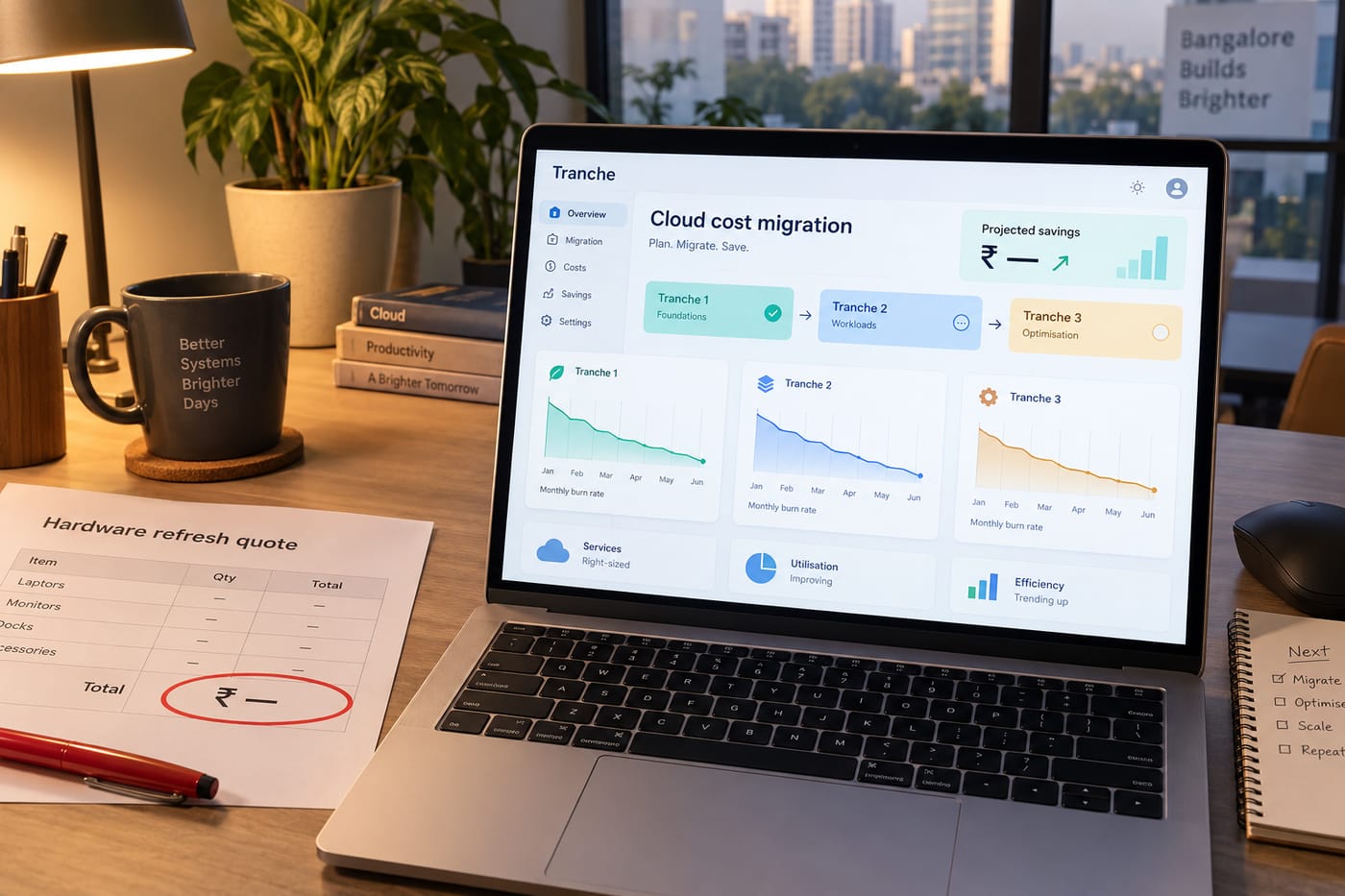
- Phase 0 — Assessment and TCO lock (4–8 weeks). Produce the five-year side-by-side with your actual numbers. This is the slide the CFO signs off on. Cost here is small and almost always recovered in the first renegotiated AMC alone.
- Phase 1 — Quick wins (3–6 months). Email, file storage, backup, disaster recovery to cloud. These are the workloads with the clearest cloud equivalents and the fastest payback. The AMC and licence savings from decommissioning the matching on-prem systems fund Phase 2.
- Phase 2 — Core applications (6–12 months). ERP, CRM, custom line-of-business apps. This is where the strangler-fig work happens. Each application retired from the rack frees up headroom and reduces the AMC footprint further.
- Phase 3 — Decommission and redeploy (1–2 months). Rack goes dark. AMC contracts cancelled. Co-location contract exited. Freed headcount redeployed to platform engineering or data work.
Illustrative only — a two-rack setup with roughly 20 workloads, no sector-specific data residency complication, and a reasonably documented estate. Your numbers will differ based on application count, integration complexity, data volume to migrate, compliance regime, and how much custom code is involved.
The specifics that turn any of this into a real quote are: how many applications and databases, how much data to move, what the compliance regime is (RBI, SEBI, IRDAI, generic CERT-In), and whether you need a hybrid landing zone or a clean cloud-native target. Those four answers move the number more than anything else.
How CodeNicely can help
Most of our modernization work starts exactly where you are — a legacy estate, a sceptical CFO, and a refresh clock ticking. Our GimBooks engagement is the closest analogue for an India-market business case: a YC-backed fintech serving Indian SMBs where the entire cost model depended on getting hosting TCO, compliance posture, and scaling economics right from the start. We built the platform, the data architecture, and the operations model with the kind of per-tenant cost discipline a CFO will actually audit.
For businesses in the strangler-fig phase of migrating a legacy ERP or custom .NET monolith, our digital transformation practice handles the dependency mapping, cutover design, and application re-platforming without forcing a rewrite you do not need. We also do not sell cloud resale — the hyperscaler relationship stays with you, and so does the IP. For a wider view of how we approach mid-market modernization in India specifically, see our India practice page.
The one-slide summary for the CFO meeting
If you remember nothing else, build this slide:
- Current fully-loaded on-premise cost over 5 years, including the refresh you are about to approve (AMC + capex + headcount + downtime risk + compliance gap)
- Projected cloud cost over the same 5 years at realistic utilisation
- The delta, and the point in the curve where cloud becomes cheaper (usually month 18–30)
- The revenue currently blocked by the compliance gap
- The decision: approve refresh capex, or redirect it into migration
Frame it as a capital allocation choice between two assets, not as 'IT wants new toys'. The refresh capex is going to be spent either way. The only question is whether it buys you another 3–5 years of the same problem, or buys you out of it.
Frequently Asked Questions
How do I calculate the real five-year TCO of my current on-premise setup?
Pull three years of invoices across six categories: hardware depreciation (including the imminent refresh), all AMC and support contracts, software licensing and renewals, power and cooling, allocated real estate for the server room, and the fully-loaded cost of the headcount fraction absorbed by maintenance. Add a line for downtime risk based on your own revenue-per-hour. Most mid-market Indian businesses find the true number is 40–80% higher than the IT budget line suggests, driven mostly by the refresh capex and absorbed headcount nobody has aggregated before.
What drives the cost of an on-premise to cloud migration in India?
Four things, in order of impact: the number and complexity of applications being moved (a 5-workload estate is nothing like a 50-workload one), the data volume and whether live-migration windows are available, the compliance regime that governs your sector (RBI and SEBI add significant design and audit overhead), and how much custom or undocumented code sits in your legacy stack. A clean lift-and-shift of commodity workloads is at the low end; a re-platforming of a heavily customised ERP with regulated data is at the high end. To turn a range into a real quote, you need an application inventory, a compliance scope, and a target architecture — that is the conversation to have with a migration partner before signing anything.
Is cloud always cheaper than on-premise over five years?
No, and anyone who tells you otherwise is selling something. Cloud tends to win decisively when a hardware refresh is imminent, when workloads are variable or seasonal, when compliance requires certifications you do not currently hold, or when the business is growing and headcount for infrastructure ops is scarce. On-premise can still be cheaper for very stable, high-utilisation, data-heavy workloads with no compliance pressure and existing depreciated hardware with years of life left. The honest answer is: run the five-year TCO with your actual numbers, including the refresh, and let the arithmetic decide.
How long does a mid-market cloud migration typically take?
Elapsed time is driven by application count, cutover tolerance, and how much the business can absorb in parallel. Phase 0 assessment is weeks. Quick-win workloads (email, file, backup, DR) move in months. Core applications — ERP, custom LOB systems, integrations — are the long pole and depend heavily on how well-documented the current estate is. The timeline shortens dramatically when there is a single executive owner, a decommission deadline on the calendar, and application owners empowered to approve cutover windows. It stretches when any of those are missing.
What happens to my IT team after migration?
In almost every successful mid-market migration we have seen, the team is not reduced — it is redeployed. The work that disappears is undifferentiated: patching, backup babysitting, hardware firefighting, capacity planning. The work that emerges is higher-leverage: platform engineering, security posture management, data pipelines, automation, and supporting the business applications themselves rather than the infrastructure underneath. Frame this honestly with the team early; migrations that are perceived as headcount threats get quietly sabotaged, and the ones framed as capability upgrades get championed.
Sources & further reading
- India Cloud Computing Market Size, Share & Outlook, 2034 — IMARC Group
- India Cloud Computing Market Size & Share Analysis — Mordor Intelligence
- Tech Iceberg: India SMB Digital Adoption Insights — Ken Research
- IT AMC Cost in India (2026): Per-Computer Rates — Aarnetix
- On-Prem vs Cloud TCO: A 5-Year Cost Breakdown & Analysis — TerraZone
- Cloud vs On-Premise in 2026: The TCO Comparison Your CFO Actually Needs — Accrets
- India's Cyber Compliance Stack 2026: RBI, SEBI, IRDAI, CERT-In Obligations Mapped — Veritect
- CERT-In Compliance Checklist: A Practical Guide for Indian Businesses — adaptive.live
Get one practical guide a week
Costs, AI tools, partner selection — written for people who make the decision. No spam, unsubscribe anytime.
Thanks — you're on the list. One practical guide a week, nothing else.
That didn't work — please check the email address and try again.
Building something in Enterprise Software?
CodeNicely partners with founders and tech teams to ship AI-native products that move metrics. Tell us about the problem you're solving.
Talk to our team Book a 30-min call