

Handing Off Your Product to an In-House Team

 Published by CodeNicely, the product studio founded by Meghal Agrawal and Ujjwal Agrawal in 2017
For: A seed-to-Series-A SaaS founder who built the product with an external dev studio and has just hired their first two in-house engineers — and needs the studio out within 90 days without breaking production
In this guide
- Step 1: Freeze scope and run a 10-day codebase and asset audit
- Step 2: Extract decision rationale, not just documentation
- Step 3: Transfer ownership of accounts and credentials — on a written schedule
- Step 4: Run supervised co-ownership for 30 days
- Step 5: Reverse shadowing and a formal exit review
- What this costs — in time and money
- Frequently Asked Questions
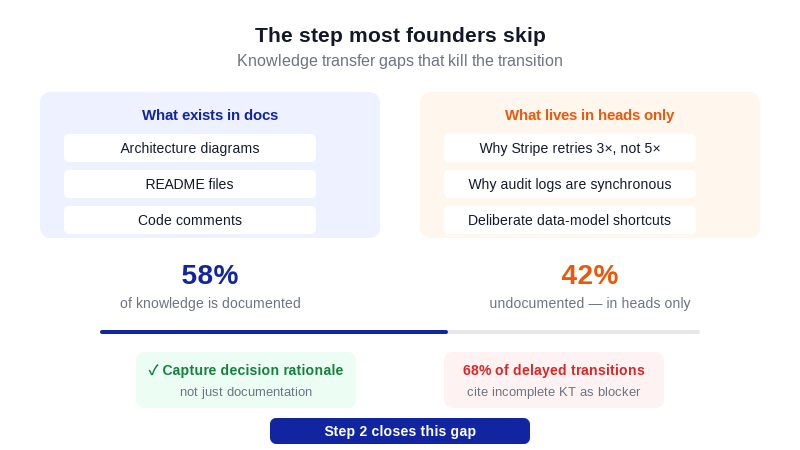
Run the handover as a founder-owned process on a 90-day clock, split into three 30-day phases: audit and inventory (what exists, what's undocumented, what's load-bearing), supervised co-ownership (your engineers ship with the studio watching), and reverse shadowing (the studio ships with your engineers watching, then leaves). The step most founders skip — and the one that quietly kills the transition — is capturing decision rationale, not documentation. Your in-house team can read the code. What they cannot reconstruct is why the Stripe webhook retries three times instead of five, why audit logs are written synchronously, or which pieces of the data model were deliberately denormalized to hit a launch date.
That gap is expensive. Everest Group found 68% of delayed outsourcing transitions cite incomplete knowledge transfer as the primary blocker, and Panopto's 2024 research estimates 42% of organizational knowledge is undocumented and lives only in individual heads. The playbook below is what you, the founder, run — not what your engineers run.
Step 1: Freeze scope and run a 10-day codebase and asset audit
Before anything transfers, you need a shared inventory. Not a wiki page — a single source-of-truth document the studio owns writing and your engineers own reviewing. The goal is to find what's missing, not to admire what's there.
The inventory covers six categories:
- Code: every repo, including internal tools, scripts, and anything running on someone's laptop. Confirm your organization owns every repo in your GitHub/GitLab org, not a studio account.
- Infrastructure: cloud accounts, DNS, CDN, monitoring, logging, error tracking. Who pays the bill? Whose credit card is on file?
- Third-party accounts: Stripe, Twilio, Plaid, SendGrid, Segment, Auth0, etc. Which are on studio emails? Which have 2FA bound to a studio phone number?
- Secrets and credentials: API keys, service account tokens, signing certificates, SSH keys. Where are they stored? Who has rotated them, and when?
- Data: production database access, backups, PII handling, any customer data the studio touches.
- Legal and compliance artifacts: DPAs with subprocessors, any audit evidence already collected, pen test reports.
Anti-pattern: accepting "it's all in the repo README." It isn't. The studio's senior engineer has three things in their head you need on paper: the on-call runbook, the list of things that have broken in production in the last 12 months, and the list of things they were afraid to touch.
You'll know this step is done when: you can list every system by name, every account by owner, and every credential by location — and your two in-house engineers have signed off that the list matches reality.
Step 2: Extract decision rationale, not just documentation
This is the step that determines whether your in-house team can safely change the code six months from now. A junior engineer can produce architecture diagrams. What you need is the why behind each non-obvious choice.
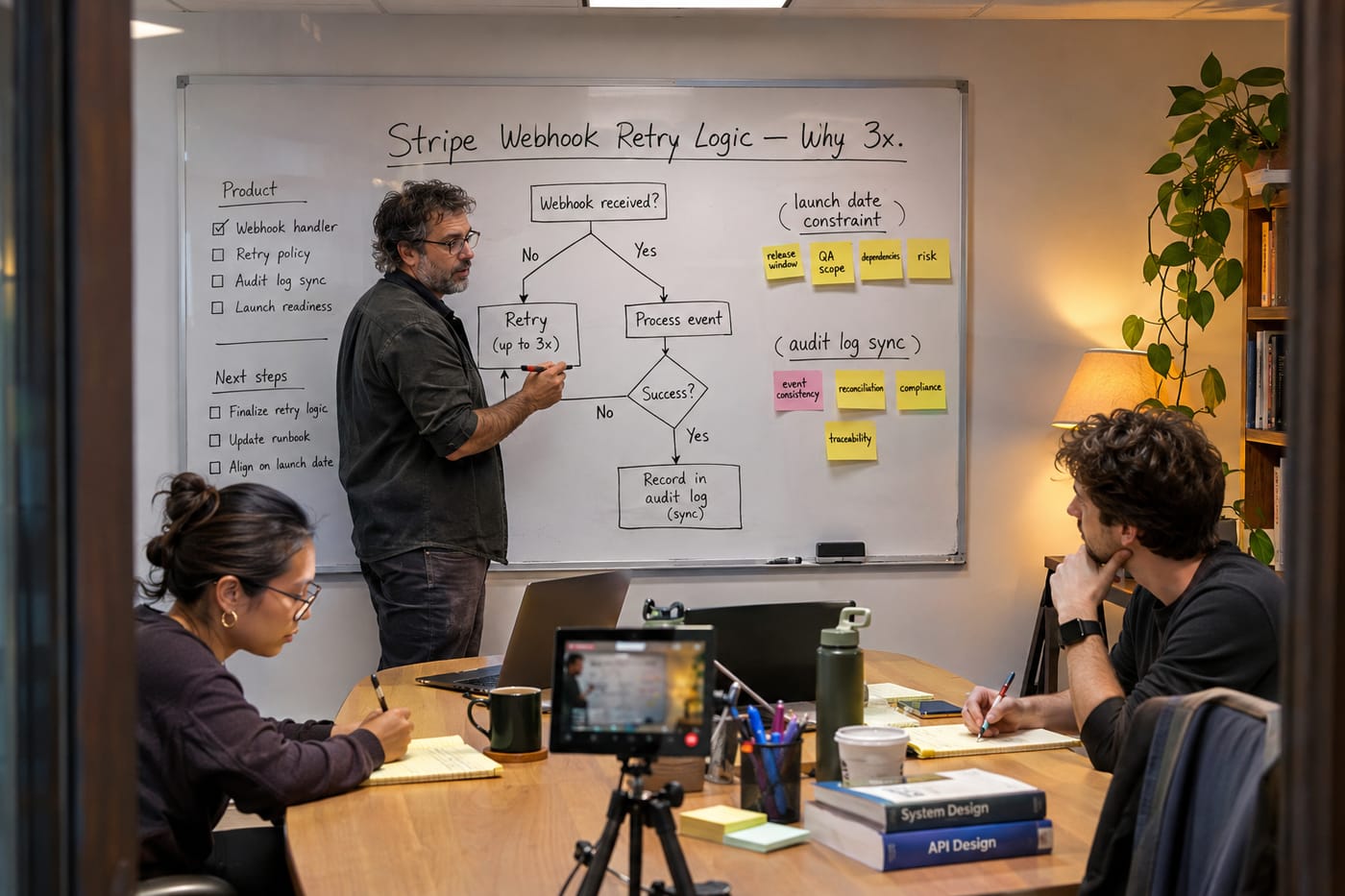
Book four two-hour sessions with the studio's lead engineer in weeks two and three. Each session covers one domain and produces one decision log. Record them. Transcribe them. Your in-house engineers run the sessions and ask the questions — you sit in and ask "why" when they don't.
The four domains:
- Compliance-driven choices. Which code exists because of SOC 2 logging requirements, HIPAA audit trails, PCI scope reduction, or GDPR data residency? If you're selling to finance or healthcare buyers, SOC 2 Type II is a de facto buyer requirement with a 6–12 month observation window — you cannot afford for an in-house engineer to "clean up" an audit log pipeline they didn't understand.
- Third-party API constraints. Rate limits, idempotency requirements, webhook retry behavior, sandbox vs. production differences. Stripe's webhook model, Plaid's item refresh cadence, Twilio's messaging compliance — each shaped parts of your code in ways that aren't obvious from reading it.
- Deliberate technical debt. Every studio defers things to hit a launch date. You need a written list: what was deferred, why, what the correct implementation looks like, and what breaks if it's left alone for another year. McKinsey's CIO survey put technical debt at 20–40% of the technology estate's value, and Stack Overflow's 2024 survey found 62.4% of developers name it their biggest frustration — most of which is inherited, undocumented debt exactly like this.
- Load-bearing hacks. The cron job that must run before the nightly export. The retry logic that papers over a flaky vendor. The feature flag that's been on for 18 months and nobody remembers why.
Anti-pattern: treating knowledge transfer as a one-shot handoff document. McKinsey found 43% of KT failures happen because organizations treat it as an event rather than a continuous process. Decision logs need to be living documents your in-house team updates as they learn more.
You'll know this step is done when: your in-house engineers can point at any non-obvious block of code and tell you, without asking the studio, why it was written that way.
Step 3: Transfer ownership of accounts and credentials — on a written schedule
This is administrative work and it is the step most likely to leak past the end date. Treat it like a checklist with a date next to every row.
For each third-party account, four things change hands: billing owner, admin role, 2FA device, and recovery email. Do them in that order, one vendor at a time, with the studio watching you log in successfully before you move on.
Specific traps:
- Apple Developer and Google Play accounts. Transferring app ownership on the App Store is a multi-week process with its own paperwork. Start this in week two or you will miss your 90-day window.
- Domain registrar and DNS. If the studio registered your domain, the transfer unlock and auth code process takes 5–7 days minimum.
- Stripe, Plaid, and other regulated-vendor accounts. Changing the account's beneficial owner or primary contact can trigger re-verification. Don't do this on a Friday.
- GitHub/GitLab org ownership. Remove the studio's org-owner role only after you've confirmed at least two of your people have it and have tested it.
- Secrets rotation. Every API key the studio has seen gets rotated on their last day. Not before — you'll break prod. Not after — you've left a hole.
Anti-pattern: "we'll keep the studio's email on the account just in case." Just in case of what? Either they're on the hook or they're not. Dangling access is a security finding waiting to happen when you run your first SOC 2 audit.
You'll know this step is done when: you have a signed-off credential transfer log with a date, a new owner, and a confirmation of access revocation for every entry — and the studio's email domain appears in zero production systems.
Step 4: Run supervised co-ownership for 30 days
Weeks five through eight: your in-house engineers ship real production work while the studio is still on retainer, available for questions, and doing code review — but not writing code themselves. This is the phase founders consistently cut short because it feels like paying twice. It isn't. It's buying insurance.
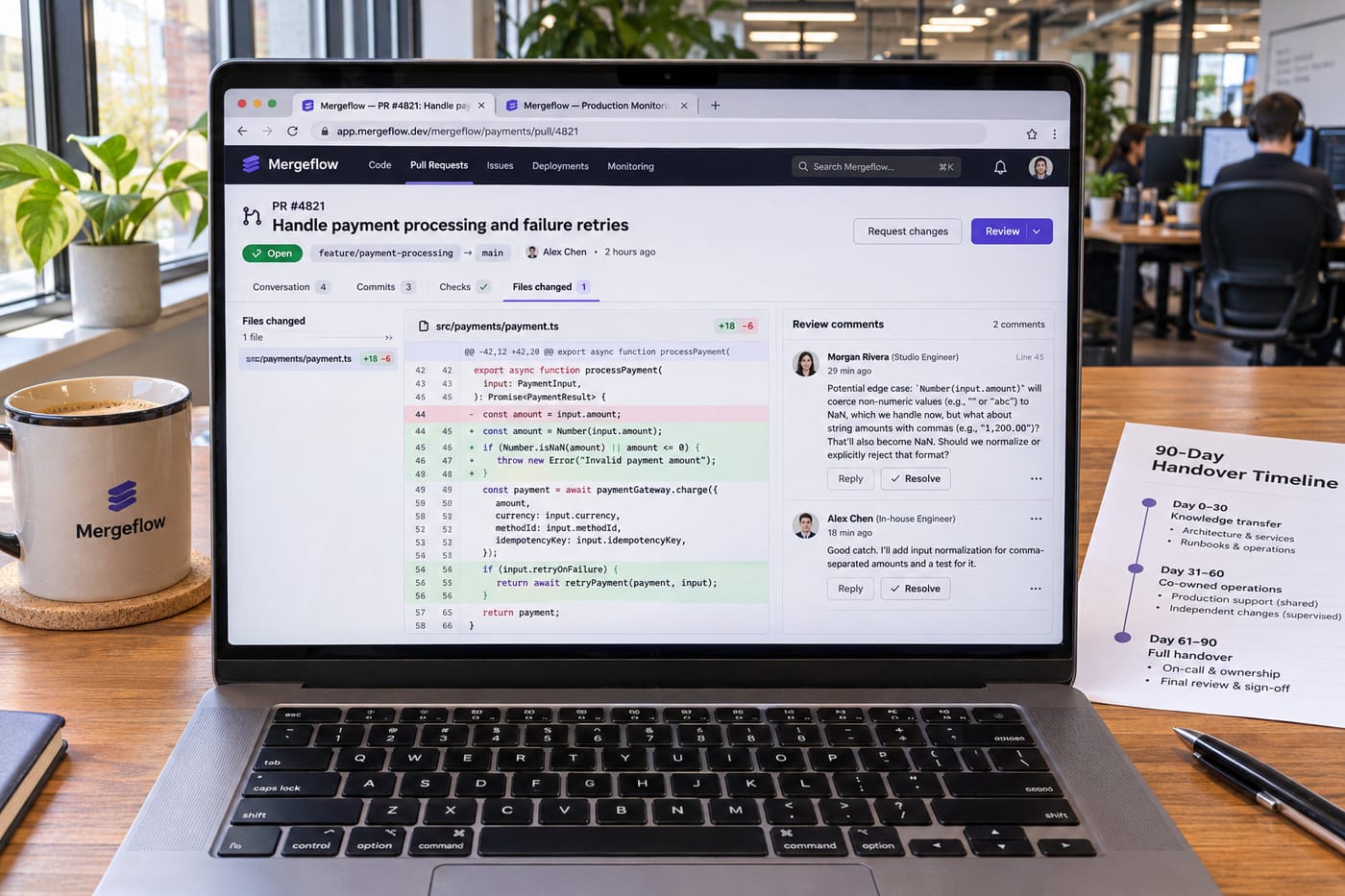
Structure it concretely:
- Your engineers own every PR. The studio reviews, comments, approves. They do not push commits.
- On-call rotates to your team, with the studio as escalation only. Every page they handle is a post-incident writeup your team owns.
- Weekly 30-minute sync between you, your lead in-house engineer, and the studio lead. Agenda: what surprised us this week, what's still undocumented, what's slowing us down.
- Your engineers ship at least one non-trivial feature end-to-end — spec, build, deploy, monitor. Not a bug fix. A feature.
This matters because the average developer takes 3–6 months to reach full productivity in a new codebase, and ad-hoc onboarding can stretch it to nine. Structured onboarding compresses that to 8–12 weeks and is associated with 82% higher retention. Your 30-day supervised window is that structure.
Anti-pattern: cutting the studio to "a few hours a week for questions" in week five. Questions don't surface on a schedule. They surface when something breaks at 11pm on a Tuesday. Pay for real availability or don't pay at all.
You'll know this step is done when: your in-house team has shipped a feature end-to-end without studio code contributions, handled at least one production incident without escalation, and the weekly sync has nothing urgent on the agenda two weeks running.
Step 5: Reverse shadowing and a formal exit review
The last 30 days invert the arrangement. The studio is available only for a defined list of open items — usually the deferred technical debt from Step 2 — and your team owns everything else outright. Any studio code that still ships goes through your engineers' review, not the other way around.
End the engagement with a written exit review, not a call. Three documents:
- Open risks register. Everything the studio knows about that your team hasn't seen in production yet. Vendor contracts expiring, certificates renewing, data migrations pending, known bugs under workarounds.
- Thirty / sixty / ninety day watchlist. What to check at each interval after the studio leaves. Billing anomalies on third-party accounts are a common first-month surprise.
- Re-engagement terms. If you need them back for a specific issue in month four, what does that cost and how fast can they respond? Negotiate this while you still have leverage, not after something breaks.
Anti-pattern: a "thanks for everything" Slack message and a final invoice. You are ending a relationship with the only people who have seen your system under load for the last two years. Close it properly.
You'll know this step is done when: the three documents are signed, credentials are rotated, the studio's access is revoked across every system, and your team has run one full week of normal operations with no contact.
What this costs — in time and money
The 90-day timeline is a reasonable target for a single-product SaaS with a handful of integrations and one or two environments. It stretches when any of the following are true: multiple products share infrastructure, you have active compliance obligations (SOC 2, HIPAA, PCI) with audit evidence that must transfer cleanly, the studio built things you don't yet have in-house skills for (ML pipelines, mobile, data engineering), or you have significant deferred debt the studio needs to help resolve before leaving.
On the money side, the dominant cost is the overlap: you're paying two teams during the supervised co-ownership phase. How large that overlap gets is driven by three things you control — how early you start the handover before the studio contract ends, how senior your in-house hires are (two staff engineers compress the timeline; two mid-levels don't), and how much decision rationale was captured during the original build versus retroactively.
The three specifics that would turn these ranges into a real estimate for your situation: (1) the current state of documentation and decision logs, (2) the compliance posture you need to maintain through the transition, and (3) the seniority and domain fit of your in-house hires. If you're thinking through a transition like this and want a second opinion on where the risk actually sits, that's a conversation worth having before you sign the final extension.
Frequently Asked Questions
How long should the overlap between the external studio and the in-house team really be?
Four to eight weeks of genuine overlap is typical for a single-product SaaS, with the external team shifting from building to reviewing to on-call-only across that window. The main drivers are the seniority of the in-house hires, how much decision rationale was captured during the original build, and whether active compliance obligations need continuous coverage. Shorter overlaps work when the codebase is small and well-documented; they don't work when the studio holds a lot of undocumented context.
What's the single biggest thing founders forget to transfer?
Decision rationale — the why behind non-obvious architectural choices. The code and documentation usually transfer fine. What gets lost is which choices were driven by compliance, which by third-party API constraints, and which were deliberate shortcuts to hit a launch date. Panopto's 2024 research found 42% of organizational knowledge is undocumented, and in a studio relationship most of that sits with one or two senior engineers.
Should we rotate every credential the studio has ever seen?
Yes, on their last day of engagement — not before, not after. Rotating early risks breaking production while the studio is still the fastest path to fix it. Rotating late leaves a window where former contractors retain access, which is a finding in any serious security review and a problem if you're pursuing SOC 2.
What if our in-house engineers find things they want to rewrite immediately?
Put a 90-day moratorium on rewrites of anything compliance-adjacent, payment-related, or touching audit trails. Your engineers are seeing the code without the context of why it was written that way. A rewrite in month two of a SOC 2 audit logging pipeline because "it looked inefficient" is the kind of mistake that costs a renewal. Refactors are fine once the decision logs are internalized.
How do we handle the studio pushing back on this level of structure?
A good studio will welcome it — clean exits are how they get referrals and repeat business. Pushback usually signals either that they underpriced the original engagement and can't afford the handover time, or that significant undocumented knowledge exists that they'd rather not expose. Either way, the structured handover is more important, not less. Write the handover scope into the contract extension, not a side email.
Sources & further reading
- Knowledge Transfer Plan for IT Outsourcing: Complete Framework (Everest Group / McKinsey stats) — OpsioCloud
- Knowledge Transfer: Meaning, Process & Templates (Panopto 2024 stat) — Hyring
- The Real Cost of a Bad First Week (3–6 month productivity ramp) — DEV Community
- Developer Onboarding: The First 90 Days Playbook (82% retention stat) — daily.dev Recruiter
- Understanding the True Impact of Technical Debt on Product Development (McKinsey 20–40% stat) — Ciklum
- The Cost of Technical Debt: What It Actually Costs You (Stack Overflow 2024 survey) — gmware
- SOC 2 Compliance Roadmap for Startups 2025 (Type II cost & timeline) — Promise Legal
- SOC 2 for SaaS Companies: A Complete Walkthrough (market-driven requirement) — Sprinto
Get one practical guide a week
Costs, AI tools, partner selection — written for people who make the decision. No spam, unsubscribe anytime.
Thanks — you're on the list. One practical guide a week, nothing else.
That didn't work — please check the email address and try again.
Building something in Software & Technology?
CodeNicely partners with founders and tech teams to ship AI-native products that move metrics. Tell us about the problem you're solving.
Talk to our team Book a 30-min call