
Red Flags in a Dev Partner Pitch: The Enterprise Checklist

 Published by CodeNicely, the product studio founded by Meghal Agrawal and Ujjwal Agrawal in 2017
For: A CIO or VP of Technology at a UK enterprise with 500+ employees who is sitting through shortlisted vendor presentations for a multi-year custom software programme and needs to distinguish a genuinely capable partner from a well-rehearsed sales team before the SOW is signed
In this guide
The single most reliable red flag in an enterprise dev partner pitch is a fixed-price quote that arrives within 48 hours of the brief. Accurate fixed pricing requires a discovery artefact — a scoped requirements document, wireframes, a data-flow diagram — that cannot physically be produced that fast. The number you are looking at is a placeholder the vendor intends to renegotiate via change orders once the SOW is signed. Industry analysis of fixed-price contracts is explicit on this: without discovery, the quote is a risk buffer, not a price.
This post is the interview script for the stage after the beauty parade — the technical deep-dive, the two-hour session where the sales lead hands over to the people who would actually build the thing. By the end of that meeting you need to know whether this vendor will survive first contact with your reality, or whether you are buying a well-rehearsed deck. The context matters: only 31% of software projects are delivered on time and on budget, and large IT programmes run 45% over budget and deliver 56% less value than predicted on average. Picking wrong is expensive in a way that dwarfs the day rate.
Below are 15 questions, ordered roughly as you should ask them. For each: why it matters, the shape of a good answer, and the shape of the answer that should end the conversation.
Before scope and commercials
1. Walk me through your discovery process. What artefact will I own at the end of it, and how long does it take?
Why it matters: Discovery is where the pricing becomes real. PMI data shows over half of projects experience scope creep averaging 27% over budget, almost always because the initial scope was never properly articulated.
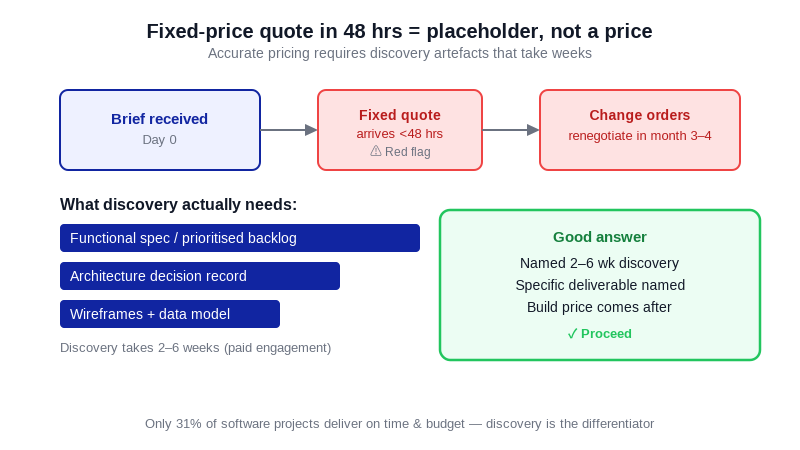
Good answer: A named, paid, two-to-six-week engagement that produces a specific deliverable — a functional specification, a prioritised backlog with story points, an architecture decision record, wireframes for the critical user journeys, a data model. They will name the artefact without being prompted, and they will tell you that the fixed price for build cannot be meaningful until it exists.
Red-flag answer: "Discovery is included" or "we do that in the first sprint." Either means they have already committed to a number before understanding the problem, and the renegotiation will come dressed as a change request.
2. Show me the SOW template you would propose. Specifically, show me the change control clause.
Why it matters: The change control clause is where the margin lives on a fixed-price contract. On T&M, it defines who can approve additional work and at what rate.
Good answer: They send the template before the meeting. The clause defines a change request threshold (anything over X hours needs written approval), caps the uplift rate for out-of-scope work, and names who on both sides can authorise. It distinguishes clarifications (free) from additions (billable).
Red-flag answer: Vague language like "reasonable changes will be accommodated" with no threshold, or an uplift rate 30–50% above the baseline. The second is how a lowball bid becomes a market-rate project by month four.
3. What's your fully-loaded cost model? Not your rate — your margin structure.
Why it matters: A pitch that cannot explain its own unit economics will not be able to explain variance when it happens.
Good answer: They will talk about blended rates, bench cost, PM overhead as a percentage of delivery, and what their target gross margin is. They will acknowledge that at your scale they are not taking the project at a loss and they do not need to.
Red-flag answer: A day rate that is 40% below the UK market with no explanation of how the maths works. Either juniors will be billed as seniors, or scope will be cut silently, or the change orders will arrive in month three.
On the team you are actually getting
3a. Who, by name, will be on this project in month one, month four, and month nine? What is your bench turnover rate?
Why it matters: Pitch teams are not delivery teams. The architect on the slide may touch your project for the first two weeks and never again.

Good answer: Named individuals with LinkedIn profiles, CVs, and current availability. A frank answer about attrition (15–20% annually is normal for the industry; much higher is a problem) and a named replacement policy — "if someone leaves, we give you two weeks of overlap at our cost."
Red-flag answer: "We'll assign the best team closer to kickoff" or "team composition is flexible based on need." You are buying a resource pool, not a team, and the people you meet in the deep-dive will not be the people who write your code.
4. Can I interview the proposed tech lead for 45 minutes, unaccompanied by sales?
Why it matters: This is the single highest-signal question in the process. Watch the reaction, not just the answer.
Good answer: Yes, with a date offered inside a week. The tech lead turns up having read the brief, asks you three sharp questions in the first ten minutes, and tells you one thing in your proposed approach that worries them.
Red-flag answer: Hesitation, scheduling friction, or an insistence that the account manager attends "to take notes." The tech lead is either not real, not available, or not trusted to talk to clients without a chaperone.
5. What percentage of the delivery team will be on-shore vs offshore, and in which time zones?
Why it matters: This is the honest version of the question. Hybrid delivery is not a red flag — opacity about it is. For a UK enterprise, a team running entirely in IST with no UK overlap window creates real cost in ceremony and clarification.
Good answer: Precise numbers. "Two UK-based senior engineers and a PM with four-hour daily overlap, six engineers in India working to UK sprint cadence, standups at 10am UK time." They will tell you honestly which roles sit where and why.
Red-flag answer: "Fully UK team" that turns out to mean one account manager in London, or evasion about where the code is actually written. For UK enterprise buyers evaluating offshore and hybrid delivery models, the structure matters less than the vendor's willingness to be precise about it.
On the technical substance
6. Show me the architecture of a system you've built that has your proposed stack running in production at our scale.
Why it matters: Reference architectures from the sales deck are not evidence. A whiteboard session is.
Good answer: The tech lead draws it live, names the services, explains why they chose Postgres over DynamoDB for this workload, acknowledges one thing they would do differently now. They can tell you p95 latency and monthly infrastructure spend.
Red-flag answer: A pre-rendered diagram that looks suspiciously like an AWS reference architecture, with no operational numbers attached.
7. What's your position on build vs buy for auth, payments, search, and notifications?
Why it matters: Vendors who want to bill hours will build; vendors who want you to succeed will buy. A partner who proposes building a custom auth layer in 2025 is either billing for the sake of it or does not understand the liability.
Good answer: Defaults to buy for commodity concerns (Auth0, Stripe, Algolia, Twilio/Postmark) and justifies any build decision in terms of specific requirements the SaaS cannot meet.
Red-flag answer: Enthusiasm for building everything in-house "for full control" or "to avoid vendor lock-in" — a phrase that often means "to maximise our billable hours."
8. Walk me through your CI/CD pipeline and your definition of done.
Why it matters: Delivery hygiene is uncomfortable to fake in real time.
Good answer: They describe trunk-based development or short-lived feature branches, automated test gates with coverage thresholds, infrastructure-as-code, a staging environment that mirrors production, and a documented rollback procedure. Definition of done includes tests, documentation, a code review, and a product owner sign-off.
Red-flag answer: Manual deployments, test coverage as a "nice to have," or a definition of done that ends at "merged to main." You will inherit a maintenance problem on day one of go-live.
9. How do you handle production incidents in a system you've built and handed over?
Why it matters: Separates partners from body shops.
Good answer: A specific SLA structure, on-call rotation, post-mortem process, and an honest account of a recent P1 they handled badly and what they changed.
Red-flag answer: "We hand over to your ops team at go-live" with no transition plan, or an SLA that commits to response times but not resolution.
On security, compliance, and liability
10. Walk me through your UK GDPR posture as a data processor, not as a data controller.
Why it matters: In March 2025, the ICO issued its first-ever UK GDPR fine against a software data processor — £3.07 million against Advanced Computer Software Group. The regulatory posture has shifted; your dev partner now carries direct liability for security failures, not just you.
Good answer: They know the Advanced ruling by name. They can describe their ISO 27001 status, penetration testing cadence, SBOM practice, and how they would structure the DPA. They will name the sub-processors they use (GitHub, AWS, their own offshore entity) without being pushed.
Red-flag answer: "We're fully GDPR compliant" with no specifics, or confusion about the processor-controller distinction. A lawyer or data protection officer on your side should review the DPA regardless — nothing in this post is legal advice — but if the vendor cannot have the conversation, the lawyer will not be able to save you.
11. What IP assignment and source code escrow do you offer by default?
Why it matters: Default terms are the terms you will probably accept. Push defaults, not the maximum concession.
Good answer: Full IP assignment on payment, source code in your repositories from day one (not theirs), no retained license for "reusable components" without explicit disclosure, and willingness to sign an escrow arrangement for critical systems.
Red-flag answer: A standard contract that retains a "perpetual license to reusable frameworks" — a clause that can effectively lock you into their continued involvement even after handover.
On evidence and references
12. Give me two reference clients where the project went badly, and tell me what you learned.
Why it matters: Reversing the standard reference request filters for self-awareness. Everyone has case studies that went well; the question is whether they can talk honestly about the ones that did not. Given 50–75% of ERP projects exceed their original budget, timeline, or expected benefits, any vendor claiming a flawless track record is either very new or lying.
Good answer: Two named projects, specific descriptions of what went wrong (scope misalignment, a key hire that didn't work out, an estimate that was off by 40% on a specific module), and concrete process changes that followed. Bonus points if the client is still a reference.
Red-flag answer: "We haven't really had any projects go badly" or deflection into case studies that clearly went well. Humans are not that good; neither are vendors.
13. Can I speak to a reference client whose project you lost money on?
Why it matters: Tests whether they absorb variance or push it onto clients. A vendor that has never eaten a loss is a vendor that invoices every slip.
Good answer: A named reference, a candid story about why (bad estimate, unexpected complexity, a team change), and the commercial terms under which they ate the overrun.
Red-flag answer: "All our projects are profitable" — which either means they are very small, or every variance has been passed through as a change order.
14. What does your handover look like six months after go-live if we choose not to renew?
Why it matters: How a partner behaves on the way out tells you everything about how they behave while they are in.
Good answer: A documented transition process, knowledge transfer workshops costed into the SOW from the start, repository access and documentation already with you, and a willingness to introduce you to engineers you might hire in-house.
Red-flag answer: Vagueness, or terms that make leaving expensive. A partner who makes departure costly is a partner banking on your inertia.
15. What would you want to change about the brief we sent you?
Why it matters: The final-answer question. A vendor that has nothing to push back on has not read the brief carefully or is not willing to risk the deal to tell you the truth.
Good answer: Two or three specific challenges — a milestone that looks unrealistic, a requirement that conflicts with another, a technical assumption they would question. Delivered respectfully, with alternatives.
Red-flag answer: "The brief is excellent, we wouldn't change a thing." You are hiring expertise. If they cannot exercise it in the pitch, they will not exercise it in delivery.
On the money and time questions you should actually ask
Two questions that are not on the checklist above but should be asked plainly, and where the shape of the answer matters more than the number.
"What's your estimate range, and what three decisions would narrow it most?" A credible answer will give you a wide range (good estimates for enterprise programmes are rarely tighter than 2x at the pre-discovery stage) and name the three variables that collapse the range — integration count and complexity, data migration volume and quality, and the compliance surface area (SOC 2, ISO 27001, FCA, NHS DSPT). McKinsey-Oxford found every additional year of planned duration adds 15% to cost overrun, so short, well-scoped phases beat long heroic ones.
"Can you phase this so we can kill it at the end of phase one without wasting the investment?" A good partner will architect the first phase as something that stands alone — a working MVP, a modernised module, an AI capability shipped into one business unit. A partner who cannot phase the work is a partner whose commercial model depends on you not being able to stop.
None of these questions produces a quote. They produce the information that makes a quote meaningful. Turning them into actual numbers requires the discovery artefact — the specification, the integration map, the data audit — that question one asks about. For enterprise programmes that span legacy modernisation, custom build, and AI embedding, that discovery phase is non-negotiable; vendors who skip it are the ones who show up at month four with a change order.
Frequently Asked Questions
How long should an enterprise discovery phase take before signing the full build SOW?
For a programme over £500k in likely build cost, two to six weeks is the typical range — shorter if the scope is narrow and the data landscape is simple, longer if there are multiple integrations, a significant compliance surface, or legacy systems to map. The output should be a specification detailed enough that a different vendor could quote against it. If a vendor offers to skip discovery to "save time," they are offering to shift all the risk onto you.
What's a reasonable range for fixed-price variance on a multi-year enterprise programme?
Even with proper discovery, expect a credible fixed price to come with a 10–20% contingency clause for defined categories of change. McKinsey-Oxford's study of 5,400 projects found large IT programmes run 45% over budget on average, and only 31% of all software projects deliver on time and on budget, so a vendor promising no variance at all is promising something the industry does not deliver. The three specifics that would turn a range into a real estimate are integration count, data migration scope, and the compliance regime — have those scoped before asking for a number.
Is a UK-only delivery team worth the premium over hybrid offshore?
Sometimes, for narrow reasons — highly regulated workloads where data residency matters, or projects requiring constant in-person collaboration with your business users. For most enterprise programmes, a well-structured hybrid team with named UK leads and a disciplined offshore delivery function delivers better value. The red flag is not the model; it is vendors who are vague about which roles sit where.
How do I verify a vendor's UK GDPR claims beyond the pitch?
Ask to see their ISO 27001 certificate (not just a claim), their most recent penetration test summary, their sub-processor list, and their standard DPA. Ask specifically how they would handle a data subject access request that touched your system. Your data protection officer or external counsel should review the DPA before signing — this post is not legal advice, and the ICO's £3.07m processor fine in 2025 makes clear that vendor security posture now carries direct regulatory weight.
What's the single highest-signal question to ask in a dev partner pitch?
Question 4 on the list above: can you interview the proposed tech lead for 45 minutes, without sales present? The answer, and the speed of the answer, tells you whether the delivery team is real and whether the vendor trusts them to represent the company. Everything else is secondary.
Sources & further reading
- Standish Group CHAOS Report 2024 — via ztabs.co
- McKinsey-Oxford: Delivering Large-Scale IT Projects on Time, on Budget, and on Value (primary PDF)
- McKinsey-Oxford 5,400-project study summary — budgetoverrun.com
- ERP Implementation Failure Statistics 2026 — erpresearch.com
- UK Custom Software Development Market Industry Report 2035 — Market Research Future
- ICO fines Advanced Computer Software £3.07m — CMS Law (primary legal analysis)
- First UK GDPR Fine on a Data Processor — Clifford Chance
- Fixed-Price vs Time-and-Materials: skipping discovery and change-order risk — cmeolabs.com
Get one practical guide a week
Costs, AI tools, partner selection — written for people who make the decision. No spam, unsubscribe anytime.
Thanks — you're on the list. One practical guide a week, nothing else.
That didn't work — please check the email address and try again.
Building something in Software & Technology?
CodeNicely partners with founders and tech teams to ship AI-native products that move metrics. Tell us about the problem you're solving.
Talk to our team Book a 30-min call