
What a Systems Integration Really Commits You To

 Published by CodeNicely, the product studio founded by Meghal Agrawal and Ujjwal Agrawal in 2017
For: A UAE-based startup founder who has received a dev proposal promising to 'integrate' their new platform with an existing payment gateway, ERP, or government API — and cannot tell whether the quoted AED 25,000 line item is complete or the start of an open-ended cost spiral
In this guide
A systems integration is not a feature you buy once; it is a dependency you take on for the life of the product. The fixed line item in your proposal almost certainly covers the first successful data flow between your platform and the third-party system — nothing more. The transformation logic, the error handling, the re-testing every time the other side ships a breaking change, and the on-call burden when a payment fails at 2am: those are either buried in the same number, deferred to a vague 'support' clause, or missing entirely. Before you sign, you need to know which.
This post is for a founder staring at a proposal that says 'Integrate with [payment gateway / ERP / UAE Pass / Open Finance API] — AED 25,000' and cannot tell whether that is a complete scope or the first invoice in a spiral. The goal is not to make you a technical reviewer. It is to give you four or five sharp questions that force the vendor to be specific.
What 'integration' actually means
When a vendor says they will integrate your platform with another system, they are promising to build and maintain a translator between two pieces of software that were not designed to talk to each other. Your platform speaks one dialect. The payment gateway, the ERP, UAE Pass, or the Central Bank's Open Finance API Hub speaks another. The integration is the code — and the operational discipline — that keeps the translation accurate as both sides change over time.
Think of it less like installing a plug into a socket and more like hiring a simultaneous interpreter for a multi-year negotiation. The interpreter has to show up every day. When either party changes vocabulary, the interpreter has to retrain. If the interpreter is sick or wrong, the negotiation stops. The upfront fee pays for the first day. Everything after that is ongoing.
A real integration has four layers, and a serious proposal names all four:
- Connection and authentication — getting the two systems to recognise each other securely, including credential rotation, token refresh, and in the UAE context, signed agreements with TDRA for UAE Pass or entity onboarding with the CBUAE's Nebras API Hub for Open Finance.
- Transformation logic — mapping the fields of one system to the other. Your 'customer' may be their 'party'. Your amount is in fils; theirs is in dirhams to two decimals. Dates, currencies, address formats, VAT codes — every mismatch is a line of code that must be written, tested, and maintained.
- Error handling and reconciliation — what happens when the third party is down, returns a malformed response, times out mid-transaction, or silently changes behaviour. This is the layer most fixed-price proposals under-scope, because it is invisible until production.
- Ongoing maintenance — patching the integration every time either side releases a change. For a UAE platform touching Open Finance, this is not hypothetical: the CBUAE standard moved from v1.0 in August 2024 to v1.2 by December 2024, per the CBUAE's own regulation documents. Two minor versions in four months. Every version is potential rework.
Why the maintenance bill dwarfs the build bill
Here is the number that reframes the conversation. Industry benchmarks across multiple analyses — Truto, Albato, and Gilzor — put annual integration maintenance at 15–25% of the original build cost, every year. A separate analysis cited by Formable puts five-year maintenance at two to four times the original build. The initial build, in other words, is typically 30–40% of two-year total cost.
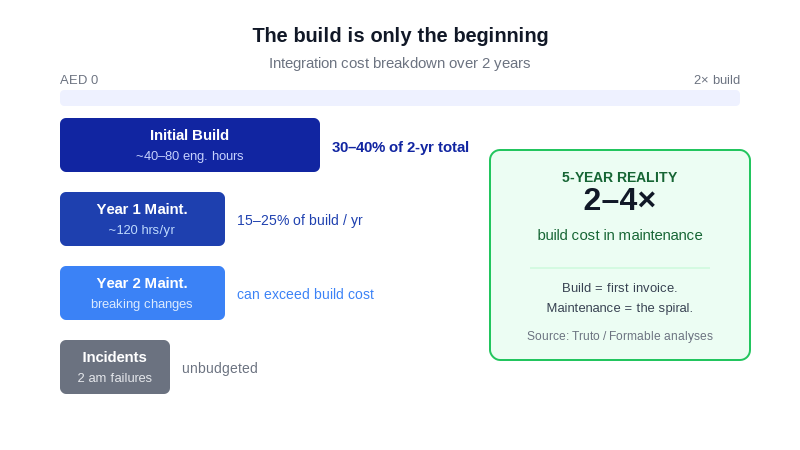
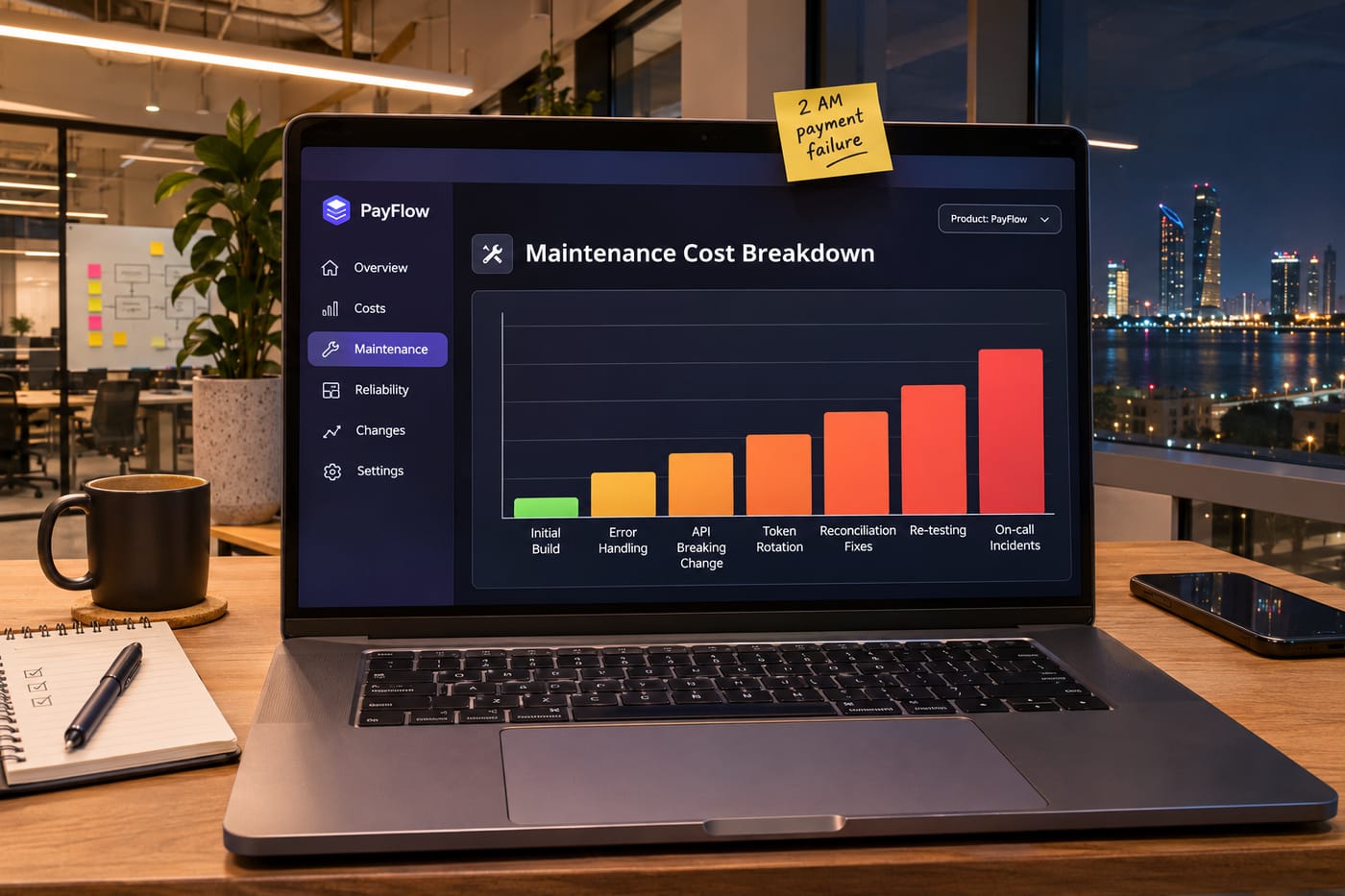
Why so high? Because a single production-grade API integration takes roughly 40–80 engineering hours to build but around 120 hours a year to maintain, according to Truto's analysis. Year-two maintenance alone can exceed the original build effort. The maintenance hours go to: patching breaking changes on the third-party side, chasing silent behaviour changes, re-running compliance checks, rotating credentials, upgrading deprecated authentication methods, and diagnosing the handful of edge-case failures that only appear once you have real transaction volume.
This is not a theoretical risk in the UAE market right now. The Open Finance Framework became mandatory on 27 June 2024, with Pay10 becoming the first fintech to initiate a live transaction with a UAE bank under the regulated framework in April 2025. That means any platform integrating with the regulated API layer today is integrating with a standard that is actively evolving. Every CBUAE version release is a scheduled maintenance event whether your vendor budgeted for it or not.
UAE Pass is similar. It has crossed 11 million registered users across 350+ entities, but production API access still requires entity eligibility checks, a signed TDRA agreement, and per-channel use-case approval. None of this is in a AED 25,000 line item. It is compliance work that eats weeks of calendar time and recurs whenever your use case changes.
How a fixed-price integration line item hides the real cost
A vendor quoting a single number for 'integration' is doing one of four things, and only one of them is honest:
- Scoping only the happy path. They have budgeted the connection, the basic transformation, and a successful test transaction. Error handling, retries, reconciliation, and alerting are either missing or in a separate 'production hardening' phase you have not seen yet.
- Bundling first-year maintenance invisibly. The number includes some patching allowance, but it is not itemised, so you cannot tell what happens in year two.
- Pricing the build and deferring maintenance to a separate SLA. This is fine if the SLA exists and is priced. Ask to see it. If it is a one-pager that says 'bug fixes within 30 days,' it is not an operational commitment.
- Being honest. The number is the build, maintenance is a separate monthly retainer, and the vendor has told you what triggers rework (version upgrades, breaking changes, new use cases). This exists. It is rarer than it should be.
The broader statistics on integration-heavy projects should calm anyone who thinks 'fixed price' means 'fixed outcome.' McKinsey and Oxford research on 6,003 IT projects found average cost overruns of 75% and schedule overruns of 46%, with one in six projects landing as a 'black swan' at 200% over budget. Gartner expects more than 70% of recently implemented ERP initiatives to miss their original business-case goals by 2027, with integration complexity cited in 51% of over-budget ERP projects. Fixed-price proposals do not change the underlying physics; they transfer the overrun risk to whoever absorbs the rework hours.
When 'we'll just integrate it' is the wrong proposal
Integration is sometimes the right answer. Sometimes it is a reflex. Push back when:
- The third-party system is itself undergoing active schema evolution. UAE Open Finance right now. Any API in public beta. Anything where the vendor's own documentation shows more than one version change in the last year. You are signing up for recurring rework.
- The proposed integration is bidirectional and real-time. One-way, batch-synced integrations are an order of magnitude cheaper to maintain than two-way, real-time ones. If the business requirement is 'show yesterday's ERP balance in the dashboard,' do not let anyone build a live sync.
- The use case will touch regulated data. Payment flows, KYC, Open Finance, health records. The integration cost is a fraction of the compliance and audit overhead. A lawyer and a compliance reviewer need to be in the conversation before the engineer scopes anything.
- Nobody on either side owns the failure mode. If the vendor cannot tell you, on paper, who gets paged when the integration breaks in production and what their response-time commitment is, the integration is not production-ready regardless of what the proposal says.
The two questions to ask the person proposing it
Everything above collapses into two questions you should ask before signing. If the vendor cannot answer both specifically, the quote is not yet a quote.

1. 'What is the itemised 24-month total cost of this integration, assuming the third party ships two breaking changes a year?' This question forces the vendor to separate build from maintenance, name an assumption about change velocity, and put a number on the ongoing cost. If the answer is 'maintenance is included for a year and then we'll see,' you have your answer: it is not scoped.
2. 'Show me the error-handling and reconciliation design — not the code, the one-page description of what happens when the third party is down, returns an unexpected response, or silently changes a field.' This question separates vendors who have built production integrations before from those who are quoting the happy path. The one-pager should exist. If it has to be written after you ask, the proposal was incomplete.
Two follow-ups, if you want to go further: who is the named engineer on call for this integration in month 13, and what is the written process for handling a CBUAE Open Finance or UAE Pass version upgrade?
How CodeNicely can help
Most of our integration work in the UAE and India starts with a founder in exactly your position — a proposal that reads clean until you ask the second question. On GimBooks, the YC-backed accounting SaaS we built with, the integration surface was the product: GST APIs, payment gateways, bank feeds, each with its own version cadence and failure modes. The engineering we invested in error handling, reconciliation, and the operational runbook was larger than the integration build itself — and it is the reason the platform scaled without the maintenance bill eating the roadmap.
If you are a UAE founder evaluating a proposal that includes UAE Pass, a payment gateway, or an Open Finance connection, the useful conversation is not 'can you do it cheaper.' It is 'can you tell me what I am actually committing to over 24 months.' That is the review we do as a paid scoping engagement before anyone writes code. More on how we work with Middle East founders on our Dubai practice page, and on integration-heavy builds generally through our offerings.
Frequently Asked Questions
What drives the cost of a systems integration in the UAE?
Four things: how many fields need transformation between the two systems, whether the data flow is one-way or bidirectional, how mature and stable the third-party API is, and whether the integration touches regulated data (payments, KYC, Open Finance). Add compliance overhead for anything touching UAE Pass or the CBUAE API Hub. A real quote requires scoping each of these; a single line item in a proposal usually means only the first two were considered.
Is a fixed-price integration quote ever trustworthy?
Yes, when it covers a well-defined, stable, one-way integration with a mature API and a separately priced maintenance retainer. It is less trustworthy for bidirectional real-time integrations, for APIs undergoing active version changes (UAE Open Finance is a live example), and for anything requiring regulatory onboarding. The industry data on IT project overruns — 75% average cost overrun across 6,003 projects studied by McKinsey and Oxford — suggests fixed prices often transfer risk rather than eliminate it.
How much should I budget for integration maintenance each year?
Industry benchmarks put annual maintenance at 15–25% of the original build cost, with five-year maintenance typically running two to four times the build. Your number will land in that range based on how often the third party ships breaking changes and how complex your reconciliation requirements are. The way to turn this into a real figure is to ask your vendor for a monthly maintenance retainer priced against a stated assumption about change velocity.
What happens when the UAE Central Bank updates its Open Finance API?
Your integration must be re-tested against the new schema, updated where fields or authentication have changed, re-certified if the CBUAE requires it, and redeployed. The standard moved from v1.0 to v1.2 in four months after the June 2024 regulation. Each version change is a scheduled maintenance event that someone has to own. If your vendor contract does not say who, assume it is you.
Should I ask my lawyer to review the integration scope?
Yes, for any integration touching payments, personal data, UAE Pass, or Open Finance. A lawyer or compliance auditor should review the data flows, the third-party terms, and any TDRA or CBUAE agreements before signing. This post is not legal or compliance advice; it is a framework for asking better questions of your vendor.
Sources & further reading
- Build vs. Buy: The True Cost of Building SaaS Integrations In-House — truto.one
- API Integration Cost: The True Price of Building In-House — albato.com
- API Integration Cost in 2026: Prices & Calculator — gilzor.com
- Affordable API: how to judge the real cost before you integrate — formabledocs.com
- Why Enterprise Integration Projects Blow Past Budget in the Last 20% — advisorytechs.com
- ERP Integration Failure Statistics 2026 — xorosoft.com
- ERP Implementation Statistics & Success Rates — flectic.com
- UAE Central Bank Open Finance Regulation (official CBUAE press release, June 2024)
Get one practical guide a week
Costs, AI tools, partner selection — written for people who make the decision. No spam, unsubscribe anytime.
Thanks — you're on the list. One practical guide a week, nothing else.
That didn't work — please check the email address and try again.
Building something in Software & Technology?
CodeNicely partners with founders and tech teams to ship AI-native products that move metrics. Tell us about the problem you're solving.
Talk to our team Book a 30-min call