

Running Weekly Delivery With an External Dev Team

 Published by CodeNicely, the product studio founded by Meghal Agrawal and Ujjwal Agrawal in 2017
For: A COO or VP of Technology at a UK enterprise — 500+ staff, regulated industry — who has just signed a contract with an external dev partner and now owns the weekly governance rhythm but has never managed an offshore team and is two sprints in with nothing to show the board
In this guide
- Why this matters more than it looks
- Step 1: Lock the Definition of Done before the next sprint starts
- Step 2: Install a weekly cadence with four fixed artefacts
- Step 3: Build the acceptance log as a legal artefact, not a project tracker
- Step 4: Separate milestone acceptance from sprint acceptance
- Step 5: Instrument the relationship with three leading indicators
- Step 6: Run a monthly steering review with real authority
- What this cadence costs you in time — and what drives it
- How CodeNicely can help
- Frequently Asked Questions
If you are two sprints in with nothing to show the board, the problem is almost never that the vendor is slow — it is that no one on your side has formally accepted anything, so there is no artefact to show and no basis to release the milestone payment. The fix is a weekly cadence you run, built around a written, time-stamped acceptance log that ties each sprint's output to the milestone clauses in your MSA. Do that and the governance question resolves itself; skip it and your vendor's Definition of Done legally supersedes yours (Law and More, Agile Contracts in IT Law).
This is a playbook for the buyer side — the COO, VP of Technology, or programme sponsor who owns the relationship but does not write the code. It assumes you have signed the contract, the vendor is onboarded, and your first milestone payment is approaching. Six steps, each with the anti-pattern that will bite you and a clear completion checkpoint.
Why this matters more than it looks
Gartner's 2024 data, cited across the UK outsourcing market, puts the failure rate of IT outsourcing engagements at 21% within the first 24 months — a number that has barely moved in a decade (IT Outsourcing Statistics 2026). The top three root causes are not technical: underdocumented requirements (58%), insufficient client-side vendor management (47%), and price-led selection (44%). When these engagements fail, the total cost — rework, rebidding, lost time — averages 240% of the original budget.
The UK Cabinet Office's own guidance on agile contracting is unusually direct about why: contracts must define what 'done' means at the sprint level, and 'employing agile without proper contracting and/or contract management will increase legal and commercial risk exposure' (Cabinet Office, June 2023). Your weekly cadence is where that contract management actually happens. Everything below is in service of that.
Step 1: Lock the Definition of Done before the next sprint starts
Before you change your meeting rhythm, change the artefact the meetings produce. For every user story or ticket entering the next sprint, there must be a written acceptance criterion the vendor and you both signed off in advance — not in Slack, not in a verbal stand-up, but in your ticketing system with a timestamp and named owner on each side.
EM Law's commentary on UK agile contracts is blunt: without detailed acceptance criteria per sprint, the vendor can credibly argue that 'no defect exists,' and user-story language alone will not carry the weight (EM Law). 'Users can log in' is not an acceptance criterion. 'Users can log in using corporate SSO via Okta, failed attempts lock the account after five tries, and the audit log records attempt metadata per our security schedule' is.
Anti-pattern: Accepting the vendor's standard Definition of Done from their onboarding deck. It is written to be easy to satisfy. Rewrite it in your language, specific to your regulated environment, and attach it to the sprint.
You'll know this step is done when: every ticket in the next sprint has written acceptance criteria that a non-technical auditor could use to say yes or no, and both sides have acknowledged them in writing before work starts.
Step 2: Install a weekly cadence with four fixed artefacts
Most buyers inherit a cadence the vendor proposed — daily stand-ups, a Friday demo, a Slack channel. That is a communication rhythm, not a governance rhythm. Replace it, or sit alongside it, with four artefacts your team produces or signs every week:
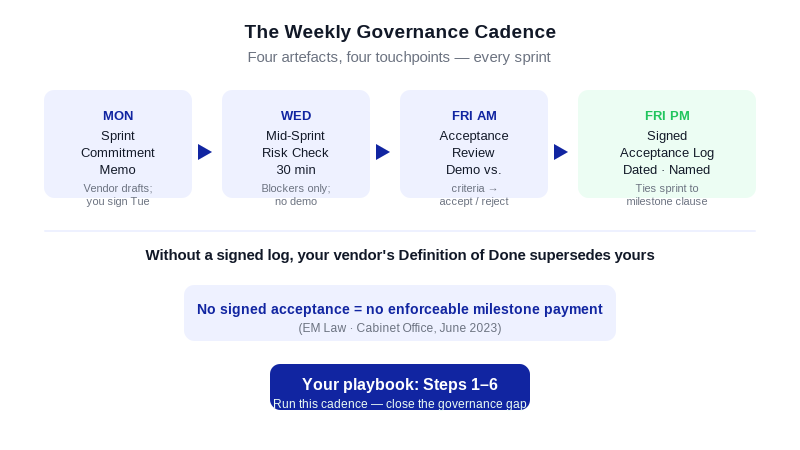
- Monday: Sprint commitment memo. One page. What is being built this week, against which acceptance criteria, which risks are open, and what the vendor needs from you by when. Vendor drafts, you counter-sign by Tuesday morning.
- Wednesday: Mid-sprint risk check. 30 minutes. Not a demo. Only two questions: what has moved off-track since Monday, and what decision do you need from me to keep Friday's acceptance on schedule?
- Friday: Acceptance review. The vendor demonstrates against the acceptance criteria. Each item is marked accepted, accepted with defects (logged), or rejected. This is the critical artefact. More on it in step 3.
- Friday PM: Signed acceptance log entry. A dated record of what was accepted, by whom, against which criteria, with any defects logged and triaged. This is what makes the milestone payment clause enforceable.
Anti-pattern: The Friday 'demo' that is really a vendor presentation with no decision output. If no one on your side said the word 'accepted' or 'rejected' and signed something, nothing happened from a contractual perspective.
You'll know this step is done when: your calendar has these four touchpoints locked for the next six weeks and your legal or procurement team has seen the acceptance log template.
Step 3: Build the acceptance log as a legal artefact, not a project tracker
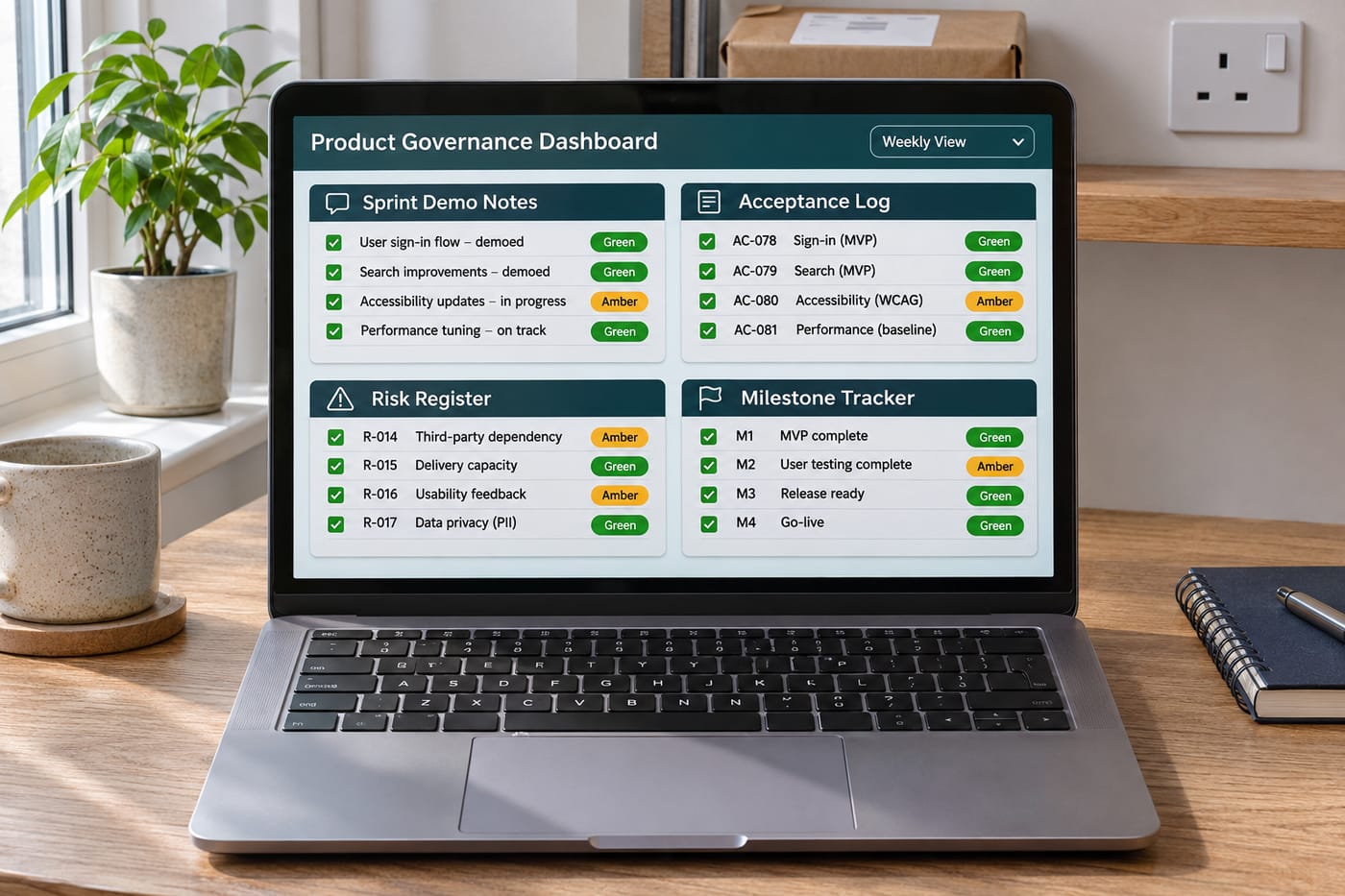
This is the single highest-leverage thing you will do, and it is the step most buyers skip because it feels administrative. The acceptance log is a running, append-only record. Each entry contains: sprint number, ticket ID, acceptance criteria as agreed on Monday, demonstration date, decision (accepted / accepted with defects / rejected), named decision-maker on your side, defects logged with severity, and a timestamp.
Legal commentary across UK and EU agile contracting is consistent on why this matters: milestone payments must be 'tied to milestones defined with enough precision that acceptance or rejection is a factual question rather than a subjective one' (Scala Teams, 2025). Without the log, when a dispute arises — and in a 21% failure-rate market, assume one might — you have Slack threads and memory. With the log, you have an evidential record that maps directly to the MSA's milestone clause.
Keep it somewhere immutable: a signed PDF per sprint deposited in your document management system, or a ticketing-system export with tamper-evident timestamps. Email threads are not sufficient.
Anti-pattern: Treating the log as an internal project tool rather than a contractual record. If your general counsel has not seen the template, it is not yet doing its job.
You'll know this step is done when: you can hand your CFO the log for the sprint ending before a milestone payment, and she can tell — without asking you — whether the payment is earned.
Step 4: Separate milestone acceptance from sprint acceptance
Sprints and milestones are not the same thing, and conflating them is how CFOs end up releasing payment for work that technically happened but commercially is not what they bought. A sprint acceptance confirms the vendor built what was committed that week. A milestone acceptance confirms that a defined outcome — 'customer onboarding flow live in UAT with sign-on, KYC check, and audit logging' — has been reached across a set of sprints.
Your MSA almost certainly ties payments to milestones, not sprints. So you need a second, lighter-weight artefact: the milestone acceptance certificate. It references the specific acceptance log entries that evidence the milestone, is signed by a named senior sponsor on your side (not the project manager), and is the trigger — the only trigger — for the finance team to release payment.
Vague milestone language is 'one of the most common sources of payment disputes in outsourcing engagements' (Scala Teams, 2025). If your MSA milestones read like 'Phase 1 complete' with no further definition, go back to your legal team now and get a side-letter clarifying each one against measurable outcomes. This is cheaper than a dispute later.
Anti-pattern: The project manager signing off a milestone because the sprints 'went well.' Milestone sign-off is a commercial decision, not a delivery one, and it belongs with the budget owner.
You'll know this step is done when: every milestone in your MSA has a written, measurable definition and a named senior sign-off authority, and your finance team has agreed not to release payment without the certificate.
Step 5: Instrument the relationship with three leading indicators
Acceptance logs tell you what happened. You also need two or three forward-looking signals that something is drifting before it shows up at the Friday review. Pick a small number and track them weekly:
- Acceptance-first-pass rate. What percentage of tickets were accepted at Friday review without defects? A falling rate over three sprints means the Monday acceptance criteria are not landing, or the vendor is over-committing.
- Decision latency. How long from a vendor question raised in the Wednesday check to a written decision from your side? If this creeps past 48 hours, you are the bottleneck, not them — and the vendor will quietly document it.
- Defect carry-forward. How many 'accepted with defects' items are still open two sprints later? More than a handful means your Definition of Done is being used as a holding pen.
Share these metrics with the vendor every week. They should see exactly what you see. A good vendor will welcome it; a struggling one will push back on the measurement itself — which is useful information on its own.
Anti-pattern: Tracking velocity in story points as your primary health metric. Velocity measures what the vendor did. It does not measure whether what they did is what you bought.
You'll know this step is done when: your Monday sprint commitment memo includes last week's three indicators as a header, and you can show the board a four-sprint trend line.
Step 6: Run a monthly steering review with real authority
The weekly cadence handles delivery. The monthly steering review handles the relationship — scope, budget burn, risks, and whether the current trajectory still matches the business case. Attendees: the budget owner from your side, a senior delivery sponsor from the vendor, and whoever on your side would have to explain this engagement to the board.
The review's job is to answer three questions in writing: are we still building the right thing, are we still on course to the next milestone, and is there anything we should stop or change? Everything else is noise.
Anti-pattern: A monthly steering meeting that is a longer version of the Friday demo. If the agenda does not include scope, budget, and risks, it is not a steering meeting.
You'll know this step is done when: the monthly review produces a one-page decision memo signed by both sponsors, and your board pack for the quarter can be assembled directly from four of them.
What this cadence costs you in time — and what drives it
Expect the buyer-side time commitment to be meaningful. Gartner's data on failed engagements points to 'insufficient vendor management resources on the client side' as a top-three root cause in 47% of cases (IT Outsourcing Statistics 2026) — which tells you underinvesting here is the default mistake, not overinvesting.
The size of the commitment depends on three things: how many parallel workstreams the vendor is running for you, how regulated your sector is (which drives acceptance-criteria depth), and whether your product owner has done this before. A single-workstream engagement in a lightly regulated domain, with an experienced product owner, is a different job from three concurrent workstreams in financial services with a first-time sponsor. The two or three specifics that would turn that into a real resourcing plan — number of workstreams, your regulatory overhead, existing internal product capability — are worth a conversation before you staff the role.
How CodeNicely can help
We have been on both sides of this. The engagement that most resembles a UK enterprise buyer's situation is GimBooks, a YC-backed fintech where the client-side team needed an auditable delivery trail across accounting and compliance workflows — sprint-level acceptance that would survive scrutiny from finance, legal, and eventually investors. The cadence we ran there was built around the same artefacts described above: written acceptance criteria per ticket, a signed weekly acceptance log, and milestone certificates separated from sprint demos. For a regulated UK enterprise two sprints into a new engagement, the practical help we offer is less about writing code and more about installing that governance layer alongside whichever delivery partner you have chosen — including ourselves. See our enterprise engagement model for how we structure that, and the services overview for the delivery shapes we support.
One honest note: this cadence is bad at one thing. It adds friction early. The first two sprints under this model feel slower than the Slack-and-vibes alternative, because you are front-loading the acceptance-criteria conversation. That is the cost. The benefit shows up at milestone four, when you can sign off a payment in twenty minutes with evidence, and at month nine, when there is no dispute to settle.
Frequently Asked Questions
How much of my own time should I expect to spend running this cadence weekly?
The buyer-side time is driven by workstream count, regulatory overhead, and whether you have an experienced product owner in place. A single-workstream engagement with a seasoned PO is a different job from multi-workstream regulated delivery with a first-time sponsor. The specifics that turn this into a real estimate are the number of parallel vendor workstreams, your compliance depth, and your existing internal product capability — worth scoping before you commit the role.
Can I enforce milestone payments if we did not define acceptance criteria upfront?
This is a legal question and your general counsel should look at the specific MSA language, but the pattern in UK and EU case commentary is consistent: without written acceptance criteria, disputes about whether a sprint succeeded 'arise more readily' and the vendor's Definition of Done tends to prevail (Law and More). The practical answer is to retrofit now — agree written criteria for the next sprint, and for milestones not yet reached, a side-letter clarifying the measurable definition. Get a lawyer to review the specifics before you rely on this.
What is the single most important artefact in this cadence?
The signed, time-stamped acceptance log. Everything else — the Monday memo, the Wednesday check, the Friday demo — exists to produce it. It is what makes the milestone payment clause in your MSA enforceable and what lets your CFO release payment with evidence rather than faith.
How long before this cadence shows results?
The governance effect — knowing what is accepted and what is not — shows up in the first full sprint under the new model. The commercial effect — milestone payments backed by evidence, cleaner disputes, better vendor behaviour — typically shows up over two or three sprints as the acceptance-first-pass rate and defect carry-forward numbers stabilise. If you are three weeks in and the first milestone is due Friday, you cannot retrofit the full cadence in time — but you can insist on written acceptance criteria and a signed log for whatever is being demonstrated this week, which is enough to defend the payment decision.
What if the vendor resists adopting this cadence?
Reasonable pushback on specific mechanics is healthy; resistance to the principle of written acceptance and signed logs is a red flag. A vendor who objects to being measured against the acceptance criteria they already agreed to in the MSA is telling you something important about how the next twelve months will go. The Cabinet Office guidance is clear that this kind of contract management is baseline, not optional, in agile engagements (Cabinet Office, June 2023).
Sources & further reading
- 43 New Outsourcing Statistics 2026 (UK & Global Data) — Limelight Digital
- IT Outsourcing Statistics 2026: Market Size, Cost Savings & Trends — Stealth Agents
- Software Development Outsourcing Statistics 2026 — Stealth Agents
- Contracting for Agile — Guidance Note, UK Cabinet Office / Crown Commercial Service (June 2023)
- Agile Software Development – a Legal Perspective — EM Law (UK)
- Agile Contracts in IT Law: Legal Control Over a Flexible Way of Working — Law and More
- What Every Software Outsourcing Contract Needs (And What Most Leave Out) — Scala Teams
- Software Development Milestone and Acceptance Terms — GC.ai
Get one practical guide a week
Costs, AI tools, partner selection — written for people who make the decision. No spam, unsubscribe anytime.
Thanks — you're on the list. One practical guide a week, nothing else.
That didn't work — please check the email address and try again.
Building something in Software & Technology?
CodeNicely partners with founders and tech teams to ship AI-native products that move metrics. Tell us about the problem you're solving.
Talk to our team Book a 30-min call