
Team Questions to Ask Before You Commission a UK Build

 Published by CodeNicely, the product studio founded by Meghal Agrawal and Ujjwal Agrawal in 2017
For: A UK SMB owner or COO who has shortlisted two or three dev partners and is about to approve a five- or six-figure spend, but cannot tell from the proposals whether the people actually assigned to their project are senior enough, stable enough, or compliant with UK GDPR data-handling obligations to justify the contract
In this guide
Before you sign, get the vendor to name — on paper, in the SOW — every engineer who will touch your codebase, their years of commercial experience, their expected allocation percentage, and the minimum notice period before any of them can be rotated off. If the proposal talks about a 'team of experienced engineers' without names, titles, or allocation percentages, you are not buying a team. You are buying a resource pool, and the senior people in the sales pitch will be gone by sprint two.
This post is the interview script for the technical deep-dive call — the one that happens after the proposal lands and before you countersign. It is written for a UK SMB owner or COO comparing two or three shortlisted partners where everyone's deck looks competent and nobody's SOW is specific enough to tell them apart.
Why team composition is the single biggest delivery risk
Deloitte's 2024 Global Outsourcing Survey found that 70% of executives had pulled previously outsourced work back in-house within five years, and skill mismatch — not technology choice, not geography — is the dominant reason engagements fail. Standish and McKinsey data cited in recent outsourcing analysis puts outright failure rates for outsourced IT projects between 17 and 31%, with up to 45% hitting significant scope, budget, or timeline overruns.
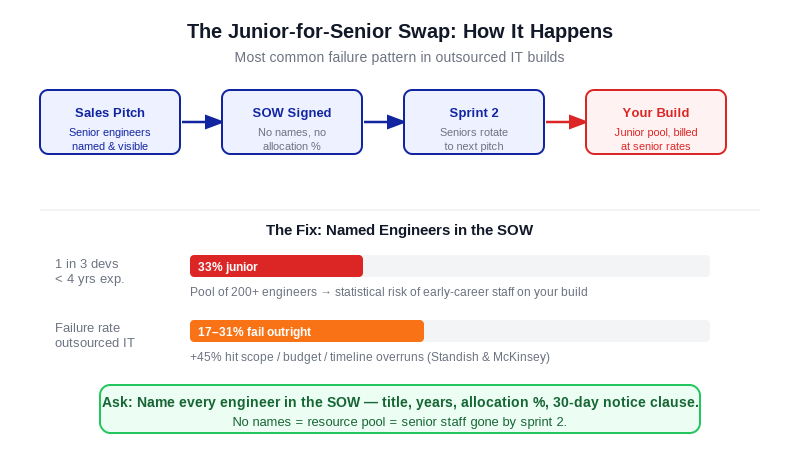

The mechanism is almost always the same. The sales engineer and delivery lead who won the pitch are senior, articulate, and know your domain. They are also booked across four other active pitches. Once the SOW is signed, they rotate off onto the next sale and your project drops into a staffing pool. If the contract does not legally pin them to your project with a notice period, nothing stops this.
And the junior-for-senior swap is a documented practice. Some offshore staffing firms bill at senior rates while placing mid-level or junior developers on the project, pocketing the margin. The Stack Overflow 2024 Developer Survey found 1 in 3 professional developers has fewer than four years of commercial experience — so in any large 'resource pool,' the statistical likelihood of early-career staff landing on your build is high.
The 16 questions to ask in the technical deep-dive
Part one: who is actually on the team
1. Can you name every engineer who will be allocated to this project, with their title, years of commercial experience, and allocation percentage, written into the SOW?
Why it matters: This is the one question that filters serious partners from staffing agencies. A real delivery team is a specific list of people. A resource pool is a pricing fiction.

Good answer: "Yes. Here is the team: Priya Sharma, Senior Full-Stack Engineer, 8 years commercial, 80% allocated; Tom Reid, Tech Lead, 11 years, 50% allocated; and so on. We'll put the names, allocations, and a 30-day notice clause for substitutions in the SOW."
Red flag: "We assemble the team once the contract is signed from our pool of 200+ engineers." Or: "We can name the tech lead but the rest will depend on availability at kick-off."
2. What is the ratio of named senior engineers to unnamed resource pool slots in this SOW?
Why it matters: This is the single most reliable predictor of how the engagement will go. A healthy ratio for a small build is at least 1:1 named-to-unnamed; for anything safety-critical or regulated, it should be fully named.
Good answer: "Four named, one junior slot we'll fill from our bench within two weeks of kick-off — and we'll share the CV before allocation."
Red flag: "One named tech lead, the rest from the pool." That is the structure that fails.
3. What percentage of the team's time is contractually guaranteed to this project, and what happens if they are pulled onto another client's escalation?
Why it matters: "Dedicated" and "allocated" mean different things. An engineer at 50% allocation is on another project the other half of the time, and that other project's fires become your delays.
Good answer: "Core team is 80%+ dedicated with a written escalation protocol — if we need to pull someone, you get 72 hours' notice and a named backfill."
Red flag: Vague language about "flexible allocation" or "shared resources for efficiency."
4. What is the average tenure of the engineers you're proposing, and what was your team attrition rate last year?
Why it matters: If the people on your project have been at the vendor for six months, they are juniors or they are a flight risk. Industry attrition in Indian IT services has run 20-25% in recent years; a vendor running at 35%+ cannot keep a team stable through a nine-month build.
Good answer: A specific number ("attrition was 14% last year, our proposed team averages 3.5 years tenure") plus a knowledge-transfer protocol for when someone does leave.
Red flag: "We don't track that" or a number above 30% with no mitigation plan.
Part two: seniority and skill mix
5. For each named engineer, what shipped production system — that I can reference-check — did they personally build or lead on?
Why it matters: A CV listing "React, Node, AWS" tells you nothing. A specific production system with a named client tells you whether they have shipped at your scale.
Good answer: "Priya led the backend rebuild for [named client's] payments service — here's the case study, and you can speak to their CTO."
Red flag: Generic skill lists, or "we can't share client names due to NDA" across the board. NDAs are real, but a healthy vendor has a mix of referenceable and confidential work.
6. Who on the proposed team has shipped a production system in our specific domain — and what did they learn from it that applies here?
Why it matters: Domain context compounds. An engineer who has shipped healthcare software knows what a DSAR workflow looks like without you explaining it. Deloitte's data identifies skill mismatch as the dominant failure cause in outsourcing — and domain mismatch is the version of this nobody catches at the proposal stage.
Good answer: A specific prior build in your sector, plus two or three concrete lessons ("we underestimated the audit log volume by 10x — we'll size for that from day one").
Red flag: "Our engineers are domain-agnostic — good architecture translates across industries." Sometimes true, usually a dodge.
7. What is the seniority pyramid — how many architects, seniors, mids, juniors — and why is that mix right for this project?
Why it matters: A build with four juniors and one tech lead will burn hours on preventable rework. A build with four architects is overpriced for most SMB work. The mix should match the risk profile.
Good answer: A specific pyramid tied to the scope ("one architect, two seniors, one mid, one junior — the junior does the admin UI work where the blast radius is small").
Red flag: An inverted pyramid heavy with juniors, or a flat team of five "senior engineers" (the title is probably inflated).
Part three: UK GDPR and data handling
8. Where will my customer data be stored and processed, and under which legal gateway does that transfer operate?
Why it matters: Article 44 of UK GDPR prohibits transferring personal data outside the UK unless there is a specific legal gateway — a UK adequacy decision for the destination country, Standard Contractual Clauses, or the International Data Transfer Agreement (IDTA). If your vendor cannot name the mechanism, they are not compliant.
Good answer: "Production data stays in a UK or EU region on your cloud account. For the dev environment, we use synthetic data. If personal data ever needs to cross to our India team, we execute the IDTA with the required Transfer Risk Assessment."
Red flag: "Our security is enterprise-grade" without naming a transfer mechanism. Or: "Data stays in our systems" with no geography specified.
9. Will you sign a UK GDPR Article 28 Data Processing Agreement before any processing begins, and can I see your template?
Why it matters: Article 28 of UK GDPR requires a written DPA with any third-party processor before processing starts. Without it, you are unlawful, regardless of the vendor's reputation. This is not optional and not negotiable. A lawyer should review the specifics of any DPA you sign.
Good answer: A template DPA sent within 24 hours, covering sub-processor consent, breach notification SLAs (72 hours), audit rights, and deletion on termination.
Red flag: "We can draft one if you need it" (they don't have one), or pushback on audit rights.
10. Who exactly — by name and location — will have access to production data, and how is that access logged and revoked?
Why it matters: The DPA defines policy. Access logs prove practice. You need to know whether an engineer in Pune who rotates off the project still has an SSH key to your database next quarter.
Good answer: Named individuals, role-based access via your IAM, session logging, quarterly access reviews, and automated revocation on project exit.
Red flag: "Our team accesses through a shared bastion" or no clear offboarding process.
11. How do you handle a UK data subject access request or a breach — what is your SLA and what will you need from me?
Why it matters: Under UK GDPR you have 72 hours to notify the ICO of a reportable breach. If your processor takes a week to tell you what happened, you have already breached your own obligations.
Good answer: "We notify you within 24 hours of detection with a written incident report, and we have a runbook for DSARs that we'll walk through with your DPO at kick-off."
Red flag: No runbook, no SLA, or a vague "we'll cooperate fully" without timings.
Part four: continuity and exit
12. What is the minimum notice period before you can rotate anyone off my team, and what is the knowledge-transfer protocol?
Why it matters: Without this clause, the vendor can swap your senior engineer for a graduate on a Monday morning, and your only recourse is to complain.
Good answer: "30 days' written notice, a named replacement with equal or greater seniority, and a two-week paired handover at our cost."
Red flag: "We reserve the right to make staffing changes as needed to deliver the project."
13. If we terminate at the end of any sprint, what exactly do I own, where does it live, and how long does handover take?
Why it matters: You need full IP ownership, code in your Git org from day one (not theirs), credentials in your vault, and a defined handover window. Anything else is lock-in.
Good answer: "You own all IP from commit one. Code is in your GitHub org. Infra is in your AWS account. On exit, we run a two-week handover to your next team or in-house hires, documented."
Red flag: Code sitting in the vendor's repos, infra on the vendor's cloud account, or handover billed as a separate project.
14. Can I speak to two clients you lost — not just two you kept — and understand why?
Why it matters: Reference calls with happy clients tell you nothing you don't already suspect. The clients who left tell you how the vendor behaves when things get hard.
Good answer: A willingness to make the introduction, and a candid explanation of why the engagement ended (scope shift, budget change, in-housing).
Red flag: "We've never lost a client" (impossible) or deflection.
Part five: how the work actually runs
15. What does a normal week look like — ceremonies, demos, written artefacts — and what does escalation look like when a sprint is at risk?
Why it matters: "Agile" means nothing. You need to know whether you'll see working software every two weeks, whether you'll get written sprint reports, and what happens when velocity drops.
Good answer: Specific cadence (Tuesday planning, Thursday demo, written Friday report), a named point of escalation on both sides, and a documented policy for scope vs. timeline tradeoffs.
Red flag: "We're flexible to your preferred way of working" (they have no system of their own).
16. What will you do in the first two weeks that proves you understood the brief — before I've paid for a full sprint?
Why it matters: A good partner can de-risk the first two weeks for you — a paid discovery, a technical spike, a working prototype of the riskiest flow. If they want full commitment before showing any work, that is a signal.
Good answer: A time-boxed, fixed-fee discovery or spike with a defined deliverable (architecture doc, clickable prototype, risk register) that you own regardless of whether you continue.
Red flag: "We need the full engagement signed to allocate the team properly."
What good answers look like, in aggregate
A vendor who passes this interview is not necessarily the cheapest or the fastest. They are the one whose SOW reads like a contract between adults: named people, defined allocations, written notice periods, a signed DPA, clear IP ownership, and a two-week proof-of-work before you commit. That shape of proposal costs more upfront to produce, which is why staffing-pool vendors avoid it.
The UK IT outsourcing market hit $39.99 billion in 2024 and is growing at 9.53% annually — there is no shortage of vendors chasing your signature. The scarcity is partners willing to commit to specifics in writing.
How CodeNicely can help
If you are a UK SMB evaluating offshore partners, the engagement that most closely parallels your position is probably GimBooks — a YC-backed fintech where we built accounting SaaS for small businesses under the kind of data-handling scrutiny that regulated finance demands. The team composition was fixed in the SOW, the IP sat in the client's org from day one, and the same core engineers stayed on the product across multiple release cycles. For healthcare-adjacent builds with stricter PII obligations, HealthPotli is the more relevant reference — the e-pharmacy build involved PHI-equivalent data handling and an AI drug-interaction layer that required named clinical reviewers in the loop.
Our standard SOW names every engineer, writes in a 30-day substitution notice, and includes an Article 28 DPA with IDTA addendum where India-based team members process UK personal data. We are happy to send the template DPA for your legal team to review before any commercial conversation. See how we structure engagements or go deeper on the SMB transformation work.
Frequently Asked Questions
How do I verify an offshore vendor's UK GDPR compliance before signing?
Ask for three documents: their standard Article 28 Data Processing Agreement, their International Data Transfer Agreement (IDTA) or SCC template, and a recent Transfer Risk Assessment they have conducted for a UK client. A compliant vendor can produce all three within a working day. Have your DPO or a data protection lawyer review the specifics before you sign — this post is not legal advice.
What should I expect to pay for a software build with a UK-facing offshore partner?
The honest answer is that the range is wide because the drivers are specific to your scope: number of integrations, whether you have existing data to migrate, the regulatory surface (FCA, ICO, clinical), the seniority mix you need, and whether you want fully dedicated or partially allocated engineers. A five-person team of named mid-to-senior engineers for six months sits in a very different bracket than a twelve-person squad with architects and compliance oversight. The three specifics that turn a range into a real quote are: the scope document, the data-handling profile, and your timeline flexibility. A scoping conversation with any shortlisted partner should produce a defensible number within two weeks.
Is it cheaper to hire a UK-based dev shop instead of going offshore to avoid these team questions?
Not usually, and not for the reason people think. UK-based shops face the same resource-pool and junior-swap patterns — 81% of UK businesses report talent shortages, which pushes smaller UK agencies to over-promise seniority. The questions in this post apply identically to UK shops. The real variable is contract specificity, not geography.
What is a 'resource pool' clause and how do I spot it in an SOW?
It is any language that lets the vendor allocate or substitute staff "as required to deliver the project" without named notice periods or seniority guarantees. Search the SOW for the words "pool," "bench," "flexible allocation," "as needed," and "appropriate resources." Each is a hinge that lets the vendor swap people after you have signed. Replace them with named engineers, allocation percentages, and a written notice-and-backfill protocol.
How long does the vendor selection and contracting process typically take?
From shortlist to signed SOW usually runs four to eight weeks for a project of meaningful size — longer if your legal team needs to negotiate the DPA, shorter if the vendor has UK-ready templates. The two phases that compress or expand this are the technical deep-dive (one to two weeks of calls like the one this post prepares you for) and legal review of the DPA and IP clauses (two to four weeks with a specialist data protection lawyer). Rushing either phase is where most of the downstream delivery pain originates.
Sources & further reading
- UK Software Development Offshoring Trends 2024: £40B Market Growth — Khiliad
- Global Offshore Software Development Market — UK Segment, Verified Market Reports
- Software Outsourcing Challenges: Common Pitfalls and How to Avoid Them (citing Deloitte 2024 Global Outsourcing Survey) — Milo Solutions
- Why Outsourcing Fails: Skill Mismatch Data (referencing Deloitte 2024 Global Outsourcing Survey) — DEV Community
- 7 Pitfalls of Outsourcing (citing Deloitte Global Outsourcing Survey & McKinsey) — Devico
- In-House vs Outsourced Software Development 2026 (citing Standish/McKinsey failure rates) — Smicolon
- UK Government Procurement Policy Note 03/22: Guidance on Data Protection Legislation (Article 44 UK GDPR offshore prohibition)
- UK Data Processing Agreement: Article 28 UK GDPR Guide — TrustYourWebsite
Get one practical guide a week
Costs, AI tools, partner selection — written for people who make the decision. No spam, unsubscribe anytime.
Thanks — you're on the list. One practical guide a week, nothing else.
That didn't work — please check the email address and try again.
Building something in Software & Technology?
CodeNicely partners with founders and tech teams to ship AI-native products that move metrics. Tell us about the problem you're solving.
Talk to our team Book a 30-min call