
What a Modernization Programme Actually Returns — and When

 Published by CodeNicely, the product studio founded by Meghal Agrawal and Ujjwal Agrawal in 2017
For: A seed-to-Series-A founder in Dubai whose 18-month-old custom build is already creating bottlenecks, who needs to justify a AED 400–800K modernization spend to a co-founder or lead investor who will ask 'what does this return and by when?'
In this guide
- Start with the cost of doing nothing, in CFO units
- The three returns your business case actually rests on
- Sequencing: strangler-fig vs big-bang
- What the business has to supply
- Phasing the spend so increment one funds increment two
- What the range of a modernization budget actually depends on
- The argument to take into the meeting
- Frequently Asked Questions
A modernization programme returns in three forms your CFO already accepts on other line items: revenue capacity the current system is blocking, headcount cost the workarounds are absorbing, and audit or fundraising risk you can close before it becomes a markdown. The first increment almost never pays back in cost savings. It pays back by unblocking one specific event — a DIFC-compliant enterprise contract, a Series A data room, a PCI audit — and that event's AED value is the number your ROI case anchors to. Not engineering hours. Not deploy frequency. The event.
If you are a Dubai founder staring at an 18-month-old custom build that is already slowing you down, the mistake to avoid is pitching your co-founder or lead investor on "faster deploys" and "cleaner APIs." Those are outputs. A CFO funds outcomes. This piece gives you the argument to take into the meeting.
Start with the cost of doing nothing, in CFO units
Before you cost the rebuild, cost the status quo. Do-nothing is never zero, and quantifying it is where most founders undersell their case.
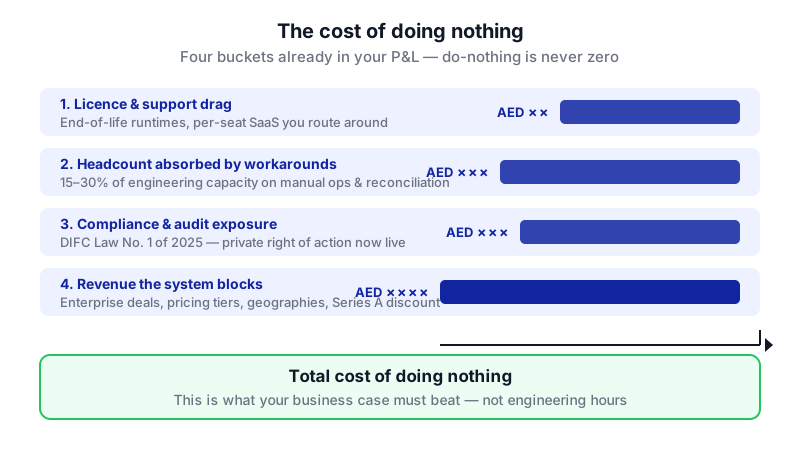
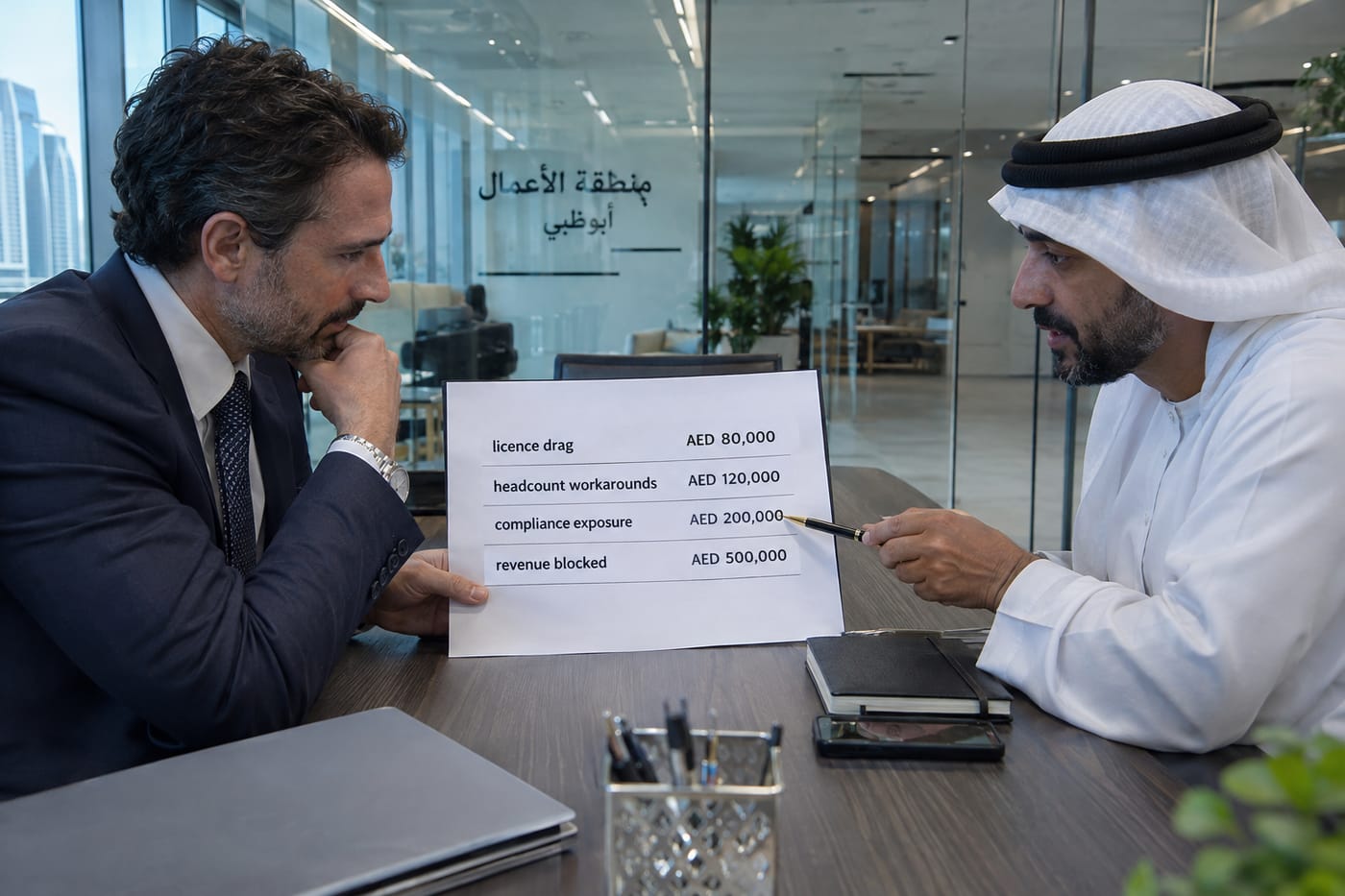
There are four buckets a UAE CFO will recognise without translation.
1. Support and licence drag you are already paying
Unsupported runtimes, end-of-life database versions, per-seat SaaS the team routes around — these are already in your P&L. Pull the last twelve months of invoices for anything the modernization would retire or consolidate. This is the easiest number to defend because it is historical fact.
2. Headcount absorbed by workarounds
This is the one founders consistently underestimate. Count the hours engineering spends on manual deploys, data reconciliation scripts, support tickets caused by the monolith, and "please export this for finance" requests. Then count the ops and finance hours spent on spreadsheet workarounds the system should be doing natively. Multiply by fully-loaded cost. In most 18-month-old builds I have seen diagnosed, this is 15–30% of engineering capacity and a similar slice of ops.
McKinsey's survey of 50 CIOs found technical debt consumes 10–20% of the budget earmarked for new products — money that was supposed to build the next thing is instead servicing the last thing (McKinsey, via TechnologyMatch). That is the number to put next to your roadmap slide.
3. The compliance and audit exposure
This is where the UAE context changes the maths. DIFC Law No. 1 of 2025, in force since 15 July 2025, gave data subjects a private right of action — they can now claim compensation directly in DIFC Courts — and expanded extraterritorial scope to non-DIFC entities processing data inside the Centre through "stable arrangements" (DIFC Data Protection Law 2025 Amendments).
More consequentially for anyone with a monolithic architecture: transfers of data from DIFC or ADGM to mainland UAE are treated as cross-border transfers, because mainland UAE does not appear on either zone's adequacy list (UAE Data Residency Laws: Cloud Compliance Guide). If your database sits in one region and serves customers in the other through the same schema, you are structurally non-compliant. A single enterprise customer with a DIFC-registered legal entity can turn that into a stopped deal.
A lawyer should review your specifics — this is not legal advice — but the CFO-facing version of the question is simple: what is the AED value of the next contract, audit, or funding round that this architecture will fail?
4. Revenue the system blocks
This is the biggest number and the one you build the business case on. Concretely:
- Enterprise contracts you cannot sign because you cannot evidence data residency, SSO, audit logs, or role-based access.
- Pricing tiers you cannot ship because the billing model is hard-coded.
- Geographies you cannot enter because the stack cannot be deployed into a second region.
- Series A diligence findings that will come back as a valuation discount or a remediation condition.
That last point is not theoretical any more. UAE investor due diligence now examines whether technology architecture incorporates regulatory requirements including audit trails and data localisation, and technology misaligned with regulatory expectations "may require costly remediation following investment" (SupportLegal, 2025). MENA Series A and B funding doubled year-on-year to a record $1.6B in 2025, and 68% of Series A capital came from international investors — up from 56% the year before (MAGNiTT FY2025, via Key Capital). The diligence bar is now set by global funds, not regional ones. They have seen the architecture pattern you are hoping to explain away.
The three returns your business case actually rests on
Reduce the pitch to three line items. Every modernization ROI I have seen approved in Dubai has been built on some combination of these.
Return 1: Recovered revenue capacity
Pick one specific revenue event the current architecture blocks. Not a category — one deal, one tier, one geography. Put its AED value on the slide. This is your anchor number.
Example framing (illustrative, your numbers will differ): "We have AED 2.4M in pipeline from three DIFC-registered enterprise customers who have asked for data-residency evidence we cannot currently provide. The first increment of the modernization — separating the DIFC tenant and introducing an audit log layer — unblocks that pipeline."
That is a sentence a CFO funds. "Cleaner microservices" is not.
Return 2: Headcount cost avoided
This is the operational saving. Take the engineering and ops hours currently absorbed by workarounds, apply a realistic post-modernization reduction (usually 40–70% for the specific workflows being modernized, not across the board), and annualise. Be honest about what does not go away — you still need people to run the new system.
Microsoft-commissioned Forrester research on Azure PaaS modernization reported 50% faster application development and a 15-month payback period for the composite customer studied (Legacy System Modernization Statistics, DreamFactory). Those are useful benchmarks for calibrating expectations but they are not promises — your gain depends on how much of your team's time is actually trapped in the legacy workflow, and benchmark figures should be treated as benchmarks, not forecasts.
Return 3: Audit and fundraising risk eliminated
This one is harder to put a single number on, so put a range and a probability on it. If your next round is 12 months out at a target of AED X, and architecture remediation is a realistic diligence finding, the expected cost is (probability of finding) × (likely valuation impact or remediation cost). Investors will recognise this framing because it is how they think about every other risk in the deck.
Kyndryl's 2025 mainframe modernization survey reported ROI of 288% for in-place modernization and 362% for migrating off legacy platforms, with incremental programmes showing 6–18 month payback (via DreamFactory). Enterprise benchmarks, not startup benchmarks — but the shape of the return (first increment pays for the next) holds at smaller scales too.
Sequencing: strangler-fig vs big-bang
Two realistic options. They have very different risk profiles and your CFO will want to see you have picked the right one for the situation, not the one the vendor prefers.
Strangler-fig (incremental)
You wrap the legacy system with an API layer, carve out one bounded context at a time (billing, auth, the DIFC tenant, the reporting pipeline), route traffic to the new service, and retire the old code path. Repeat.
Good at: cash flow management (each increment is independently funded and justified), reversibility (a failed increment does not take the business down), and letting you ship the revenue-unblocking increment first.
Bad at: speed to a fully modern stack (you will run both systems in parallel for 12–24 months), and it demands discipline — teams that cannot resist "just one more feature on the old system" end up with three systems instead of one.
Big-bang rebuild
You freeze the legacy system, build the replacement in parallel, cut over.
Good at: getting to a clean architecture fast, avoiding the parallel-run overhead, and sometimes the only option when the legacy stack genuinely cannot be wrapped (unsupported runtime, no API surface, encrypted vendor binary).
Bad at: almost everything else. Cutover risk is concentrated into one weekend. The business case has to carry the entire spend before any return lands. And the "we'll cut over in Q3" date slips, in my experience, 80% of the time by at least a quarter.
For an 18-month-old custom build with a working customer base, strangler-fig is almost always the right call. The exception is when the first increment's revenue event is so large and so time-bound — a signed enterprise LOI with a 90-day compliance deadline, for instance — that you are better off rebuilding the specific slice end-to-end and worrying about the rest later.
What the business has to supply
Modernization programmes fail on the business side more often than the engineering side. The CFO will want to know what you are committing beyond budget.
- A product owner with decision rights. Not a committee. Someone who can say "this edge case is not in scope" without a three-week escalation.
- Access to the people who actually use the workarounds. Finance, ops, support. Their undocumented knowledge is half the requirements doc.
- A frozen scope for increment one. The single most common cause of a blown modernization timeline is the business treating the rebuild as a chance to add features. Pick the revenue event. Rebuild to unblock it. Add features after.
- Data you can actually migrate. If the legacy database has ten years of inconsistent schemas, someone on the business side has to decide what gets cleaned, what gets archived, and what gets dropped. Engineering cannot make those calls alone.
- A compliance owner. For DIFC, ADGM, or PCI scope decisions, someone needs to own the answer and brief the lawyers.
Phasing the spend so increment one funds increment two
This is the structural trick that makes the business case defensible.
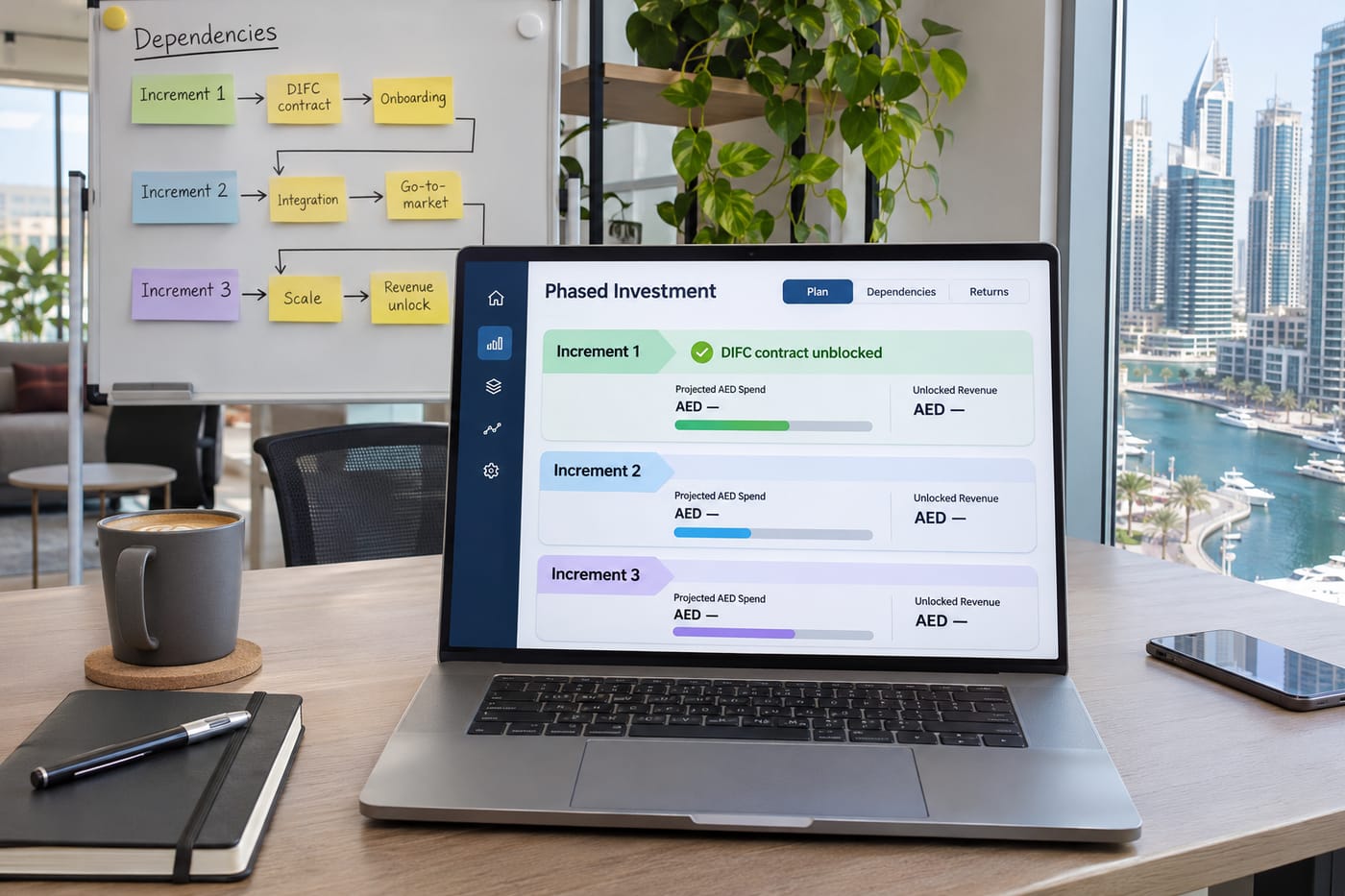
Phase the programme so the first increment targets the single highest-value revenue event, lands within a payback window the CFO can live with, and generates enough recovered revenue or avoided cost to fund the second increment from operating cash rather than a new budget request.
Illustrative sequencing — assumptions stated, your situation will differ:
- Increment 1 (the revenue unblocker): the specific architectural change that unlocks the named contract or deal pipeline. Scope: one bounded context, one compliance boundary, one data-residency fix. Business case anchored to the AED value of the unblocked revenue.
- Increment 2 (the cost-out): funded from increment 1's return. Targets the workflows absorbing the most headcount. Business case anchored to annualised cost avoided.
- Increment 3 (the diligence-ready layer): audit logs, SSO, role-based access, observability. Business case anchored to the next funding round's diligence requirements.
The sequence matters. If you do the diligence-ready layer first because it feels most urgent, you spend the budget without unblocking the revenue that funds the rest. The CFO will approve the first increment on its own merits and the subsequent increments on the strength of the first one's results. That is a much easier conversation than asking for the whole programme upfront.
What the range of a modernization budget actually depends on
Budget ranges you see quoted for UAE modernization programmes vary by an order of magnitude for good reasons. The drivers, roughly in order of impact:
- How many bounded contexts you are modernizing. One tenant isolation is not the same as rebuilding billing, auth, and the reporting pipeline.
- Data migration complexity. Clean schemas and good test coverage shrink the number. Ten years of accreted edge cases expand it, sometimes doubling the engineering time.
- Compliance scope. DIFC plus mainland plus a KSA expansion is a different programme from DIFC alone.
- Integration surface. Every third-party system the legacy touches — payment gateway, KYC provider, ERP, CRM — is a mini-project.
- Whether you keep running the legacy in parallel. Parallel operation is safer and more expensive.
The three specifics that turn a range into a real quote: the exact scope of increment one (which bounded context, which compliance boundary), the state of the data you need to migrate, and the integrations that have to come with it. Any team quoting without those three answered is either guessing or padding. If you want that conversation scoped properly, that is where a Dubai-based modernization partner earns its fee — in the diagnosis, not the pitch deck.
The argument to take into the meeting
Compress the whole case to one slide:
- Cost of doing nothing: support drag + headcount absorbed + compliance exposure + named blocked revenue. One number, four components.
- The anchor event: the single revenue or funding event increment one unblocks, with its AED value.
- Payback window for increment one: expressed as a range, with the two variables that will move it.
- Phased spend: increment one funded from budget, increments two and three funded from increment one's return.
- Risk if deferred: the specific contract, audit, or round that gets harder each quarter you wait.
That is the argument. It is not "we need to modernize." It is "here is a specific AED number we are leaving on the table, here is what the first increment costs to recover it, and here is how the rest of the programme pays for itself." A CFO or a lead investor will fund that. They will not fund "cleaner APIs."
Frequently Asked Questions
How do I calculate modernization ROI for a UAE startup specifically?
Anchor to three measurable returns: recovered revenue capacity (the AED value of deals or tiers the current architecture blocks), headcount cost avoided (engineering and ops hours absorbed by workarounds, times fully-loaded cost), and audit or fundraising risk eliminated (expected cost of a diligence finding, weighted by probability). The UAE-specific wrinkle is that DIFC and ADGM data residency rules can turn an architectural issue into a stopped enterprise deal, so compliance exposure often becomes the largest single line.
What is a realistic payback period for a legacy system replacement?
Enterprise benchmarks from Kyndryl's 2025 survey report 6–18 months for incremental modernization programmes, and a Forrester study of Azure PaaS modernization found a 15-month payback for its composite customer. Startup payback can be faster when the first increment is scoped tightly to a named revenue event, or much slower when the programme is sequenced around engineering preference rather than business outcomes. The main drivers are how specific the first increment's revenue anchor is and how disciplined the business is about freezing scope.
Should I do a strangler-fig migration or a full rebuild?
Strangler-fig is the right default for an 18-month-old working build with real customers, because each increment is independently funded and reversible. A full rebuild is only worth the concentrated risk when the legacy stack genuinely cannot be wrapped, or when a single time-bound revenue event (signed LOI with a 90-day compliance deadline) makes end-to-end rebuild of one slice faster than wrapping and carving. The vendor who recommends big-bang without asking what your first revenue event is has not done the work.
How do I know if my current architecture will fail Series A due diligence in the UAE?
The architecture-level questions UAE investors now ask include whether you can evidence data residency for DIFC or ADGM customers, whether audit trails exist at the record level, whether access controls are role-based and reviewable, and whether tenant data is logically separated. With 68% of 2025 Series A capital in MENA coming from international investors, the diligence standard is global. A tech due diligence pre-mortem — done by someone other than your current build team — before you open the round is the cheapest version of this question to answer.
What does a modernization budget actually depend on?
The biggest drivers are the number of bounded contexts in scope, data migration complexity, compliance footprint (DIFC, ADGM, mainland, cross-border), integration surface with third-party systems, and whether you run the legacy in parallel during cutover. Ranges you see quoted vary by an order of magnitude because those variables do. Turning a range into a real quote requires three specifics: the exact scope of increment one, the state of the data to be migrated, and the integrations in scope — without those, any number is a guess.
Sources & further reading
- Tech Debt: Reclaiming Tech Equity — McKinsey (via TechnologyMatch summary)
- UAE Data Residency Requirements 2026: Laws and Sector Rules
- DIFC Data Protection Law Compliance — 2025 Amendments Explained
- UAE Data Residency Laws: Cloud Compliance Guide (DIFC cross-border transfer rule)
- Tech Due Diligence: What UAE Investors Expect from Startups
- MENA's Global Investors — MAGNiTT FY2025 Series A/B data (Key Capital)
- MENA's Startup Ecosystems Become Market of Capability — Startup Genome 2026
- 51 Legacy System Modernization Statistics (2026) — DreamFactory
Get one practical guide a week
Costs, AI tools, partner selection — written for people who make the decision. No spam, unsubscribe anytime.
Thanks — you're on the list. One practical guide a week, nothing else.
That didn't work — please check the email address and try again.
Building something in Software & Technology?
CodeNicely partners with founders and tech teams to ship AI-native products that move metrics. Tell us about the problem you're solving.
Talk to our team Book a 30-min call