

Legacy System Replacement: Pricing the Compliance Retrofit

 Published by CodeNicely, the product studio founded by Meghal Agrawal and Ujjwal Agrawal in 2017
For: A Series A-stage UAE founder whose legacy SaaS platform passed early-stage audits but is now facing a DIFC PDPL or CBUAE remediation letter that the existing codebase cannot satisfy without a structural rebuild
In this guide
- Why the retrofit is almost never just a retrofit
- The honest shape of the number
- Cost drivers, in order of impact
- An illustrative worked example
- What pushes the number up vs. pulls it down
- Why vendors keep quoting the full replacement number
- The broader legacy debt sitting underneath
- The three questions that turn a range into a quote
- Frequently Asked Questions
If you have a remediation letter on your desk, here is the honest answer: the retrofit-versus-replacement decision is not driven by how large your platform is. It is driven by whether your original data schema was designed with a consent object and an immutable audit log, or whether those were assumed to be application-layer concerns. If your schema is consent-aware, you are usually looking at a bounded retrofit in the low six figures AED. If it is not — and almost no pre-Series A UAE SaaS schema is — you are looking at a structural rebuild of the data layer, and every vendor instinct to re-scope the whole application is correct, even if annoying.
This post breaks down what actually sits inside that range, why vendors keep quoting you the full replacement number, and the three questions that let you convert a range into a real quote.
Why the retrofit is almost never just a retrofit
The specific clauses driving most 2025 UAE remediation letters are narrow and technical. CBUAE's Open Finance framework requires "comprehensive audit trails for SupTech supervision" — meaning every consent grant, modification, revocation, and data access event must be captured in a cryptographically verified log. CBUAE Article 22 defines 15+ mandatory fields per consent object and caps consent duration at 12 months per grant. DIFC Data Protection Law No. 5 of 2020, as amended in July 2025, now lets data subjects sue directly in DIFC Courts and carries administrative fines of USD 10,000–100,000 per violation, aggregable.
Read those together and a pattern emerges. None of them are UI requirements. None are policy-document requirements. They are all claims about the shape of your data at rest and the shape of your write path. You cannot satisfy them with a middleware layer that intercepts API calls, because the audit mandate requires the log entry to be causally linked to the state change — which means the log has to live next to, or inside, the transaction that produced it.
This is why vendors scope the whole project. Not because they are padding. Because the minute they look at your schema, they find user records with no consent foreign key, transaction tables with no append-only mirror, and encryption applied at the disk level rather than the field level. Each of those is a structural decision made at day one of the platform. Undoing them touches every service that reads or writes those tables.
The honest shape of the number
A UAE compliance retrofit on a Series A SaaS platform usually falls into one of three bands. These are shapes, not quotes — your situation will sit somewhere inside them based on the drivers in the next section.
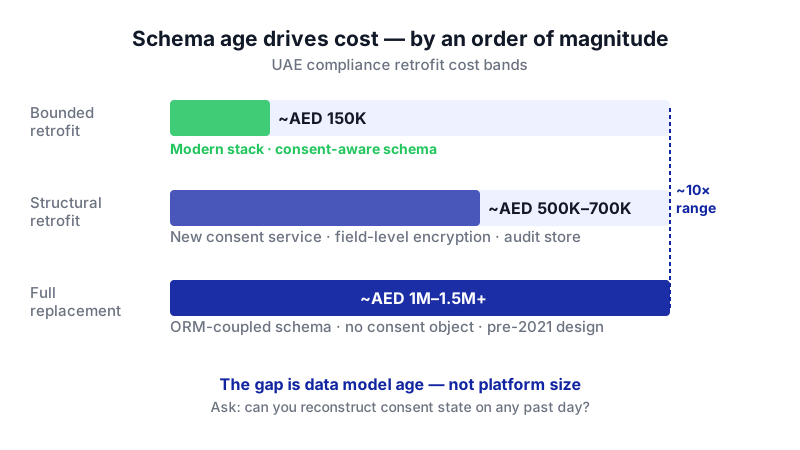
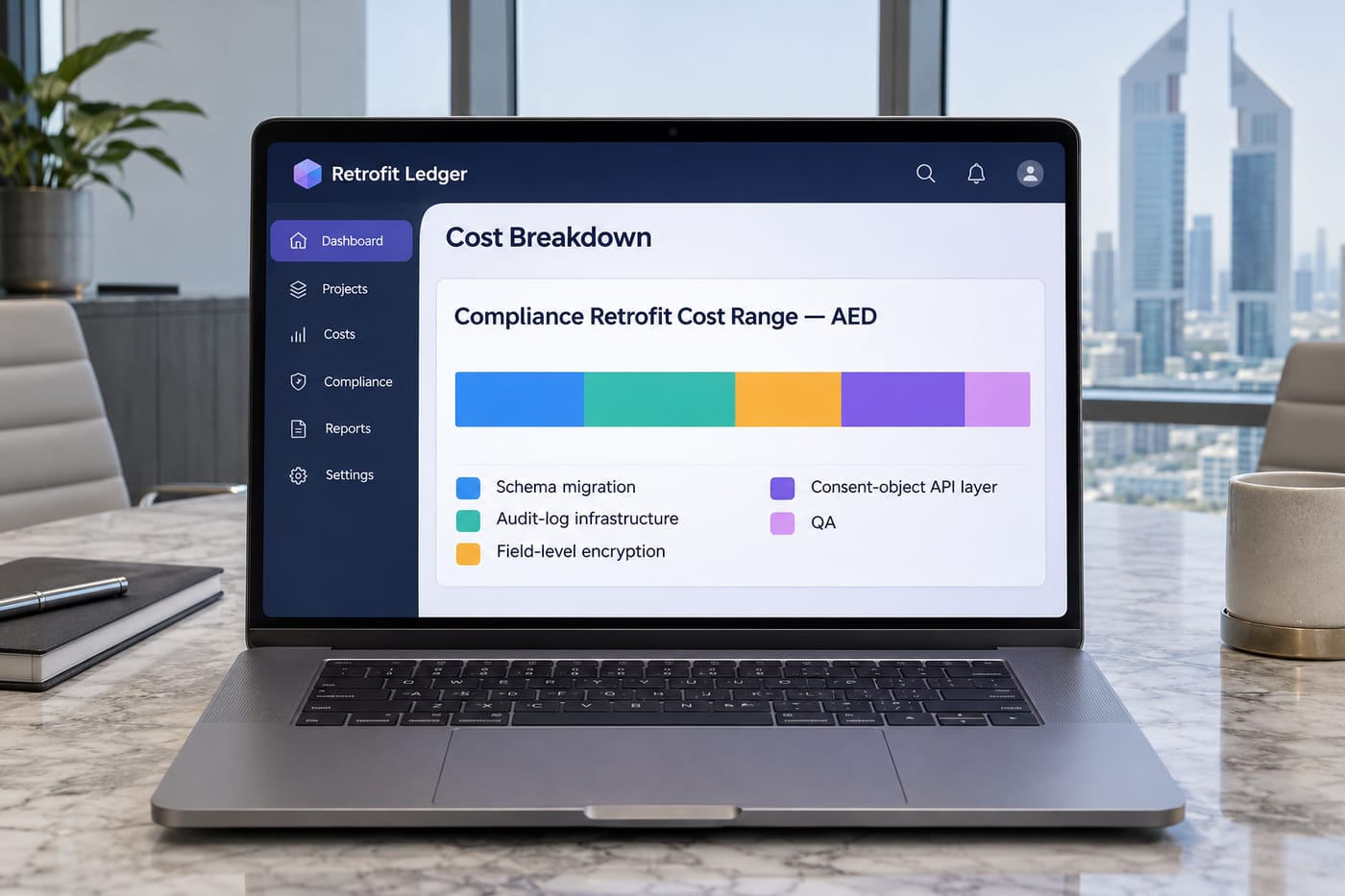
- Bounded retrofit (low end). The platform was built in the last three years on a modern stack, the data model already separates identity from profile data, and the audit requirement can be satisfied by adding an event-sourced log alongside existing tables. Scope is measured in weeks, not months. This is the AED 150K story the founder in the brief above was hoping for. It is real, and it is rare.
- Structural retrofit (middle). The platform needs a new consent-capture service, field-level encryption applied to PII columns, and an append-only audit store — but the core application logic can stay. Most of the work is a data-layer rewrite plus migration. This is where a majority of 2020–2022-vintage UAE SaaS platforms land once a proper gap analysis is done.
- Full replacement (high end). The schema was designed before PDPL enforcement was on anyone's radar, the ORM is tightly coupled to the application code, and attempting a retrofit means touching every service anyway. At this point rebuilding on a compliance-native architecture is usually faster and lower-risk than the retrofit. Vendors who quote you this number are often right, even when it feels like overreach.
The gap between the low and high end is roughly an order of magnitude. That is not vendor inconsistency. It is a real signal about the age of your data model.
Cost drivers, in order of impact
1. Age and shape of the data model
This is the single biggest driver and the one buyers consistently underweight. A schema designed before 2021 almost certainly treats consent as a boolean on a user record rather than a first-class object with history. The CBUAE Article 22 requirement for 15+ consent fields per grant, with a 12-month expiry and per-access logging, is incompatible with that design. You are not adding a column. You are introducing a new aggregate root and migrating every piece of code that reads user consent.
Ask your CTO one question: "If a user revoked consent 40 days ago and then granted it again 10 days ago, can we reconstruct exactly what data was accessible to which third party on day 25?" If the answer is no, you are not in the retrofit band.
2. Which regulator sent the letter
DIFC PDPL remediation is usually narrower than CBUAE Open Finance remediation. PDPL remediation focuses on consent capture, data subject rights (access, rectification, erasure), cross-border transfer controls, and breach notification. Most of that can be addressed with a consent service, a rights-request workflow, and improvements to logging.
CBUAE Open Finance remediation is a bigger surface because it adds mandatory API conformance to Open Finance Standards v1.2, SupTech-grade audit trails, and consent management under Article 22. If your letter cites Open Finance, you are closer to the structural retrofit band by default.
3. Encryption posture
Disk-level encryption (what most cloud providers give you by default) does not satisfy the PDPL expectation for sensitive data at rest. You will likely need envelope encryption with per-tenant or per-record keys, managed through a KMS, with key rotation and access logging. Retrofitting this requires touching every read and write path for the protected fields. The cost scales with the number of distinct services that touch PII, not with user count.
4. Integrations and third-party data flows
Every integration that sends or receives personal data becomes a consent-check surface. Payment processors, KYC vendors, analytics, support tools, marketing automation — each needs to be tied to a specific consent purpose and logged at the point of data egress. A platform with four integrations is a different project than one with twenty.
5. Data migration load
You cannot retrofit the consent model without back-populating consent records for existing users. Depending on how clean your existing consent evidence is (signup logs, cookie banner records, ToS acceptance timestamps), this ranges from a batch script to a user-facing re-consent flow with careful UX to avoid churning your existing base.
6. Who runs the gap analysis
If the remediation letter came with a specific gap report from a DIFC-approved auditor or a CBUAE examination, the scope is largely defined and the vendor's job is execution. If you are starting from a general "your platform is non-compliant" letter, you are paying for a proper technical gap analysis first — usually four to six weeks — before anyone can give you a credible remediation number.
7. How much of the current platform has to keep running
The cheapest path is often a strangler pattern: stand up the compliant services alongside the existing platform, route traffic through a new consent-aware gateway, and migrate functionality piece by piece. This keeps revenue flowing but roughly doubles the surface area during transition. The alternative — a cutover — is riskier but structurally simpler. The decision here is usually driven by whether your enterprise customers will tolerate a maintenance window.
An illustrative worked example
To make the model concrete — this is illustrative, not a quote, and every assumption is on the table:
Scenario. A 2021-vintage B2B fintech SaaS, Series A, serving UAE SMEs, received a DIFC PDPL remediation letter citing missing consent-capture architecture, inadequate audit trails, and unencrypted PII at rest. Not yet CBUAE Open Finance regulated but likely to be within 18 months.
Assumptions. Monolithic Node.js + PostgreSQL application, roughly 180K lines of code, six third-party integrations, 12,000 active users, no existing consent service, consent captured as a timestamp on signup only, disk-level encryption only, audit logging is application-level console logs flushed to S3.
Scope. A new consent service as a separate bounded context, event-sourced audit store, field-level encryption on 14 PII columns across four tables with KMS-managed keys, a data subject rights workflow (access, rectification, erasure, portability), re-consent UX for existing users, and integration-level consent enforcement for all six third parties. Keep the existing platform running throughout.
Timeline shape. Gap analysis and architecture sign-off in the first four to six weeks. Consent service and audit store in parallel over the following eight to twelve weeks. Encryption migration — which is the risky part because of the data rewrite — over six to eight weeks with careful staging. Rights workflow and integration work overlapping. Realistically, a sequenced plan where the regulator-facing deliverables land in staged milestones over four to seven months, not a single big-bang release.
Band. This scenario sits in the middle band — structural retrofit, not full replacement — because the application logic is salvageable even though the data layer is not. The decisive factors were that the ORM allowed field-level interception and that the integrations were already abstracted behind a service layer.
What pushes the number up vs. pulls it down

| Pushes it up | Pulls it down |
|---|---|
| Schema older than 2021 with consent as a boolean | Schema already uses a consent aggregate or event-sourced patterns |
| CBUAE Open Finance scope (API conformance + Article 22) | DIFC PDPL scope only |
| Tightly coupled monolith with no service boundaries around PII | Service-oriented or modular monolith with clean PII boundaries |
| More than ~10 integrations touching personal data | Small, well-documented integration surface |
| Existing users cannot be forced through a re-consent flow | Clean existing consent evidence, or acceptable to re-consent |
| Must keep legacy running in parallel for enterprise SLAs | Cutover window available |
| No existing gap report — scoping starts from zero | Auditor or regulator delivered a specific findings list |
| Multiple regulators in scope (DIFC + CBUAE + federal PDPL) | Single regulator, single jurisdiction |
Why vendors keep quoting the full replacement number
Three reasons, and only one of them is self-interest.
First, the technical reason above: in most 2020–2022 UAE SaaS codebases, the retrofit genuinely does touch everything. A vendor who scopes just the "compliance surface" and then discovers mid-project that the ORM cannot support field-level encryption without a rewrite is in a worse position than one who scoped the rewrite up front.
Second, the risk-pricing reason. UAE federal PDPL fines reach AED 5 million per violation and DIFC's 2025 amendment added a private right of action. A vendor delivering a retrofit is implicitly standing behind the sufficiency of that retrofit against a regulator. The scope expands because the risk is uncapped.
Third, legitimate commercial instinct. If the realistic path is a structural rebuild, quoting a cheap retrofit wins the deal and loses the project. Most vendors have been burned by this once and will not do it again.
The way through this is not to find a vendor who will quote lower. It is to arrive at the briefing with a clear gap report, a defensible scope boundary, and a view on which band you are actually in. A short, independently run technical gap analysis — distinct from the remediation delivery — is usually the highest-leverage spend you can make at this stage.
The broader legacy debt sitting underneath
One uncomfortable thing worth naming. McKinsey estimates technical debt consumes 40–50% of total tech estate value and adds 10–20% to every new project running on a legacy stack. Gartner finds companies on legacy systems are 40% more likely to fail compliance audits, and that 60–80% of IT budgets go to legacy maintenance, with most organisations undercounting true legacy costs by 40–60%.
The retrofit-vs-replacement question is itself a signal. If you are asking it under regulatory pressure now, you will be asking a version of it under growth pressure in 18 months — when your next enterprise customer demands SOC 2 Type II, or when you want to add an AI-driven feature and the data model cannot support feature extraction. Founders who treat the compliance retrofit as a chance to address the structural layer tend to spend more now and much less over the next two years. Founders who treat it as a line item to minimise tend to pay the cost twice.
This does not mean you should rebuild everything. It means the scope boundary should be drawn with the next two years in mind, not just the remediation letter. For context on what a staged modernisation looks like in practice, our digital transformation and UAE software development pages walk through the sequencing we see work.
The three questions that turn a range into a quote
Before you can get a credible number from any vendor, you need defensible answers to these:
- What exactly did the regulator cite? A specific gap report with clause references (DIFC PDPL Article X, CBUAE Open Finance Section Y) scopes the project. A general "you are non-compliant" letter means you are paying for a gap analysis first. Get the specific findings in writing from your auditor or regulator before briefing vendors.
- What does your current data model actually look like? Specifically: is consent a first-class object with history, is PII isolated behind service boundaries, and is there an append-only store anywhere in the architecture? If your CTO cannot answer these in one meeting, the first deliverable is a technical architecture review — not a remediation plan.
- What is your tolerance for parallel operation vs. cutover? This single decision changes the shape of the project more than any other scope choice. It is driven by your enterprise contracts, your regulatory deadline, and your appetite for release risk. Decide it before you brief vendors, because it fundamentally changes how they architect the solution.
With those three answered, a vendor can give you a real number in weeks. Without them, every quote you receive will default to the full-replacement band, because that is the only scope a careful vendor can stand behind without more information.
Frequently Asked Questions
Can we just get a legal opinion that our current system is compliant and skip the rebuild?
No, and a lawyer will tell you the same. DIFC PDPL and CBUAE Open Finance both include technical conformance requirements — audit trail structure, consent object fields, encryption at rest — that are matters of fact about your codebase, not matters of interpretation. A legal opinion can clarify scope but cannot substitute for the technical remediation. You should absolutely have a UAE data protection lawyer review the remediation letter and the final scope, but the engineering work is unavoidable.
How long does a compliance retrofit typically take end-to-end?
The timeline shape is driven by the same factors as cost: schema age, regulator scope, and parallel-operation requirements. A bounded retrofit on a modern stack can land in two to three months. A structural retrofit with a data-layer rewrite and staged migration realistically runs four to seven months with a competent team working in parallel streams. A full replacement is usually a 9–14 month program. The variables that most move the number are whether you have a specific gap report in hand on day one, and whether you can force existing users through a re-consent flow or need to build around them.
Should we wait for full UAE federal PDPL enforcement before spending on this?
If you are already DIFC-licensed or CBUAE-regulated, no — those regimes are already enforcing. If you are only subject to the federal PDPL and have not received a letter, you have more time, but full enforcement is expected by January 1, 2027 with fines up to AED 5 million per violation. The practical argument against waiting is that the structural work (consent service, audit store, field-level encryption) is the same regardless of which regulator enforces first, and the engineering talent to do it well is scarce.
Can we do the retrofit in-house instead of hiring a vendor?
You can, and some teams should. The question is whether your engineers have shipped a consent-aware data layer before, specifically against DIFC PDPL or CBUAE Open Finance requirements. The technical patterns (event sourcing, envelope encryption, consent aggregates) are well understood in principle but have UAE-specific interpretation points — particularly Article 22's consent field list and the SupTech audit trail format. In-house teams who have not done this before typically take 1.5–2x longer than vendors who have, which is fine if you have the runway and are optimising for institutional knowledge.
What happens if we ignore the remediation letter?
This is a question for a UAE-qualified lawyer, not a technology blog, and you should get that advice immediately. In general terms, DIFC's 2025 amendment added a private right of action and fines per violation can be aggregated; CBUAE non-compliance can affect licensing. The founder-level risk is that a remediation letter not responded to escalates from administrative to enforcement, and from there into customer-visible incidents that are harder to recover from than the engineering cost of fixing the underlying issue.
Sources & further reading
- CBUAE Open Finance Regulation — Clifford Chance Q&A (April 2024)
- CBUAE Open Finance Standards v1.2 — Ozone API Tracker
- The Developer's Guide to CBUAE Open Finance Compliance 2026 — KhaleejAPI
- CBUAE Open Finance Regulation — Official CBUAE Rulebook
- CBUAE Open Finance Insurance APIs — Regure (audit trail and consent requirements)
- UAE Data Privacy Laws: Federal PDPL, DIFC & ADGM Guide (2026) — RecordingLaw
- UAE PDPL Compliance Guide 2026 — Al Maazmil Lawyers (penalties section)
- UAE PDPL Compliance — vCISO and DPO Guide 2026 (DIFC 2025 amendment fines and private right of action)
Get one practical guide a week
Costs, AI tools, partner selection — written for people who make the decision. No spam, unsubscribe anytime.
Thanks — you're on the list. One practical guide a week, nothing else.
That didn't work — please check the email address and try again.
Building something in Software & Technology?
CodeNicely partners with founders and tech teams to ship AI-native products that move metrics. Tell us about the problem you're solving.
Talk to our team Book a 30-min call