

When Your Spreadsheets Block a Series A Due Diligence

 Published by CodeNicely, the product studio founded by Meghal Agrawal and Ujjwal Agrawal in 2017
For: Founder or COO of a UK-based B2B SaaS or services business with £1M–£5M ARR who has just received a Series A term sheet and discovered that their data room is built on interlocked Excel files no investor data-room auditor will accept
In this guide
- Why the spreadsheets suddenly matter now
- The cost of doing nothing, in terms a CFO recognises
- Sequencing: strangler-fig versus big-bang
- The cost and timeline model
- Phasing the spend so phase one pays for phase two
- What the business has to supply
- How CodeNicely can help
- The argument to take into the meeting
- Frequently Asked Questions
If an investor has issued a term sheet and the data room request has surfaced that your revenue recognition, churn cohorts, or commission calculations live in linked Excel files, you have roughly four to eight weeks to make those processes auditable — or accept a re-trade. The fastest route is not a platform rebuild. It is to identify the two or three spreadsheets touching numbers the investor is pricing, replace those first with a system of record that has version history and role-based access, and leave the rest for after close. This post explains how to sequence that work, what it costs in the shape buyers recognise, and the argument to take to a CFO who still thinks the spreadsheets are working fine.
Why the spreadsheets suddenly matter now
Before the term sheet, your spreadsheets were an operational choice. After it, they are a diligence artefact. UK Series A investors at the £2M–£10M raise range expect reviewed or audited financials, cohort-level retention and churn analysis, data processing agreements, and structured board minutes — all traceable, all reproducible, all in a data room their auditors can navigate without a call to your ops lead.
The non-obvious risk is not GDPR exposure or a lost file. It is that FCA-registered investors and the auditors they instruct apply the operational resilience test from SS1/21 — identify single points of failure and critical dependencies — to processes and information, not just to code and infrastructure. A revenue recognition workbook with no version history, maintained by one finance manager, with formulas that reference cells in a second workbook that references a third, is a single point of failure by their definition. And once an auditor flags it as such, the valuation conversation changes.
The mechanism is simple. A 2024 literature review found 94% of business spreadsheets used in decision-making contain critical errors, and F1F9's research puts material defects in large-company models at around 50%. Investors know this. Their diligence providers know it. When the revenue number they are pricing depends on a workbook that falls into those base rates, they discount for the uncertainty. A forecast miss of more than 20% in a fundraising quarter can compress the forward-ARR multiple a UK SaaS Series A is priced on, because it signals the number carries more uncertainty than the pitch deck claimed. Spreadsheet-sourced numbers carry that uncertainty on arrival.
The cost of doing nothing, in terms a CFO recognises
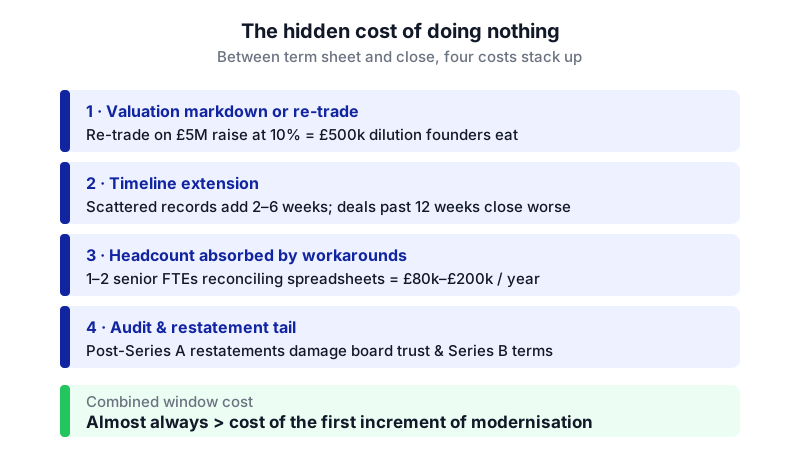
The CFO's instinct — "the spreadsheets are working fine" — is defensible on the month-to-month P&L. They are not showing up as a line item. The cost lives in four places the CFO does not yet attribute to them.

1. The valuation markdown or re-trade
This is the largest and most immediate number. If diligence finds that your ARR, net revenue retention, or gross margin calculations cannot be reproduced from source data without the finance team opening a specific workbook, the investor has two options: adjust the price or add conditions precedent that delay close. Both cost money. A re-trade on a £5M raise at a 10% markdown is £500k of dilution the founders eat, not the business.
2. The timeline extension, which is also a valuation risk
UK Series A diligence typically runs four to eight weeks from term sheet to close, with scattered records extending it by two to six weeks. Every additional week is a week the term sheet is exposed to market conditions, a competing deal in the investor's pipeline, or a change in your own trading. Deals that drag past 12 weeks close at worse terms or do not close at all.
3. Headcount absorbed by workarounds
Count the finance and ops hours spent reconciling spreadsheets at month-end, rebuilding cohort views for board packs, and chasing the one person who understands the commissions model. In a £1M–£5M ARR business this is usually one to two full-time equivalents, often senior ones. At UK loaded cost that is £80k–£200k a year that produces no customer value.
4. The audit and restatement tail
Once institutional money is in, you have audited accounts annually. In the first ten months of 2024, 140 public companies told investors their previous financial statements were unreliable and required restatement — many tracing to spreadsheet reporting. A restatement after Series A damages board trust in a way that affects the Series B conversation. The JPMorgan London Whale loss, over $6 billion, traced in part to a spreadsheet risk model with formula and manual process errors, is the standard example auditors reach for.
Added together, the cost of doing nothing in the specific window between term sheet and close is almost always larger than the cost of the first increment of modernisation. That is the CFO argument.
Sequencing: strangler-fig versus big-bang
The two realistic options for migrating off spreadsheets in a UK business of this size are a strangler-fig increment — replacing the highest-risk spreadsheets one at a time while the rest keep running — or a big-bang rebuild onto a single platform. In the specific context of a live fundraise, only one of these is sensible.
The strangler-fig approach
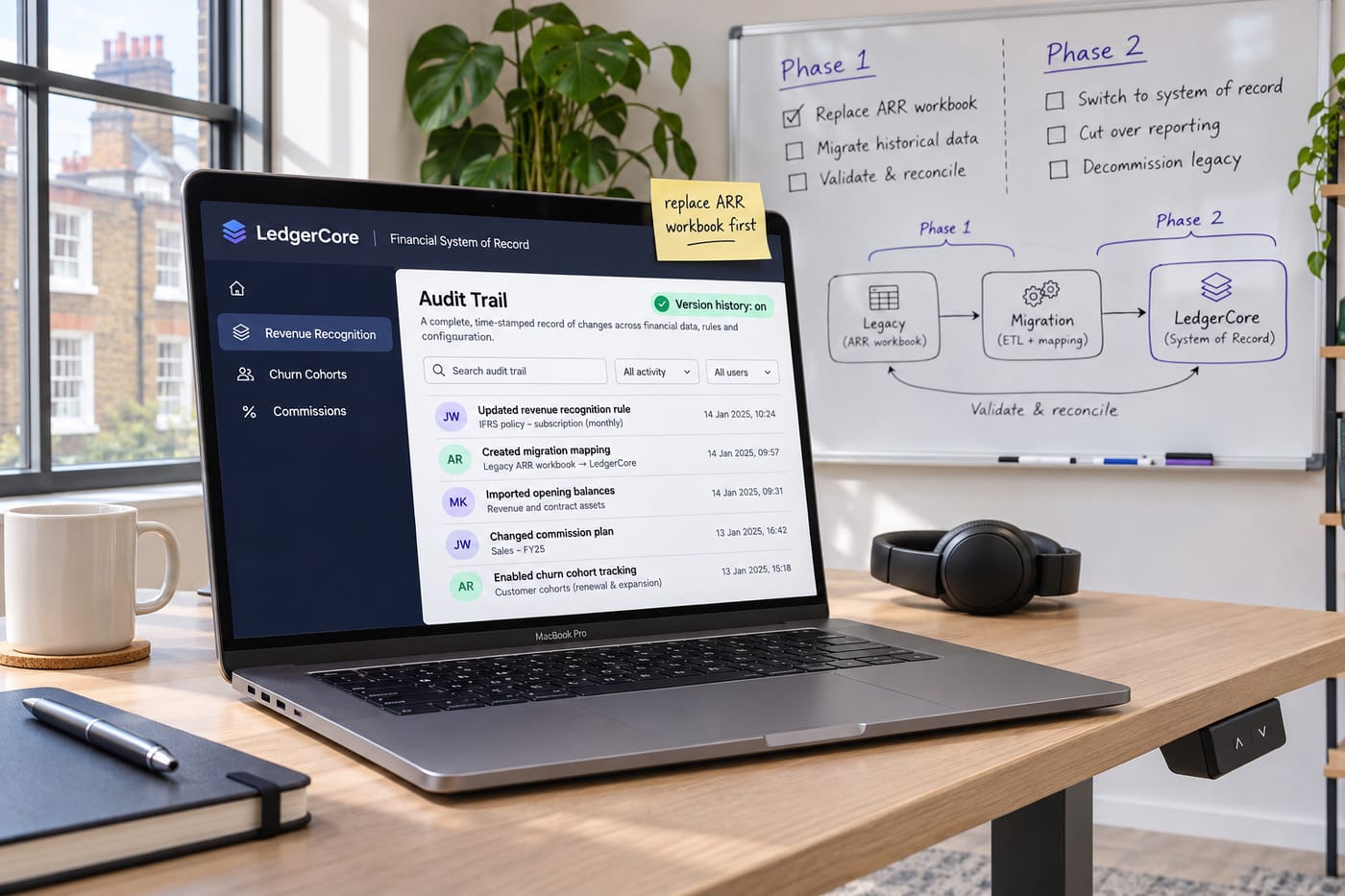
You rank spreadsheets by the risk they carry in diligence, not by how annoying they are to maintain. The revenue recognition workbook ranks first. The churn and cohort workbook ranks second. The commissions model and the cash flow forecast usually tie for third. You replace these two or three with a system of record — a customer-facing billing system that produces the ARR number, a BI layer that produces cohorts from the source database, a CRM-integrated commissions tool — and leave the office supplies tracker and the hiring pipeline where they are.
Good at: Closing the deal. Each increment is a few weeks, visible to the investor, and auditable on its own. The first increment demonstrably removes a diligence blocker, which lets you point to it in the next weekly call.
Bad at: Architectural coherence. You end up with three or four best-of-breed tools and integrations between them that someone has to own. If you never get around to the second and third phase after close, you have added tool sprawl without finishing the job.
The big-bang rebuild
You pick a single ERP or operations platform — NetSuite, a modern cloud ERP, or a custom build — and migrate everything at once. For an SMB, ERP Research puts total implementation at $25k–$150k, with mid-market deployments running $150k–$750k. Gartner finds 60% of organisations exceed their cloud migration budget, with overruns averaging 30–50%.
Good at: Long-term coherence. One system, one source of truth, one integration surface.
Bad at: Hitting a fundraise deadline. Big-bang projects run six to eighteen months. If diligence closes in eight weeks, this project does not help you. It also carries the budget-overrun risk at exactly the moment you have raised money against a specific use of proceeds.
For a business in the term-sheet window, strangler-fig wins. For a business that has just closed and is planning the next twelve months, the choice is open.
The cost and timeline model
The question every founder asks next is what the first increment costs and how long it takes. The honest answer is that the number is driven by four variables, and until someone has looked at your specific spreadsheets, any figure is a shape, not a quote.
The four cost drivers:
- How many systems the replacement has to read from and write to. A revenue recognition replacement that reads from Stripe and writes to Xero is one integration profile. One that reads from Stripe, HubSpot, a usage-metering database, and a legacy invoicing tool is four, and the cost scales with that number, not linearly but close.
- The state of the source data. If the spreadsheet is the source of truth — meaning it contains data that exists nowhere else — you have a migration project before you have a build project. If the spreadsheet is a view over data that already lives in Stripe or your CRM, you skip the migration.
- The complexity of the business logic encoded in formulas. Twenty years of revenue recognition rules, FX adjustments, and one-off customer deal terms baked into IF statements take longer to unpick than a clean SaaS subscription model.
- Whether you need a bought tool configured or a custom build. For standard SaaS metrics a configured BI tool on top of the source database is usually enough. For non-standard commissions or revenue recognition, a small custom app may be faster than forcing a product to do something it was not built for.
An illustrative shape, not a quote: a two-integration replacement of a single revenue-recognition workbook, where the underlying data already lives in Stripe and a billing system and only the aggregation logic needs rebuilding, tends to sit at the lower end of the ERP Research SMB range and ships in weeks rather than months. Add a second spreadsheet (cohorts and churn) and the timeline roughly doubles rather than triples, because the data plumbing is shared. Add bespoke commissions logic with partner overrides and historical true-ups and you move into the mid-market range. These are shapes from public implementation data, not CodeNicely figures.
To turn any of this into a real number, three specifics do most of the work: which spreadsheets are in scope, where their input data actually lives today, and whether the finance team can spare four to six hours a week during the build to answer questions. A short scoping conversation with CodeNicely is how that becomes a quote.
Phasing the spend so phase one pays for phase two
The CFO argument gets easier when each phase has a measurable return before the next one is committed. A sensible phasing for a spreadsheet to software due diligence situation:
- Phase 0 — one week, mostly your team's time. Inventory every spreadsheet touching a number in the investor's data room request. Rank by: does this produce a number in the deck, does one person own it, is there version history, is the source data elsewhere. The top three are your phase one scope.
- Phase 1 — the fundraise-critical replacement. Replace the top one or two spreadsheets with a system of record before close. The return is the deal closing on original terms. This is the phase whose cost is justified by the markdown it avoids, not by operational efficiency.
- Phase 2 — the first 90 days post-close. Replace the next two or three spreadsheets, now with the benefit of real budget and no clock. The return is reduced finance headcount drag and a clean first audit.
- Phase 3 — month 4 onwards. Decide whether to consolidate onto a single platform or keep best-of-breed. By this point you have real data on which integrations are painful, which is the right basis for the decision.
Phase 1 is funded from the raise — specifically from the "finance and operations" line most Series A decks already include. Phase 2 is funded from the headcount cost it removes. Phase 3 is a strategic decision, not a fundraise defence.
What the business has to supply
No modernisation vendor can do this work alone, and founders who assume otherwise are the ones who end up in Gartner's 60%. The business has to supply:
- One decision-maker per spreadsheet in scope. Someone who can answer "what should this formula actually do" without a committee.
- Access to the source systems. Stripe, Xero, HubSpot, the product database. API keys, not screenshots.
- Finance team time during the build. Four to six hours a week of the person who currently owns the workbook, for the duration of their spreadsheet's replacement.
- A clear definition of "done" tied to the investor's diligence list. Not "the system is nicer to use" but "the ARR number in the data room is now produced by this system, with version history, and reconciles to Stripe to within £500."
How CodeNicely can help
Our most relevant engagement for this situation is GimBooks, a YC-backed accounting SaaS where we built the systems that replace spreadsheet-based bookkeeping for small businesses. The work that matters here is not the end product but the problem shape: taking messy, formula-driven financial logic — invoicing, GST, reconciliation — and encoding it in software that produces numbers an auditor can trace. That is the same problem a UK B2B SaaS has when it needs to move revenue recognition and cohort reporting off Excel before a Series A auditor arrives.
Our usual engagement for a fundraise-window modernisation is a two-week scoping sprint — we look at the spreadsheets, the source systems, and the diligence list, and come back with a phase one scope, a cost range, and a build sequence. For teams in the term-sheet window we work alongside the finance lead and the lead investor's diligence provider so the replacement artefact is something the auditor has already agreed to accept. More context on how we approach this kind of work is on our digital transformation page.
What we are not: a packaged ERP reseller. If the right answer for you is a NetSuite implementation, we will say so and point you to a specialist. Our work is where the business logic is custom enough that a configured product forces awkward compromises.
The argument to take into the meeting
Boiled down, the case to the CFO is three sentences. The cost of a 10% valuation markdown or a four-week deal extension is larger than the cost of replacing the two spreadsheets the investor's auditor will flag. The replacement does not require a platform rebuild; it requires a system of record for the numbers in the data room, and the rest of the spreadsheets can stay for now. Phase one is funded by the raise, phase two is funded by the finance headcount it frees, and the decision to consolidate onto a single platform can wait until after close when it is a strategic choice rather than a defensive one.
That is the argument. The specifics — which spreadsheets, what cost, what timeline — depend on your data. A specialist lawyer and your auditor should review the diligence-facing elements before any migration goes live; nothing here is a substitute for either.
Frequently Asked Questions
How long before close should we start replacing the spreadsheets?
Ideally before the term sheet, because the diligence list is usually similar across investors and you can prepare on your own timeline. In practice most founders start the day after term sheet. If you have more than four weeks to close, phase one of a strangler-fig approach is realistic. If you have less, scope ruthlessly — one spreadsheet, the one producing the ARR number, is better than three half-finished replacements.
What does it cost to migrate off spreadsheets for a Series A data room?
The number is driven by how many spreadsheets are in scope, whether their source data already lives in systems like Stripe or Xero or only exists in Excel, how much custom business logic is encoded in formulas, and whether a configured product will fit or a small custom build is needed. Public SMB implementation ranges from ERP Research put this at $25k–$150k for a small business and $150k–$750k for mid-market; your actual number depends on scope. A scoping call with CodeNicely is how that becomes a quote.
Will an investor accept a partial migration where only some spreadsheets have been replaced?
Yes, if the replaced ones are the ones producing the numbers they are pricing — ARR, net revenue retention, gross margin, cohort retention. Investors do not require that every operational process is in software. They require that the numbers in the data room can be reproduced from source data without relying on a workbook only one person understands. Scope accordingly.
Can we do this with our existing finance team and a contractor?
For a single spreadsheet replacement with clean source data, sometimes. The failure mode is scope creep — the contractor finds that the revenue workbook depends on a cohort workbook which depends on a CRM export, and the two-week project becomes a three-month project with no finish line. The reason to use a team that has done this before is not the build itself but the ability to cut scope at the right line so phase one actually ships before close.
What happens to the spreadsheets we don't replace?
They stay. The goal in the fundraise window is to clear diligence, not to eliminate Excel from the business. Post-close, phase two and three decide which of the remaining spreadsheets are worth replacing based on how much finance team time they absorb and whether they will come up again at the Series B. Some of them never need to move.
Sources & further reading
- Study finds 94% of business spreadsheets have critical errors — Frontiers of Computer Science / Phys.org
- Why 94% of Financial Spreadsheets Contain Errors (And What It Costs You) — NextProcess
- Reimagining Spreadsheets: Stop Assembling Data and Start Analyzing It — Jack Henry (cites F1F9 research and JPMorgan London Whale)
- Spreadsheet Errors in Accounting: Hidden Costs — GoLimelight (cites Ideagen Audit Analytics 2024 restatement data)
- The Hidden Audit Risk in Your IFRS 9 Spreadsheets — IFRS Tech
- Series A Data Room: What UK Investors Verify — Thrivefinity
- Data Room for Due Diligence UK: Checklist + Guide — Beamprobe
- FCA Operational Resilience 2026: What Firms Must Evidence — SureCloud
Get one practical guide a week
Costs, AI tools, partner selection — written for people who make the decision. No spam, unsubscribe anytime.
Thanks — you're on the list. One practical guide a week, nothing else.
That didn't work — please check the email address and try again.
Building something in Software & Technology?
CodeNicely partners with founders and tech teams to ship AI-native products that move metrics. Tell us about the problem you're solving.
Talk to our team Book a 30-min call