

Pricing a Customer Mobile App Before You Brief Anyone

 Published by CodeNicely, the product studio founded by Meghal Agrawal and Ujjwal Agrawal in 2017
For: A COO or VP of Digital at a mid-market enterprise ($50M–$500M revenue) who has been asked to own a customer-facing mobile app initiative, has received two wildly different vendor quotes, and needs to defend a budget line to the CFO before issuing an RFP
In this guide
If you are holding mobile app quotes that range from $80K to $600K for what appears to be the same scope, the spread is almost never about the app. It is about the API and middleware layer that has to sit between your ERP, CRM, or order management system and a mobile client — and the vendors at the low end of your range have either excluded it, assumed it already exists, or buried it under a vague 'integrations' line. Before you issue an RFP, you need to price the integration surface first, the app second, and the ongoing cost of ownership third. This post gives you a model to do that in an afternoon.
The honest shape of the number
A customer-facing mobile app for a mid-market enterprise is not one project. It is three projects stapled together: a mobile client (iOS and Android), an integration layer that exposes your existing systems of record to that client, and an operations layer that keeps the whole thing alive. Any quote that does not price all three separately is quoting a demo, not a product.
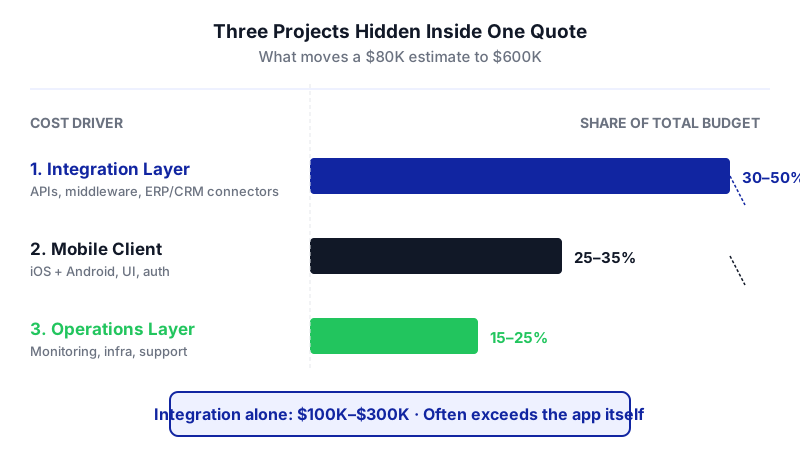
Published benchmarks for enterprise mobile apps span a very wide range because the integration surface dominates the total. Industry data consistently shows that integration with existing enterprise systems typically represents 30%–50% of total project budget, and for complex enterprise applications, integration budgets alone can run $100,000–$300,000 and often exceed the app development itself. If a vendor's quote shows integrations at 10% of their total, they have either done this exact integration before (ask for the reference) or they have not priced it.
So the question 'how much does a customer mobile app cost' has the same answer as 'how long is a conference call' — it depends on who is on the line. What you can do before you brief anyone is build a defensible range by pricing each cost driver independently.
The six cost drivers, in order of impact
1. The integration surface (30%–50% of total)
This is the one that moves the number the most and the one buyers consistently underestimate. Every piece of data the app shows a customer — their order status, their loyalty balance, their service tickets, their invoice history — has to come from a system of record that was not designed to serve a mobile client. That means one of three things:
- Your backend already exposes clean REST APIs. Rare in mid-market enterprises. If true, integration cost collapses to connector work.
- Your backend exposes something, but it is SOAP, RFC, or a proprietary protocol. This is the modal case for companies running SAP ECC, older Oracle, or any ERP implemented before 2015. Legacy integrations using SOAP or custom protocols typically require specialized middleware costing $30,000–$150,000 per integration.
- Your backend exposes nothing externally. You need a middleware or API gateway layer built from scratch. This is where $600K quotes come from, and they are often correct.
Per-system benchmarks to pressure-test a vendor quote: SAP integration via BAPI/RFC typically adds $8,000–$25,000 per project; production-grade Salesforce bi-directional sync adds $5,000–$15,000. CRM integrations are the most consistently underestimated line item, routinely running 50–80 engineering hours per integration — $4,000–$12,000 before licensing.
Count your integrations before you brief anyone. Order management, CRM, identity/SSO, payment gateway, notification service, analytics, customer support — most customer apps need five to eight. Then ask each vendor to price each one as a line item, not as a bundle.
2. Scope: transactional vs. informational
The second-biggest swing is whether the app lets a customer do things or just see things.
An informational app (order tracking, account balance, documents, support ticket submission) is mostly read-only. You can cache aggressively, you fail safe, and a two-minute API outage is survivable.
A transactional app (checkout, policy renewal, loan application, prescription refill, logistics booking) writes back to your systems of record. Every write path needs idempotency, reconciliation, a failure mode, and a customer-service workflow for when it breaks. This can double the engineering cost of the same feature set. It also doubles the QA cost, which vendors almost never price honestly on the first quote.
3. Compliance surface
If your app touches health data, payment card data, lending decisions, or EU/California personal data at scale, compliance is a line item, not a checkbox. It shows up as:
- Encryption at rest and in transit, key rotation, and a KMS
- Audit logging that survives a regulator's request years later
- Role-based access control on the backend admin surfaces
- Penetration testing before launch and annually after
- Data residency constraints (often the hidden one — forces regional infra)
A vendor who does not ask what compliance regime you are under in the first 30 minutes of the scoping call is either going to under-quote and renegotiate, or ship something your general counsel will not let you launch. Either way you pay twice.
4. Data migration and historical state
Customers expect to see their history on day one. If your systems of record hold 10 years of order data in a schema that was never designed to be queried by a mobile client, someone has to build the ETL, the caching layer, and the fallback for the records that will not parse. This is almost always under-scoped in vendor quotes because it only becomes real during build.
The question that reveals it: 'When a customer logs in on day one, how many months of history do they see, and where does it come from?' If the answer involves a nightly batch job you have not built yet, that batch job is a project.
5. Who owns the domain knowledge
If your vendor needs to learn your domain — insurance underwriting rules, pharma distribution constraints, logistics documentation, lending covenants — they will learn it on your budget. If you provide a dedicated internal product owner and a subject-matter expert for weekly working sessions, you can cut discovery and rework by 20–30%.
Vendors rarely say this out loud because it reads as pushing work back on the client, but the cheapest engagements have a client-side product owner who can answer domain questions inside a day. The most expensive ones route every ambiguity through three layers of email.
6. Ongoing cost of ownership
This is the one CFOs ask about and vendors do not volunteer. Multiple industry benchmarks put annual maintenance costs for enterprise mobile apps at 15%–25% of the original build cost. That is before any feature enhancement. For a $300K build, budget $45K–$75K per year, every year, just to keep the app in the stores and the integrations working as the underlying systems change.
If you present the build cost to your CFO without the five-year total cost of ownership, you will have the same conversation again in 18 months.
An illustrative worked example
This is illustrative only. Every assumption is stated so you can swap in your own numbers.
Scenario: A mid-market specialty distributor ($180M revenue) wants a customer-facing app for their 12,000 B2B buyers. The app must show order status, reorder from history, submit returns, and view invoices.
Stated assumptions:
- iOS and Android, native or cross-platform (not web)
- Six integrations: SAP ECC (orders and invoices, via RFC), Salesforce (customer and contact), an in-house returns system (no API, must be built), Okta (SSO), Stripe (payment), Firebase (push and analytics)
- SAP exposes RFC but no REST; middleware must be built
- Three years of order history must be visible on day one (ETL required)
- Transactional (reorder writes back to SAP)
- PCI SAQ-A scope only (Stripe hosted fields)
- Internal product owner at 50% allocation; no dedicated SME
- Ten-month build window, launch in one geography
Where the money lands, as a rough proportion of total:
| Workstream | Share of budget | Why |
|---|---|---|
| Middleware / API layer | ~30% | SAP RFC adapter, returns-system wrapper, API gateway, auth |
| Mobile client (iOS + Android) | ~25% | Feature build, state management, offline handling |
| Integration engineering (per-system) | ~15% | Salesforce bi-directional, Okta, Stripe, Firebase |
| Data migration / ETL | ~8% | Three years of order history, reconciliation |
| QA, security testing, UAT | ~12% | Transactional write paths, pen test, store submission |
| Project management + discovery | ~10% | Ten-month engagement, weekly steering |
Note that the mobile client — the thing everyone thinks they are buying — is a quarter of the budget. The middleware, integration, and data layers are more than half. That is the ratio that explains the $80K-to-$600K spread: the $80K quote priced the mobile client and left the rest for change orders. The $600K quote priced the whole thing.
What pushes this up, what pulls this down
| Pushes the number up | Pulls the number down |
|---|---|
| Legacy ERP with no REST layer | Modern backend already exposing REST/GraphQL |
| Transactional writes to multiple systems | Read-only / informational scope for v1 |
| HIPAA, PCI level 1, or regulated financial data | Minimal PII, hosted payment, no regulated data |
| Years of historical state visible day one | 'From today forward' with history link-out |
| Native iOS + native Android codebases | React Native or Flutter with shared logic |
| No internal product owner or SME | Dedicated internal PO and weekly SME access |
| Multi-geography launch, localization | Single-market, single-language v1 |
| Real-time sync requirements | Eventual consistency, 5-minute cache acceptable |
| Custom design system from scratch | Material / Human Interface guidelines + brand layer |
| Offline-first with conflict resolution | Online-only with graceful degradation |
The strategic question your CFO will ask
Before you defend the number, defend the app. In January 2025, Gartner predicted that mobile app usage will decline 25% by 2027 as AI assistants intermediate more customer interactions. That does not mean do not build the app. It means the integration and API layer you are building — the expensive part — is the asset. The mobile client is one of several interfaces that will sit on top of it. A chatbot, a voice assistant, a partner portal, and a future AI agent all consume the same APIs.
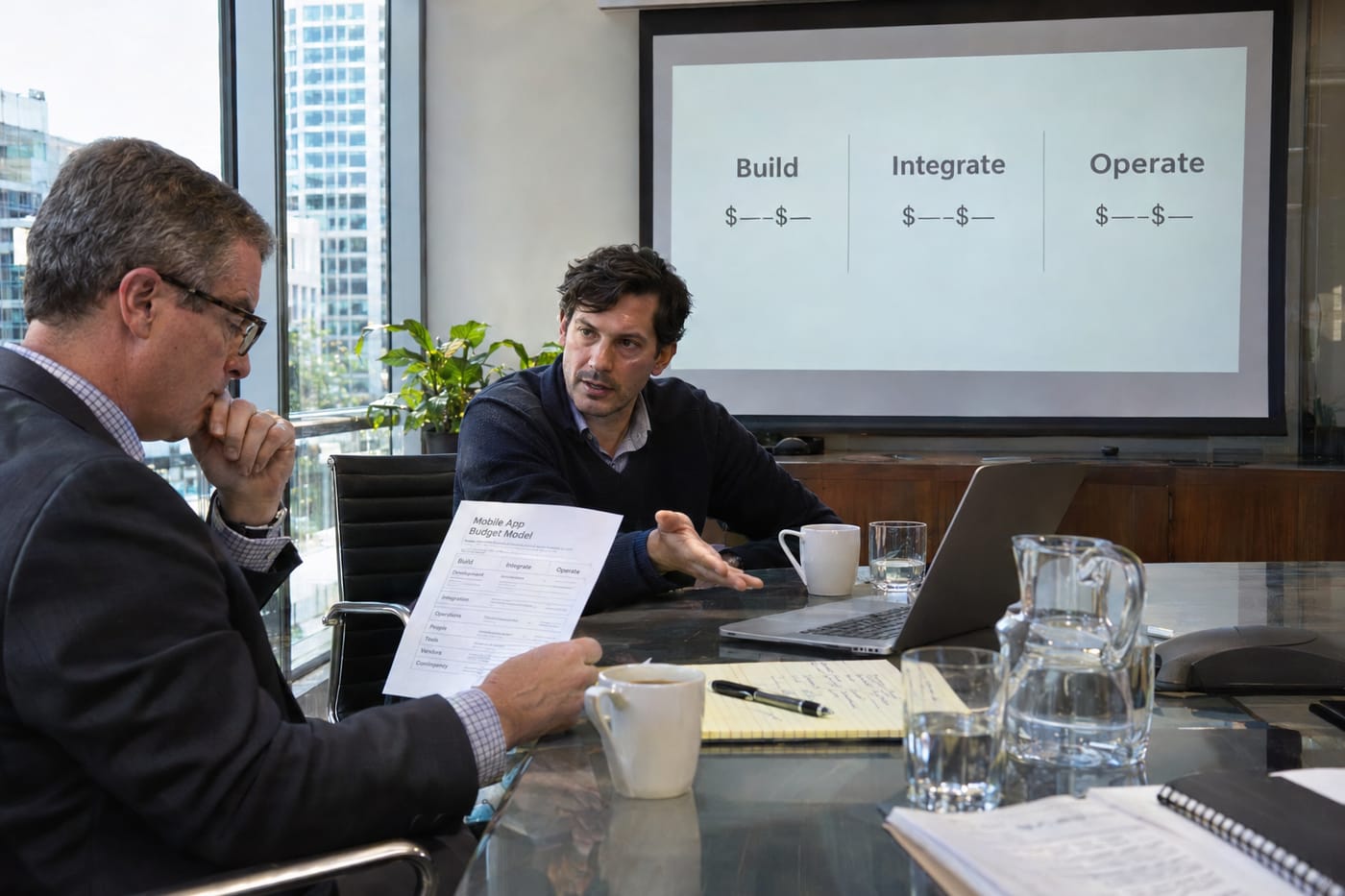
Framed that way, the 30%–50% you are spending on middleware is not mobile-app spend. It is digital infrastructure spend that happens to have a mobile app as its first consumer. That reframing is often the difference between a CFO who approves the budget and one who does not.
How CodeNicely can help
Most of the enterprise mobile engagements we are brought into start the same way: two or three vendors have quoted numbers that do not reconcile, and the buyer cannot tell which one is right. Our role at that stage is usually a two-week discovery that maps the integration surface, counts the real line items, and produces a scoped range the buyer can take to their CFO — independent of whether we end up building it.
The engagement closest to the scenario in this post is Vahak, a logistics marketplace where the mobile app was the visible product but the real engineering was in the middleware connecting dispatch, verification, and routing systems that had never been designed to serve a mobile client. The scoping work there — separating 'what the app does' from 'what the systems behind the app have to start doing' — is the same work a mid-market distributor, lender, or specialty retailer needs before issuing an RFP. If you are earlier on the stack and the backend itself needs refactoring before any client can consume it, GimBooks is a closer reference.
If what you actually need is an API layer that a mobile app, a partner portal, and an eventual AI agent can all consume, that is the kind of scope we unpack in the AI studio conversations rather than treating it as a mobile project.
The three questions that turn a range into a quote
Before any vendor can give you a defensible number, you (or they, in discovery) need answers to three things:
- What does each backend system expose today, and in what protocol? Not 'we have SAP' — specifically which modules, which interfaces are live, which are RFC/BAPI versus REST, and who owns them internally. This single answer moves the integration line by a factor of three.
- Which v1 features write back to systems of record, and which only read? This determines QA scope, failure-mode design, and reconciliation requirements — usually the second-largest swing factor.
- What is the compliance and data-residency regime, and who signs off on security before launch? If the answer involves a regulator or a security committee you have not briefed yet, that is a two-month critical-path item nobody has priced.
Get those three answered and you can brief a vendor in a way that produces a quote you can actually defend. If you want a second opinion on the scoping before you issue the RFP, that is a conversation worth having — here is what that looks like.
Frequently Asked Questions
Why are vendor quotes for the same mobile app spec so different?
Almost always because of what is excluded, not what is included. Low quotes typically price the mobile client and treat integrations, middleware, data migration, and compliance work as separate change orders. High quotes include all of it. Ask every vendor to itemize integrations per system of record, and ask what they assume about your backend's existing APIs. The quote that assumes clean REST APIs where you actually have SAP RFC will double in month three.
How do I know if my backend is 'mobile-ready'?
Three-question test: (1) Can a developer today, without IT's help, hit a documented REST endpoint and get a customer's order history back as JSON? (2) Is there a sandbox environment separate from production? (3) Is there an authentication layer other than a service account? If any answer is no, you are building middleware, and that is where 30%–50% of your budget will go.
Should I build native iOS and Android, or cross-platform?
For customer-facing B2B apps with moderate feature depth, React Native or Flutter typically cuts client-build cost by 30–40% versus two native codebases, at the cost of some performance and platform-feature access. For consumer apps where polish and performance directly drive engagement (gaming, media, anything with heavy camera/AR use), native is usually worth it. For a reorder-and-track app for 12,000 B2B buyers, cross-platform is almost always the right call.
What ongoing cost should I plan for after launch?
Industry benchmarks put annual maintenance at 15%–25% of original build cost — covering OS updates, security patches, store resubmissions, backend keeping pace with ERP/CRM changes, and minor bug fixes. That is before any new features. Present the five-year total cost of ownership to your CFO, not just the build number, or you will have an uncomfortable conversation in year two when the maintenance invoice arrives.
Can I reduce cost by launching with fewer integrations?
Yes, and it is usually the single best lever. A v1 that shows order status (one integration) and nothing else can launch for a fraction of the full-feature number, prove adoption, and build the political capital to fund the rest. The trap is building v1 cheaply in a way that cannot extend — a throwaway integration layer that gets rebuilt in v2. The scoping conversation is about which integrations to defer, not which to skip forever.
Sources & further reading
- Mobile Enterprise Application Market Report 2026 — The Business Research Company
- Enterprise Mobile Application Development Platform Market — Market Research Future
- Enterprise Mobile App Development Cost in 2026: Complete Pricing Guide for CTOs & IT Leaders — Naveck Technologies
- Comprehensive Guide to Enterprise Mobile App Development — Trio.dev
- Mobile App Development Cost Breakdown (SAP/Salesforce/legacy integration benchmarks) — TMS Outsource
- Mobile App Development Guide: Cost & Process Explained (legacy SOAP middleware costs) — Nadcab
- Mobile App Development Cost: 2026 Complete Guide (CRM integration hours benchmark, 200+ apps) — Netguru
- Enterprise Mobile App Development: Cost, Process & Best Practices (2026) — Purrweb
Get one practical guide a week
Costs, AI tools, partner selection — written for people who make the decision. No spam, unsubscribe anytime.
Thanks — you're on the list. One practical guide a week, nothing else.
That didn't work — please check the email address and try again.
Building something in Software & Technology?
CodeNicely partners with founders and tech teams to ship AI-native products that move metrics. Tell us about the problem you're solving.
Talk to our team Book a 30-min call