

Pricing Your First MVP: What the Scope Document Hides

 Published by CodeNicely, the product studio founded by Meghal Agrawal and Ujjwal Agrawal in 2017
For: A first-time founder in India who has received two or three MVP proposals ranging from ₹8 lakh to ₹35 lakh for what appears to be the same product, and cannot explain the gap to their co-founder or angel investor
In this guide
- The shape of the number
- Driver 1: Integrations are where the quote lies to you
- Driver 2: Compliance surface
- Driver 3: Domain expertise
- Driver 4: What keeps running after launch
- An illustrative worked example
- What pushes it up, what pulls it down
- How to read a proposal in forty minutes
- The three questions that turn a range into a quote
- Frequently Asked Questions
If you are holding three MVP proposals ranging from ₹8 lakh to ₹35 lakh for what looks like the same product, the gap is almost never engineering hours. It is a set of unstated assumptions about who pays for third-party API integrations, who owns compliance work like DLT registration, and whether the quote covers a payment checkout screen or an actual production-grade payment integration with reconciliation. The cheapest proposal is usually not the cheapest project — it is the one that has pushed the most work below the scope line, where it will resurface as a change request two months in.
This post is the framework to read those proposals properly. It explains the shape of MVP pricing in India, the specific line items vendors routinely omit, and the three questions that convert a range into a quote you can actually defend to your co-founder or your angel.
The shape of the number
Indian MVP build quotes in 2026 cluster into three bands. Industry survey data puts basic MVPs at ₹2–5 lakh, standard MVPs at ₹5–12 lakh, and advanced or AI-enabled MVPs at ₹12–25 lakh and up. A proposal at ₹35 lakh is not automatically overpriced and ₹8 lakh is not automatically a steal — they are describing different products, usually without saying so.
The spread exists because the phrase "MVP" covers four variables that each move the number by 2–5x:
- Surface area — number of distinct user roles, screens, and workflows
- Integration count and depth — how many external systems, and whether "integrated" means a UI mock or a production webhook pipeline
- Compliance surface — KYC, data residency, DLT registration, audit trails
- Who supplies the domain expert — you, or the vendor at a day rate
When two proposals look the same but differ by 3x, it is almost always variables two and three. Let us pull them apart.
Driver 1: Integrations are where the quote lies to you
This is the single largest hidden cost in Indian MVP proposals. A scope document will list "Razorpay integration" as one line item alongside "user profile page" and "admin dashboard," as if they are comparable units of work. They are not.
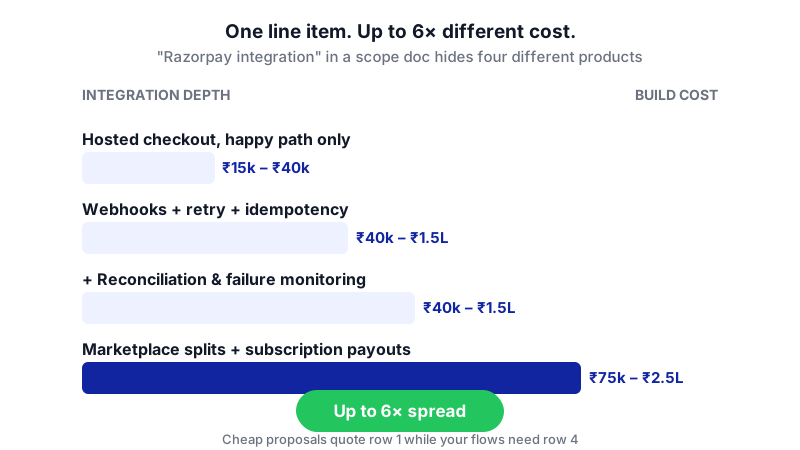
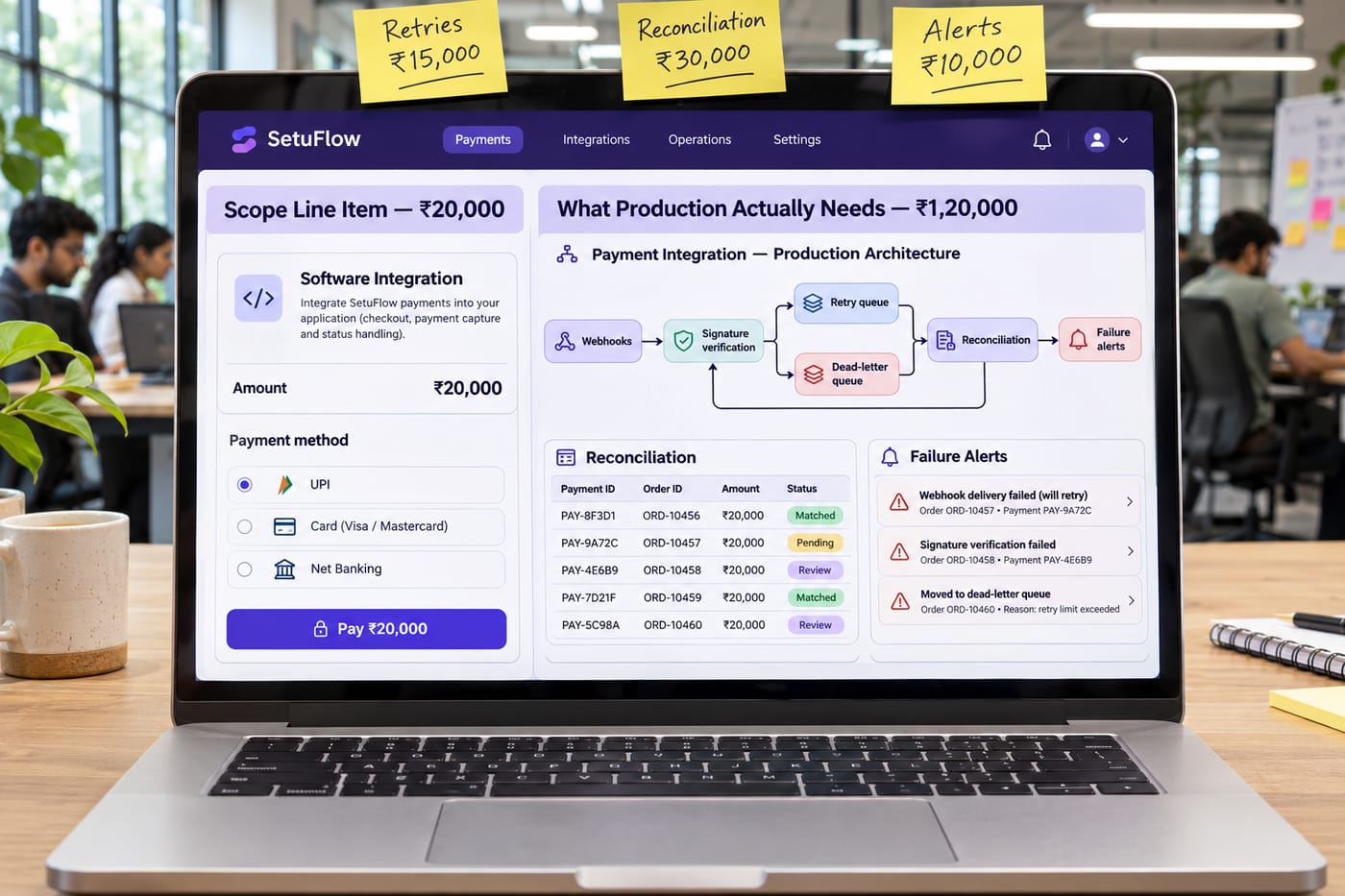
A simple payment integration — a hosted checkout, happy-path only, no marketplace splits, no subscription billing, no reconciliation dashboard — costs ₹15,000–₹40,000 to build in India in 2026. A production-grade integration with webhooks, retry logic, idempotency, reconciliation against settlement files, and failure monitoring costs ₹40,000–₹1,50,000. For marketplace or subscription flows with split payouts, that climbs to ₹75,000–₹2.5 lakh.
The cheapest MVP proposal almost always quotes the first version while the user flows in the same document describe the third. You will hit the gap the first time a customer pays and your dashboard does not show the payment, or the first time a webhook gets retried and your system double-credits a wallet.
Count your integrations before you read any proposal. For a typical Indian consumer or B2B MVP, the list is longer than founders remember:
- Payment gateway (Razorpay, Cashfree, PhonePe)
- SMS OTP gateway (MSG91, Twilio, Gupshup)
- Email (SES, SendGrid, Postmark)
- Aadhaar eKYC (if you touch regulated flows)
- GST verification (if B2B)
- PAN verification
- Bank account verification (penny drop)
- Maps and geocoding (Google, MapmyIndia)
- Analytics, crash reporting, push notifications
- WhatsApp Business API
Three to four production-grade integrations can double or triple the engineering cost of the MVP itself. A proposal that lists ten integrations and still lands at ₹8 lakh is telling you something about the depth of each one.
The recurring cost tail nobody budgets for
The build cost is the one-time cost. The transaction costs are forever, and they are almost never in the proposal.
Razorpay charges 2% per domestic transaction plus 18% GST — an effective rate of about 2.36% — with no setup fee. That feels like nothing at MVP stage. It is not. A startup processing ₹1 lakh/month pays ₹2,360 in gateway fees before any other unit economics. Custom negotiated pricing typically only opens up past ₹5 lakh/month in volume, which means the unit economics you modeled with "standard rates" are wrong for the entire first year.
Aadhaar eKYC via OTP is priced at ₹3.00 per successful transaction by UIDAI for full demographic retrieval, with resellers (KUAs and Sub-KUAs) offering ₹2–5 per transaction depending on volume commitments. For a lending or fintech MVP doing 500 KYCs a month, that is ₹1,000–₹2,500 a month — manageable. At 50,000 KYCs a month, you are spending ₹1–2.5 lakh a month on a line item that was never in the build quote.
GST verification APIs range from ₹0.10 to ₹2.00 per call across Indian providers, with volume breaks starting at 2,500–25,000 lookups. A B2B platform that verifies every vendor at onboarding plus runs monthly re-verification can spend a few lakhs a year on what looks like free API calls.
SMS OTP is the one where the choice of provider matters most relative to its visibility in the scope document. MSG91 costs ₹0.16–₹0.25 per SMS plus 18% GST, while Twilio runs around ₹0.63. That is a 3–4x gap. A scope that says "OTP integration" without naming the gateway is leaving that decision — and that cost — as your problem.
Driver 2: Compliance surface
Every MVP in India that sends transactional SMS must complete TRAI's DLT (Distributed Ledger Technology) registration before going live. Header and template registration, principal entity onboarding, consent management flows — this is a two-to-four-week calendar item regardless of how fast your engineers are, because the approvals are not under your control.
Fixed-price proposals routinely omit this. The engineering work is small; the compliance work is annoying and slow. If your proposal does not call out DLT registration, SMS header approval, or template whitelisting as line items, assume the vendor is planning to hand that work back to you the week before launch.
The same pattern applies to:
- Razorpay merchant onboarding — KYC documents, website policy pages, settlement bank setup. The vendor builds the integration; you do the paperwork, usually without being told.
- Aadhaar eKYC access — you do not get direct UIDAI access. You need a KUA or Sub-KUA relationship, which involves contracts and audits. See the 2026 fintech KYC guide for the current regulatory shape.
- Play Store and App Store review — permissions declarations, data safety forms, privacy policy hosting. Two to three weeks of calendar time for a first submission.
- Data residency and DPDP Act compliance — where your database lives, what consent flows look like, how deletion requests are handled.
None of this is engineering-heavy. All of it is launch-blocking. A proposal that treats these as your problem is not wrong — a lot of vendors do work this way — but you need to know, so you can either take it on knowingly or ask them to price it in.
Driver 3: Domain expertise
If you are building a lending product, someone on the project needs to understand EMI calculations, prepayment, foreclosure, DPD buckets, and NPA classification. If you are building a healthcare product, someone needs to know how a prescription workflow differs from an OTC flow, and what drug interaction checks require.
Either you supply that person — you, a co-founder, a domain-expert advisor — or the vendor does, at a billable rate. A quote from a generalist shop that assumes you will provide every detail of the business logic is cheaper on paper and more expensive in practice, because the back-and-forth lengthens every sprint. A quote from a specialist shop that has built three products in your category costs more per hour and typically fewer total hours.
The question to ask a vendor is not "have you built an MVP before" but "have you built one in this category, and can I speak to that founder." CodeNicely's work on Cashpo (lending, KYC, credit scoring) and Gimbooks (accounting SaaS) are useful precisely because the domain decisions were already made the second time around.
Driver 4: What keeps running after launch
MVPs do not ship and stop. They ship and start costing money every month. Line items the proposal usually does not break out:
- Cloud hosting — ₹8,000–₹40,000/month for a typical early-stage product on AWS or GCP, more if you have ML workloads
- Transactional email — a few thousand rupees a month at MVP scale
- SMS and WhatsApp — as above, scales with user activity
- Monitoring and error tracking — Sentry, Datadog, or equivalent
- Bug fixes and small changes post-launch — usually billed at a monthly retainer or hourly
- App store developer accounts — ₹8,250/year Apple, ₹2,100 one-time Google
A ₹12 lakh build with ₹60,000/month running costs is a different financial profile from an ₹18 lakh build with ₹20,000/month running costs. The second is cheaper over 18 months. Neither proposal will frame it that way.
An illustrative worked example
The numbers below are illustrative, not a quote. Every assumption is stated.
A two-sided B2B marketplace MVP for Indian SMBs: vendor onboarding with GST and PAN verification, buyer-side search and ordering, Razorpay checkout with escrow-style release, SMS and WhatsApp notifications, basic admin dashboard. Web + Android. No iOS. No AI features. English only. Vendor supplies no domain expert; founder is the product owner. Target: launch in four months with 50 vendors and 500 buyers in pilot.
Honest build range for this spec from a competent Indian studio: roughly ₹14–22 lakh, benchmarked against the standard-to-advanced MVP band. The spread comes from:
- Razorpay integration depth — hosted checkout vs. Route (marketplace splits) — swings ₹60,000–₹2 lakh
- GST + PAN verification — production-grade with retry and caching vs. basic — ₹40,000–₹1.5 lakh
- WhatsApp Business API — template approvals and conversation tracking — ₹50,000–₹1.5 lakh plus Meta's per-conversation fees
- Admin dashboard — three screens vs. twelve screens with exports and filters — swings ₹1–3 lakh
- DLT registration, Razorpay onboarding support, Play Store submission — ₹50,000–₹1.5 lakh if the vendor owns it, zero if you do
Expected recurring costs in month one with modest traffic: ₹15,000–₹35,000 across hosting, SMS, WhatsApp, GST lookups, and payment gateway fees on pilot GMV. This scales roughly linearly with transactions, not users.
The same spec quoted at ₹8 lakh is not a bargain. It is a different spec — probably hosted checkout only, no marketplace splits, no reconciliation, basic admin, DLT and onboarding on you, and no buffer for the integration depth discovery that will inevitably happen in week six.
What pushes it up, what pulls it down
| Pulls the number down | Pushes the number up |
|---|---|
| Single user role, single platform (web or Android, not both) | Multi-role with admin, vendor, buyer, support dashboards |
| Hosted payment checkout, no marketplace logic | Split payouts, escrow, subscription billing, refunds dashboard |
| You own domain expertise and write user stories | Vendor discovers business rules during sprints |
| You handle DLT, Razorpay KYC, Play Store submission | Vendor owns all compliance and launch paperwork |
| English only, single region | Multi-language, multi-currency, multi-region |
| Mock integrations acceptable for demo, real ones post-funding | Production-grade integrations from day one |
| No data migration from existing system | Importing users, transactions, or catalog from legacy platform |
| No AI features, or a thin wrapper around an LLM API | Custom models, fine-tuning, or on-device inference — see AI Studio for how this scopes |
How to read a proposal in forty minutes
Open each proposal and mark it up:
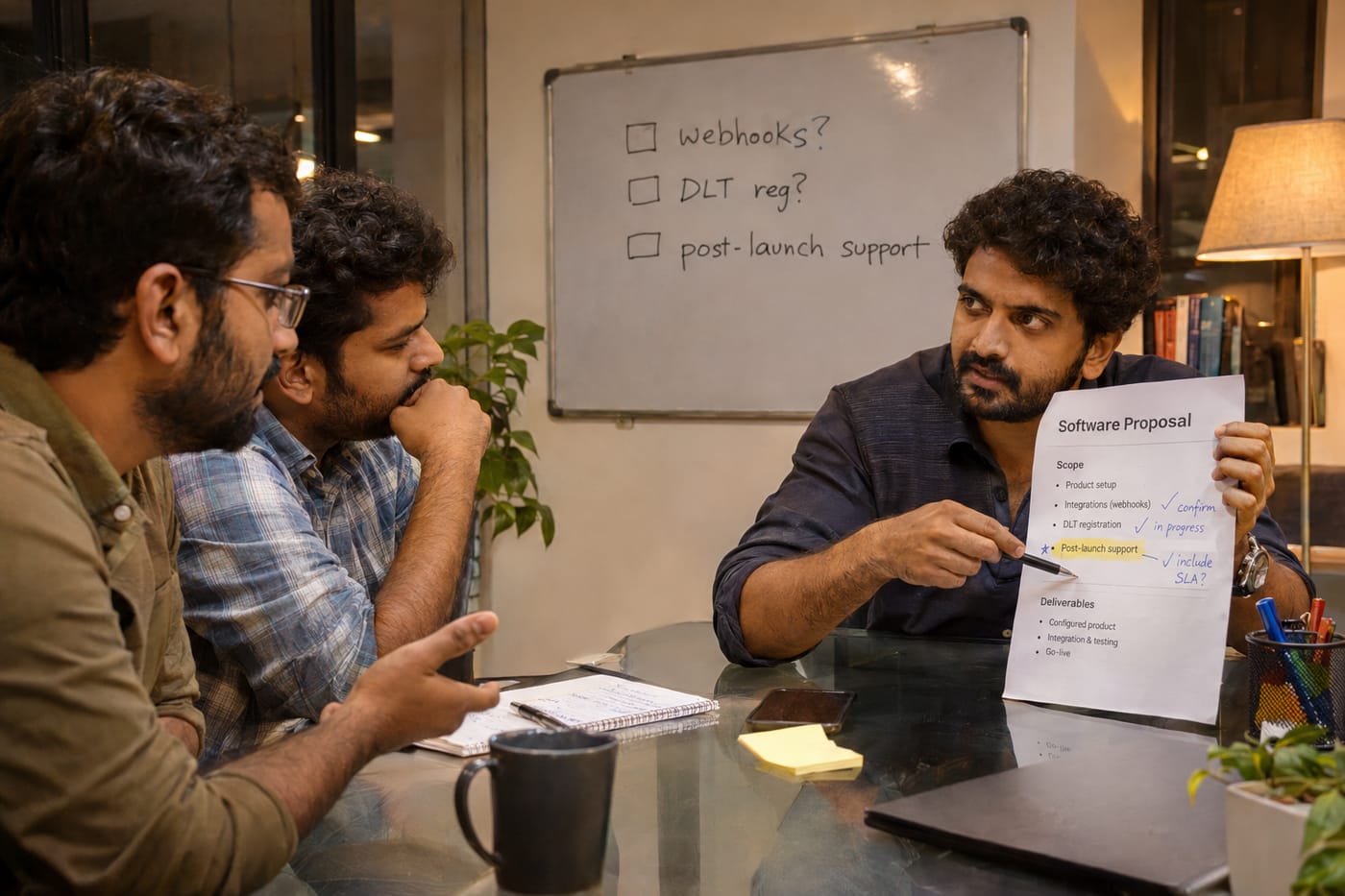
- Count the integrations in the scope. For each one, note whether the proposal specifies the provider (MSG91 vs. Twilio matters), the depth (hosted vs. API vs. with webhooks and reconciliation), and who handles the vendor onboarding paperwork.
- Find the compliance line items. DLT registration, Razorpay merchant KYC, Play Store submission, privacy policy and T&C drafting. If they are not there, they are yours.
- Check the admin side. Founders obsess over the user-facing product and forget that the operations team needs screens too. A two-screen admin panel vs. a real ops console is often a ₹2–4 lakh difference.
- Look for the words "production-ready," "reconciliation," "webhook handling," "retry logic," and "monitoring." If they are absent from integration line items, the integration is a UI, not a system.
- Ask what is excluded. The exclusion list in a good proposal is longer than the inclusion list. If the exclusions section is one line, be nervous.
The three questions that turn a range into a quote
Nobody can give you a real number without answers to these:
- Which integrations need to be production-grade at launch, and which can be mocked or deferred? This single answer swings the build cost more than anything else. A hosted Razorpay checkout and a mock KYC flow for a closed pilot is a very different build from Razorpay Route with live Aadhaar eKYC on day one.
- Who is handling compliance and vendor onboarding — DLT registration, Razorpay KYC, Play Store review, Aadhaar KUA relationships? If the answer is "you," subtract two to four weeks of calendar time but not any engineering cost. If the answer is "the vendor," expect ₹50,000–₹1.5 lakh added and genuine accountability for launch date.
- What does "done" mean, and what are the first three things you will build after launch? This exposes whether the vendor is scoping an MVP or a v1. An MVP ships with gaps and a plan to close them. A v1 ships complete and costs twice as much. Either is valid; pretending the first is the second is not.
Once you have answers to those three, any serious studio can give you a defensible range within a week. Indian studios building for Indian startups — see how we scope this — will usually need a 45-minute call plus a short written brief to get there. Beyond those three, further specifics (data volumes, expected transaction counts, specific SLA targets, team composition preferences) narrow the range further.
And a note that is not legal advice but matters: the DPDP Act, RBI co-lending guidelines if you touch credit, SEBI rules if you touch investments, and health data rules if you touch patient data all have specifics your lawyer needs to look at before you ship. A development partner can build to a compliance spec; they cannot write one.
Frequently Asked Questions
How much does an MVP cost in India in 2026?
Based on published industry ranges, basic MVPs run ₹2–5 lakh, standard MVPs ₹5–12 lakh, and advanced or AI-enabled MVPs ₹12–25 lakh and up. The band you fall into depends mostly on integration depth, compliance surface, and whether you need production-grade or demo-grade quality at launch — not on the number of screens, which is what most founders instinctively count.
Why are my three MVP quotes so different for the same product?
Because they are not quoting the same product, even though they look like it. The main hidden variables are the depth of third-party API integrations (a hosted Razorpay checkout vs. a full marketplace with reconciliation differs by ₹1–2 lakh for one line item), who owns compliance work like DLT and Razorpay onboarding, and whether the admin and ops dashboards are real or stubbed. Mark up each proposal against those three variables and the gap usually explains itself.
What recurring costs should I budget for after the MVP ships?
Expect cloud hosting (₹8,000–₹40,000/month early stage), payment gateway fees at an effective 2.36% of Razorpay volume, SMS at ₹0.16–₹0.63 per message depending on provider plus 18% GST, KYC costs of ₹2–5 per Aadhaar verification, and GST lookups at ₹0.10–₹2 per call. At pilot scale these total ₹15,000–₹50,000/month. They scale with transactions, not signups, so model them against your expected activity, not your user count.
Should I pay fixed price or time and materials for my MVP?
Fixed price works when the scope is genuinely fixed, which is rare for a first-time founder — you will discover things in week six that change the product. Time and materials works when you trust the team and want flexibility, but exposes you to drift. A reasonable middle ground is a fixed scope for the first milestone (usually auth, core happy path, and one integration) followed by T&M or small fixed sprints for the rest. Whichever model, insist on weekly demos and a hard change-request process in writing.
How long does an MVP take to build in India?
The engineering work for a standard MVP is typically 10–16 weeks of calendar time with a team of three to five. The practical calendar is longer because of compliance approvals that are not under the team's control — DLT header approval, Razorpay merchant KYC, Play Store review, Aadhaar KUA onboarding if relevant. A realistic plan from kickoff to live pilot users is four to six months. The specifics that move this are the integration count, whether compliance workstreams run in parallel with engineering, and how fast you can make product decisions. Talking to a studio with your integration list and target launch window is the fastest way to tighten that range.
Sources & further reading
- MVP Development Cost in India — Complete Guide (GoMilestone, 2026)
- MVP Development Cost: A Realistic Budget Breakdown for Startups (Applore Technologies)
- Razorpay Payment Gateway Pricing and Fees Explained (Razorpay Official Blog)
- Razorpay Integration for Ecommerce: Fees, UPI Rules & Setup 2026 (Amitra Labs)
- API Integration Services in India: Complete 2026 Guide (CodingClave)
- KYC in India: The 2026 Guide for Fintech (DeepVue.ai)
- KUA–Sub-KUA Fees, Relationships & Connectivity Standards — Aadhaar eKYC Transaction Fees (DPDPIndia)
- Best GST Verification API in India: 12 Compared (2026) (GSTINapi.in)
Get one practical guide a week
Costs, AI tools, partner selection — written for people who make the decision. No spam, unsubscribe anytime.
Thanks — you're on the list. One practical guide a week, nothing else.
That didn't work — please check the email address and try again.
Building something in Software & Technology?
CodeNicely partners with founders and tech teams to ship AI-native products that move metrics. Tell us about the problem you're solving.
Talk to our team Book a 30-min call