

Offshore vs. Onshore Dev: The Decision US Enterprises Get Wrong

 Published by CodeNicely, the product studio founded by Meghal Agrawal and Ujjwal Agrawal in 2017
For: A VP of Engineering or CIO at a 300–2,000-person US enterprise who has board pressure to cut software delivery costs but is accountable for SOC 2 Type II, HIPAA, or PCI DSS compliance and cannot afford a breach or an audit finding traced back to a vendor decision they approved
In this guide
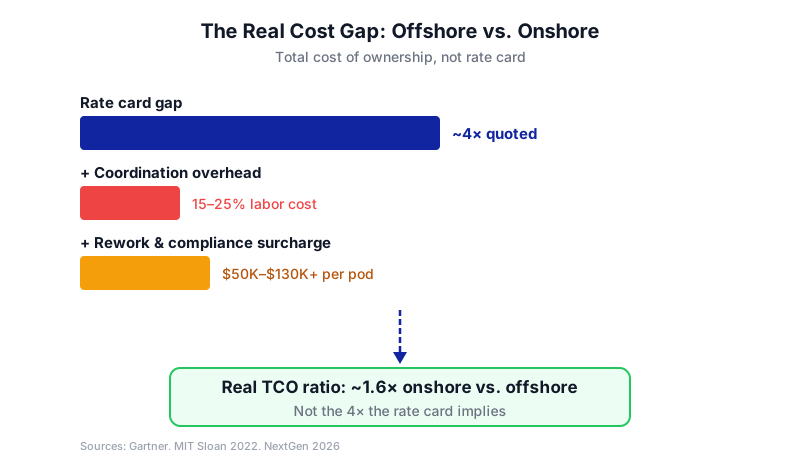
For a US enterprise under SOC 2, HIPAA, or PCI DSS obligations, the honest answer on offshore vs onshore software development is this: the rate card gap is real, but the total cost of ownership gap is roughly 1.6x, not 4x, once you price in coordination overhead, rework, and the compliance surcharge for regulated data. That makes offshore the right call for clearly scoped, non-regulated workloads where you already have strong internal program management — and the wrong call for ambiguous scope, regulated data pods under 15 people, or teams where your internal governance bench is thin. Everything below is how to tell which situation you're actually in before you sign.
The decision, stated crisply
You are choosing a delivery model for a multi-year software investment, not a vendor. The model determines your cost structure, your failure modes, and what happens when requirements change in month six — which they will. The three options on the table:
- Onshore partner or hire — US-based engineers, same time zone, rate card $180–$260/hr fully loaded, $195,000–$262,000 annually per senior per the NextGen 2026 cost index.
- Offshore partner — India, Philippines, Vietnam, Eastern Europe. Rate card $25–$55/hr, $45,000–$75,000 annually per senior.
- Nearshore partner — Latin America, Canada. Rate card $60–$110/hr, overlapping business hours, smaller cultural and process gap.
The question is not which rate card is lowest. The question is which model produces the lowest total cost of ownership for your workload, given your compliance obligations and your internal governance capacity.
The five axes that actually decide this
1. True total cost of ownership, not rate card
Gartner research summarized across outsourcing studies finds organizations underestimate offshore total cost by 20–50% once coordination, governance, and rework are factored in. MIT Sloan's 2022 work pegs coordination overhead at 15–25% of total project labor cost — documentation duplication, meeting shadow-staffing, vendor oversight.
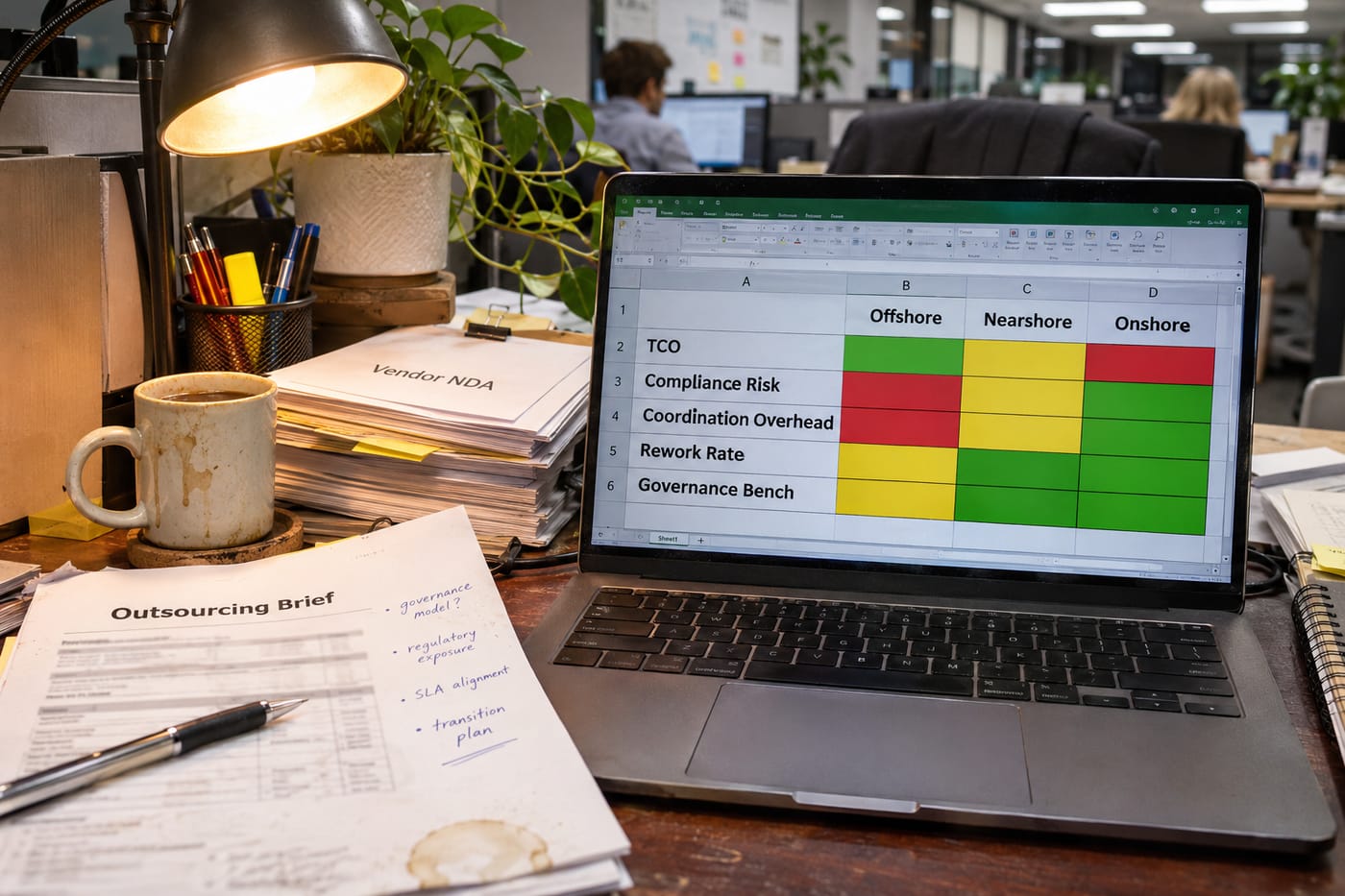
The three line items that go missing from most offshore business cases:
- Internal program-management overhead. Running an offshore pod of 8 engineers realistically consumes 0.5–1.0 FTE of your own program-manager time. A portfolio of 150–250 offshore FTEs across three regions needs 5–10 internal governance staff — vendor managers, program managers, architects, security. This headcount almost never shows up in the rate-card comparison.
- Rework from asynchronous acceptance. 20–40% of offshore projects carry meaningful rework even in well-run single-region models. The 24–48-hour async feedback cycle means milestones slip 2–3 weeks per sprint compared to co-located work.
- Compliance surcharge. For offshore pods touching regulated data: $20,000–$50,000 in legal setup (SCCs, local labor counsel), $30,000–$80,000 in SOC 2 audit remediation risk, 30–90 days of security-review delay before the pod can actually touch production data. HIPAA breach exposure if you get it wrong runs into the millions.
Net of all this, realistic offshore savings are 40–55%, not the 60–70% vendors quote. The effective fully-loaded cost ratio compresses to roughly 1.6x onshore vs offshore, not 4x. That still favors offshore for the right workloads — but the margin for error is much thinner than the rate card suggests.
2. Speed to first value
Onshore partners typically start producing shippable work faster because the discovery-to-first-commit loop is shorter: same-day whiteboarding, same-timezone acceptance, no SCC paperwork gating production access. Offshore pods carry a longer onboarding tail — $2,000–$3,750 per developer in direct onboarding cost, plus a 4–8 week ramp before velocity stabilizes.
If the thing you're building is a 12-week MVP to validate a product thesis, the onshore speed premium often pays for itself. If it's a 24-month platform rebuild where months 1–3 are architecture and discovery anyway, offshore's ramp tax amortizes acceptably.
3. Scope clarity and failure risk
Gartner's 2024 outsourcing data shows 21% of IT outsourcing engagements fail within 24 months, and the two leading causes are unclear scope and poor vendor selection — not geography. But geography amplifies both. Ambiguous scope offshore produces more rework than ambiguous scope onshore because the feedback loop is slower and the shared context is thinner.
Rule of thumb: if you can write a one-page scope that a senior engineer who has never met you could estimate within 20%, offshore is viable. If scope will emerge through conversation with product and design, keep the work closer.
4. Regulatory and data-residency posture
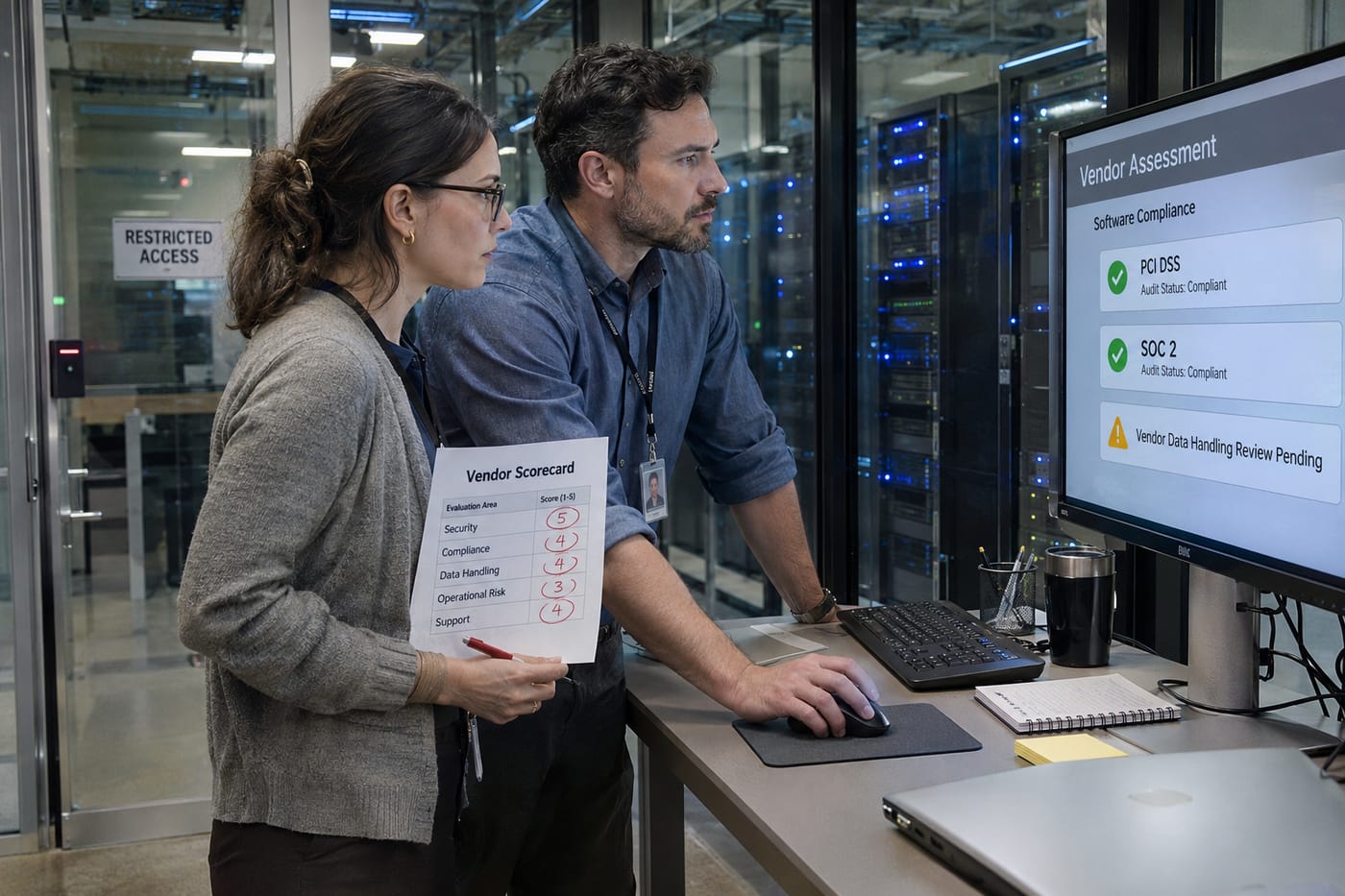
This is where most VP of Engineering decisions get made badly. The default assumption — "we'll just have offshore engineers work on non-PHI code" — breaks down the moment the offshore team needs a realistic staging environment, production logs for debugging, or a customer support escalation path. Each of those is a BAA conversation, a SOC 2 vendor review, and an audit trail.
For HIPAA workloads specifically, the compliance overhead frequently erases the offshore cost advantage on pods under 15 FTE. Above 15 FTE, the fixed compliance cost amortizes and offshore becomes economical again — if you have the internal security staff to run the vendor program properly. We've seen this pattern repeatedly in healthcare builds; our work on HealthPotli's e-pharmacy and drug-interaction AI is one example where the regulatory boundary shaped the delivery model as much as the technical choices did.
5. What happens if you change your mind in month six
The unspoken axis. Onshore partners and fixed-scope offshore contracts both lock you in differently. Onshore staff augmentation is easiest to unwind — notice periods are short, knowledge transfer is same-timezone, you can hire the contractor permanently if they're good. Offshore fixed-scope contracts are hardest — IP transfer provisions, source-code escrow, knowledge handoff across 10 time zones.
If you expect the product definition to churn, optimize for exit flexibility over rate. The savings you capture on rate you will pay back twice on transition cost.
Scoring the options honestly
| Axis | Onshore | Offshore | Nearshore |
|---|---|---|---|
| Fully-loaded TCO | Baseline (1.0x) | 0.55–0.65x | 0.70–0.80x |
| Speed to first commit | 1–2 weeks | 4–8 weeks | 2–4 weeks |
| Scope ambiguity tolerance | High | Low | Medium |
| Regulated-data overhead | Low | High ($40K–$120K setup) | Medium |
| Internal PM burden | 0.1–0.2 FTE per pod | 0.5–1.0 FTE per pod | 0.25–0.5 FTE per pod |
| Exit friction at month 6 | Low | High | Medium |
The case against hiring any development partner
Worth stating plainly because every decision framework that skips this is selling something: for some workloads you should hire in-house and not outsource at all. Specifically:
- The software is your core competitive moat and will be for the next five years.
- You already have an engineering leadership bench that can hire, onboard, and retain senior engineers at scale.
- Your product direction is still forming and you need the people building it to also be shaping it.
- You're in a regulatory environment where every vendor touchpoint multiplies audit surface.
Deloitte's data shows 92% of Global 2000 companies use IT outsourcing, so the "never outsource" position is empirically rare — but it exists for a reason. The honest question is which 10–30% of your engineering work is core enough to keep in-house and which is not.
If you are in situation A, do X
Situation A: Clearly scoped platform work, non-regulated data, 12+ month horizon
Do offshore or nearshore, fixed-scope, with onshore technical leadership. This is where the cost advantage survives contact with reality. Examples: internal tools rebuilds, data pipeline work, mobile app development against a stable API, workflow automation. Budget 0.5 FTE of your own program management per 8-person pod. Insist on SOC 2 Type II from the vendor even if your data isn't regulated — it's a proxy for operational maturity.
Situation B: HIPAA, PCI DSS, or SOC 2 Type II data in scope, pod under 15 FTE
Do onshore or nearshore with explicit BAA and single-region delivery. The compliance surcharge eats the offshore savings at this scale. You can revisit offshore once the pod is large enough to amortize the fixed compliance cost — usually above 20 FTE on a single workstream. This is the pattern we saw on lending work like Cashpo's KYC and AI credit scoring, where the regulated-data boundary dictated where engineers could sit.
Situation C: Ambiguous scope, product discovery, 6–9 month MVP
Do onshore or a hybrid studio model where product, design, and senior engineering sit onshore and build execution extends offshore after the shape is clear. The async feedback cost is highest when requirements are forming. Pay the onshore premium during discovery and recapture it during build. A YC-backed fintech like GimBooks or a marketplace like Vahak shows this pattern — tight product loops during the shaping phase, broader execution once the model is stable.
Situation D: Legacy modernization, large existing codebase, strong internal architecture
Do offshore staff augmentation under onshore architectural direction. The work is well-specified by the existing system, scope ambiguity is low, and the cost advantage is large across a multi-year effort. This is a common digital transformation pattern for US enterprises modernizing out of on-prem Java or .NET estates.
Situation E: You don't have the internal governance capacity to run an offshore program
Do onshore, period, until you've built the capacity. If you cannot staff 0.5–1.0 FTE of program management per offshore pod, offshore will cost you more than onshore and you will be in the 21% failure cohort. Build the muscle on a small nearshore engagement first.
What would turn these ranges into a real quote
Every figure above is a model, not a number for your specific situation. Three specifics turn the model into an actual quote:
- Scope precision. A one-page problem statement produces a different estimate than a 40-page spec. Vendors who quote the first are guessing; vendors who refuse to quote until the second exists are stalling. The honest path is a two-week paid discovery that produces the spec.
- Compliance surface. Which data classes does the team touch, in which environments, under which framework (SOC 2 Type II, HIPAA, PCI DSS, GDPR)? This drives the fixed compliance cost more than headcount does.
- Internal capacity. How many program managers, architects, and security staff can you actually assign to this? This determines whether offshore savings are real or theoretical.
If you want to pressure-test your own situation against this framework for a US-market build, our US delivery team runs these scoping conversations without a sales pitch attached.
Frequently Asked Questions
How much does offshore software development actually save a US enterprise?
Rate cards suggest 60–75% savings. Realistic savings after coordination overhead, rework, and compliance costs land at 40–55%, and at under 15 FTE touching regulated data the savings can disappear entirely once BAA negotiation, SOC 2 vendor review, and data-residency controls are priced in. The number that matters is fully-loaded TCO over 24–36 months, not the hourly rate.
How long does it take to stand up an offshore development pod?
From contract signature to stable velocity, 8–14 weeks is realistic for a non-regulated workload — vendor selection and legal is 2–4 weeks, onboarding and environment setup is 2–4 weeks, and velocity stabilization is another 4–6 weeks. Regulated-data pods add 30–90 days for security questionnaires and BAA negotiation. The specifics that change this are scope clarity, your security team's bandwidth, and whether the vendor already has SOC 2 Type II.
Is offshore development compatible with SOC 2 Type II?
Yes, but it requires a vendor who is themselves SOC 2 Type II certified, written data-handling controls that your auditor accepts, and explicit scoping of which environments offshore staff can access. The cost of getting this wrong — an audit exception traced to a vendor — typically runs $30,000–$80,000 in remediation plus enterprise sales delays. This is a conversation to have with your auditor and outside counsel before vendor selection, not after.
When does nearshore beat both onshore and offshore?
Nearshore (Latin America, Canada) wins when you need overlapping business hours with US teams but cannot justify onshore rates — typically for product-adjacent engineering where same-day iteration matters but core-moat sensitivity is moderate. The TCO sits between onshore and offshore, and the exit friction is lower than deep-offshore. It is often the right answer for growth-stage product teams that have outgrown pure onshore but cannot absorb 8–12 hour time-zone gaps.
What is the single biggest mistake US enterprises make in this decision?
Underestimating the internal program-management headcount required to run an offshore engagement properly. The rate-card comparison assumes a 1:1 engineer substitution; the reality is you add 0.5–1.0 FTE of your own PM time per offshore pod, plus a vendor manager and a security reviewer at portfolio scale. Enterprises that skip this line item end up in the 21% of engagements that fail within 24 months — not because offshore doesn't work, but because they never staffed the governance side of it.
Sources & further reading
- Onshore vs Offshore Software Development: The Real Trade-Offs (Educated Guess)
- Onshore vs Offshore Software Development: True Total Cost of Ownership (Educated Guess)
- IT Outsourcing Statistics 2026: Market Size, Cost Savings & Trends (Stealth Agents, citing Gartner/Statista/Mordor Intelligence)
- IT Outsourcing Industry Statistics 2026: Market Size, Revenue and Global Trends (Quantumrun, citing Statista/Mordor Intelligence)
- Engineer Cost Index 2026: Onshore vs Nearshore vs Offshore (NextGen Coding Company)
- How Much Does Offshore Software Development Cost in 2026 (Wisemonk)
- Offshore Developer Cost Comparison: The Full TCO Guide 2026 (KoreBPO, citing Gartner/GolabsTech)
- What a Three-Region Offshore Portfolio Actually Costs to Run in 2026 (Offshore.dev)
Get one practical guide a week
Costs, AI tools, partner selection — written for people who make the decision. No spam, unsubscribe anytime.
Thanks — you're on the list. One practical guide a week, nothing else.
That didn't work — please check the email address and try again.
Building something in Software & Technology?
CodeNicely partners with founders and tech teams to ship AI-native products that move metrics. Tell us about the problem you're solving.
Talk to our team Book a 30-min call