
What 'We'll Use an AI Agent' Actually Commits You To

 Published by CodeNicely, the product studio founded by Meghal Agrawal and Ujjwal Agrawal in 2017
For: A COO or CIO at an Indian enterprise — logistics, lending, or manufacturing — who has just received a vendor proposal recommending 'AI agents' to automate an ops workflow and needs to know what that phrase actually commits the business to before signing
In this guide
- What an AI agent actually is, in one paragraph
- The business problem it is supposed to solve
- Decode the proposal: which of these four did the vendor actually quote?
- What the regulator now requires, if you are in finance, lending, or insurance
- The cost model nobody shows you
- When a team proposes an agent and shouldn't
- The two questions to ask the person proposing it
- Frequently Asked Questions
When a vendor says they will "use an AI agent" to automate a workflow, you are not being sold a feature — you are being sold a system that decides, a data pipeline that feeds it, a human review layer that oversees it, and, if you are in lending, insurance, logistics, or anything touching customer money in India, a Board-approved governance policy to go with it. Before you sign, you need to know which of those four the vendor has actually scoped, and which they are quietly expecting you to build later at your own cost.
This post is for the COO or CIO reading a proposal right now. It is not a how-to. It is a way to read the proposal.
What an AI agent actually is, in one paragraph
An AI agent is a program that uses a large language model to decide what to do next, calls tools or APIs to do it, and loops until a task is done. That is the only part most vendors agree on. The difference between a useful agent and a demo is almost entirely about what sits around the model: what data it can read, what actions it is allowed to take, who reviews those actions, and what happens when it is wrong.
The analogy that holds up: an AI agent is a new junior analyst. Smart, fast, tireless, overconfident, and occasionally catastrophically wrong in ways a human analyst never would be. You would not let a new hire approve a loan on day one. You would not let them email a customer without review. You would not let them touch the general ledger. An agent needs the same scaffolding, and that scaffolding is where the real work and the real cost live.
The business problem it is supposed to solve
Agents earn their keep on workflows that are high-volume, rule-heavy, require pulling information from multiple systems, and currently eat analyst or ops time. Claims triage. Loan pre-qualification. Shipment exception handling. Vendor invoice reconciliation. Customer support ticket routing with context.
The pitch is real. McKinsey's work on agentic AI in logistics and advanced industries found 20%+ drops in inventory and logistics costs from autonomous routing and scheduling, with broader agentic automation savings in a 30–50% range. Gartner expects 40% of enterprise applications to include task-specific AI agents by end of 2026, up from under 5% in 2025.
The pitch is also fragile. The same Gartner analysts forecast that over 40% of agentic AI projects will be canceled by end of 2027 because of escalating cost, unclear value, or missing risk controls. McKinsey's State of AI 2025 found 62% of organizations are experimenting with agents, but fewer than 40% of AI investors report measurable gains. The gap between demo and production is where most of the money gets burned.
Decode the proposal: which of these four did the vendor actually quote?
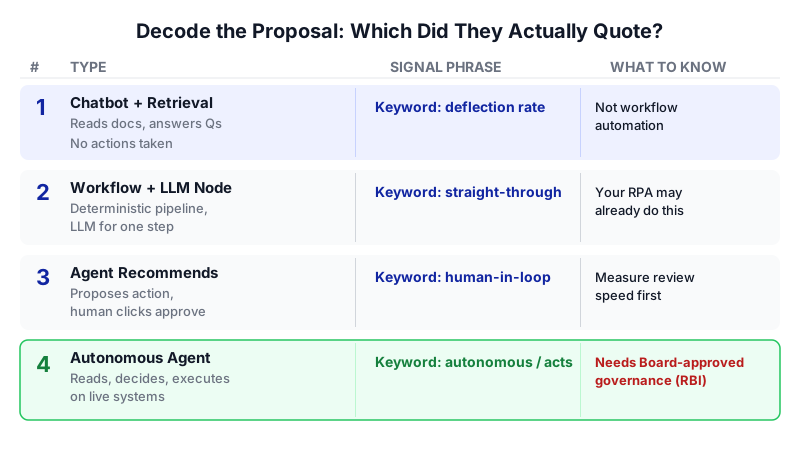
Most "AI agent" proposals land in one of four buckets. The price tags look similar. The commitments do not.

1. A chatbot with retrieval, dressed up
The agent reads from your documents or FAQ and answers questions. It does not take actions. It does not touch transactional systems. This is useful for internal knowledge, HR queries, or Tier-1 support. It is not what most ops leaders mean when they say "automate the workflow." If the proposal talks about "deflection rate" and not "straight-through processing," this is what you are buying.
2. A workflow automation tool with an LLM in the middle
The vendor has built a deterministic pipeline (triggers, API calls, approvals) and uses an LLM for one step — usually classification, extraction, or drafting. This is often the right answer. It is also something your existing iPaaS or RPA stack can probably do with an LLM node bolted on. Ask whether you are paying agent prices for workflow work.
3. An agent that recommends, with a human acting
The agent reads live data, proposes an action, and a human clicks approve. This is the realistic 2025 enterprise pattern for anything regulated. The economics only work if the human review is faster than doing the work from scratch. Measure that before, not after.
4. An agent that acts autonomously on live systems
The agent reads, decides, and executes against production APIs — moving money, updating credit limits, dispatching vehicles, releasing shipments. This is the category with the highest ROI and the highest regulatory and reputational exposure. If your vendor has quoted this for an India-regulated workflow without a governance section, the proposal is incomplete.
What the regulator now requires, if you are in finance, lending, or insurance
This is the part most vendor decks skip. The RBI FREE-AI framework, released 13 August 2025, is not guidance. For regulated entities it sets 26 recommendations across six pillars and, among other things, requires a Board-approved AI governance policy, explicit explainability thresholds per model, and documented human-override paths for high-stakes decisions — credit, claims, fraud.
RBI's own survey of 612 regulated entities found only around 28% had human-in-the-loop oversight, 15% used interpretability tools, 18% kept audit logs, and roughly a third had any board-level AI oversight. FREE-AI was written to close that gap. If you are one of the entities on the wrong side of those numbers, the compliance build is on your clock, not the vendor's.
A specific consequence worth reading twice: customers must be informed when AI is involved in a decision and retain the right to override or challenge it. Any agent touching onboarding, credit, or claims needs a disclosed, auditable appeal path built before go-live — not after a complaint.
Layered on top: MeitY's national AI Governance Guidelines published 5 November 2025, and IRDAI's 2025 Regulatory Sandbox rules for AI-driven InsurTech. If your workflow touches finance and insurance, you now have a multi-regulator stack to satisfy. A lawyer, not this blog, should tell you exactly which clauses apply — but a vendor who cannot name these frameworks in their proposal has not priced for them.
The cost model nobody shows you
The model API fee is the cheapest part. Below is the shape of the real run-rate, in order of what tends to dominate.
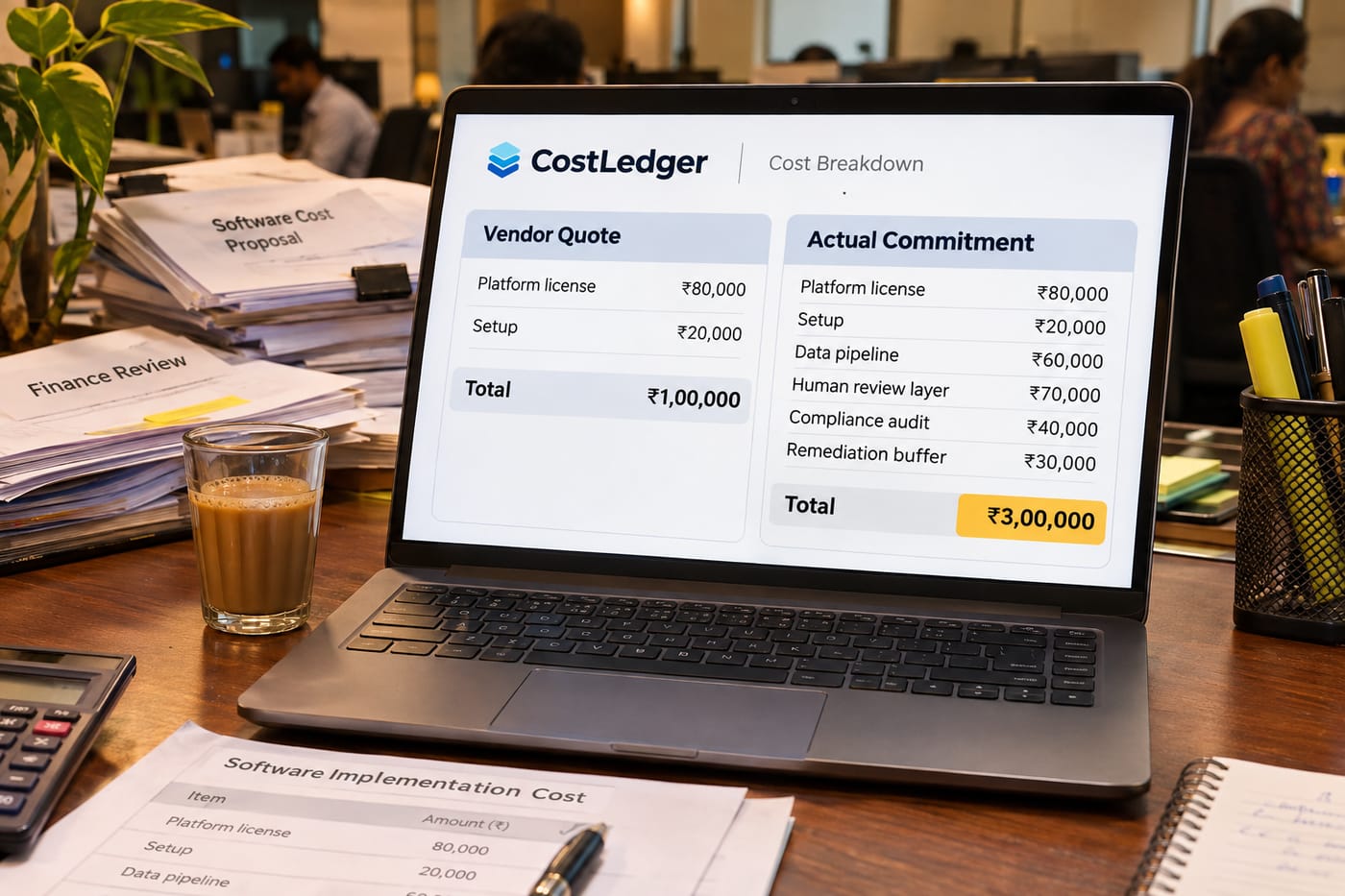
- Human review labor. If every agent action needs a reviewer, your ongoing cost is a function of reviewer salary times volume times review time, not token cost. Halving review time is worth more than halving model cost.
- Data plumbing. The agent is only as good as the live data it can reach. Connectors to your core banking, LOS, TMS, or WMS, plus the identity, logging, and rate-limiting around them, are usually the largest one-time build.
- Evaluation and regression. Models change. Prompts change. Your rules change. You need a test harness that replays real past cases and flags behavior drift. Without it, you cannot certify the agent is still safe next quarter.
- Audit, logging, explainability. FREE-AI expects traceable decisions. That is storage, retention, and a reviewer UI — real engineering, not a checkbox.
- Governance overhead. Board policy, model risk committee, incident response. Mostly people time, but real.
- Model and infrastructure fees. The thing everyone quotes. Often less than 20% of total run cost at steady state.
Illustrative only: picture a lending agent that pre-qualifies two-wheeler loan applications, reads from three internal systems, drafts a decision, and routes to a human underwriter. Assume no new data platform is needed and the existing LOS has usable APIs. In that shape, model fees are a minor line item; the dominant costs over three years are the underwriter review time, the connector maintenance, and the audit log infrastructure. Change any one of those assumptions — add a data migration, add a fourth system, require sub-second latency — and the ranking shifts. The only honest way to turn this into a number is to scope the specific workflow, volume, and systems; that conversation is what a studio like CodeNicely's AI studio or your internal team should be having before you sign.
When a team proposes an agent and shouldn't
- The workflow is deterministic. If the rules fit on one page and never change, a rules engine is cheaper, faster, and auditable by default.
- The volume is low. Under a few hundred cases a month, human analysts are cheaper than the build.
- The upstream data is bad. An agent cannot fix a broken master data problem. It will just automate the confusion.
- There is no owner for model risk. If nobody in the org is accountable for "the agent made a bad decision today," do not deploy one.
- The goal is headcount reduction in a regulated process. FREE-AI effectively requires humans in the loop for high-stakes decisions. You are not removing them; you are repositioning them.
The two questions to ask the person proposing it
You do not need to become a machine learning engineer to evaluate an agent proposal. You need two answers in writing.
1. "Draw me the decision path for one real case, and show me where a human is in the loop, where the audit log is written, and which regulation covers each step." If they cannot do this on a whiteboard in fifteen minutes, they have not designed the system. They have designed a demo.
2. "What is the three-year run cost split across model fees, human review, data integration maintenance, and audit infrastructure — and who pays for each?" The honest answer is a range with stated assumptions. A single number, or a number that is 90% model fees, means they are either underestimating or planning to send you a change order in month four.
If the proposal survives both questions, you have something worth scoping properly. If it does not, you have saved yourself from being one of the 40% of agentic AI projects Gartner expects to be canceled by 2027. For related reading on how similar decisions play out in regulated lending or logistics operations, the case studies are more useful than any framework.
Frequently Asked Questions
Is an AI agent the same as RPA or workflow automation?
No, but the line is blurry and vendors exploit that. RPA follows fixed rules and breaks when the screen or the input changes. An agent uses an LLM to decide what to do, which makes it more flexible and less predictable. For stable, high-volume, rule-based work, RPA is usually cheaper and easier to audit. For work that requires reading unstructured input or reasoning across systems, an agent earns its cost — if the governance is in place.
What does an AI agent actually cost to run in an Indian enterprise?
The honest answer is a range driven by five things: the volume of decisions per month, how much human review each decision requires, how many live systems the agent must integrate with, how stringent your audit and explainability requirements are under RBI or IRDAI rules, and whether you already have a usable data layer. Model API fees are usually the smallest line. The two specifics that turn a range into a real quote are the target workflow's monthly volume and the list of systems it must read from and write to. That is a scoping conversation, not a blog answer.
Does RBI's FREE-AI framework apply to us if we are not a bank?
If you are an RBI-regulated entity — NBFC, payments, lending, cards — yes. If you are an insurer, IRDAI's 2025 sandbox rules apply. If neither, MeitY's November 2025 national AI governance guidelines still create baseline expectations around transparency, grievance redress, and risk management. A lawyer should confirm your exact exposure; this post is not legal advice.
How long before an AI agent pilot produces measurable value?
Shape, not number: pilots that target one workflow with clean data and an engaged business owner tend to show signal faster than cross-functional "platform" plays. McKinsey's 2025 data shows most organizations experimenting with agents are not yet reporting measurable gains, which tells you the median pilot is slower than the vendor deck implies. The levers that actually move timeline are scope discipline, data readiness, and whether a human reviewer is designed into the workflow from day one.
Can we start with an agent that only recommends, and automate later?
Yes, and for most regulated workflows in India this is the sensible path. Deploy the agent as a decision support tool, measure the quality of its recommendations against human outcomes for a defined period, then expand its authority on narrow slices where accuracy and audit trails justify it. This also aligns with FREE-AI's expectation of human override for high-stakes decisions.
Sources & further reading
- Gartner Predicts Sharp Rise in AI Agents Within Enterprise Applications by 2026 — Process Excellence Network
- Gartner: Agentic AI Hype Cycle & Project Cancellation Forecast — datagrid.com
- The State of AI in 2025: Agents, Innovation, and Transformation — McKinsey (November 2025 PDF)
- Empowering Advanced Industries with Agentic AI — McKinsey
- RBI FREE-AI Committee Report — Framework for Responsible and Ethical Enablement of AI (13 August 2025)
- RBI's FREE-AI Framework: Key Highlights Summarised — AuthBridge
- AI Accountability in Banking: RBI's Proposed Framework for Explainability, Oversight and Model Risk — AMlegals
- India AI Governance Framework 2026: From Advisories to Regulation (MeitY + IRDAI layer) — Veritect.ai
Get one practical guide a week
Costs, AI tools, partner selection — written for people who make the decision. No spam, unsubscribe anytime.
Thanks — you're on the list. One practical guide a week, nothing else.
That didn't work — please check the email address and try again.
Building something in Software & Technology?
CodeNicely partners with founders and tech teams to ship AI-native products that move metrics. Tell us about the problem you're solving.
Talk to our team Book a 30-min call