
Hiring Locally vs. Outsourcing: What Indian Startups Miss

 Published by CodeNicely, the product studio founded by Meghal Agrawal and Ujjwal Agrawal in 2017
For: A seed-to-Series-A founder in Bengaluru or Delhi whose first product is built but whose roadmap is 6–9 months behind because they cannot decide whether to hire two full-time engineers or stay with an external dev partner — and their next funding conversation is in 90 days
In this guide
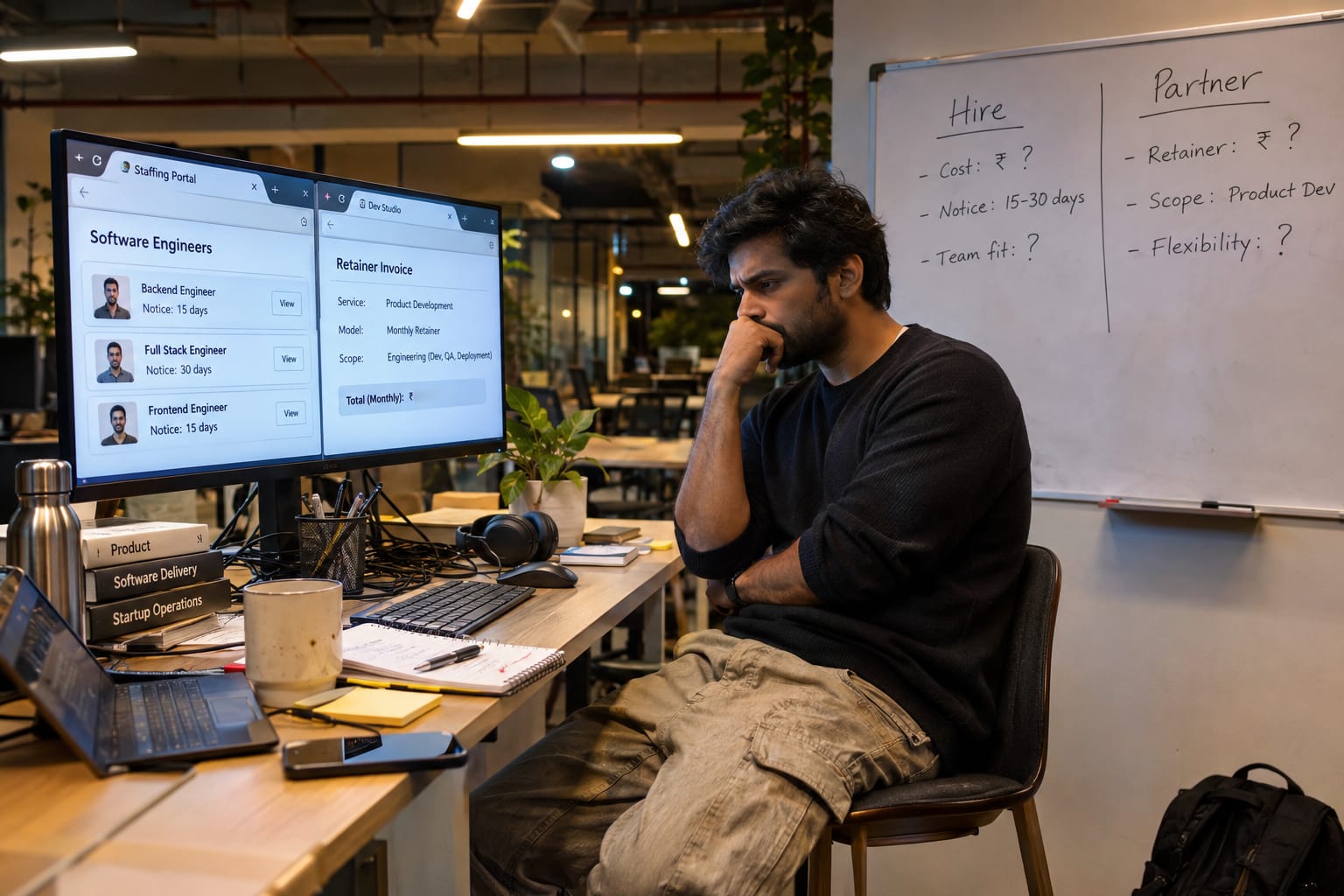
If you have a product in market, 90 days to your next funding conversation, and a roadmap six months behind, the correct choice is almost never the one that feels cheapest on the spreadsheet. A dev partner looks expensive at the retainer level and cheap at the delivered-feature level. A full-time hire looks cheap at CTC and expensive once you count the 62-day notice period, the 28% chance they ghost you on joining day, and the three months before their code stops needing rework. The honest answer: for most Indian startups between seed and Series A, a dev partner is cheaper and faster through roughly month seven. After that, in-house wins — if you survived long enough to get there.
This post gives you the framework to decide which side of month seven your company actually lives on.
The decision, stated plainly
You are choosing between two commercial structures, not two talent pools. Both draw from the same 5.4–5.95 million-person Indian engineering workforce NASSCOM counts in FY26. The question is who carries the hiring risk, the ramp cost, and the bench time between features.
- Option A — Hire in-house. Two full-time engineers at ₹18–28 LPA each. You own the IP, the context, the roadmap velocity, and every rupee of PF, gratuity, notice-period gap, and attrition risk.
- Option B — Retain a dev partner. ₹6–12 lakh/month covers a small pod (typically 2–4 people, fractional PM, fractional design). The partner carries hiring, bench, and ramp risk. You rent delivery velocity and give up some context depth.
There is no universal winner. There is a crossover point, and the five axes below decide where yours sits.
The five axes that actually decide this
1. Time to first shipped feature
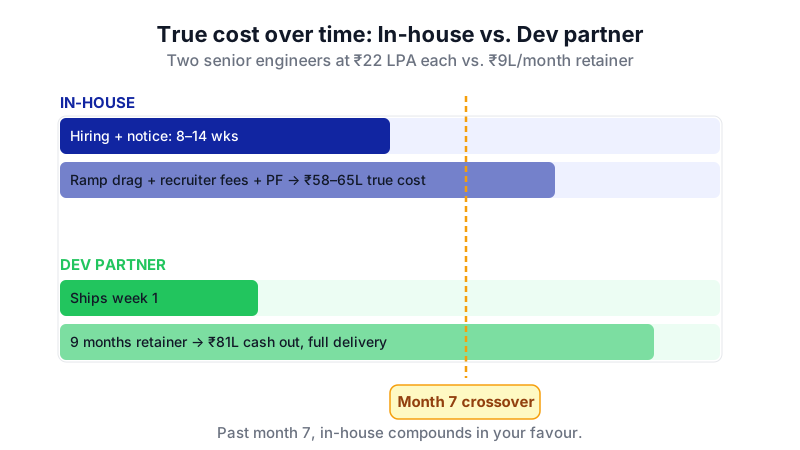
This is the axis founders undercount most. A senior engineer in India serves an average notice period of 62 days in 2026, and end-to-end sourcing plus notice runs 8–14 weeks per Quantalent AI. Then onboarding. Then ramp — roughly 25% productivity in month one, full productivity around month three for seniors in a non-trivial codebase.

Illustrative math, with every assumption stated: if you sign an offer on day 1, the realistic timeline to "first feature shipped without heavy review rework" for a senior hire is week 16–20. Two hires doubles the coordination overhead but not the wait — unless one of them is in the 28% of accepted offers that drop before joining, in which case you restart.
A dev partner with an existing delivery rhythm ships week one. That is the entire argument for outsourcing in the first 90 days before a funding round.
2. Total cost of ownership at month 9
Compare what you actually pay, not what the offer letter says.
Full-time hire, true cost: Base CTC + ~13% employer EPF load (12% contribution, 0.5% EDLI, 0.5% admin) + gratuity accrual + laptop/tools/software + recruiter fees (typically 8.33% of annual CTC) + the $40,000+ SHRM estimates in ramp-up productivity loss per hire when reduced output, manager coaching time, and rework are counted.
Illustrative worked example: two senior engineers at ₹22 LPA each. True 12-month cost lands closer to ₹58–65 lakh once PF, recruiter fees, equipment, and ramp drag are counted — not the ₹44 lakh in the headline. Assumption: no attrition, no no-show, standard tooling.
Dev partner, true cost: Retainer × months + scope-change cost + whatever you pay internally to manage them (a part-time technical founder usually, 4–6 hours/week). No PF, no gratuity, no laptops, no recruiter fees, no ramp.
At ₹9 lakh/month × 9 months = ₹81 lakh. Higher cash out. But you got nine months of shipping, not five months of shipping plus four months of hiring and waiting.
The crossover is roughly month seven. Past that, in-house compounds in your favour — the ramp cost is sunk, PF is a fixed line, and marginal output per rupee improves every month the team stays.
3. Key-person risk
If one of two full-time engineers resigns at month 10, you lose 50% of your engineering capacity, 50% of your codebase context, and you restart the 8–14 week hiring cycle. India's senior engineering attrition sits in the high teens annually; the probability of one of two hires leaving inside 18 months is not low.
A dev partner carries this risk on their balance sheet. If their lead engineer quits, you get a replacement from their bench with a handover week, not a hiring cycle. You pay for this insurance in the margin baked into their retainer. Whether it is worth it depends on whether you can afford a 10-week gap at month 10.
4. What happens if you change your mind in month six
This is the axis nobody discusses honestly in the pitch meeting. Roadmaps change. Series A theses pivot. A payments feature becomes a compliance feature becomes a lending feature.
With full-time hires, changing direction means either retraining or firing — and firing engineers in India carries legal and reputational cost that lingers in the ecosystem. With a dev partner, you renegotiate the statement of work. A good partner has already worked across fintech, healthtech, logistics, and lending — the pattern library moves with them. Look at how a lending product with KYC and AI credit scoring and an e-pharmacy with drug-interaction AI share almost no domain vocabulary but 60% of their delivery playbook.
5. Depth of product context
Here the full-time hire wins unambiguously, and anyone selling you outsourcing who denies this is selling. A full-time engineer sits in standups, hears customer calls, debugs production at 2am, and builds the kind of tacit product intuition that makes a Series B team ship three times faster than a Series A team on the same stack. A dev partner, however good, is renting you execution with limited domain osmosis.
If your moat is engineering depth on a hard technical problem — real-time infrastructure, ML models you tune weekly, a proprietary matching engine — in-house is correct even at the cost penalty. If your moat is distribution, GTM, or a specific vertical workflow where execution speed matters more than engineering elegance, a partner is correct.
Scoring the two options honestly
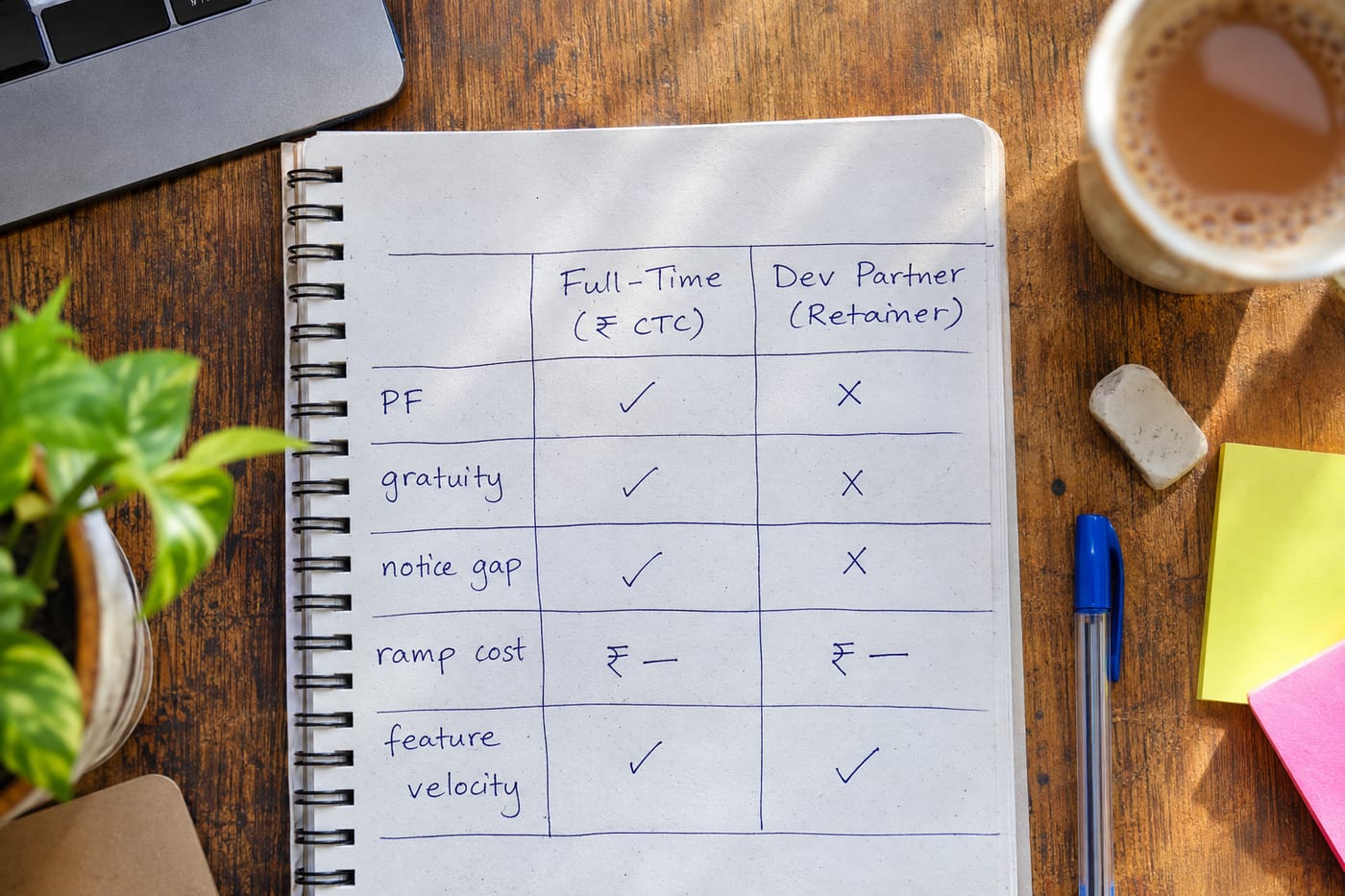
| Axis | Full-time hire | Dev partner |
|---|---|---|
| Time to first shipped feature | 16–20 weeks | 1–2 weeks |
| Cost through month 6 | Higher (ramp drag) | Lower |
| Cost beyond month 9 | Lower | Higher |
| Key-person risk | Carried by you | Carried by partner |
| Pivot flexibility | Low | High |
| Product context depth | High | Medium |
| IP ownership | Clean | Clean only if contract says so — check this |
The case against hiring an agency at all
This framework would be dishonest without it.
- You will not build engineering culture through a vendor. If your plan is to be a 40-engineer company in 24 months, you need the first five hires in-house setting the bar. Outsource the sixth-through-tenth project, not the first.
- Bad partners exist in volume. India's $21.4 billion domestic IT services outsourcing market (Grand View Research, 2024) growing at 13.4% CAGR means supply is abundant and quality variance is enormous. A partner that ships a beautiful MVP in month three and disappears into bug-fix hell in month six is common enough that you should assume it until proven otherwise. Reference-check the month-nine clients, not the month-three ones.
- IP and velocity lock-in. If the contract does not explicitly transfer source code, architecture docs, cloud accounts, and CI/CD pipelines to your ownership from day one, you are renting your own product. Get a lawyer to read the MSA before signing — this is not an area to take blog advice on.
- Context handover is real work. When you eventually move in-house, budget 4–6 weeks of overlap and expect the first in-house engineers to rewrite 20–30% of what they inherit. This is normal, not a failure of the partner.
If you're in situation A, do X
Situation A: Pre-Series-A, 90 days to pitch, roadmap behind, technical founder stretched
Retain a dev partner. Ship the next three roadmap milestones. Use the Series A proceeds to hire the first two in-house engineers as the partner winds down to a maintenance role. Your goal is not to minimise the next nine months of spend — it is to raise the round. Velocity now is worth more than TCO optimisation at month 12.
Situation B: Series A closed, 18-month runway, planning to be 25+ engineers in 24 months
Start hiring in-house immediately. Use a dev partner only for a parallel workstream — a second product surface, a data-platform build, an AI feature your team cannot staff this quarter. The partner is a capacity valve, not the engine.
Situation C: Deeply technical moat (ML, infra, real-time systems)
In-house, always. Pay the 16-week wait. The depth you need cannot be rented, and the context loss on partner handover will cost you more than the ramp did. A partner here is appropriate only for surrounding work — admin dashboards, internal tooling, the mobile app wrapper.
Situation D: Modernising a legacy product or embedding AI into existing operations
Partner-led, with your product owner embedded daily. The work is pattern-heavy, the risk is integration risk, and a team that has done five legacy modernization and AI-embedding projects will outrun one that is doing its first. Transition to in-house ownership after the second major release.
Situation E: Non-technical founder, first product
Partner. You cannot hire well for roles you cannot evaluate, and a bad first senior hire at this stage is a 12-month setback. Use the partner to ship v1 and to help you recruit (and interview) the first in-house tech lead once there is traction to show them.
The three specifics that turn any range into a quote
Every cost figure above is a shape, not a quote. Before anyone — a partner, a recruiter, a CFO — can give you a real number, you need three things on paper:
- Scope. Not "build the v2" but a feature list with acceptance criteria, integration points (payments, KYC, SMS, maps, LLM APIs), and non-functional requirements (latency, uptime, compliance regime).
- Existing state. Codebase size, tech stack, test coverage, documentation quality, whether data needs migration, and who owns the current cloud account.
- Decision speed. How fast you can give yes/no answers on product calls. This is the single largest determinant of velocity on any engagement, in-house or outsourced, and the one founders most consistently underestimate.
With those three documented, both a recruiter and a dev partner can quote you honestly. Without them, every number is a guess that will change in month three.
If you want a second pair of eyes on whether a partner structure fits your specific stage, our team at CodeNicely is happy to look at your roadmap and tell you plainly where in the framework above you sit — including when the answer is "hire in-house, not us."
Frequently Asked Questions
At what team size should an Indian startup stop outsourcing entirely?
Usually between 8 and 12 in-house engineers. Below that, a partner adds capacity faster than you can hire. Above that, coordination cost with an external team starts to exceed the velocity it adds, and your internal engineers should be setting architectural direction without vendor involvement. The exact number depends on how specialised your domain is.
How do I protect IP when working with a development partner in India?
Three contractual requirements, non-negotiable: (1) source code, infrastructure, and all artefacts are your property from the moment of creation, not on project completion; (2) cloud accounts, domains, and third-party service accounts are in your name from day one; (3) a documented handover clause specifying what you receive if the engagement ends mid-sprint. Have a lawyer familiar with Indian IT services contracts review the MSA — generic templates miss the operational clauses that matter.
What really drives the cost difference between hiring and outsourcing?
Four hidden line items, mostly: the ~13% employer EPF load on top of CTC, the ramp-up productivity loss SHRM estimates at over $40,000 per hire, recruiter fees (typically 8.33% of annual CTC), and the carrying cost of the 62-day notice-period gap. A partner retainer bundles these into one line, which looks expensive until you itemise what you are actually paying for in-house.
Can I hire one in-house lead and use a partner for the rest of the team?Yes — this is often the best structure between seed and Series A. One strong in-house technical lead sets architecture, owns code review, and carries product context. The partner provides execution capacity. This gives you most of the velocity of a full outsourced team and most of the context depth of a full in-house team, at a cost between the two. The failure mode is hiring the lead too junior to push back on the partner; budget for a genuinely senior profile here.
How do I evaluate a dev partner's real quality, not their pitch deck?
Ask to speak to two clients who are past month nine with them, not month three. Ask what the partner shipped last week, not last year. Ask what their engineer attrition was in the last twelve months and who owns the code if the engagement ends tomorrow. The quality of their answers to those four questions tells you more than any portfolio page. If they resist any of them, move on — India's outsourcing supply is deep enough that you do not need to settle.
Sources & further reading
- The India Tech Hiring Playbook 2026 — Teksands
- How Long Does It Take to Hire Engineers in India? 2026 — Quantalent AI
- A CHRO's Guide to Software Developer Hiring India — Taggd
- New Developer Onboarding: Ramp-Up to Full Productivity — DEV Community / PanDev Metrics
- Ramp-Up Period: Meaning, Timeline & 30-60-90 Plan (SHRM 2023 data) — Hyring.com
- Developer Onboarding Process: The Complete Guide 2026 (SHRM 2025 data) — Cycloid
- PF Compliance in India: Complete Guide for Startups & Businesses — Treelife
- India IT Services Outsourcing Market Size & Outlook, 2030 — Grand View Research
Get one practical guide a week
Costs, AI tools, partner selection — written for people who make the decision. No spam, unsubscribe anytime.
Thanks — you're on the list. One practical guide a week, nothing else.
That didn't work — please check the email address and try again.
Building something in Software & Technology?
CodeNicely partners with founders and tech teams to ship AI-native products that move metrics. Tell us about the problem you're solving.
Talk to our team Book a 30-min call