
How Long Does a Live System Migration Actually Take in the UAE

 Published by CodeNicely, the product studio founded by Meghal Agrawal and Ujjwal Agrawal in 2017
For: COO or IT director at a UAE multi-entity trading or services group running a legacy ERP or custom-built system that cannot go offline — deciding whether to approve a migration project and how long to protect operations around it
In this guide
- Why the vendor's quoted timeline is almost never the real timeline
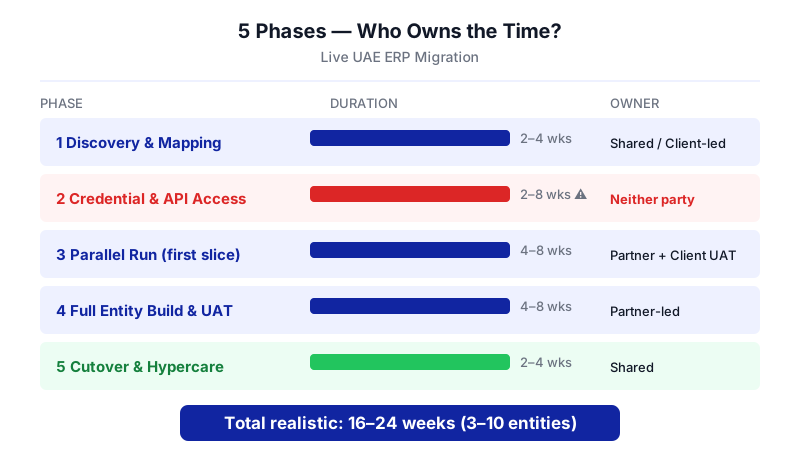
- The five phases of a live UAE migration — and who owns each one
- A realistic total, assembled
- The three things that most reliably add weeks
- The context: UAE is a growing, not shrinking, ERP market
- What to do in week zero to shorten the whole thing
- How CodeNicely can help
- Frequently Asked Questions
A realistic live-system migration for a UAE multi-entity trading or services group runs 16 to 24 weeks for three to ten entities on a single ERP, and 9 to 18 months once you cross ten entities, multiple jurisdictions, or regulated financial workflows (Octura benchmark framework). The elapsed time is driven less by code and more by three things the migration vendor does not control: written release of credentials from your incumbent vendor, access windows from your own data owners, and regulatory sign-off from CBUAE, DIFC or ADGM where applicable. If you are deciding whether to approve the project now, the question is not “is the vendor's number right” — it is “which weeks on that Gantt chart are mine to lose.”
This post breaks the elapsed time into the five phases a COO or IT director can actually track, says which phases depend on you rather than the vendor, names the three things that most often add weeks, and ends with what you can do in week zero to compress the whole thing.
Why the vendor's quoted timeline is almost never the real timeline
Panorama Consulting's 2025 ERP Report, based on 131 respondents, put the median ERP project at nine months — down from 15.5 months the year before (Panorama 2025). Encouraging, until you read IDC's 2024 data: 75% of ERP deployments slip more than 25% past their original end date, with a median overrun of 27% (Net Fusion / IDC 2024). Gartner goes further — by 2027, more than 70% of recently implemented ERP initiatives will fail to fully meet original business case goals, and up to 25% will fail catastrophically (Flowscope citing Gartner).
Panorama's 2026 follow-up names the mechanism bluntly: the top schedule killers are “delayed vendor deliverables, unplanned change orders, and unclear ownership between the SI and vendor.” Translated into a UAE context, the SI is your migration partner. The “vendor” is the incumbent system you are leaving. And the ownership gap between them is where four to eight weeks go to die.
The five phases of a live UAE migration — and who owns each one
Phase 1: Discovery and current-state mapping (2–4 weeks)
Owner: shared, leans client. The migration partner runs workshops, documents your chart of accounts across entities, maps the integration surface (banks, VAT filing, courier APIs, payroll, WPS, any custom modules), and extracts a schema from your legacy system. Sounds routine. It is not.
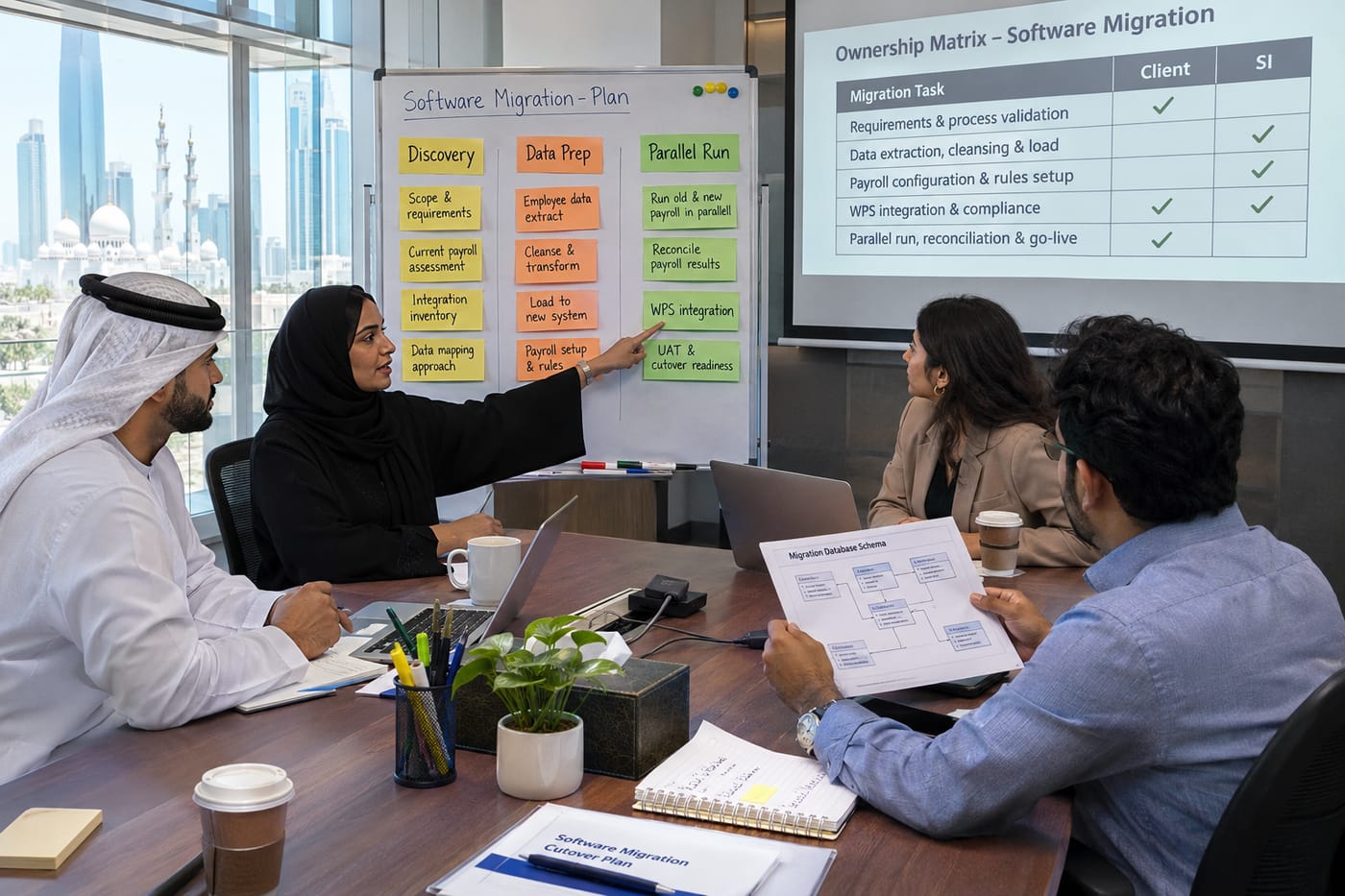
Discovery stalls when the people who actually know how the legacy system is wired — usually one or two long-tenured finance or IT staff — cannot give eight uninterrupted hours a week. If your CFO cannot name the single person who knows which custom field in the sales module drives inter-entity settlement, assume Phase 1 takes four weeks, not two.
Early signal of delay: three weeks in, the partner is still asking for a data dictionary that does not exist.
Phase 2: Integration access and credential release (2–8 weeks, mostly outside both parties' control)
This is the phase that most reliably blows up timelines, and the one almost no statement of work assigns ownership for. It has three sub-items:
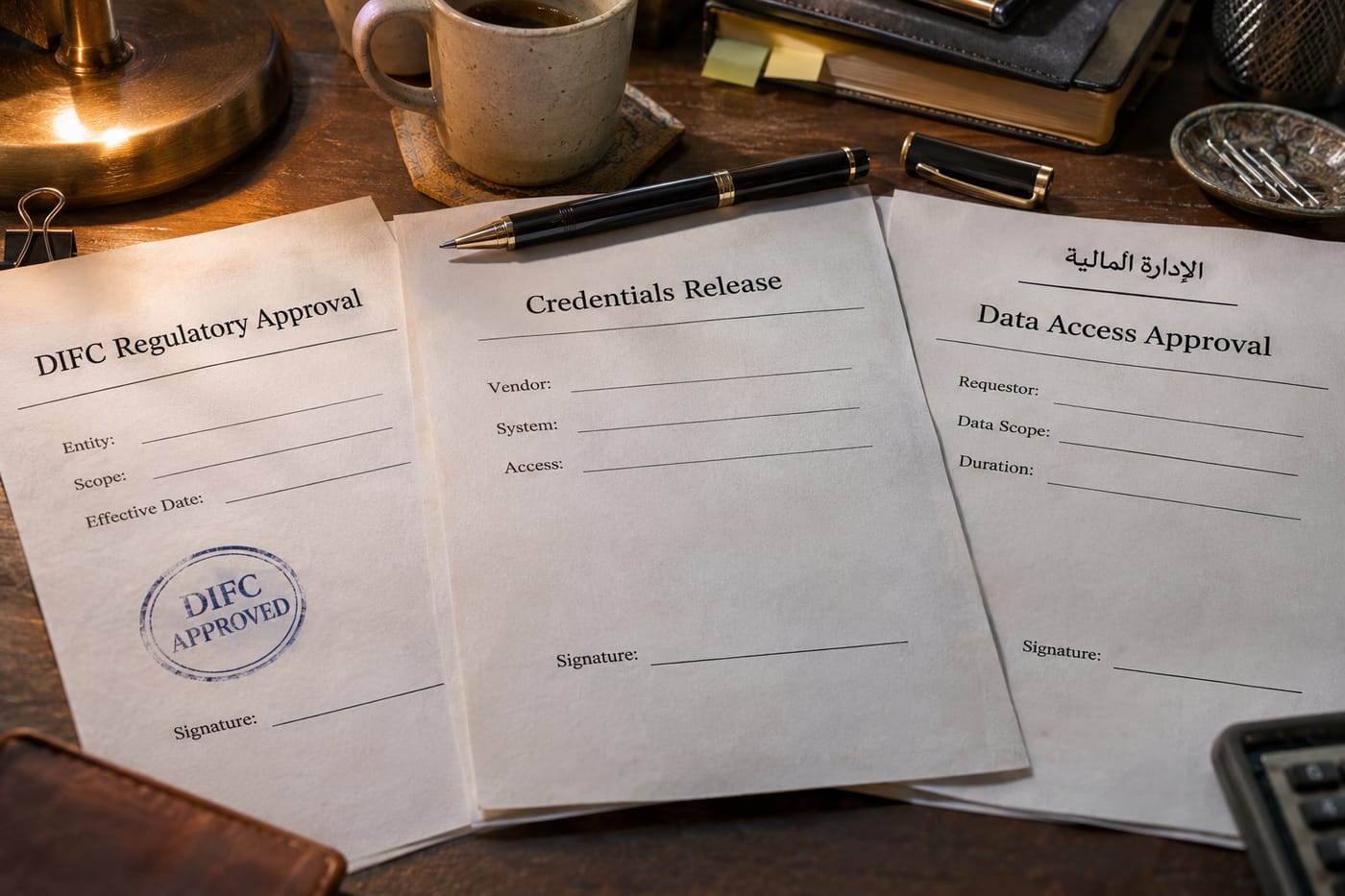
- Written release from the incumbent vendor. You need API credentials, schema documentation, and often a data-export cooperation clause. Incumbent vendors are rarely motivated to cooperate quickly. Expect four to eight weeks of legal and commercial back-and-forth before you see a signed letter. Start this in week zero, not week eight.
- Third-party API credentials. Emirates NBD or ADCB host-to-host banking, FTA e-invoicing endpoints, WPS gateway, courier partners, payment gateways. Each has its own onboarding queue — typically two to six weeks per integration, run in parallel if someone owns the tracker.
- Regulatory pre-notification where it applies. If you are a financial institution, exchange house, or any entity under CBUAE supervision, the central bank requires a written no-objection before a core system goes live, and a material change to a critical operation requires an independent expert report filed at least 30 calendar days ahead of implementation (CBUAE 30-day notice rule, Business CISO; MAST Consulting on CBUAE migration assurance). For a brand-new license, CBUAE approvals run 6–12 months; DIFC and ADGM 3–6 months (Remitso 2026 licensing guide). You are not re-licensing, but the notification clock is real.
Early signal of delay: week six, and the incumbent vendor's account manager is “checking with legal.” That means another month. Escalate commercially.
Phase 3: First usable slice in parallel-run (4–8 weeks)
Owner: migration partner, with client UAT. A competent partner will not try to rebuild everything before anyone sees it. They will pick one entity or one business flow — often the simplest trading entity, or a single warehouse's inventory — and get it running on the new system in parallel with the legacy. Real transactions flow through both. Finance reconciles daily.
This is where you learn what the discovery phase missed. Expect the first slice to surface ten to twenty assumptions that turn out to be wrong — a currency-rounding rule, an obscure VAT treatment for a free-zone entity, a report the auditor needs in a specific format. Budget two weeks of rework.
For multi-entity groups with 30–50% of the total effort typically consumed by integration rebuilds alone (Octura), the first slice is where you find out whether the integration estimates were sane.
Phase 4: Hardening, data migration rehearsal, and cutover plan (3–6 weeks)
Owner: migration partner, with client sign-off on the cutover runbook. Full historical data gets migrated into staging. The team runs at least two full dress rehearsals of the cutover — extract, transform, load, reconcile, switch DNS or integration endpoints, smoke test. Each rehearsal surfaces something: a bank file format the test environment did not have, a user who logs in from a VPN that was not in scope.
The cutover runbook itself is a document the COO should read. It should list, hour by hour: who freezes what, what the rollback trigger is, who can call “abort,” and what the maximum tolerable data loss window is (usually zero for financial transactions, minutes for operational data).
Phase 5: Cutover and hyper-care (1 week cutover + 4–8 weeks hyper-care)
Owner: shared. A true zero-downtime migration uses one of two patterns — a strangler-fig cutover where the new system takes over module by module, or a dual-write period followed by a read-switch. Either way, the weekend of the cutover is not the end. Hyper-care is where the partner sits with your finance and operations team daily, fixes the long tail of edge cases, and transfers knowledge to your internal admins.
Cutting hyper-care short to save budget is the single most common reason a “successful” migration shows up as a disaster in the next month-end close.
A realistic total, assembled
For a mid-size UAE trading group — six entities, one core ERP, eight integrations, no regulated financial activity — a disciplined timeline looks like this. This is illustrative; your numbers depend on the specifics below.
| Phase | Elapsed weeks | Primary risk owner |
|---|---|---|
| Discovery | 3 | Client (SME access) |
| Integration access & credentials | 4–8 (overlaps discovery) | Incumbent vendor + third parties |
| First usable slice | 6 | Migration partner |
| Hardening & rehearsal | 4 | Migration partner |
| Cutover + hyper-care | 5 (1 + 4) | Shared |
| Total elapsed | 18–22 weeks |
That matches the Octura benchmark for 3–10 entity enterprises of 16–24 weeks. Add a CBUAE-regulated entity and the 30-day independent expert report window pushes you to 22–26. Add a tenth entity in a different jurisdiction with its own tax and payroll rules, and you are in the 9–18 month band.
The three things that most reliably add weeks
1. Incumbent vendor cooperation on credentials and schema
Four to eight weeks, and sometimes more if the commercial relationship is bad. Early signal: the incumbent asks to “scope” the data export as a paid engagement. That is a negotiation, not a technical question. What to do in week zero: have your legal counsel send a written request for API credentials, schema, and export cooperation, citing the termination clause of the existing contract. Do this before you sign with the migration partner.
2. Data-owner availability inside your own business
Two to four weeks of slippage. Early signal: workshop attendance drops off after week two because month-end hit. What to do in week zero: name a single full-time migration lead on your side — not a committee — and back-fill their day job. A migration run as someone's third priority will take twice as long as one run as someone's first.
3. Regulatory notification and approval windows
Four to twelve weeks for CBUAE-regulated changes; 30 calendar days minimum for an independent expert report on a material change (Business CISO on CBUAE Open Finance). Early signal: no one on the call can name which of your entities is directly supervised and which is not. What to do in week zero: ask your compliance lead for a one-page map of which entities need which notifications, and start the regulator conversation in parallel with discovery, not after it. A compliance lawyer should review the specifics — the CBUAE framework has material carve-outs for the kind of activity and the kind of change.
The context: UAE is a growing, not shrinking, ERP market
The UAE ERP software market generated USD 631.8 million in 2025 and is projected to reach USD 1.5 billion by 2033 at an 11.6% CAGR (Grand View Research). What that means practically: you are not an edge case. The talent, the integration partners, and the regulatory playbooks for a UAE live migration are more mature than they were three years ago. Vendors who claim everything is bespoke are often hiding scope they do not want to commit to.
What to do in week zero to shorten the whole thing
- Send the incumbent vendor a written credentials-release request before you sign anything else. This is the single highest-leverage action.
- Name one internal migration lead, not a steering committee. Protect 60% of their calendar.
- Get a one-page regulatory map of which entities trigger which CBUAE, DIFC, ADGM or FTA notifications.
- Insist the SOW assigns ownership for every third-party credential and every regulator interaction — with a named person on each side and a target date.
- Agree the cutover pattern up front — strangler-fig or dual-write — so the architecture decisions in Phase 3 do not get relitigated in Phase 5.
- Budget hyper-care through the next month-end close. If the partner wants to demobilise before that, say no.
How CodeNicely can help
Our work on GimBooks — a YC-backed accounting SaaS serving businesses with multi-entity books, GST filings and bank reconciliations — gave us direct experience with the parts of a live migration that look boring until they break: schema drift across entities, VAT and tax edge cases, bank-format integrations, and the operational discipline needed to run dual-write periods without losing a single transaction. The UAE equivalents (FTA e-invoicing, WPS, CBUAE notifications, multi-entity consolidation) are different in specifics but identical in shape.
Where we tend to add the most value on a UAE engagement is in Phase 2 — the credentials and integration access phase that most SOWs leave unowned. We write that ownership into the contract explicitly, run the incumbent-vendor conversation jointly with your legal team, and track every third-party API and regulator interaction as a first-class project risk, not a footnote. If you are weighing a legacy modernization decision for a UAE group, our Dubai practice can scope the shape of the project in a two-week engagement before you commit to a full migration.
What we are honest about: if your incumbent vendor is non-cooperative and your internal migration lead is part-time, no partner on earth will hit 16 weeks. The ceiling on migration speed is set by things outside the migration partner.
Frequently Asked Questions
How long does a zero-downtime migration actually take for a UAE trading group with six entities?
The Octura benchmark framework puts 3–10 entity migrations at 16–24 weeks of elapsed time, assuming a competent partner and a cooperative incumbent vendor. The range narrows once you know three things: how many third-party integrations you have, whether any entity is CBUAE-supervised, and how available your internal data owners are. A conversation that scopes those three variables turns the range into a real plan.
Who is responsible when the migration slips — the vendor or us?
IDC's 2024 data shows 75% of ERP projects slip past 25% of their original timeline, and Panorama's 2026 report traces most of that to “unclear ownership between the SI and vendor.” In practice, delays in discovery and the cutover are usually the migration partner's responsibility; delays in integration access, regulatory notification, and data-owner availability are usually the client's. A well-written SOW names an owner for every third-party dependency.
Do we need CBUAE approval for a system migration?
Only if the entity being migrated is directly supervised by CBUAE — which covers banks, exchange houses, payment service providers, and certain finance companies. For those, a written no-objection and, for material changes to critical operations, an independent expert report filed at least 30 days ahead are required (Business CISO, MAST Consulting). A compliance lawyer should confirm which of your entities trigger this before you plan the timeline.
What should the migration cost — and what drives the number?
Published benchmarks do not give a reliable single figure for the UAE because the cost is driven almost entirely by scope: number of entities, number of integrations, volume and quality of historical data, regulatory overhead, and how much customisation your legacy system accumulated. Integration rebuilds alone typically consume 30–50% of total effort (Octura). The three specifics that turn a range into a quote are: how many third-party systems need to be reconnected, whether any entity is CBUAE/DIFC/ADGM regulated, and whether you need historical data migrated or just a clean cutover. A scoping conversation with CodeNicely can shape those variables into a proposal.
Can we run the old and new systems in parallel to reduce risk?
Yes, and for a live financial system you almost always should. Dual-write for 2–6 weeks, followed by a read-switch, is the lowest-risk pattern. The cost is roughly 15–25% more engineering effort in Phase 3 and a heavier reconciliation burden on your finance team during the parallel period. For a multi-entity group with no tolerance for a bad month-end close, that is a trade worth making.
Sources & further reading
- UAE ERP Software Market Size & Outlook, 2026–2033 — Grand View Research / Horizon Databook
- Panorama Consulting Group Releases 2025 ERP Report (EINPresswire)
- ERP Migration: What It Costs, Why It Overruns — Flowscope (cites Gartner 2027 forecast)
- ERP Implementation Failure Rate — Net Fusion Technology (cites IDC 2024, Gartner, McKinsey)
- What Is ERP Migration? A Six-Phase Framework — Octura Solutions
- CBUAE System Migration Assurance Services — MAST Consulting
- UAE Open Finance Regulation: Licensing and Security Rules — Business CISO (CBUAE 30-day notice requirement)
- Money Transfer License UAE 2026: CBUAE, DIFC, and ADGM — Complete Guide (Remitso)
Get one practical guide a week
Costs, AI tools, partner selection — written for people who make the decision. No spam, unsubscribe anytime.
Thanks — you're on the list. One practical guide a week, nothing else.
That didn't work — please check the email address and try again.
Building something in Software & Technology?
CodeNicely partners with founders and tech teams to ship AI-native products that move metrics. Tell us about the problem you're solving.
Talk to our team Book a 30-min call