

What a Warranty Period Actually Obligates Your Vendor to Fix

 Published by CodeNicely, the product studio founded by Meghal Agrawal and Ujjwal Agrawal in 2017
For: CIO or COO at a UAE enterprise — a bank, logistics group, or multi-entity retail group — who is six weeks from go-live on a custom platform and has just been handed the final MSA to approve before the vendor demobilises
In this guide
If your warranty clause defines a 'defect' as the software failing to perform in accordance with the SOW specifications, your vendor's post-launch obligation ends the moment UAT is signed. Production load problems, third-party integration breakage, model drift, and any change the Central Bank asks for after go-live are out of scope and billable — even during the warranty window. Fix this by replacing the SOW-anchored defect definition with one that references production behaviour, defined performance benchmarks, and a named list of integrations the vendor is responsible for keeping green.
That is the whole post in two sentences. The rest is the wording that matters, the wording that quietly does not, and the questions to put to your vendor before you countersign.
Why this clause is the one that bites
UAE enterprise software spend is projected to move from $4.02 billion in 2025 to $11.04 billion by 2033, a 13.5% CAGR. The contracting templates in circulation have not kept up with what these platforms now do. Most MSAs in the market still treat software like a shrink-wrapped product: delivered, accepted, warranted against manufacturing defects for a fixed window. That framing breaks the moment the system is handling live transactions, live customers, and live regulator scrutiny.
The standard outsourcing warranty period runs 60 to 90 days from production deployment, and the template defect definition is strictly that the software fails to execute according to the SOW. Anything the SOW did not anticipate — and SOWs written six months before go-live anticipate very little about production — is not a warranty item. It is a change request. The commercial consequence is that your vendor is paid twice: once to build, once to fix what the build did not cover.
Compounding this: UAT does not catch everything. A commonly cited defect leakage study found 42 of 140 defects were found by end users post-go-live — a 30% leakage rate. CISQ estimates operational software failures alone cost the US economy $1.56 trillion a year. The defects that matter most are the ones that only appear under real load, real data, and real user behaviour. Your warranty clause needs to be written for those, not for the ones UAT already caught.
This is not legal advice. Have a UAE-qualified lawyer review the final MSA. What follows is the commercial logic a CIO or COO should understand before that review starts.
What the standard warranty clause actually says
Pull up the warranty section of the MSA on your desk. You will typically find four moving parts:
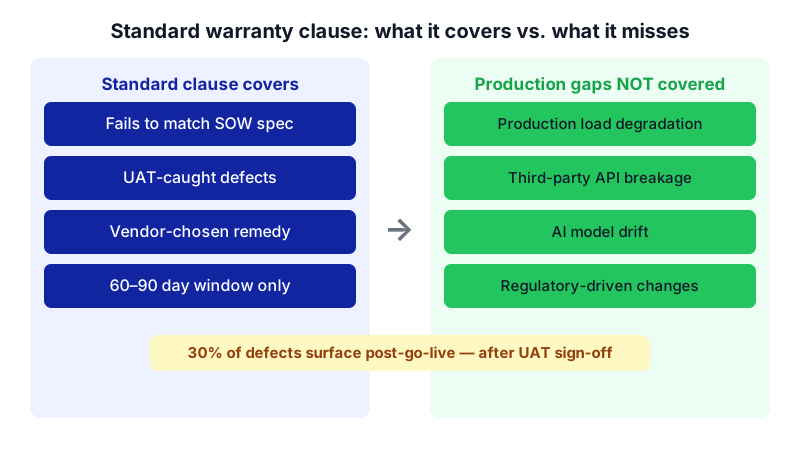
- A defect definition — usually: "a failure of the Software to perform substantially in accordance with the Specifications set out in the applicable SOW."
- A warranty period — 60, 90, or sometimes 180 days from Acceptance or Go-Live.
- A remedy — vendor will, at its option, repair, replace, or refund. "At its option" is doing a lot of work here.
- Exclusions — misuse, modification by the customer, third-party software, changes in the operating environment, force majeure.
Read strictly, this clause obligates the vendor to fix only behaviour that contradicts the written specification, only for a short window, only on terms the vendor chooses, and only if none of the exclusions apply. The exclusion for "changes in the operating environment" alone is usually enough to disclaim any issue caused by a bank's own infrastructure, a payment gateway upgrade, or a cloud provider configuration change.
The buyer's exposure is everything the clause does not name. In a 2025 UAE context, that includes at minimum:
- Performance degradation under production load that passed synthetic UAT load tests
- Breakage caused by a sub-processor or third-party API changing its contract (Network International, Emirates NBD open banking endpoints, a KYC provider's new schema)
- AI model drift, hallucination rate increases, or retraining needed because real data distributions diverged from training data
- Regulatory-driven changes — including anything flowing from Federal Decree-Law No. 6 of 2025, which entered force 16 September 2025 and gives entities until 16 September 2026 to regularise
- Security vulnerabilities disclosed after go-live in libraries the vendor chose
- Data corruption that reveals itself only after month-end close or a quarterly batch
None of that is "a defect" under the standard wording. All of it is operationally your problem.
The wording that protects the buyer
You are trying to do three things in the warranty clause: expand the defect definition beyond the SOW, tie remedies to time and outcomes rather than vendor discretion, and name the categories of post-launch work the vendor is obligated to do without a change order.
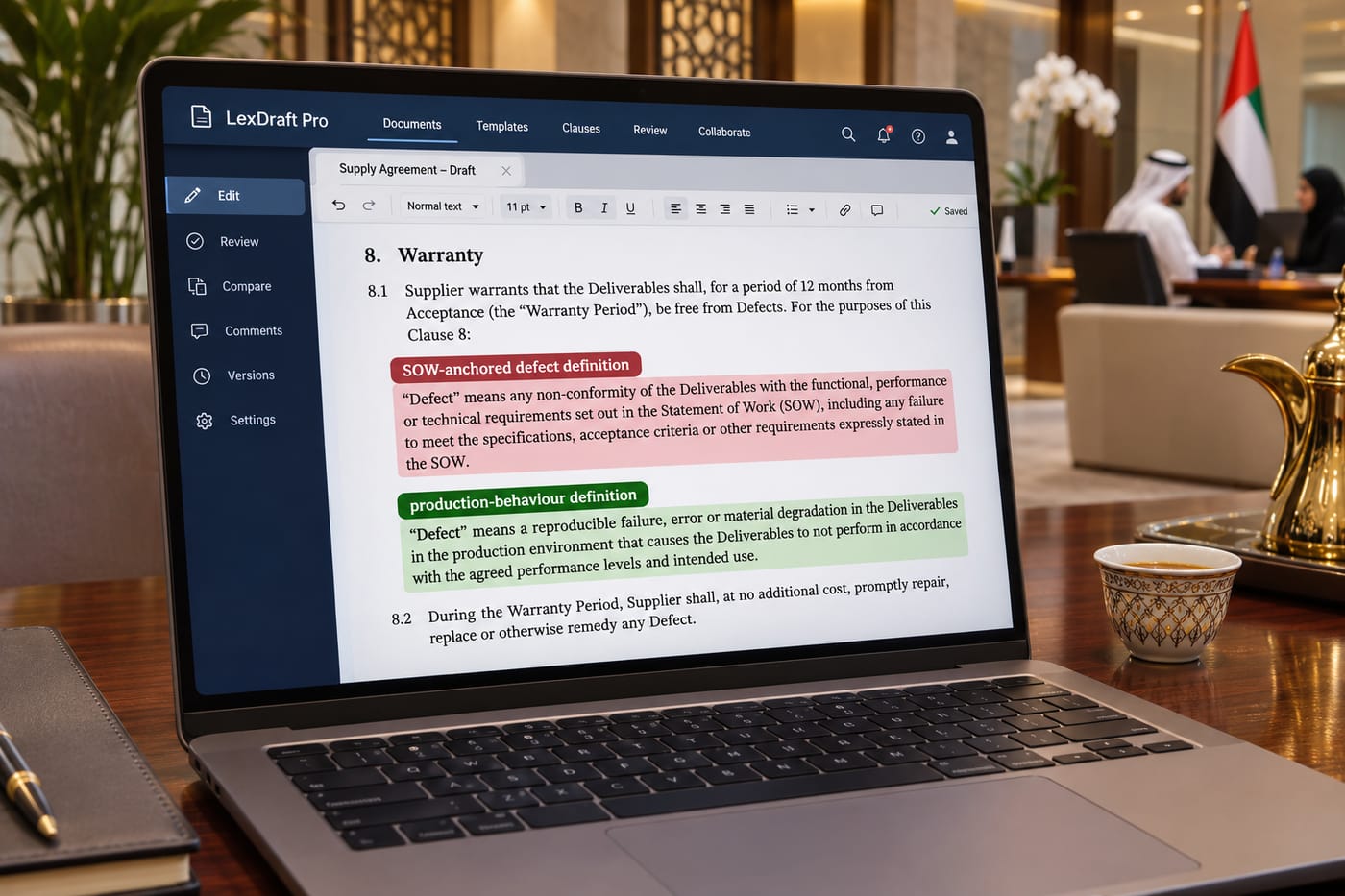
1. Redefine "defect" against production behaviour, not just the SOW
Replace the standard definition with something closer to:
"Defect" means (a) any failure of the Software to perform in accordance with the Specifications; (b) any failure of the Software to meet the Production Performance Benchmarks set out in Schedule [X] when operated within the Supported Environment; (c) any failure of a Named Integration listed in Schedule [Y] that is caused by the Software or by the Vendor's implementation of the integration; and (d) any Security Vulnerability rated High or Critical under CVSS v4.0 disclosed in a component selected by the Vendor.
The work then moves into the two schedules. Schedule X lists the production benchmarks: p95 response time under stated concurrent user load, transaction throughput, batch job completion windows, AI inference latency, and — for AI components — a floor on accuracy or a ceiling on hallucination rate measured against a holdout set you both agree on at go-live. Schedule Y lists every third-party integration by name and version, with the vendor accepting responsibility for keeping them functional for the warranty period.
The vendor will push back on Schedule X. They should — benchmarks they cannot control are unfair. The negotiation is about what "Supported Environment" means: the cloud region, the data volumes, the concurrent user ceiling, the upstream dependencies in a known-good state. Agree those, and the benchmarks become fair and enforceable.
2. Extend the warranty window and tie it to observed stability, not the calendar
A 90-day warranty from go-live expires before month-end close has been run three times. For an enterprise platform with monthly or quarterly cycles, push for 180 days minimum, and consider a "rolling" extension: the warranty period extends by the duration of any Severity 1 incident plus a 30-day stability observation window after it is resolved. This stops the clock running out during the exact weeks when the vendor is firefighting.
3. Replace "at vendor's option" with time-bound severity tiers
The remedy section should look like an SLA, not a menu. Define Severity 1 through 4, give each a response time and a resolution target, and attach service credits to missed targets. "At its option, repair, replace or refund" is a clause that lets the vendor spend six weeks deciding what to do. A Severity 1 production-down incident needs a response in minutes and a workaround in hours.
4. Carve in regulatory change — carefully
You cannot reasonably ask a vendor to absorb unlimited regulatory change work for free. You can reasonably ask that changes flowing from regulations in force at the signature date, or published-but-not-yet-effective at signature date, be included. The CBUAE law is the live example: it was published in 2025 with a one-year regularisation window. A platform going live in late 2025 or 2026 should have CBUAE-driven changes within scope of warranty, not treated as new work. Article 62 extends CBUAE supervision to any person facilitating a licensed financial activity regardless of the technology employed — which means your vendor is already operating in the regulator's perimeter whether the MSA acknowledges it or not.
5. Separate warranty from post-launch support — and buy both
Warranty covers defects. Post-launch support covers everything else: enhancements, minor changes, training, operational advice, tuning. Buyers often conflate the two and end up with neither. Negotiate a warranty clause that is tight and defect-focused, and a separate support agreement with a defined monthly envelope of hours for work that is not a defect. This keeps the warranty argument clean (is this a defect or not?) because the answer no longer determines whether anything gets done — it only determines who pays.
The wording that quietly does not protect you
Four phrases to watch for and push back on:
"Substantially in accordance with the Specifications." "Substantially" is the vendor's escape hatch. If 90% of the functionality works and 10% does not, the vendor can argue the software substantially conforms. Delete "substantially" or define it numerically.
"Vendor's sole and exclusive remedy shall be..." This caps your recourse at whatever follows — usually a refund of fees paid for the defective component. If a defect causes a regulatory breach or customer-facing outage, your actual losses dwarf the component fee. Negotiate a carve-out for breaches of warranty that cause regulatory action or data loss.
"Excluding any issues caused by third-party software or services." Every modern platform is held together by third-party services. This exclusion, read literally, means almost nothing is a warranty item. Narrow it to third-party software the customer introduced, not components the vendor selected.
"Warranty period commences on Acceptance." Acceptance is a vendor-controlled event. If the vendor can delay sign-off, they can shrink the warranty period against your go-live date. Tie commencement to the later of Acceptance or Production Go-Live, and define Production Go-Live objectively.
The questions to put to the vendor before you sign
- Walk me through what happens on day 45 post-go-live if the platform's p95 response time triples because our actual user base is twice what the UAT load test modelled. Is that a defect under this clause? If not, how is it priced?
- If Network International changes its tokenisation API contract and our checkout breaks, who owns the fix during the warranty period?
- If the CBUAE issues a regulation under the new law that requires a change to our transaction reporting before our regularisation deadline, is that warranty work or a change request?
- For the AI components, what is the defined acceptable range for model accuracy and hallucination rate post-launch, and what triggers your obligation to retrain?
- Show me the Severity 1 response and resolution times you will commit to in writing. What are the service credits if you miss them?
- What is your definition of the Supported Environment, and what specifically falls outside it?
- If we hit a defect on day 85 of a 90-day warranty and it takes you 20 days to fix, does the warranty extend?
A vendor who cannot answer these cleanly in a room is a vendor whose warranty clause will not hold up in a dispute.

How CodeNicely can help
Most of the warranty disputes we see in UAE enterprise work trace back to an SOW that was written for a build and a warranty clause that was written for a product — neither drafted for how the system actually behaves in production. We work differently on the paperwork because we have been on the hook for the production behaviour.
On GimBooks, a YC-backed accounting SaaS, the work involved multi-tenant financial data, GST and tax-period boundaries, and month-end batch behaviour that only surfaced under real small-business usage patterns. The warranty and support structure we worked under there defined "defect" against observed production behaviour at month-end and quarter-end, not against a frozen SOW — which is close to the structure a UAE bank or multi-entity retail group needs for their own financial close cycles.
For UAE-specific engagements, our Dubai practice structures MSAs and SOWs with production benchmarks, named integration lists, and the regulatory-change carve-in discussed above. We are happy to review a warranty clause you have been handed and tell you where it is thin, even if we are not the vendor who built the platform. See our enterprise offerings for how we scope post-launch support separately from warranty.
Frequently Asked Questions
Is a 90-day software warranty period enough for a UAE enterprise platform?
For most enterprise platforms with monthly or quarterly business cycles, no. A 90-day window expires before you have run three month-end closes or seen quarterly batch behaviour. Push for 180 days minimum, with a rolling extension that pauses the clock during Severity 1 incidents and resumes after a defined stability window.
Should the warranty cover changes required by the new CBUAE law?
Changes flowing from regulations in force or published at the signature date — which includes Federal Decree-Law No. 6 of 2025 and its subsidiary rules — are a reasonable ask to include within warranty scope. Regulations issued after signature are normally priced as change requests. Have your lawyer review the exact wording; this is a negotiation, not a default.
Who owns the fix when a third-party integration breaks after go-live?
Under the standard clause, nobody on the vendor side. Under a well-drafted clause, the vendor owns fixes for integrations they selected and implemented, listed by name in a schedule, for the warranty period. Integrations you brought to the project or chose over the vendor's objection sit with you. The Named Integration schedule is where this gets resolved, not the main clause.
What drives the cost of properly scoping warranty and post-launch support?
Three things move the number more than anything else: the number of third-party integrations the vendor is being asked to stand behind, the strictness of the production performance benchmarks (and the volume and concurrency assumptions behind them), and whether AI components are in scope with accuracy or drift floors. A platform with two integrations and no AI will have a materially different support envelope from one with twelve integrations and a production LLM. To turn a range into a quote, a vendor needs your integration list, your production load profile, and your definition of Supported Environment. That is a scoping conversation — talk to us with those three items in hand.
Do I need a separate post-launch support agreement if the warranty is strong?Yes. Warranty covers defects; it does not cover enhancements, minor changes, training, operational tuning, or work driven by your own business evolution. Running those through the warranty clause creates arguments about whether something is a defect. A separate support agreement with a defined monthly hours envelope keeps the warranty argument clean and makes sure non-defect work actually gets done.
This article discusses commercial and contractual structures and is not legal advice. The specific wording of any MSA, SOW, or warranty clause should be reviewed by a UAE-qualified lawyer before signature.
Sources & further reading
- UAE Enterprise Software Market Size & Outlook, 2026–2033 — Grand View Research
- Enterprise Software Solutions in the Middle East (2025–2030) — CustomerThink
- UAE Central Bank Issues New Central Bank Law Consolidating Financial Sector Regulation — Gibson Dunn
- Function Over Form: What The UAE's New CBUAE Law Means For Fintech, DeFi And Technology Providers — Mondaq
- Software Warranty Periods in 2026: How Long Should You Fix Bugs for Free? — developer.law (Story LLP)
- Software Engineering Outsourcing Contracts: SOW Structuring, IP Transfer, and Warranty Clauses — NextGen Coding Company
- The Cost of Poor Software Quality in the US: A 2022 Report — CISQ (via Black Duck / Synopsys)
- What is Defect Leakage in Software Testing? — Testsigma
Get one practical guide a week
Costs, AI tools, partner selection — written for people who make the decision. No spam, unsubscribe anytime.
Thanks — you're on the list. One practical guide a week, nothing else.
That didn't work — please check the email address and try again.
Building something in Software & Technology?
CodeNicely partners with founders and tech teams to ship AI-native products that move metrics. Tell us about the problem you're solving.
Talk to our team Book a 30-min call