
Hiring a Dev Partner in Dubai: What UAE Startups Must Verify

 Published by CodeNicely, the product studio founded by Meghal Agrawal and Ujjwal Agrawal in 2017
For: A seed-to-Series-A founder based in Dubai or DIFC who is about to wire a five- or six-figure deposit to a dev partner and has never hired one in the UAE before
In this guide
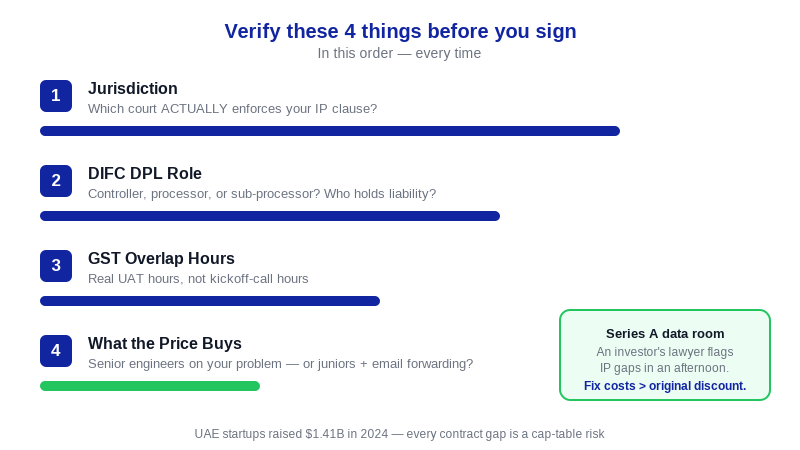
Before you sign, verify four things in this order: (1) which court actually has jurisdiction over your IP assignment clause, not just which law the contract names; (2) whether the vendor is a controller, processor, or sub-processor under DIFC Data Protection Law No. 5 of 2020 and who carries the liability; (3) how many Gulf Standard Time working hours you genuinely overlap during UAT, not during kickoff; and (4) what the quoted price band actually buys — senior engineers on your problem, or junior engineers plus a project manager who forwards emails. Everything else is secondary.
This matters because the money moving through Dubai is real. UAE startups raised $1.41 billion in venture capital in 2024, and more than 90% of all UAE VC since 2017 has gone to Dubai-based startups. The DIFC crossed 10,000 active companies in mid-2026, with 1,933 AI, fintech, and innovation firms — a 39% jump year-over-year. Every one of those companies is a potential buyer of dev work, and most of them will discover the IP and data problems only when an investor's lawyer opens the contract at the Series A data room.
The non-obvious trap: governing law versus enforceable jurisdiction
Here is the pattern we see repeatedly. A Dubai founder gets three proposals — one from a Dubai-registered agency, one from a studio in South Asia, one from Eastern Europe. The offshore proposals are 40–60% cheaper. The founder picks one, and the contract says "governed by the laws of the DIFC, with exclusive jurisdiction of the DIFC Courts." Looks clean.
Except the contract was drafted by the vendor's in-house counsel using a template from the vendor's home jurisdiction. The IP assignment clause uses language that works in Delaware or Bengaluru but does not satisfy the written-assignment and recordal requirements under UAE IP law, where registered IP often needs recordal with the relevant UAE authority to be effective against third parties. The warranty clause caps liability at fees paid — fine in most jurisdictions, but a DIFC Court may read that against a background of DIFC DPL obligations the vendor never agreed to in writing. And when you try to enforce in the DIFC Courts, the vendor has no UAE assets, no registered presence, and no reason to show up.
An investor's lawyer at Series A will flag this in an afternoon. The fix — renegotiating IP assignment with a vendor who has already been paid — costs more than the original discount saved.
The eight criteria that actually decide it
1. IP ownership and governing law — the one most founders get wrong
Why it matters: Your cap table assumes you own the code. If the IP assignment is unenforceable in the court that has jurisdiction, you do not own it until you can prove it. Under UAE onshore IP law a written assignment is required for copyright, and registered IP often requires recordal with the relevant UAE authority to bind third parties. A private assignment buried in a service agreement can leave gaps.
Exact questions to ask:
- "Show me the IP assignment clause. Is it a present assignment ("hereby assigns") or a promise to assign in future? Only the first survives a vendor bankruptcy."
- "Which court has exclusive jurisdiction — and does your firm have assets or a registered branch in that jurisdiction?"
- "Will you sign a separate, standalone Deed of Assignment at project close, in a form my UAE counsel approves?"
- "Who owns pre-existing libraries, and is the licence to us perpetual, royalty-free, sublicensable, and assignable to an acquirer?"
If the vendor pushes back on the standalone deed, that tells you everything.
2. DIFC Data Protection Law posture
Why it matters: DIFC DPL 2020 applies to any business processing personal data on behalf of a DIFC-incorporated entity, regardless of whether processing happens inside or outside the DIFC. An offshore dev studio touching your users' data is a processor under the law, whether they realise it or not. Penalties under the law range from $25,000 to $100,000 per violation across 35 listed infractions, with scope for larger fines for serious breaches and uncapped compensation claims from data subjects directly in DIFC Courts.
Separately, the DIFC does not recognise mainland UAE as having adequate data protection, so a DIFC startup transferring personal data to a mainland dev studio needs specific contractual safeguards. Most founders do not know this.
Exact questions to ask:
- "Are you willing to sign a Data Processing Agreement that mirrors DIFC DPL Article 28 processor obligations?"
- "Where will production data live during development? If you use any customer PII for testing, what is your anonymisation process?"
- "Do you carry cyber liability insurance that covers claims brought in DIFC Courts, and what is the limit?"
3. Time-zone overlap — measured in UAT hours, not kickoff hours
Why it matters: GST is UTC+4. A studio in India (UTC+5:30) gives you a full working day. Eastern Europe (UTC+2 to +3) gives you most of the afternoon. US East Coast (UTC-5) gives you roughly two hours in your late afternoon, their early morning. During kickoff and spec, this does not matter much. During UAT, when a bug blocks a demo tomorrow, a five-hour gap is a day lost.
Exact questions to ask:
- "Name the engineers on my project. Which city do they sit in? What are their actual working hours in GST?"
- "During UAT, will you commit to a daily overlap window of at least four hours with my Dubai team?"
- "Who is my on-call contact for a P1 production bug at 9pm GST on a Thursday?"
4. Regulatory and sector fluency
Why it matters: If you are in fintech, your partner needs to understand ADGM FSRA or DFSA sandbox posture. If you are in health, you need a partner who has worked with DoH Abu Dhabi or DHA clinician data constraints. A generalist studio will learn on your dime.
Exact questions to ask:
- "Name two UAE clients in my sector. May I speak to them?"
- "Which UAE regulators have you interacted with directly — not just read about?"
5. Delivery speed and what drives it
Why it matters: A credible partner will tell you their MVP timeline is a range driven by scope, integrations, and data migration — not a fixed number on a slide. If someone commits to "12 weeks" before scoping, they are selling, not estimating.
What drives the timeline: number of third-party integrations (payments, KYC, SMS, maps); whether you have existing data to migrate and in what shape; how many user roles and permission layers; regulatory approvals that sit outside the vendor's control; and the decision-making cadence on your side.
What you control: speed of design sign-off, availability for weekly demos, and whether you add scope mid-sprint.
6. Proof of scale
Why it matters: A studio that has only shipped prototypes will build you a prototype and call it production. You want evidence they have taken something from zero to tens of thousands of users without a rewrite.
Exact questions to ask:
- "Show me a product you built that is still in production three years later. Who maintains it now?"
- "Have you had a client raise a Series A on code you wrote? May I see the architecture diagram?"
7. NDA and compliance basics
Why it matters: Mutual NDA before the first technical conversation is table stakes. If a vendor sends a one-way NDA that only protects them, that is the posture you will see for the rest of the engagement.
8. What the local price band actually buys
The UAE custom software development market generated USD 1,034.9 million in 2025 and is forecast to reach USD 3,792.0 million by 2033 at a 17.5% CAGR. That demand has pulled in three distinct tiers of supplier, and the price gap between them is real:
- Dubai-registered boutique agencies tend to sit at the top of the price band. You are paying for GST working hours, UAE-law contracts, and a team you can meet in person. Good for regulated workloads and for founders who need the vendor in the room for investor conversations.
- Offshore studios with a Dubai sales presence sit in the middle. Delivery is from India, Egypt, or Eastern Europe; account management is local. The quality here varies more than any other tier — the sales office can mask a weak delivery team. Reference-check aggressively.
- Pure offshore studios are the cheapest and the most variable. Works well for a founder who is technical enough to manage delivery directly and who is comfortable with the IP and jurisdiction trade-offs above.
The question is not "which tier is best" — it is "which tier matches my stage, my regulatory exposure, and my own technical bandwidth." A pre-seed founder prototyping a non-regulated consumer app has different needs from a DIFC fintech processing customer PII.
The two or three specifics that would turn any of these ranges into a real quote: a scoped feature list with integration count, a decision on whether you own hosting and data residency, and whether you need the partner to carry post-launch support for 6 or 12 months. Any vendor quoting without those three is guessing.
A UAE startup dev partner checklist, in order
- Mutual NDA signed before technical scoping.
- Written confirmation of governing law, jurisdiction, and whether the vendor has enforceable assets in that jurisdiction.
- Draft IP assignment clause reviewed by your UAE counsel — not just read by you.
- Standalone Deed of Assignment agreed as a project-close deliverable.
- DPA that mirrors DIFC DPL processor obligations, if you are DIFC-registered or process UAE user data.
- Named engineers, named cities, named overlap hours.
- Two reference calls with UAE clients in your sector.
- One architecture walkthrough of a production system they built that is still live.
- Cyber liability insurance certificate with limits you can read.
- Payment schedule tied to acceptance milestones, not calendar dates.
If a vendor cannot clear this list in two weeks, they will not clear it in six months.
How CodeNicely can help
We are an AI-first product studio that has been shipping production software since 2017, and we work with UAE founders through our Dubai software development practice. The engagement most relevant to the reader of this post is probably GimBooks — a YC-backed accounting SaaS where we built the core product through multiple funding rounds. The reason it is the right reference: the IP, data, and architecture decisions we made in year one had to survive investor diligence in year three. That is the standard we build to.
For founders in regulated verticals, HealthPotli (e-pharmacy with AI drug-interaction checks) and Cashpo (lending with KYC and AI credit scoring) are closer analogues — both required us to operate inside regulatory constraints from day one rather than retrofit them. We sign mutual NDAs before scoping, we present-assign IP in writing, and we are comfortable with DIFC-governed contracts reviewed by your counsel.
What we are honestly less suited for: pure staff-augmentation where you want eight engineers to sit under your CTO. We work as an outcome-accountable product team. If you need bodies, there are cheaper options.
The one thing to do before your next vendor call
Forward the draft MSA from each shortlisted vendor to a UAE-qualified lawyer and ask one question: "If this vendor disappeared tomorrow, in which court would I sue, and would the IP assignment be enforceable there?" The answer, in writing, is worth more than any sales deck. Nothing in this post is legal advice — a UAE-qualified lawyer should review your specific contracts and a licensed auditor should review your compliance posture before you sign.
Frequently Asked Questions
Should I hire a Dubai-registered agency or a cheaper offshore studio?
It depends on your regulatory exposure and your own technical bandwidth. A DIFC-registered fintech processing user PII should strongly prefer a vendor with enforceable UAE presence, because DIFC DPL liability and IP enforcement both get much harder with a pure offshore counterparty. A non-regulated consumer app built by a technical founder can reasonably go offshore if the contract is drafted properly. The decision is about risk-adjusted cost, not sticker price.
What does an MVP from a Dubai dev partner typically cost?
There is no honest single number — the cost is a range driven by integration count, data residency choices, regulatory review burden, and how much design and product work you bring versus buy. Dubai-registered agencies sit at the top of the UAE band, hybrid studios in the middle, pure offshore at the bottom, and the spread between them is wide. To turn the range into a real quote you need a scoped feature list, a decision on hosting and data residency, and clarity on post-launch support duration. A scoping conversation with any shortlisted partner — including CodeNicely — is where that gets pinned down.
How long does it take to ship an MVP with a Dubai or UAE-focused dev partner?
The honest answer is a range, not a date. Timeline is driven mostly by integration count (payments, KYC, SMS, maps each add real time), whether you have existing data to migrate, the number of user roles, and any regulator-in-the-loop approvals. What you control is design sign-off speed, availability for weekly demos, and mid-sprint scope discipline. Any vendor offering a fixed week count before scoping is selling, not estimating.
Does DIFC Data Protection Law apply if my dev partner sits outside the UAE?
Yes, if you are DIFC-incorporated and the vendor processes personal data on your behalf. DIFC DPL 2020 follows the data, not the processor's location. You need a Data Processing Agreement, defined security measures, and in many cases specific contractual safeguards for cross-border transfer — the DIFC does not treat mainland UAE as adequate. A UAE-qualified data protection lawyer should review the specifics of your setup.
Who owns the IP if my offshore vendor's contract is governed by their home country's law?
On paper, whatever the contract says. In practice, enforceability depends on whether that law recognises the assignment in a form that your DIFC or onshore UAE court will accept, and whether the vendor has assets in a jurisdiction where you can actually enforce a judgment. A UAE-qualified lawyer should review your IP clause before signing, and a standalone Deed of Assignment at project close is a good belt-and-braces step regardless of the governing law.
Sources & further reading
- How to Secure Startup Funding in the UAE: A Complete Guide — Hub71
- UAE tech start-ups to enjoy better funding prospects in 2024 — Khaleej Times
- UAE Custom Software Development Market Size & Outlook, 2033 — Grand View Research
- Software Outsourcing Statistics and Trends 2026 (DIFC company count) — The Arc Forth
- Important FAQs on Data Protection & Privacy — DIFC Official
- New DIFC Data Protection Law in Force — Akin Gump
- DIFC Data Protection Law — CMS Law
- Drafting Software and SaaS Contracts in the UAE (2026) — Kayrouz & Associates
Get one practical guide a week
Costs, AI tools, partner selection — written for people who make the decision. No spam, unsubscribe anytime.
Thanks — you're on the list. One practical guide a week, nothing else.
That didn't work — please check the email address and try again.
Building something in Software & Technology?
CodeNicely partners with founders and tech teams to ship AI-native products that move metrics. Tell us about the problem you're solving.
Talk to our team Book a 30-min call