
What Happens to Your Code When You Stop Paying

 Published by CodeNicely, the product studio founded by Meghal Agrawal and Ujjwal Agrawal in 2017
For: Owner or COO of an Indian SMB or scaleup who is 6–18 months into a custom software engagement and has begun to suspect the vendor relationship is souring — or is about to sign a new contract and wants to know what happens if they ever need to leave
In this guide
- Why this matters more in India than most buyers realise
- The clause family you actually need to understand
- The transition-out SLA: what "reasonable cooperation" should actually say
- What this costs you to get right, and what it costs you to get wrong
- If you are already mid-contract and the paperwork is thin
- How CodeNicely can help
- The one-page checklist
- Frequently Asked Questions
If your contract with a development vendor ends tomorrow — for any reason, friendly or not — the vendor controls the timeline, format, and price of returning your own code unless the paperwork says otherwise. Most Indian software contracts treat termination as the end of payment obligations and stop there. They do not define handover as a deliverable with its own scope, acceptance criteria, and payment-hold mechanism. That single gap is why owners discover, mid-dispute, that they have a working app they cannot modify, a database they cannot export, and a GitHub repository sitting in someone else's personal account.
This post walks through the termination and transition-out clause family the way the person signing it needs to read it — what each clause is for, what wording actually protects you, what wording quietly does not, and what to ask the vendor before you sign. This is not legal advice. Have a lawyer review the final document, especially the IP assignment and the escrow language.
Why this matters more in India than most buyers realise
India's IT outsourcing market reached USD 54.10 billion in 2024 and the custom software segment alone is growing at 28.5% CAGR. The scale means two things: SMBs now routinely commission bespoke software from vendors they have known for weeks, and vendor disputes are common enough that legal analysts have documented standard patterns of how they go wrong.
The most expensive pattern: without a transition assistance clause, a terminated vendor may legally withhold source code, infrastructure access, or documentation until the underlying dispute is resolved. Resolution can take months. In the meantime, your product is frozen.
The clause family you actually need to understand
Termination and transition-out is not one clause. It is four clauses that have to agree with each other: the IP assignment, the source-code and asset handover, the credentials and infrastructure transfer, and the payment-hold / final invoice mechanism. If any one of them is vague, the other three cannot save you.
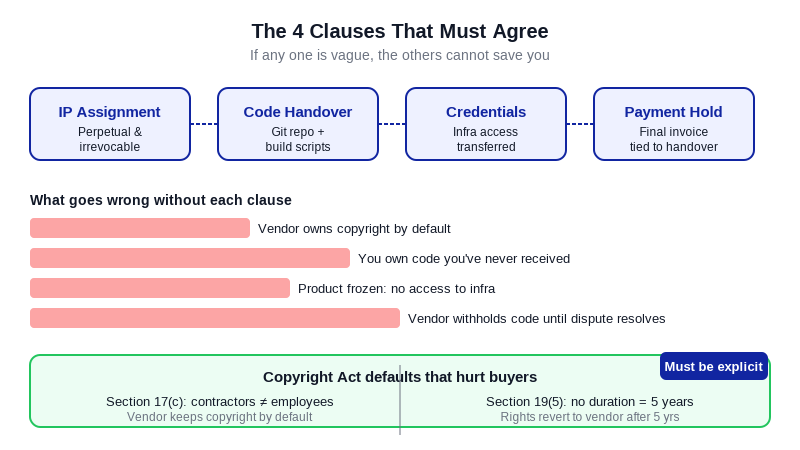
1. IP assignment — the clause most buyers get wrong on day one
Before you can argue about handover, you have to establish that the code is yours. In India, two statutory defaults trip buyers up.
First, under Section 17(c) of the Copyright Act, the "employer owns the work" rule applies only to employees under a contract of service. It does not apply to independent contractors or vendor companies. So if your SOW simply says "CodeNicely will build the application," the default position is that the vendor owns the copyright in the code they wrote, not you. You need an explicit assignment.
Second, and this one is brutal: under Section 19(5) of the Copyright Act, if your assignment clause does not specify a duration, it defaults to five years. After that, the rights revert to the developer. A codebase you paid lakhs for, built your business on, and depend on daily can legally boomerang back to a vendor you fired three years ago.
Wording that protects you — the assignment names the works (source code, object code, documentation, designs, UI assets, trained model weights, fine-tuning datasets, prompt libraries, and derivative works), is "absolute, perpetual, worldwide, irrevocable, and royalty-free," and takes effect on creation, not on final payment.
Wording that quietly does not — "The Developer assigns all intellectual property rights in the Deliverables to the Client." No duration. No list of what counts as a Deliverable. No mention of model weights or training data if there is an AI component. No clarification of when assignment vests.
Ask the vendor — "If we terminate this contract in month nine, who owns the code committed in month three? Who owns any models you fine-tuned on our data? Show me the clause."
2. Source-code and asset handover — define it as a deliverable
This is the clause almost no SMB contract has, and it is the one that decides what actually happens the day you leave. Legal commentary on software disputes consistently finds that many clients discover mid-dispute they only ever received a compiled binary — the source lived in a repository under the developer's account the whole time. Owning the IP in theory does not help if you have never been given a copy.
Treat handover as its own deliverable, with a scope, a format, a deadline, and acceptance criteria. At a minimum the handover package should include:
- Full source code for all environments (prod, staging, dev), delivered as a Git repository transferred into a client-owned organisation, with commit history intact
- Build and deployment scripts that have been tested on a clean machine by someone not on the vendor team
- Infrastructure-as-code definitions (Terraform, CloudFormation, Pulumi) for every cloud resource
- A database schema plus a current data export in a documented, portable format
- All environment variables and secrets, delivered through a secure channel, with a list of which ones are third-party keys that need rotating
- API documentation and a current list of all third-party services, their account owners, billing status, and renewal dates
- A runbook for the three most common operational tasks (deploy, rollback, restore from backup) and the three most common failure modes
- Trained model weights, fine-tuning datasets, and the prompt library if the product uses AI
Wording that protects you — "Within 15 business days of a Transition Trigger Event (defined as termination for any reason, non-renewal, or written request by the Client), the Developer shall deliver the Handover Package as specified in Schedule X. The Client has 20 business days to test the Handover Package. Acceptance occurs when the Client confirms in writing that a named third-party engineer has successfully built and deployed the application to a new environment using only the Handover Package."
Wording that quietly does not — "Upon termination, the Developer shall provide reasonable cooperation to facilitate transition." Reasonable, in a dispute, means whatever the vendor's lawyer says it means.
Ask the vendor — "Walk me through what the handover looks like on day one. Which engineer runs it? How is it tested? What happens if we find the build doesn't work on day 16?"
3. Credentials, repositories, and the account-ownership trap
This is an operational clause disguised as an administrative one. The question is: during the engagement, in whose name are things registered?
The single most common disaster pattern is the GitHub repository, the AWS account, the Firebase project, the OpenAI API key, the domain registrar login, and the Play Store developer account all sitting under the vendor's company — or worse, under a founder's personal email. On termination, the vendor is under no obligation to transfer ownership of accounts they created in their own name. They can offer to. They can also not.
Wording that protects you — "All cloud accounts, source code repositories, domain registrations, app store developer accounts, third-party SaaS subscriptions, and API credentials used for the Client's product shall be created in the name of the Client and shall list the Client as the billing and legal owner from inception. The Developer shall be granted access as a collaborator or IAM user, revocable by the Client at any time."
Wording that quietly does not — "The Developer shall provide access to all relevant accounts upon termination." Access is not ownership. A collaborator can be removed. An owner cannot.
Ask the vendor — "On the day we sign, in whose name will the GitHub org, the AWS root account, and the Play Store listing be created? Send me the screenshots after setup."
4. Payment hold, escrow, and the leverage problem
Handover language only works if there is a consequence for not honouring it. The consequence is money. Your vendor's leverage is that they hold the code. Your leverage is that you hold the final payment.
But there is a legal nuance Indian buyers need to understand. In software development disputes, courts will enforce conditional handover terms literally — if the contract makes delivery of source code contingent on full payment, the client cannot compel handover until payment is made, even if the client is withholding payment because of defects. So the drafting has to decouple the two: the handover is not conditional on final payment, and final payment is not released until handover is accepted.
Wording that protects you — structure the final 15–20% of the contract value as a "Transition Milestone," payable only upon written acceptance of the Handover Package. Pair this with a source-code escrow for high-stakes engagements. The RBI recommended source-code escrow for outsourced software as far back as 1998, and major Indian banks now require it in procurement tenders. The principle applies equally to a logistics SMB whose warehouse runs on custom WMS.
Wording that quietly does not — "Final payment is due within 30 days of project completion. Developer shall hand over all materials upon receipt of final payment." This gives the vendor zero reason to help once the money arrives, and gives the client zero leverage if handover is incomplete.
Ask the vendor — "Are you comfortable with 15% of the contract tied to a tested, accepted handover package? If not, which specific part makes you uncomfortable?" The answer tells you a lot.
The transition-out SLA: what "reasonable cooperation" should actually say
Beyond the asset handover, you want a defined transition-out period with named hours. For a mid-sized engagement, something like:
- Up to 40 hours of handover support from a named lead engineer within the first 30 days post-termination, included in the contract value
- Up to a further 80 hours over the following 60 days, billed at a pre-agreed hourly rate (locked at signing, not renegotiated at termination)
- A written knowledge transfer session (recorded) covering architecture, known issues, and the "things we never got around to documenting" list
The locked-in hourly rate matters. Without it, a departing vendor can quote any number for transition help, and you have no benchmark to push back with.
What this costs you to get right, and what it costs you to get wrong
Buyers often ask whether tightening these clauses adds to project cost. Honestly, at contract stage, the incremental legal fee to add proper handover, IP, and escrow language is small — it is a drafting exercise, not a scoping exercise. The cost sits in two places: the lawyer's time to review and negotiate, and the vendor's willingness to accept the terms (some will push back, which itself is useful information).
The cost of getting it wrong is the number you should anchor on. Industry research on vendor lock-in puts the average enterprise migration cost at around $315,000, with switching costs running 2–3x the cost of staying put over a 3–5 year window. For an Indian SMB the absolute numbers are smaller, but the ratio is similar: rebuilding a product from a compiled binary, or from scratch because the vendor will not release the source, typically costs more than the original build did, because you are paying twice for discovery and architecture.
What turns these ranges into a real number for your situation: how much of your product is bespoke versus off-the-shelf, whether your data is portable or trapped in a proprietary schema, whether the third-party integrations are documented, and how much institutional knowledge sits only in the vendor's heads. Those are the questions to scope before signing — and the ones to revisit if you are already mid-contract and worried.
If you are already mid-contract and the paperwork is thin
You cannot rewrite the contract unilaterally, but you can do four things this week:
- Audit account ownership. Log in to every service and check who the root owner is. For anything in the vendor's name, open a conversation about transferring ownership now, while the relationship is still functional. Frame it as governance hygiene, not distrust.
- Ask for a current source-code snapshot and a database export, as a scheduled quarterly deliverable. Any healthy vendor will agree.
- Commission a one-day independent code review. The reviewer's real job is to confirm the code builds from scratch on a clean machine using only what the vendor has handed over.
- Negotiate a side letter — a short amendment specifically covering handover obligations, account ownership, and IP duration. It is far easier to get signed while things are calm than after a dispute has started.
How CodeNicely can help
We take the opposite position to vendor lock-in by default, because we have been on the receiving end of handover disasters as a replacement vendor and know what they cost the client. Across engagements like GimBooks — a YC-backed accounting SaaS where the client needed full code ownership from day one to satisfy investor diligence — and Vahak, where the logistics marketplace operated across infrastructure the client controlled directly, repositories, cloud accounts, and third-party services sit under the client's name from project kickoff, not at termination.
If you are evaluating a new engagement or auditing an existing one, our services overview and SMB page describe how we structure IP assignment, handover packages, and transition-out terms. If you are mid-contract with a different vendor and worried about the exit, we also do independent code and handover audits — an outside engineer builds your product from scratch using only what your current vendor would hand over in a termination scenario, and tells you honestly what is missing.
The one-page checklist
- IP assignment is explicit, perpetual, worldwide, and lists model weights and data if AI is involved
- Handover is a defined deliverable with a 15-day delivery window and 20-day acceptance window
- Handover package contents are listed in a schedule, not left to "reasonable cooperation"
- All accounts (repo, cloud, domain, app stores, API keys) are in the client's name from day one
- 15–20% of contract value is held against accepted handover, decoupled from defect disputes
- Source-code escrow is in place for anything business-critical
- Transition-out SLA specifies named hours at a pre-agreed rate
- A lawyer who has seen IT outsourcing disputes has reviewed the final document
Frequently Asked Questions
If my contract says I own the IP, isn't that enough to get my source code back?
No. Owning the IP is a legal right. Possessing the code is an operational fact. If the source has only ever lived in the vendor's GitHub org and your contract does not require them to deliver a specific handover package on a specific timeline, you can win an IP argument and still have no working code. The two clauses — assignment and handover — have to exist separately.
What is source code escrow and do I actually need it?
Escrow is a third-party arrangement where the vendor deposits a current copy of the source code (and usually build instructions and credentials) with a neutral escrow agent, who releases it to you only under defined trigger events — typically vendor insolvency, prolonged breach, or acquisition. The RBI has recommended it for Indian financial institutions since 1998. For a small internal tool, it is overkill. For anything your business cannot operate without for a week, it is cheap insurance.
How long will a proper handover actually take in practice?
It depends on three things: how disciplined the vendor has been about documentation and account ownership during the project, how many third-party integrations need credential rotation, and whether an independent engineer can build the app from scratch using only the handover package. For a well-run engagement, a transition can be substantially done in two to four weeks. For a poorly documented one, the same transition can stretch into months of back-and-forth. The way to turn that range into a real estimate for your situation is a handover readiness audit — scope, integrations, documentation state — which is a conversation worth having with a transition specialist before you issue a termination notice.
Can I force my current vendor to sign a side letter improving these terms mid-contract?
Force, no. Negotiate, often yes — especially if you frame it as governance preparation for a funding round, an audit, or a board request rather than as a loss of trust. Vendors who refuse any amendment are telling you something important. Vendors who engage in good faith usually accept reasonable additions around account ownership and quarterly code snapshots, even if they push back on payment-hold clauses.
Does any of this apply if we're using a no-code platform or a SaaS product instead of custom development?Partly. IP assignment is less relevant because you are licensing, not commissioning. But data portability, account ownership, and export formats matter even more — you often cannot get the application logic out at all, only the data. The equivalent clause family is the data export obligation, the notice period for discontinuation, and the format in which data is returned. The underlying principle — define exit as a deliverable, not a hope — is identical.
Sources & further reading
- India IT Outsourcing Market Size, Share, Growth, Trends – IMARC Group (via OpenPR)
- India Custom Software Development Market: 2026 Report – Wisemonk
- IP Assignment Clauses in India: The 5-Year Default Most People Miss – Adira Law
- Software Agreements in India: How to Comply With the Indian Copyright Act – My Legal Pal
- Prevent IT Outsourcing Disputes With Indian Tech Vendors – Lawzana
- Software Development Disputes: Resolving Failed Projects – Jonathan Lea Network
- Vendor Lock-In in the Age of AI: Risks and How to Avoid Them – Kong
- What Is Vendor Lock-In: Prevent Traps & Save Costs – Pebb.io
Get one practical guide a week
Costs, AI tools, partner selection — written for people who make the decision. No spam, unsubscribe anytime.
Thanks — you're on the list. One practical guide a week, nothing else.
That didn't work — please check the email address and try again.
Building something in Software & Technology?
CodeNicely partners with founders and tech teams to ship AI-native products that move metrics. Tell us about the problem you're solving.
Talk to our team Book a 30-min call