How to Phase a Product Launch So Each Stage Funds the Next

 Published by CodeNicely, the product studio founded by Meghal Agrawal and Ujjwal Agrawal in 2017
For: A UK enterprise COO or VP of Digital at a 500-person business who has board approval for a multi-phase software programme but no internal framework for sequencing phases so that each one produces measurable return before the next budget cycle is asked to fund the next
In this guide
- Step 1: Rewrite every phase definition as a P&L sentence before the SOW is signed
- Step 2: Agree the measurement baseline with Finance, not with the vendor
- Step 3: Scope a paid discovery that ends with a re-pricing option, not a go/no-go
- Step 4: Write phase-one acceptance criteria as a release of phase-two funds
- Step 5: Ring-fence phase-two budget on approval of phase one's business case, not phase one's delivery
- Step 6: Run a 30-day post-phase-one review that is chaired by Finance, not IT
- How to think about budget and timeline across phases
- Frequently Asked Questions
Phased software programmes fail the second funding gate when phase-one acceptance criteria were written against feature completion instead of a named business metric the CFO agreed to before the SOW was signed. Fix that one thing — tie each phase's exit criteria to a cash or throughput number the finance function already tracks — and the next tranche of budget stops being a fresh argument. This playbook is the process a COO or VP of Digital runs to get there, not something to delegate to a programme manager after the contract is live.
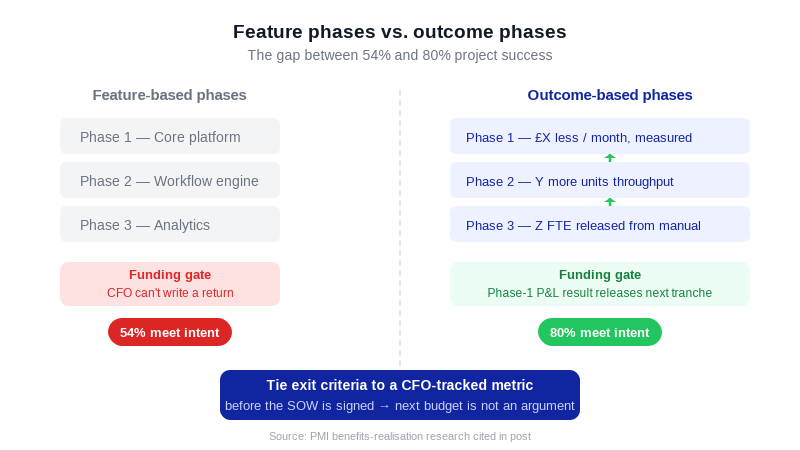
The stakes are not abstract. A McKinsey and University of Oxford study of more than 5,400 large IT projects found they ran 45% over budget while delivering 56% less value than predicted. PMI's benefits-realisation research is the counterweight: organisations with a formal benefits identification process see 80% of projects meet their business intent, versus 54% without one. The gap is almost entirely about what you commit to measure before you start, not how well you execute afterwards.
Step 1: Rewrite every phase definition as a P&L sentence before the SOW is signed
Most phased programmes arrive at the board as a feature roadmap dressed up as phases: "Phase one — core platform and user management. Phase two — workflow engine. Phase three — analytics." That is a build sequence, not a funding sequence. A CFO cannot write a return against "workflow engine."
Before you sign the statement of work, force every phase to be describable in a single sentence of the form: "At the end of phase N, [named business process] will cost £X less per month / produce Y more units of throughput / release Z FTE from manual work, measured by [system of record the finance team already uses]." If you cannot write that sentence, the phase is not scoped — it is a wish list.
The anti-pattern: accepting a vendor's phase plan that reads in features because it sounds decisive and the board is in the room. Features are what the vendor delivers; outcomes are what you bought. A vendor who pushes back on outcome-anchored phasing is telling you they do not yet understand your operations well enough to commit — which is useful information, not a dealbreaker, provided you fix it in paid discovery (step 3) rather than in phase one proper.
You'll know this step is done when your CFO can read each phase definition aloud and name the line item on the management accounts where the effect will show up.
Step 2: Agree the measurement baseline with Finance, not with the vendor
The second failure point is subtler. Finance and operations measure the same process differently — operations knows the handling time per invoice, finance knows the fully-loaded cost per invoice including overhead allocation. If phase one's success metric is "reduce invoice processing cost by 30%" and you have not agreed which of those two numbers is the baseline, you will spend the end of phase one arguing about denominators instead of releasing phase two.
Run a 60-to-90-minute working session with the CFO or Financial Controller before the SOW is final. Walk through each phase's named metric and get written agreement on: the exact figure that is today's baseline, the system it comes from, who owns the report, and how often it refreshes. Capture this as a one-page measurement charter and attach it to the SOW as a schedule. It is a governance document, not a technical one.
The anti-pattern: letting the delivery partner propose the measurement methodology in the kickoff deck. They will, reasonably, propose something measurable in their tooling — product analytics, feature adoption, cycle time in the new system. None of those are what your CFO will use to judge the investment at the next budget cycle.
You'll know this step is done when the finance team can produce the baseline report today, from the current state, without asking anyone in IT for help.
Step 3: Scope a paid discovery that ends with a re-pricing option, not a go/no-go
A two-to-six-week paid discovery, done before phase one's fixed scope is locked, is the single highest-leverage spend in the whole programme. Its purpose is not to produce wireframes. It is to pressure-test whether the outcome sentences from step 1 are achievable at the phase budgets implied in the board paper. More than 55% of executives in BCG's 2024 study said their company does not manage the full portfolio of dependencies between projects in replacement programmes — discovery is where you find those dependencies while the money is still small.
Structure the discovery SOW so the deliverable is three documents: a validated phase-by-phase outcome map (updated from step 1 with what discovery learned), a dependency register that flags any upstream system, data migration or integration that must happen before the outcome can be measured, and a re-pricing recommendation for phases one and two. Explicitly give the vendor permission to come back and say "phase one as specified will not produce the outcome at this budget; here are three ways to adjust." Discovery that cannot change the plan is theatre.
The anti-pattern: scoping discovery as a fixed-price deliverable with the first implementation sprint tacked on the end. The vendor then has a commercial incentive to confirm the original plan rather than challenge it. Keep discovery commercially separate.
You'll know this step is done when you have a written recommendation from the delivery partner that either confirms the original phase budgets or proposes a specific adjustment, with the reasoning attached.
Step 4: Write phase-one acceptance criteria as a release of phase-two funds
This is the step most programmes skip, and it is the one that makes the whole model work. Phase one's acceptance criteria should not be "the software is in production and users are trained." They should be: "the named business metric from step 1 has moved by at least X, sustained over a measurement window of Y weeks, verified by the finance report named in step 2 — on satisfaction of which, phase two funding is released from the previously ring-fenced budget line."
Two things follow from writing it this way. First, the delivery partner now has a direct commercial interest in the outcome moving, not just the code shipping — which changes how they prioritise the backlog from week one. Second, phase two stops being a fresh capital request. It becomes a release of pre-approved funds against a pre-agreed trigger, which is a dramatically easier internal conversation at budget time.
Build in a measurement window of at least four to eight weeks of real operational use between phase-one go-live and the acceptance decision. Day-one metrics are noise. A phase that goes live in March and is formally accepted in May is a phase whose numbers will survive the CFO's scrutiny.
The anti-pattern: go-live equals acceptance. You will ship the software, celebrate, and then discover at the phase-two gate that nobody actually measured the before-and-after because the operations team was absorbed in change management.
You'll know this step is done when the phase-one acceptance clause in the SOW references a specific finance report, a specific metric movement, and a specific measurement window — and your Head of Operations has signed up to own the measurement, not the vendor.
Step 5: Ring-fence phase-two budget on approval of phase one's business case, not phase one's delivery
Take the full multi-phase programme budget to the board once, at the start, with the condition that each subsequent phase's funds release automatically on satisfaction of the prior phase's measured acceptance criteria. You are not asking the board to commit to spending it all; you are asking them to pre-approve the release mechanism so that future releases are a governance decision, not a capital decision.
This matters because of how corporate budget cycles actually work. If phase one goes live in November and phase two funding has to be submitted into the next year's capex round in January, you will miss the window regardless of how well phase one performed. The ring-fence protects the programme from the calendar. Every additional year of project duration adds an average of 15% to cost overruns according to the McKinsey–Oxford data — the delay between phases is often the hidden driver.
The anti-pattern: treating each phase as a standalone capex request. You will spend one quarter in every four re-selling the programme instead of running it, and the second-order effect is that scope gets padded into phase one "just in case" phase two does not get funded — which blows out phase one and starts the doom loop.
You'll know this step is done when your CFO can describe phase two as a release, not a request, and the Finance Business Partner on the programme knows the trigger clauses by heart.
Step 6: Run a 30-day post-phase-one review that is chaired by Finance, not IT
Thirty days after phase one go-live, run a review meeting chaired by the CFO or Financial Controller — not the CIO, not the programme sponsor. The agenda is one item: did the baseline metric from step 2 move as committed? Everything else — user feedback, defect counts, roadmap updates — is a different meeting. Keep this one clean.
The reason it is chaired by Finance is political. When the person who controls the next tranche of money is the person reading the metric aloud, the organisation adjusts fast. When it is the CIO presenting to Finance, it becomes a negotiation about whether the number is good enough. The goal is to make phase-two release a mechanical outcome of a measurement, not a judgement call.
The anti-pattern: a glossy post-implementation review with the vendor presenting feature screenshots and NPS scores. If the business metric moved, you do not need the deck. If it did not, the deck will not save you.
You'll know this step is done when the review minutes contain one of two sentences: "Phase-two funds released on [date], per clause X of SOW" or "Phase-two release deferred pending remediation plan to be reviewed on [date]." No third option.
How to think about budget and timeline across phases
Buyers reasonably want to know what a phased enterprise programme costs and how long each phase takes. The honest answer is that the range is set by four things the buyer controls more than the vendor does: the number of upstream systems each phase must integrate with, whether phase one includes data migration from a system of record or defers it, whether the named business metric is measurable from existing finance reports or requires new instrumentation, and how many business units are in scope for the first measurable rollout.
As an illustrative shape — not a quote — a phase scoped around a single business unit, two integrations, no data migration, and a metric already captured in the current ERP will run shorter and leaner than a phase that touches three business units, five integrations, a legacy data migration, and a metric that has to be newly instrumented. The latter is not twice the first; it is often three to five times, because the dependencies compound. The McKinsey–Oxford data on budget overruns and the Standish CHAOS findings that scope creep (33%) and unclear requirements (39%) are the top failure drivers both point at the same thing: it is the ambiguity in scope, not the size of scope, that causes the overruns.
To turn a range into a real number, three specifics need to be on the table: the integration inventory per phase, the data-migration decision (in phase one or deferred), and the measurement instrumentation gap between the metric you want to track and the reports you have today. Those three answers move the estimate more than anything else. If you want to pressure-test a draft phase plan against this model, that is the kind of conversation a digital transformation discovery is designed for, and it is also where enterprise engagements we have run on multi-phase modernisation tend to start.
Frequently Asked Questions
How long should phase one of an enterprise software rollout be?
Short enough that the measurement window fits inside a single budget cycle — typically a build phase followed by a four-to-eight-week operational measurement window, with the two together comfortably inside six to nine months. Longer phase ones compound risk: the McKinsey–Oxford data shows each additional year of duration adds roughly 15% to cost overruns. If phase one cannot be scoped to deliver a measurable outcome in that window, it is really two phases wearing one label.
What should phase-one acceptance criteria actually say?
They should name a specific business metric, a specific baseline from a specific finance report, a required movement in that metric, and a measurement window of several weeks of operational use after go-live. "Software is in production and users are trained" is not acceptance — it is handover. Acceptance is the moment the CFO agrees the investment produced the return it was sold on, which is also the trigger for releasing phase-two funds.
How do we stop phase-two funding getting re-litigated at the next budget cycle?
Get the full programme budget pre-approved once, with phase-two and phase-three funds ring-fenced and released automatically on satisfaction of the prior phase's measured acceptance criteria. This converts future phase approvals from capital requests into governance decisions. Without this, you will lose a quarter per phase re-selling a programme the board has already said yes to.
Should discovery be done by the same vendor who will build phase one?
Usually yes, because the handover cost of switching after discovery is high and discovery is also how you test the working relationship. But the discovery contract must be commercially separate from the phase-one build contract, with an explicit option to re-price or re-scope phase one based on what discovery finds. If the vendor cannot come back and say "the original plan will not produce the outcome at this budget," discovery is not doing its job.
What does a paid discovery cost and how long does it take?
The shape is two to six weeks of elapsed time with a small senior team — typically a solution architect, a business analyst, and a delivery lead from the vendor, paired with named stakeholders from operations and finance on your side. The cost range is driven by the number of business units interviewed, the integration inventory to be mapped, and whether discovery includes a working prototype or stays at the documentation level. To turn that into an actual figure, the specifics that matter most are scope breadth (how many processes), depth (documentation only versus prototype), and whether a measurement baseline exists today — a short scoping conversation is what turns the shape into a number.
Sources & further reading
- Delivering Large-Scale IT Projects on Time, on Budget, and on Value — McKinsey & University of Oxford
- Managing Large Technology Programs in the Digital Era — McKinsey
- IT Project Failure Statistics (2026): What the Data Says About ERP, S/4HANA and AI Programs — The Sign-Off Table
- IT Project Budget Overruns: Source Data Compared — BudgetOverrun.com (McKinsey–Oxford Study)
- Standish CHAOS Report: 69% IT Project Failure Rate Explained — BudgetOverrun.com
- Custom Software Development Statistics 2026: 40+ Data Points (Standish Group 2024) — Raft Labs
- Strategic Impact of Projects: Identify Benefits to Drive Results — PMI (Primary Source)
- Benefits Realization Management Practice Guide — PMI (via PSI Solutions)
Get one practical guide a week
Costs, AI tools, partner selection — written for people who make the decision. No spam, unsubscribe anytime.
Thanks — you're on the list. One practical guide a week, nothing else.
That didn't work — please check the email address and try again.
Building something in Software & Technology?
CodeNicely partners with founders and tech teams to ship AI-native products that move metrics. Tell us about the problem you're solving.
Talk to our team Book a 30-min call