

Build vs. Buy in the UAE: What SaaS Pricing Hides

 Published by CodeNicely, the product studio founded by Meghal Agrawal and Ujjwal Agrawal in 2017
For: A seed-to-Series-A UAE founder who has been quoted AED 180K–300K for a custom build and is now wondering whether a SaaS stack of three tools at AED 2K/month each is simply the smarter call
In this guide
If you are a UAE founder choosing between an AED 180K–300K custom build and three SaaS tools at roughly AED 2K/month each, the honest answer is: the SaaS stack is almost certainly cheaper for the first 18 months, and almost certainly more expensive by month 30 — but only if you grow past 40–50 seats or touch personal data that falls under DIFC or CBUAE rules. The build-vs-buy decision is really a bet on headcount growth and data residency, not on software. This post gives you the framework to make that bet with your eyes open.
The decision, stated crisply
You are not choosing between "SaaS" and "custom software." You are choosing between:
- Option A — Rent: Assemble 3–8 commercial SaaS tools, pay per seat per month in USD, accept the vendor's data residency and feature roadmap.
- Option B — Build: Pay a one-time capital cost to a development partner (or hire in-house), own the IP, host where you choose, and carry the ongoing maintenance burden yourself.
- Option C — Hybrid: Rent commoditised layers (email, payroll, CRM at low seat counts), build only the workflow or data layer that is actually differentiated or regulated.
Almost every sensible answer at seed-to-Series-A is Option C. The real question is which parts you build. This framework tells you.
Why the upfront comparison lies
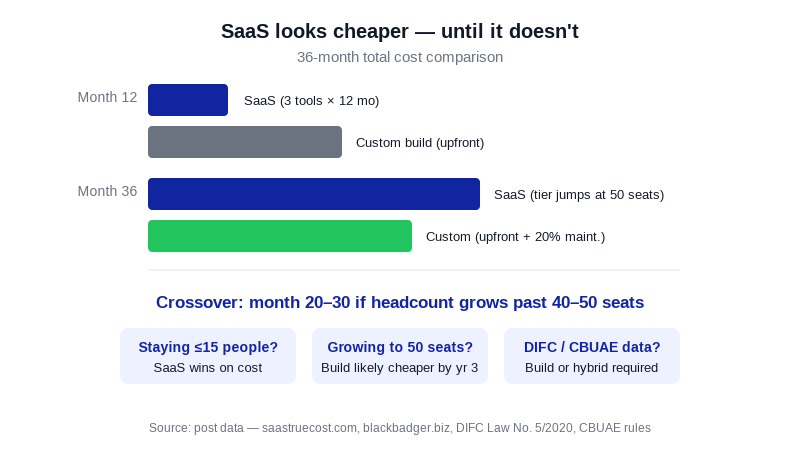
The AED 2K/month × 3 tools × 12 months = AED 72K/year figure a founder sees in a SaaS quote is the number at today's seat count, at today's tier, with data sitting wherever the vendor defaults to. Three things move inside that number between year one and year three, and none of them appear in the proposal.
1. Per-seat pricing is not linear
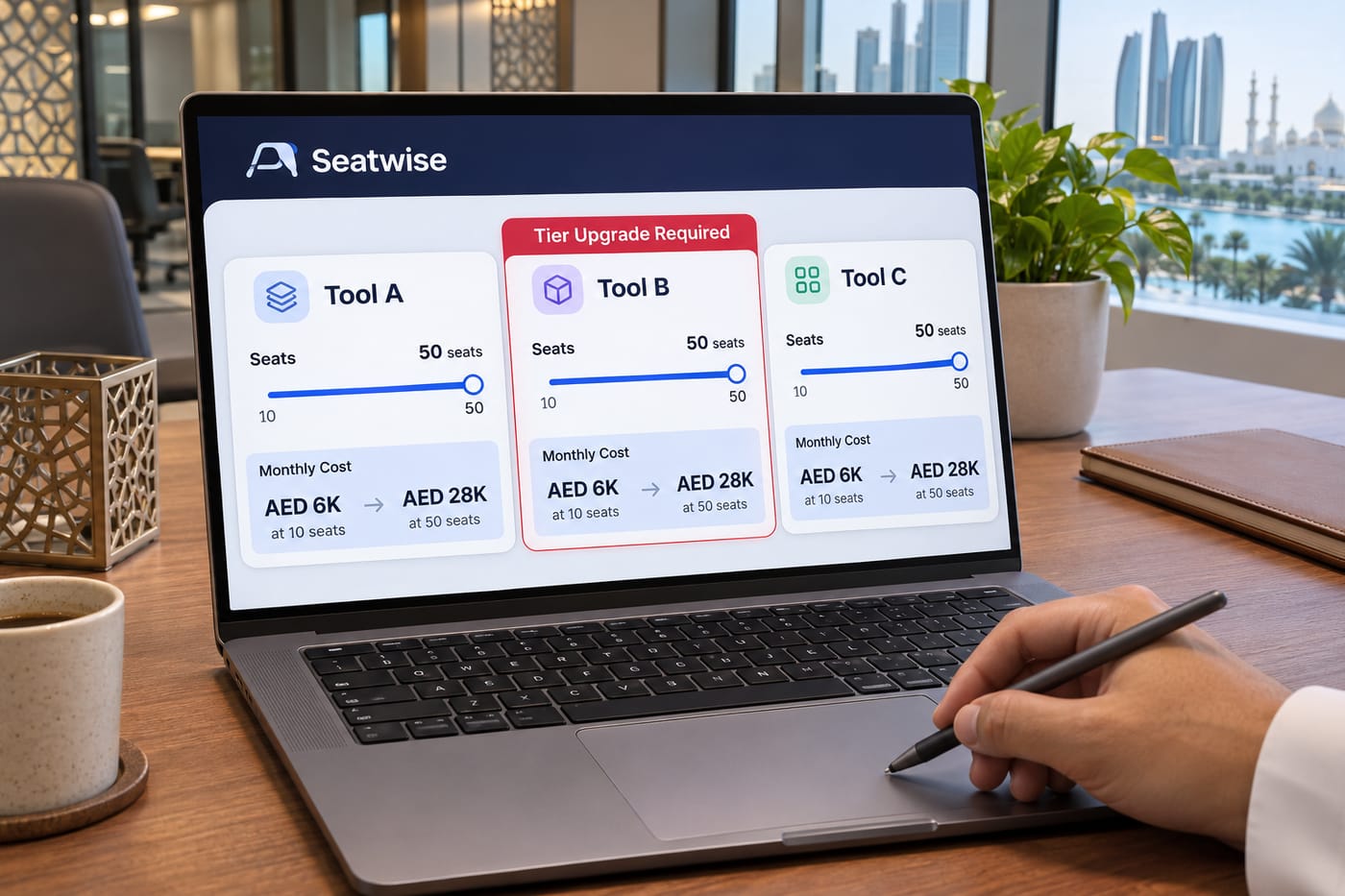
SaaS vendors tier aggressively at headcount thresholds. HubSpot Starter can jump from roughly USD 1,000/month at 25 seats to USD 4,500/month at 50 seats when the seat count forces a tier upgrade to Professional — a 4.5× increase for 2× headcount growth, according to saastruecost.com. That is one tool. A typical core stack of 8 tools at 50 seats costs around USD 4,712/month (USD 56,544/year) on annual billing before add-ons, and mid-market teams at 50 seats commonly spend USD 80,000–USD 200,000/year across their full SaaS stack (same source).
Compounding makes this worse. A 10-person team on a USD 75/seat/month platform growing to 50 people over five years accumulates roughly USD 152,000 in total spend, with the per-seat price 31% higher by year five due to standard annual increases, per blackbadger.biz.
2. UAE-specific data residency is not in the base price
Most SaaS tools you will evaluate store data in EU or US regions by default. If you are a DIFC-registered entity or process data of individuals in the DIFC, DIFC Data Protection Law No. 5 of 2020 Article 10 restricts transfers of personal data out of the DIFC to jurisdictions with an "adequate level of protection." Non-compliance fines sit in the USD 25,000–50,000 band per violation (Linklaters; Bird & Bird on the 2022+ amendments, which broadened extraterritorial scope).
If you are a licensed financial institution, the bar is higher. CBUAE requires your Master System of Record and all confidential/transaction data to remain within the UAE, and you need prior non-objection before any material data is outsourced or offshored. In February 2026 CBUAE launched the Sovereign Financial Cloud Services Infrastructure with Core42 specifically to enforce this (VLink).
Translation: at some SaaS vendors, UAE data residency is a paid enterprise add-on. At others it is not available at all, which means you either migrate off or build a compensating control. Neither was priced in your original quote.
3. Integration and workaround debt
SaaS tools interoperate well with each other and poorly with your actual business. Every custom field, every Zapier bridge, every exported-CSV-then-reimported workflow is debt you will pay for later in either a middleware subscription (Workato, Tray, n8n self-hosted) or engineering time. This is rarely itemised at purchase.
The five axes that actually decide it
Axis 1 — Total cost of ownership over 36 months, not 12
Model SaaS spend at your projected headcount in month 36, not month 1, and include the next tier jump. Model the build as upfront cost + 18–22% of that cost per year in maintenance and iteration (the industry rule of thumb; your actual number depends on scope). The crossover for most seed-to-Series-A teams lands somewhere between month 20 and month 30 if headcount is growing. If you are staying at 10–15 people, SaaS almost always wins on pure cost.
Axis 2 — Speed to first value
SaaS: days to weeks. Custom build: weeks to months for an MVP, longer for anything production-grade and compliant. If your business cannot wait a quarter for the workflow, rent it now and plan to replace it later. This is the honest reason most hybrid approaches win — you rent to learn, build what you have proven matters.
Axis 3 — Regulatory surface area
Score yourself on three questions. Do you process personal data of DIFC-based individuals? Are you (or do you plan to be) regulated by CBUAE, DFSA, or ADGM FSRA? Does your customer contract require UAE data residency? If the answer to any of these is yes, the SaaS tools in your stack that touch that data need an enterprise-tier plan with explicit UAE region hosting, a signed DPA with Standard Contractual Clauses equivalents, and audit rights. The pricing delta from Starter to that enterprise tier is routinely 3–5×. Have your lawyer review the specifics — this is not legal advice.
Axis 4 — Key-person and vendor risk
Custom build risks: the two engineers who wrote it leave, or the agency disappears. Mitigation: insist on full IP ownership, documented architecture, and code in your repo from day one. SaaS risks: vendor is acquired, sunset, or repriced. Mitigation: export paths tested quarterly, contractual price caps, no single tool holding your canonical customer record. Both risks are real. Neither is a reason to default to one option.
Axis 5 — What happens if you change your mind in month six
This is the axis most founders skip. If you bought SaaS and want to leave: your data is exportable but your workflows, custom fields, and integrations are not. Realistic migration cost: 1–3 months of engineering time plus dual-running fees. If you built custom and want to abandon it: you have shelf-ware and a sunk cost. The build path is harder to reverse, which is why it should follow — not precede — a working rented version of the same workflow.
What the build actually costs — the model, not a number
A custom build quote in the AED 180K–300K band is driven by five things, in roughly this order of impact:
- Scope of workflows: number of distinct user roles, screens, and state transitions. This is 50–60% of the variance.
- Integrations: every external system (payment gateway, KYC provider, accounting, WhatsApp Business API, bank feed) is 2–6 weeks of work depending on API quality.
- Data residency and compliance posture: UAE-region hosting, audit logging, encryption-at-rest with managed keys, and DPIA documentation add real engineering time.
- Data migration: moving off existing spreadsheets or a legacy tool is often underestimated by 3–4×.
- Design maturity: whether you have wireframes and a decided information architecture, or are discovering it during build.
As an illustrative shape — not a quote — a two-integration MVP with no data to migrate, one user role, UAE-region hosting on a hyperscaler, and ready wireframes sits at the lower end of that band. The same MVP with five integrations, KYC, an admin portal, and a migration from an existing SaaS tool sits well above the top. The three specifics that turn this range into a real quote are: (1) the integration list, (2) whether you have a design system and decided workflows, and (3) your compliance scope. A 60-minute scoping call will get you there. For UAE-based founders, our Dubai team runs these.
Scoring the three options honestly
| Scenario | Rent (SaaS) | Build (Custom) | Hybrid |
|---|---|---|---|
| 10 seats, no regulated data, workflow is generic | Win | Overkill | Fine |
| 10 seats, DIFC personal data, generic workflow | Risky without enterprise tier | Overkill | Win |
| 50 seats projected in 18 months, generic workflow | Expensive | Possible | Win |
| CBUAE-licensed, transaction data | Not viable for core | Win for core; rent the edges | Win |
| Workflow is your actual product differentiation | Loses the moat | Win | Fine |
| Pre-PMF, workflow still changing weekly | Win | Premature | Fine |
The case against hiring any agency at all
Worth stating plainly. If your workflow is genuinely generic (standard CRM, standard HR, standard accounting), building it is value-destructive. The SaaS vendor has spent more engineering-years on it than you can afford. Rent. The case for a build is not "custom is better" — it is "this specific workflow is either my product differentiation, is regulated in a way vendors do not serve, or will cost me more to rent than to own within 24 months." If none of those three apply, do not build, and do not hire an agency to build.
If you are in situation A, do X
Situation A — Pre-PMF, under 15 people, no regulated data: Rent everything. Revisit in 12 months or when you cross 25 seats, whichever comes first. Do not let an agency talk you into a build.
Situation B — Headcount tripling in 18 months, workflow is stabilising, data is sensitive but not CBUAE-regulated: Hybrid. Rent commoditised layers (payroll, email, support ticketing). Build the one or two workflows that are either your differentiation or your biggest per-seat cost. Our GimBooks engagement is the shape of this — an accounting SaaS where we built the domain-specific workflow layer that no commercial tool served, while the team continued to rent the generic infrastructure.
Situation C — DIFC-registered or CBUAE-licensed, touching personal or transaction data: Build the data layer and anything touching the regulated data. Rent the edges (marketing, internal comms). Treat UAE data residency as a non-negotiable architectural requirement from day one, not a retrofit. Cashpo is the closest analogue in our portfolio — a lending platform where KYC, credit scoring, and the customer record had to live inside a compliant perimeter we built and owned.
Situation D — Your workflow is the product: Build. Rent is strategic surrender of the one thing customers pay you for. See Vahak — route optimisation and marketplace matching were the product, so renting a generic logistics SaaS would have meant selling someone else's software with a markup.
How CodeNicely can help
Most of our UAE and India engagements start as hybrid builds — the founder has already assembled a SaaS stack and hit a ceiling, either on cost, on data residency, or on a workflow the vendor will not customise. The GimBooks build is the closest template for a seed-to-Series-A founder at the crossover point: domain-specific workflows the team owned outright, built to integrate with the commercial tools they still rented. We work on full IP ownership, no vendor lock-in, and will tell you honestly when the answer is "keep renting for another 12 months" — our AI studio and product teams sit in Raipur and Dubai, so UAE-region hosting and a scoping call in your timezone are straightforward.
Frequently Asked Questions
At what seat count does a custom build usually beat a SaaS stack on cost?
There is no universal number, but the shape is consistent: the crossover lands between 30 and 60 seats for most horizontal workflows, driven by SaaS tier jumps and compounding annual price increases. HubSpot going from roughly USD 1,000 to USD 4,500/month between 25 and 50 seats is a representative example from saastruecost.com. Model your specific stack at month 36 headcount, including the next tier jump, before committing either way.
Does DIFC Data Protection Law apply if my SaaS vendor is based in the US?
Potentially yes. The 2022+ amendments broadened extraterritorial scope so the law covers data processing within the DIFC regardless of where the controller or processor is incorporated, per Bird & Bird. Transfers out of the DIFC need an "adequate level of protection" or an approved mechanism under Article 10. Have a UAE-qualified lawyer review your specific vendor list and data flows — this is not legal advice.
How much does a custom MVP cost in the UAE and how long does it take?
Both are driven by the same five variables: scope of workflows, number of integrations, compliance posture, data migration, and design maturity. Ranges a founder sees quoted are wide because those variables are. The three specifics that turn a range into a real quote are your integration list, whether your workflows and designs are decided, and your regulatory scope. A scoping conversation is the fastest way to get to a defensible number.
Can I start with SaaS and migrate to a custom build later?
Yes, and this is often the right answer. The cost to budget for is not just the build — it is 1–3 months of dual-running, data export and transformation, and rebuilding the custom fields and integrations you accumulated in the SaaS tool. Plan the migration path at the point you sign the SaaS contract, not when you decide to leave, by testing your export quarterly and keeping your canonical customer record in a system you control.
What UAE data residency options exist for a regulated startup?
UAE regions are available on AWS (Middle East — UAE), Microsoft Azure (UAE North and Central), Oracle, and the CBUAE-backed Sovereign Financial Cloud Services Infrastructure launched with Core42 in February 2026 for licensed financial institutions (VLink). Which is appropriate depends on your regulator, your workloads, and your customer contracts. An auditor or compliance advisor should confirm the specifics for your licence category.
Sources & further reading
- Middle East and Africa Software as a Service (SaaS) Market Size & Growth 2031 — BlueWeave Consulting
- UAE Cloud Computing Market Size & Outlook, 2024–2030 — Grand View Research
- DIFC Data Protection Law No. 5 of 2020 (Consolidated Version, July 2025) — DIFC Official
- Article 10: Transfers out of the DIFC — adequate level of protection (Thomson Reuters / DFSA Rulebook)
- Data Protected: DIFC — Linklaters (fines and transfer obligations)
- DIFC enacts amendments to Data Protection Law — Bird & Bird
- DIFC Data Protection Law: Fines, Breach Notification, Data Transfers — ProConsult / UAE Ahead
- Cloud Migration Services in the UAE: Process, Data Residency & Costs (2026 Guide) — VLink
Get one practical guide a week
Costs, AI tools, partner selection — written for people who make the decision. No spam, unsubscribe anytime.
Thanks — you're on the list. One practical guide a week, nothing else.
That didn't work — please check the email address and try again.
Building something in Software & Technology?
CodeNicely partners with founders and tech teams to ship AI-native products that move metrics. Tell us about the problem you're solving.
Talk to our team Book a 30-min call