
What Modernization ROI Looks Like on a CFO's Balance Sheet

 Published by CodeNicely, the product studio founded by Meghal Agrawal and Ujjwal Agrawal in 2017
For: A COO or CIO at a 300-to-2,000-employee US enterprise who has already approved a modernization discovery but now has to defend a $1M–$5M multi-year programme budget to a CFO who sees only sunk cost and no GAAP-recognizable return
In this guide
- Why your current ROI case is failing the CFO's filter
- The cost of doing nothing, in numbers a CFO recognises
- The ASC 350-40 argument: turning spend into an asset
- Sequencing: strangler-fig vs big-bang, and the risk profile each presents to finance
- How to phase the spend so the first increment pays for the next
- What the ROI numbers look like, with sources
- What the business has to supply
- How CodeNicely can help
- The argument you take into the CFO meeting
- Frequently Asked Questions
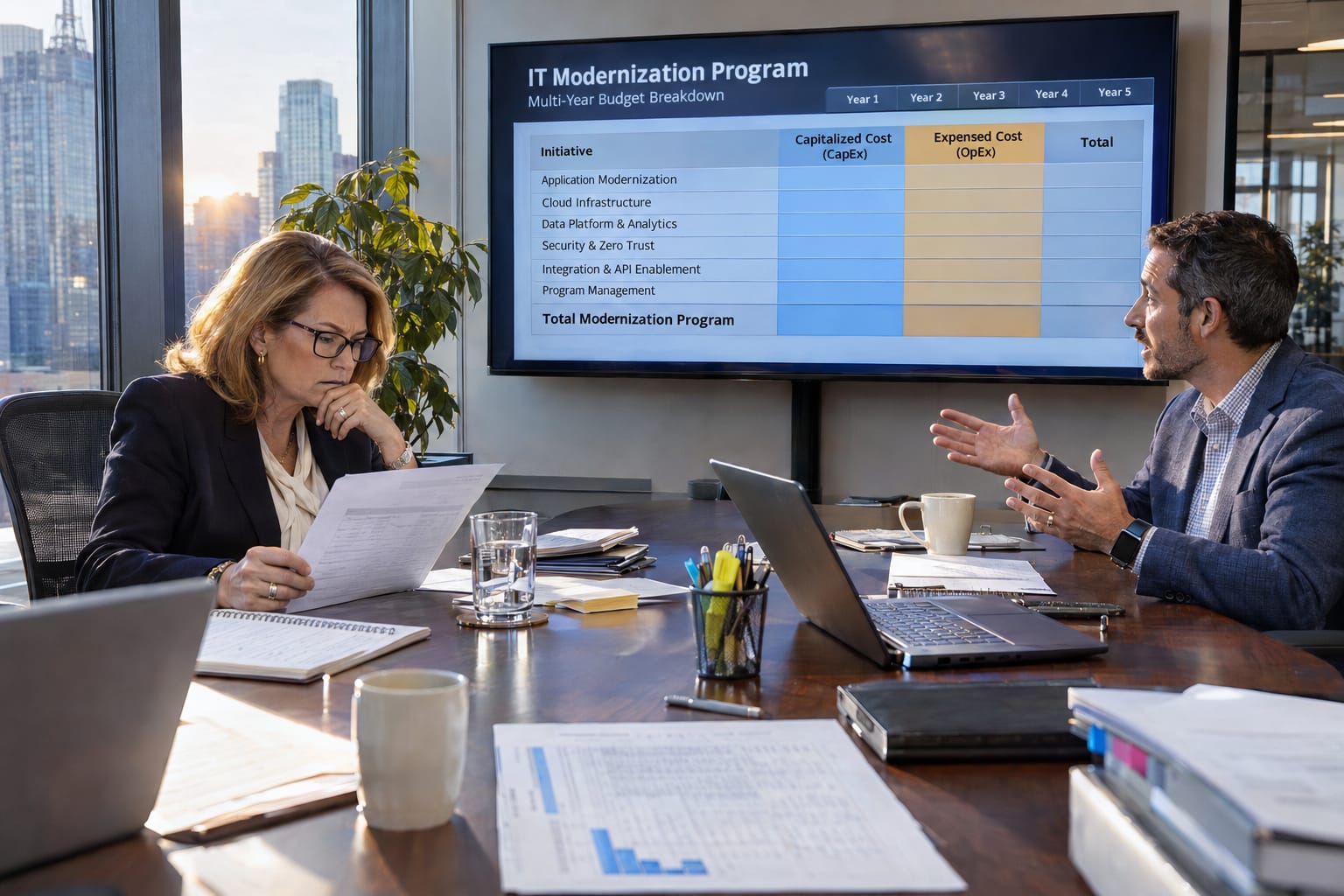
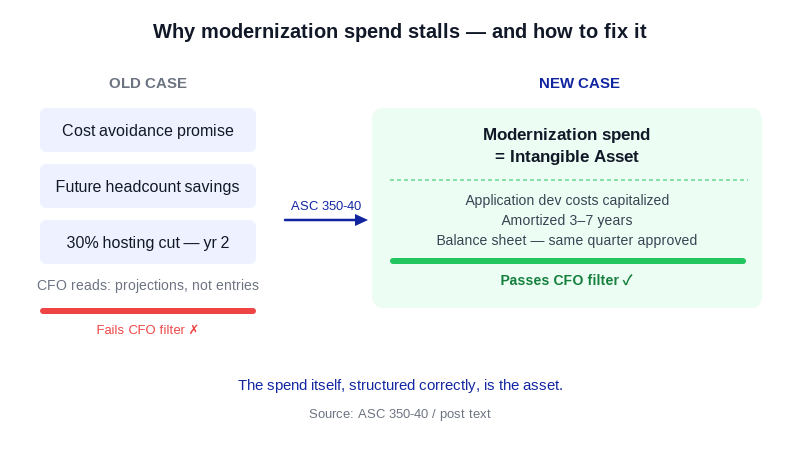
The reason your modernization business case keeps stalling at budget review is that you're selling cost avoidance and your CFO is looking for an asset. Under ASC 350-40, internal and external costs incurred during the application development stage of internal-use software must be capitalized as an intangible asset rather than expensed. Scoped and documented correctly, a phased modernization programme produces a balance-sheet line item in the same quarter the spend is approved — which is a fundamentally different conversation than “trust me, we'll save headcount in year three.” This post gives you the argument to walk into that CFO meeting with.
Why your current ROI case is failing the CFO's filter
A CFO evaluating a $1M–$5M multi-year programme is running three filters in parallel: what hits the P&L this quarter, what lands on the balance sheet, and what the audit committee will ask about. Most modernization business cases fail the second filter and then the third.
The typical deck leads with productivity gains (“engineers spend 23% of time on legacy workarounds”), avoided risk (“audit exposure on unpatched systems”), and infrastructure savings (“30% reduction in hosting spend by year two”). All three are real. None of them are GAAP-recognizable revenue or a capitalizable asset. To a CFO, they read as projections, not entries. That's why the programme stalls.
The reframing is simple: the spend itself, if structured correctly, is the asset. You are not asking the CFO to believe in future savings. You are asking them to approve the creation of an intangible asset that sits on the balance sheet and amortizes over its useful life, typically three to seven years.
The cost of doing nothing, in numbers a CFO recognises
Before the capitalization argument, you need the burning-platform argument — and it has to use the CFO's vocabulary, not IT's.
1. The maintenance tax on every dollar of IT budget
Gartner and Deloitte estimate enterprises spend 60–80% of their IT budgets maintaining existing legacy systems, leaving as little as 20–40% for anything that moves the business forward. McKinsey adds that 10–20% of the budget earmarked for new products gets redirected to resolving technical debt. Put differently: the CFO is already paying for modernization. They're just paying for it in the most expensive form — emergency fixes, consultants, and opportunity cost — with none of it capitalizable.
2. The balance-sheet-adjacent cost of tech debt
A 2023 McKinsey analysis found tech debt represents approximately 40% of IT balance sheets across large enterprises. That number is uncomfortable because it is not an estimate of future risk — it is an estimate of value that has already leaked out of recorded IT assets. Accenture research cited by CISQ puts the annual drag at $2.41 trillion in lost productivity, emergency fixes, security incidents, and delayed projects across U.S. businesses.
3. The specific line items on your P&L
Translate the above into the four categories your CFO will underwrite:
- Support and licensing contracts on end-of-life systems — vendor premiums for extended support on unsupported ERP or database versions typically run 2–3x standard maintenance. Pull the actual invoices.
- Headcount absorbed by workarounds — count the operations staff whose job description is “reconcile between System A and System B.” That is a fully loaded salary line defending a legacy system.
- Audit and compliance exposure — quantify the remediation cost of the last audit finding, and the deal-cycle impact of failing a SOC 2 or customer security review. A lawyer or auditor should review the specific exposure for your systems before you put a number in the deck.
- Revenue the system blocks — the clearest number. What product launches, customer onboarding timelines, or pricing changes are gated by the legacy platform? That is forgone revenue, and it is the only line in this list the CFO will weight as highly as capitalization.
The ASC 350-40 argument: turning spend into an asset
This is the part most modernization business cases miss entirely, usually because it was drafted by IT or a consultant rather than reviewed with finance.
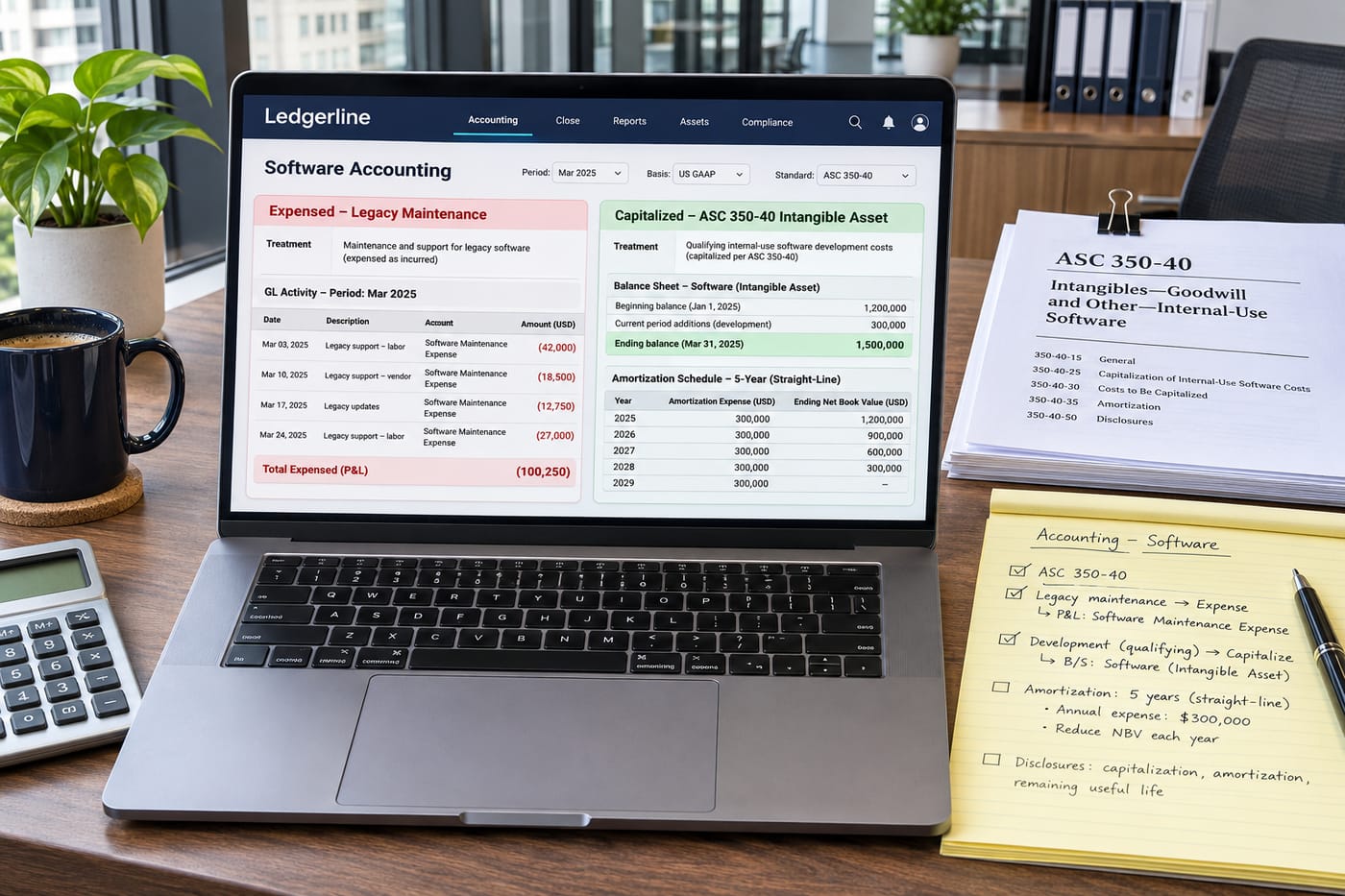
ASC 350-40 governs the accounting for internal-use software. It splits a software project into three stages: preliminary (expensed), application development (capitalized), and post-implementation (expensed). Costs in the application development stage — including internal payroll for engineers working on the project, external developer fees, direct materials, and interest costs — must be capitalized as an intangible asset and amortized over the software's useful life.
For a modernization programme, this means a material portion of the spend — often the majority of a build-focused phase — becomes a balance-sheet asset rather than a hit to operating expense in the year incurred. The CFO is not approving a sunk cost. They are approving the creation of an amortizing asset.
What changed in 2025, and why it matters now
FASB ASU 2025-06, effective for calendar-year public companies on January 1, 2026, replaced the rigid three-stage model with a judgment-based “probable-to-complete” threshold. In practice, this gives your finance team more flexibility on when capitalization begins — particularly useful for agile and iterative modernization programmes where the old stage-gate model was a poor fit. It also adds new note disclosures, so finance needs to be in the room from day one.
The practical implication: if your programme is structured as a series of defined increments with clear “probable-to-complete” criteria at each one, you get cleaner capitalization treatment than if you scope it as one open-ended transformation. Finance and architecture need to agree on the increment boundaries before the SOW is signed.
What does not capitalize
Be honest with the CFO about this, because your auditor will be:
- Preliminary project stage work — discovery, vendor selection, business case development — is expensed.
- Training, data conversion (in most cases), and change management are expensed.
- Post-implementation maintenance, bug fixes, and minor enhancements are expensed.
- Software-as-a-service arrangements follow different rules under ASC 350-40 as amended; implementation costs may qualify but subscription fees do not.
A good rule of thumb: the build phase is capitalizable, the wrapper around it is not. If your programme is 70% build and 30% wrapper, you have a strong capitalization story. If it is 30% build and 70% process re-engineering, you do not.
Sequencing: strangler-fig vs big-bang, and the risk profile each presents to finance
The sequencing decision is usually framed as an engineering choice. It is actually a finance choice, because it determines how the spend hits the books and how quickly the first increment demonstrates value.
Big-bang rebuild
What it is: freeze the legacy system, build the replacement in parallel, cut over on a date.
What finance sees: a long capitalization period with no amortization starting until go-live, a large concentrated impairment risk if the project fails or is cancelled mid-flight, and a single audit event. If the project is cancelled before the asset is placed in service, the capitalized costs are written off — which is exactly the sunk-cost scenario the CFO is worried about.
When it makes sense: regulated systems where parallel operation is impractical, or where the legacy platform is genuinely at end-of-support with a hard vendor deadline.
Strangler-fig increments
What it is: stand up new capability alongside the legacy system, route traffic to the new system module by module, retire the legacy system piece by piece over 18–36 months.
What finance sees: each increment is a separately scoped project with its own capitalization period, its own placed-in-service date, and its own amortization schedule. The first increment reaches “probable-to-complete” within a quarter or two, begins amortizing, and demonstrates GAAP-recognizable asset creation before the next tranche is approved. Impairment risk is isolated to the increment, not the whole programme.
When it makes sense: almost always, for programmes in the $1M–$5M range at mid-market enterprises. It is also the structure that lets you phase the spend so the first increment pays for the next — more on that below.
What it is bad at: strangler-fig carries a higher total integration cost than big-bang, because you are maintaining interfaces between old and new for the duration. It is also harder to govern — scope creep in increment three can quietly unwind the economics of the whole programme. Someone has to own the end-state architecture across increments, or you end up with a distributed monolith that is worse than what you started with.
How to phase the spend so the first increment pays for the next
This is the structural move that turns a $1M–$5M programme from a budget fight into a rolling approval.

- Scope increment one around the most expensive pain point, not the easiest technical win. If the vendor support premium on the legacy ERP is $400K/year, target the modules that let you drop to the base support tier. If headcount is absorbed by a reconciliation workaround, target that workflow. The savings from increment one should be large enough and fast enough to fund increment two without a new budget cycle.
- Structure each increment as a separately capitalizable project. Finance signs off on the increment-level scope, capitalization treatment, and placed-in-service criteria before build starts. This protects the asset treatment and makes each increment auditable on its own.
- Tie the savings from increment one to a named budget line that funds increment two. “The $X we no longer pay in extended vendor support in FY26 is reallocated to the increment-two build budget.” This is the sentence that gets the CFO to approve the full programme in principle while only committing cash to the first tranche.
- Report on realized vs. projected savings at each increment boundary. If increment one underdelivers, the CFO can pause before committing to increment two. If it overdelivers, you have earned the right to a larger increment two. This is the governance structure finance will actually underwrite.
What the ROI numbers look like, with sources
You will need benchmarks in the deck. These are the ones that hold up under CFO scrutiny because they come from named studies, not vendor marketing.
- Infrastructure cost reduction: McKinsey data shows organizations typically achieve 30–50% infrastructure cost reductions within two years of structured modernization.
- Median programme ROI: McKinsey estimates cloud modernization programmes deliver a median ROI of approximately 180%.
- Mainframe-specific ROI: Kyndryl's 2025 State of Mainframe Modernization Survey reports ROI ranging from 288% to 362% with payback periods of 6 to 18 months, depending on whether workloads stay on the mainframe or move off entirely.
- Forward-looking cost compression: Gartner predicts that by 2027, generative AI tools will reduce legacy modernization costs by 70% through automated code explanation and replacement generation. This matters because it changes the calculus on “should we wait?” — the answer is usually no, because the carrying cost of the legacy system compounds faster than the tooling improves, but the deck should acknowledge it.
Use these as directional benchmarks, not as your committed numbers. Your committed numbers come from the discovery you've already approved.
What the business has to supply
This is the part IT usually forgets to put in the business case, which is why programmes under-deliver on the ROI the CFO was promised.
- A single accountable executive sponsor who owns the increment-by-increment go/no-go decisions, not a steering committee.
- Finance embedded from week one — specifically a controller or FP&A lead who owns the capitalization treatment, works with the auditor on ASU 2025-06 disclosures, and signs off on the placed-in-service dates.
- Current-state documentation of the legacy system — not a wish list, an honest map. Where documentation doesn't exist, budget the discovery time to build it.
- Business process owners for every workflow being modernized, with time allocated (not “as needed”) for requirements validation and UAT.
- A data migration and reconciliation plan with named owners on the business side. This is where most modernization programmes miss their dates.
- A change management budget that is separate from the build budget. This expenses rather than capitalizes, so it needs its own line.
How CodeNicely can help
If the system you're modernizing is a spreadsheet-and-workflow-driven operational backbone rather than a monolithic ERP, the GimBooks engagement is the closest reference. GimBooks is a YC-backed accounting SaaS where we built the product that replaced exactly the kind of spreadsheet-and-paper workflow mid-market finance and ops teams run on. The relevant parallel for your CFO conversation: the build was scoped as discrete, separately releasable increments, each one standing up a workflow that let the next one be scoped against real usage data rather than projections.
For enterprises modernizing off a .NET monolith or an unsupported ERP, our digital transformation practice runs the discovery-to-increment-one sequence with finance embedded from the start, so the capitalization treatment is agreed with your controller before build begins. We work with full IP ownership and no vendor lock-in, which matters for the CFO conversation because the capitalized asset is yours, not ours. If you're a US buyer, our US delivery practice is the right starting point.
We are deliberately not quoting a price or a timeline here — neither is meaningful until we've seen the system, the increment-one scope, and your finance team's capitalization position.
The argument you take into the CFO meeting
One paragraph, in their vocabulary:
“We are spending [current maintenance + workaround headcount + vendor support premium] annually to keep a system running that blocks [named revenue opportunity] and carries [named audit exposure]. None of that spend is capitalizable. The modernization programme converts a portion of that same run-rate spend into a capitalizable intangible asset under ASC 350-40, phased as discrete increments so each one stands up on its own balance sheet and funds the next. Increment one targets [the most expensive specific pain point] and reaches placed-in-service within [finance-approved window]. We're asking for approval of increment one now, with the full programme approved in principle and each subsequent increment gated on realized savings from the prior one.”
That is the argument. It wins because it treats the CFO as the budget owner they are, not as the obstacle IT usually casts them as.
Frequently Asked Questions
What portion of a modernization programme can actually be capitalized under ASC 350-40?
The application development stage — internal payroll for engineers on the project, external developer fees, direct materials, and some interest costs — is capitalizable. Preliminary work (discovery, vendor selection), training, most data conversion, change management, and post-implementation maintenance are expensed. For a typical build-focused modernization increment, a material majority of the build-phase spend qualifies, but the exact split depends on how the SOW is structured and should be reviewed with your controller and auditor.
How does ASU 2025-06 change the capitalization timing?
ASU 2025-06, effective for calendar-year public companies January 1, 2026, replaces the rigid three-stage model with a judgment-based “probable-to-complete” threshold. In practice, it gives finance teams more flexibility to begin capitalization on agile and iterative programmes that didn't fit the old stage-gate model cleanly. It also adds new note disclosures, so your finance team needs to be involved in programme structure from the start, not brought in at year-end.
What drives the cost of a legacy modernization programme?
Four things move the number more than anything else: the complexity and documentation state of the current system, the number of integrations that have to be preserved or rebuilt, the volume and quality of data to migrate, and whether the business processes themselves are being re-engineered or just re-platformed. A 10-year-old .NET monolith with sparse documentation, 20 integrations, and 15 years of accumulated data is a different programme than a workflow lift-and-shift. Turning a range into a real quote requires a discovery that maps the current system, the integration surface, and the increment-one scope — which is the conversation to have with us next.
How long before the first increment delivers measurable ROI?
Benchmarks from Kyndryl's 2025 mainframe modernization survey put payback periods in the 6–18 month range, depending on scope. For non-mainframe programmes structured as strangler-fig increments, the first increment typically needs to demonstrate realized savings within two to four quarters to maintain CFO confidence for subsequent tranches. The actual timeline depends on the increment-one scope and the business's capacity to absorb the change — both scoped during discovery.
What if the programme is cancelled mid-flight? Does the capitalized asset get written off?
Yes — if a capitalized software project is abandoned before being placed in service, the capitalized costs are generally written off as an impairment. This is the specific risk that makes big-bang rebuilds uncomfortable for CFOs and makes strangler-fig increments attractive: impairment risk is isolated to a single increment rather than the whole programme. Your auditor should sign off on the write-off treatment for any specific scenario.
Should we wait for generative AI tooling to reduce modernization costs?
Gartner projects that by 2027, generative AI tools will cut legacy modernization costs by roughly 70% through automated code explanation and replacement generation. That is real and worth factoring in. But the carrying cost of the legacy system — maintenance tax, blocked revenue, audit exposure — compounds faster than tooling improves for most enterprises. The usual answer is to start now with the increments where the burning platform is hottest, and let later increments benefit from the tooling as it matures.
Sources & further reading
- FASB ASU 2025-06: ASC 350-40 Targeted Improvements to Internal-Use Software Accounting (FASB official PDF)
- ASC 350-40 Software Capitalization: 2026 Practitioner's Guide (Including ASU 2025-06) — Finrep.ai
- Software Capitalization: CFO Guide to ASC 350-40 & ASU 2025-06 — DualEntry
- The Real Cost of Technical Debt: A CFO's Guide — Brights.io (citing McKinsey, Stack Overflow 2024 Developer Survey, Oliver Wyman)
- Technology Debt Is Business Risk: How to Get Leadership to Care — Coretelligent (citing Accenture, Deloitte)
- Enterprise Modernization: Defusing the Core System Timebomb — Authority.inc (citing Kyndryl 2025 State of Mainframe Modernization Survey)
- Legacy Modernization: The Definitive Business Case Data Guide (2024–2026) — CTO Accelerator (citing Gartner, McKinsey)
- 7 Legacy Application Modernization Strategies: 2026 Guide — Idea Maker (citing McKinsey, Gartner)
Get one practical guide a week
Costs, AI tools, partner selection — written for people who make the decision. No spam, unsubscribe anytime.
Thanks — you're on the list. One practical guide a week, nothing else.
That didn't work — please check the email address and try again.
Building something in Software & Technology?
CodeNicely partners with founders and tech teams to ship AI-native products that move metrics. Tell us about the problem you're solving.
Talk to our team Book a 30-min call