Hiring a Dev Partner vs. First Engineer: What UK Startups Actually Pay

 Published by CodeNicely, the product studio founded by Meghal Agrawal and Ujjwal Agrawal in 2017
For: A non-technical UK seed or pre-Series A founder who has just closed a round, has 12–18 months of runway, and must decide in the next 30 days whether to hire their first permanent engineer or commission a development partner to build the MVP
In this guide
If you have 12–18 months of runway and 30 days to decide, the honest answer is this: a first UK engineering hire rarely ships production code in under six months once you include the search, the notice period, and the ramp — and once you add 15% employer National Insurance, a recruiter fee of 18–22% of base, and six months of fully-loaded salary before meaningful output, the all-in cost typically clears a fixed-scope MVP engagement by £25–40k. That does not mean you should always pick a partner. It means the two numbers founders usually compare — a salary line and an agency quote — are not the two numbers that actually decide this.
This post gives you the real cost model, the three or four axes that should drive the call, and a clean 'if A then X, if B then Y' at the end.
The comparison founders actually make (and why it is wrong)
The usual mental model looks like this: 'A mid-level engineer is £70k. A dev partner quoted me £120k for the MVP. The hire is obviously cheaper — and I keep the person.'
Three things are missing from that sum.
1. Employer on-costs are now meaningfully higher. From April 2025, UK employer National Insurance rose from 13.8% to 15%, and the secondary threshold at which it kicks in dropped from £9,100 to £5,000 — a change ICAEW described as a significant increase to employer NIC liabilities and which took effect in the new tax year. Add pension auto-enrolment (minimum 3%), equipment, software licences, and your actual cost of employment is roughly 1.20–1.25× the headline salary before you have thought about an office or a bonus.
2. You have to find the person first. Contingency recruiters for UK software roles charge 18–22% of first-year base salary, so a £70k hire triggers a £12,600–£15,400 invoice before VAT. You can run the search yourself, but founder time at seed is not free. And the search is not fast: UK software engineering roles take 6–16 weeks to fill, with senior roles at 10–16+ weeks. Gem's 2025 benchmarks show time-to-hire rose 24% between 2021 and 2024, with engineering among the slowest funnels. Then add a UK notice period of one to three months.
3. The ramp is real and it is long. The Linux Foundation's 2024 data puts average technical ramp to normal productivity at 4.8 months, with 58% of organisations saying it takes longer than four. Brandon Hall Group's benchmark for software engineering specifically is 7.4 months. For your first engineer — no codebase to onboard into, no senior to learn from, you as the only product context — the realistic number is at the upper end of that band.
A worked illustration (all assumptions stated)
Illustrative only. Your numbers will differ. Assume a London seed-stage startup hiring one mid-level full-stack engineer at the Ravio 2026 UK median for seed/early-stage P3 engineers of £70,800, using a contingency recruiter at 20%, with a six-month ramp before the engineer ships production features independently.
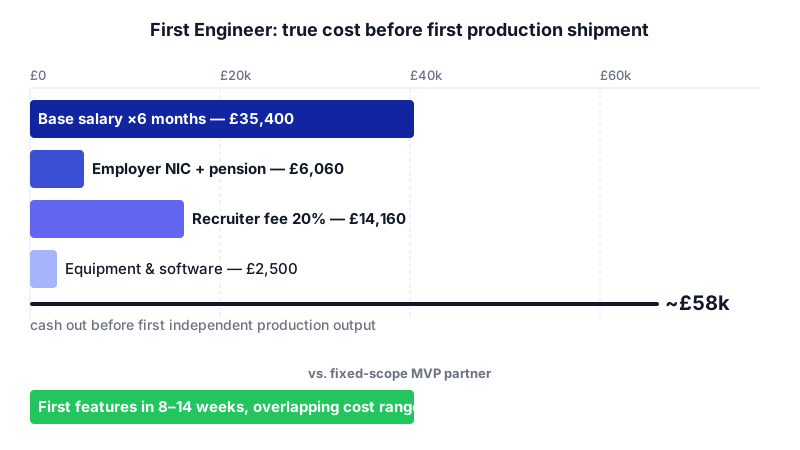
| Line item | Illustrative figure (Year 1, to first production shipment) |
|---|---|
| Base salary, 6 months | ~£35,400 |
| Employer NIC at 15% above £5k threshold (pro-rated) | ~£5,000 |
| Pension (3% minimum) | ~£1,060 |
| Recruiter fee (20% of £70,800, one-off) | ~£14,160 |
| Equipment, software, benefits (6 months) | ~£2,500 |
| Founder/CTO time in search, interviews, onboarding | Significant but unpriced |
| Cash out before independent production output | ~£58,000 |
That is cash spent on one engineer in the window before they are shipping independently, assuming you fill the role in eight weeks and they ramp in six months. If the search takes 12 weeks and ramp takes seven, the figure is higher and your 12–18 month runway is now a 10–16 month runway on the same spend.
Against this, a fixed-scope MVP engagement with a credible partner for a two-to-three integration product typically lands in a range that overlaps with — and often undercuts — that £58k, with first production features inside 8–14 weeks instead of 24–30. The two or three specifics that would turn either option into a real quote are: (a) the actual feature scope of your v1, (b) whether you have existing data or systems to integrate against, and (c) your appetite for post-launch iteration speed. Those three move the number more than anything else, and are the right things to walk a partner (or a prospective CTO) through on a scoping call.
The axes that actually decide this
1. Speed to first value
If you have sold a pilot, promised a design partner a Q2 launch, or need usage data to raise your A, the clock matters more than the headcount. A partner compresses the 'find + notice + ramp' window from ~6 months to ~2–3 weeks. If speed is not the binding constraint, this axis is neutral.
2. Total cost of ownership over 18 months, not 12
The partner looks more expensive on a 36-month view because you are paying a margin on every hour. The hire looks more expensive on a 6–9 month view because of the ramp and the search. Where you cross over depends on how long you expect to build before product-market fit. For most seed startups pre-PMF, the honest horizon is 'we do not know,' and the partner's optionality — stop, pause, scale down — is worth real money.
3. Key-person risk
One first engineer is the single highest concentration of risk in a seed startup. They quit in month nine and your codebase, your context, and your velocity leave with them. A partner distributes that risk across a team and documents by default because they have to hand things over. The counter-argument: a partner can also walk, and switching partners mid-build is painful. Mitigate with contractual IP ownership, source in your repos from day one, and a documentation standard written into the SOW.
4. What happens if you change your mind in month six
You will change your mind. The question is what it costs you. Firing a full-time hire in month six is a redundancy conversation, a possible settlement, and a hit to your ability to recruit the next person. Pausing or re-scoping a partner engagement is a conversation and an amendment. This asymmetry is underweighted by founders who have never had to let someone go.
5. The quality of your product thinking right now
This is the one that cuts against partners. If you genuinely do not yet know what you are building — the problem is still moving weekly, the user is unclear, the wedge is unproven — a fixed-scope partner engagement will crystallise the wrong thing beautifully. In that case, neither option is right. You need a technical co-founder, a fractional CTO, or a very short discovery sprint before you commit to either path.
The honest case against hiring a dev partner
Three scenarios where the partner route is the wrong call:
- The product is the engineering team. If your moat is proprietary infrastructure, novel ML research, or anything where the daily craft of the engineers is the product, you need that craft in-house from day one. A payments API wrapper is not this. A new vector database is.
- You already have a technical co-founder who will build the MVP themselves. Then the question is not 'partner or hire' — it is 'when do we add the second engineer,' which is a different post.
- Your scope is small and stable. A six-week internal tool with no integrations and no roadmap beyond v1 is often cheaper as a contractor engagement than either a partner or a hire.
The decision, cleanly
If you are in situation A — you have a reasonably clear v1 scope, a deadline that matters (pilot, raise, seasonal launch), and your edge is not the engineering itself — commission a dev partner for the MVP, with contractual IP ownership, your repos, and a clause that lets you hire out of the team at month nine or twelve. Use the time saved to find your first permanent engineer unhurriedly, and have them inherit a working codebase instead of a blank repo.
If you are in situation B — your product thesis is still moving, your edge is the engineering, and you have 15+ months of runway with no fixed external deadline — hire the first engineer, budget honestly for the £55–70k cash-out before independent production output, and accept that your first production release is a Q3 or Q4 event, not a Q1 one. Consider a fractional CTO for the first 90 days to run the search and the technical interviews.
If you are in situation C — you are not sure which you are in — you are probably in B but under deadline pressure that feels like A. Spend two weeks with a fractional CTO or a partner's discovery team pressure-testing the v1 scope before committing to either path. That fortnight is the highest-leverage spend on your cap table right now.
How CodeNicely can help
We have run this exact path with UK and international seed founders who needed a production MVP in a window shorter than a UK hire cycle. The most relevant reference point for most readers of this post is GimBooks, a YC-backed fintech where we built the accounting SaaS platform under a fixed-scope engagement with full IP in the founder's repos — the kind of setup that lets a founder hire their first permanent engineer later into a working codebase rather than a blank one. For founders whose v1 needs real AI work (not an OpenAI wrapper), HealthPotli's drug-interaction system is the better parallel. If you want to talk through whether your situation is A, B or C before you commit to either path, that is the conversation to have — bring your v1 scope, your runway, and your deadline, and we will tell you honestly which route makes sense, including when it is neither of us. More on our approach at AI Studio and how we work with startups.
Frequently Asked Questions
What is the real all-in cost of a £70k UK engineering hire in year one?
Expect roughly 1.20–1.25× the base salary once you include 15% employer National Insurance (effective from April 2025), 3% minimum pension, equipment and software — so a £70k hire is ~£84–88k in ongoing cost. On top of that, a one-off recruiter fee of 18–22% of base adds £12,600–£15,400 if you use a contingency agency. The specifics that move this most are your location (London adds materially), whether you self-source, and your benefits package.
How long does it take to hire a first engineer in the UK right now?
The search itself takes 6–16 weeks for UK software engineering roles, with senior roles at the upper end, per 2026 industry data. Then add a UK notice period of one to three months, then a ramp to independent productivity that averages 4.8 months and runs to 7.4 months for software engineering specifically. A realistic 'signed offer to shipping production features independently' window is 5–9 months.
Is it cheaper to hire a developer or use an agency for an MVP?
For a bounded MVP shipped within three to four months, a fixed-scope partner engagement is frequently cheaper than a first hire once you include recruiter fees, employer NICs, and six months of salary during ramp. For an open-ended build over 18+ months with stable scope, a direct hire wins on hourly cost. The crossover depends on your scope stability, your deadline, and how much founder time the search will consume — those are the three questions to answer before pricing either option.
Can I hire a developer later if I start with a dev partner?
Yes, and this is often the right sequence. Insist on full IP ownership, code in repositories you own from day one, and a documentation standard written into the statement of work so a future in-house hire can inherit the codebase. Some partners will also let you hire out of their team after a defined period, which de-risks the handover further.
What should I ask a dev partner before signing an MVP contract?
Four things: who specifically will be on the team and what is their availability; what happens to the code, infrastructure, and credentials if we part ways in month four; how change requests are priced once scope moves (and it will); and whether they will walk you through two engagements that failed and what they learned. Partners who answer the fourth question well are the ones worth talking to further.
Sources & further reading
- Employer NI Contributions — April 2025 rate and threshold changes (gofile.co.uk)
- National insurance increases for employers announced in Budget — ICAEW
- Recruitment Agency Fees UK 2026: What 15–25% Actually Costs — on3works.com
- How Long Does It Take to Hire Software Engineers in the UK in 2026? — weassemble.team
- Software Developer Hiring Statistics 2026 (Gem 2025 Benchmarks) — rockstardeveloperuniversity.com
- Embedded Engineering Hiring Statistics (Linux Foundation 2024 ramp-up data) — fidus.com
- How Long Does It Take a New Employee to Become Productive? (Brandon Hall Group / SHRM) — asa.team blog
- Software Engineer Salary Trends 2026 (Ravio Compensation Benchmarks, by funding stage)
Get one practical guide a week
Costs, AI tools, partner selection — written for people who make the decision. No spam, unsubscribe anytime.
Thanks — you're on the list. One practical guide a week, nothing else.
That didn't work — please check the email address and try again.
Building something in Software & Technology?
CodeNicely partners with founders and tech teams to ship AI-native products that move metrics. Tell us about the problem you're solving.
Talk to our team Book a 30-min call