
What Your Budget Actually Buys at Each Stage: UAE Startups

 Published by CodeNicely, the product studio founded by Meghal Agrawal and Ujjwal Agrawal in 2017
For: A seed-to-Series A founder in Dubai who has raised between AED 500K and AED 5M, has never commissioned a bespoke software build before, and is trying to figure out whether their budget is enough to get something real — or whether they are about to waste it on a discovery that leads nowhere
In this guide
Short answer: in the UAE market, AED 50K–150K buys you a narrow, single-flow MVP from an AI-first product studio or a senior freelancer — but almost nothing useful from a big consultancy or system integrator, who will burn most of it on discovery. AED 150K–500K buys you a real, production-grade MVP with two or three integrations from a product studio, or the first milestone of a mid-market agency build. AED 500K–1.5M is where larger agencies and boutique studios genuinely compete. Above AED 1.5M, you are in enterprise and system-integrator territory, and the question shifts from can they build it to who owns the IP when they are done.
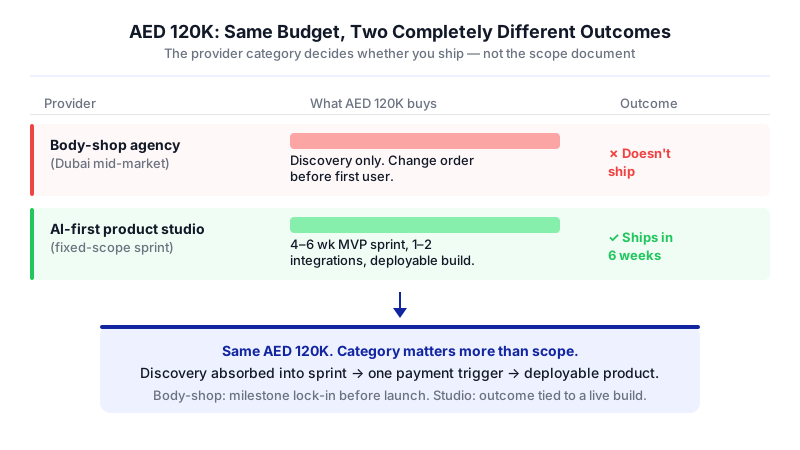
The non-obvious part — the thing that burns most first-time founders — is that at the AED 50K–150K band, the category of provider matters more than the scope document. A body-shop agency will accept your AED 120K, ring-fence the work at milestone one, and issue a change order before a single user touches the product. A fixed-scope AI-first studio at the same price will typically absorb discovery into a 4–6 week MVP sprint with one payment trigger tied to a deployable build. Same budget. Completely different outcome.
This post is the calibration a seed-to-Series A founder in Dubai needs before taking the first vendor call.
The UAE market context, in three numbers
Before the tiers, the backdrop that explains why pricing in Dubai is so wide:
- UAE startups raised $1.41 billion in VC in 2024, with seed and pre-Series A making up 42% of deals and enterprise software seeing a 175% YoY jump in seed activity per MAGNiTT's Q3 2024 report. There is more early capital chasing software builds than the local supply of senior engineers can cleanly absorb.
- The UAE software market hit USD 5.7B in 2024 and the custom-software slice alone is on a 22% CAGR to USD 3.25B by 2030 per Grand View Research. Demand is outpacing capacity, which is why agency pricing has stretched.
- Dubai agencies quote senior engineering at roughly AED 250–500 per hour, and mid-size custom builds land between AED 300K and 1.2M per Rocket Systems. The same report notes that many Dubai agencies subcontract the actual engineering to South Asia without disclosing it — meaning you pay Dubai rates for Bengaluru delivery.
That last point is the buyer's edge. If someone else is already offshoring the work and marking it up, you are allowed to go direct.
The vendor landscape: five categories, honestly compared
There are really only five types of provider a UAE founder will encounter. Each has a pricing model, a sweet spot, and a predictable failure mode.
| Category | Typical pricing model | Right for | Bad at |
|---|---|---|---|
| Big consultancies (Accenture, Deloitte Digital, PwC) | T&M, blended rates AED 800–2,500/hr; minimum engagements AED 1.5M+ | Regulated enterprises, government tenders, board-level risk cover | MVPs. Anything under AED 1M. Speed. Founder-level dialogue. |
| System integrators (local Dubai SIs, resellers) | Fixed-scope on licensed platforms (Salesforce, SAP, Oracle); AED 500K–5M+ | Customizing an existing enterprise platform; connecting legacy systems | Greenfield products. Owning your own IP. AI-native builds. |
| Mid-market Dubai agencies | Milestone-based, AED 300K–1.2M per project; AED 250–500/hr for change requests | Marketing sites, standard mobile apps, e-commerce builds with known patterns | Novel AI products. Honest subcontracting disclosure. Absorbing scope changes without re-pricing. |
| Freelancers & small pods | Hourly AED 150–400, or fixed AED 30K–150K per phase | Prototypes, design sprints, single-feature additions, specialist work (ML model, iOS) | Multi-year ownership. Compliance. Covering sickness, holidays, handovers. |
| AI-first product studios (including CodeNicely) | Fixed-scope MVP sprints AED 150K–450K; retained squads AED 180K–400K/month | 0-to-1 AI products, MVPs that need to ship in 6–10 weeks, founders who want to own the IP | Pure staff-aug. Six-figure-hour enterprise RFPs. Clients who want a body count instead of an outcome. |
In-house is the sixth option, and it deserves its own note. For a three-person Dubai tech team, outsourcing is 40–60% more cost-effective than hiring and extends runway by 12–18 months per market data cited by Rocket Systems and nDigital. In-house makes sense once the product is in market, revenue is predictable, and the roadmap is clearer than it was at seed. Hiring a CTO and two engineers to build V1 is almost always the wrong call at this stage.
What each budget tier actually buys in the UAE
These bands reflect what the Lasting Dynamics 2025 UAE pricing survey and Decipherzone's 2026 guide report, cross-checked against what founders in the market are actually quoted. Treat them as shape, not quotes.
Tier 1: AED 50K–150K — the "is this even enough?" band
This is the band where the category of provider decides whether you ship or not. The money itself is tight but workable.
What it buys you:
- From an AI-first studio: a single-flow MVP — one user journey, one or two integrations (auth, payments, or a single AI model call), deployed to a staging URL. Think "a parent books a tutor and pays," not a full marketplace.
- From a senior freelancer: a working prototype, probably no-code or low-code, suitable for user testing and pre-seed demo days.
- From a mid-market Dubai agency: discovery, wireframes, and milestone one of five. You will need another AED 300K to see a working product.
- From a big consultancy or SI: a proposal document. That is it.
The trap: the agency that happily accepts AED 120K for a "full MVP." Read the SOW: scope is defined at a level of abstraction that lets any new user story become a change order. The Technource MVP data is honest about this — a true MVP is 10–30% of a full build and ships ~35% faster, which means if someone is quoting you a full-product feature list at MVP prices, one of the two numbers is wrong.
What to ask for: a fixed-scope statement with a named deliverable ("deployed Flutter app with Firebase auth, Stripe checkout, one OpenAI-powered recommendation endpoint, handed over on GitHub with full IP transfer"), a single payment trigger tied to that deliverable, and a written answer to "who writes the code and where do they sit?"
Tier 2: AED 150K–500K — the real MVP band
This is where most UAE seed-stage founders actually land, and it is where you can ship something a real user will pay for.
What it buys you:
- A production MVP with two to four integrations, a proper admin panel, basic analytics, and 4–8 weeks of post-launch stabilization.
- From an AI-first studio: the above, plus one meaningful AI capability built in — RAG over your documents, a fine-tuned classifier, an agentic workflow — not a ChatGPT wrapper.
- From a mid-market agency: a solid build on a conventional stack, likely subcontracted to Pakistan or India, with a Dubai-based account manager. Check this before signing.
- UAE PDPL compliance (Federal Decree-Law No. 45 of 2021) should be in scope. Building it in from sprint one adds 15–20% to the build; retrofitting it later costs three to five times more. Pay the 15% now.
The trap: paying studio-grade prices for a glorified Webflow site with a GPT API key taped to the back. Ask to see the architecture diagram and the names of the engineers who will be on your Slack.
Tier 3: AED 500K–1.5M — the "serious product" band
This is where you buy a product that can take funding, not just demonstrate an idea.
What it buys you:
- A full V1: multi-role users, payments, notifications, admin, analytics, three to six integrations, mobile and web, SOC-2-friendly architecture, PDPL-compliant data handling.
- A dedicated squad (typically 4–7 people) for 4–6 months — product manager, designer, 2–4 engineers, QA, DevOps.
- An AI layer that is not an afterthought: a vector store, evals, prompt versioning, observability, a feedback loop.
- Handover documentation that an in-house team can actually pick up.
The trap: the "platform play" scope creep. At this budget, agencies will happily sell you a configurable, multi-tenant, white-label version of the thing you need. You do not. Ship the single-tenant version to one customer first. Every founder who skipped that step regrets it.
Tier 4: AED 1.5M+ — enterprise, scale, or over-building
Above AED 1.5M you are either building something genuinely complex (regulated fintech core, multi-country logistics, a true platform) or you are being over-sold. The honest test: can you name three features in your V1 that would be illegal to ship without a lawyer's sign-off? If yes, you belong here. If no, you are in the wrong tier.
At this level, big consultancies and SIs compete credibly. The watch-outs shift from "will it ship" to "who owns the code, the models, the training data, and the cloud account when the relationship ends." The default position of most large vendors is that they own enough of it to make leaving expensive. Negotiate IP, source control, and cloud-account ownership before signing, not at the end.
The four specifics that turn a range into a real quote
None of the bands above are a quote. What moves a UAE project from "somewhere in Tier 2" to a real number is a short list of decisions:
- Integrations. Each third-party system (payment gateway, UAE Pass, WhatsApp Business, a hospital's HIS, a bank's open-banking API) adds 1–3 weeks and a predictable cost line. List them before the first call.
- Data. Is there existing data to migrate? From where, in what shape, how clean? "We have an Excel sheet" and "we have 400K rows in a legacy Oracle DB" are different projects.
- Compliance scope. PDPL baseline, or PDPL plus DHA/DOH for health, or plus CBUAE for payments. Each one changes the architecture.
- AI depth. API call to GPT-4o is one thing. RAG over your own documents with evals is another. Fine-tuned model with human-in-the-loop labeling is a third. Say which one.
A vendor who gives you a number without asking about all four is guessing, and the number will move.
How CodeNicely fits — and when we don't
CodeNicely is an AI-first product studio and sits in the fifth category above. We have shipped 50+ products reaching 5M+ end users since 2017, and we work with UAE founders from our Dubai practice on fixed-scope MVP sprints and retained product squads, with full IP ownership and no vendor lock-in written into every contract.
The engagement that most often matches a UAE seed founder's situation is GimBooks — a Y Combinator-backed accounting SaaS where we took a narrow MVP hypothesis, shipped a production build with tax and compliance integrations, and handed over a codebase the in-house team scaled from there. If your V1 involves payments, regulated data, or an AI layer that has to be right the first time (think HealthPotli's drug-interaction engine or Cashpo's KYC and credit scoring), that is the pattern.
Where we are not the right pick: pure staff-augmentation (hire a freelancer or a dev shop), heavily customized Salesforce or SAP work (go to an SI), or AED 5M+ RFPs where the buyer explicitly wants a Big Four logo on the proposal. We will tell you that on the first call rather than the third.
Frequently Asked Questions
What does AED 100K actually build in Dubai?
From an AI-first studio or senior freelancer, roughly: one user flow, one or two integrations, deployed to real users as an MVP — not a full product. From a mid-market agency, usually just discovery and the first milestone. The variable is not the budget but the provider category and how the scope is written. Ask for a fixed deliverable and a single payment trigger before signing anything.
How much should a UAE seed-stage startup spend on an MVP?
Industry data from Technource puts an MVP at 10–30% of a full product build, and Lasting Dynamics' UAE survey places simple apps at AED 50K–100K and mid-tier at AED 100K–200K. For most funded Dubai seed startups, the sweet spot is AED 200K–400K — enough for a production MVP with real integrations and PDPL compliance, without over-building before product-market fit. The real drivers are integration count, data migration, and AI depth.
Is it cheaper to hire an in-house team or outsource in Dubai?
Outsourcing is generally 40–60% more cost-effective than building an in-house team for MVP-stage work, and savings for a 3-person Dubai tech team exceed AED 300K — roughly 12–18 months of extra runway per market analysis from Rocket Systems. In-house becomes the right call once the product is in market and the roadmap is predictable enough to justify permanent hires. Before then, a studio or squad is almost always the better capital decision.
Why do Dubai agency quotes vary so wildly for the same scope?
Three reasons: senior engineering hourly rates in Dubai range from AED 250 to AED 500 depending on the agency's overhead; many agencies subcontract to South Asia without disclosing it, which hides a large margin; and most "same scope" documents are not actually the same — one includes PDPL compliance and post-launch support, another doesn't. Normalize the quotes by asking each vendor the same four questions on integrations, data, compliance, and AI depth.
What should I ask a UAE software vendor before signing?
Who writes the code and where do they sit physically; who owns the IP, the repository, and the cloud account on day one and at the end; what triggers a change order; how is PDPL compliance handled; and can I speak to two clients who shipped with you in the last twelve months. A vendor who hesitates on any of these is telling you something. A lawyer should review the MSA and SOW before signing — this post is a calibration guide, not legal advice.
If you are sizing a UAE build and want a second opinion on whether a proposal in front of you is fairly priced, talk to our Dubai team. We will tell you honestly which tier and which category of provider fits — even when that provider isn't us.
Sources & further reading
- Q3 2024 UAE Venture Investment Premium Report – MAGNiTT
- How to Secure Startup Funding in the UAE: A Complete Guide – Hub71
- UAE Software Market Size & Outlook, 2025–2030 – Grand View Research
- Custom Software Trends in 2025: What UAE Enterprises Can't Ignore – Titanisolutions
- Affordable Software Development UAE – Lasting Dynamics
- How to Outsource Software Development from Dubai in 2026 – Rocket Systems
- Custom Software Development Cost in UAE: 2026 Guide – Decipherzone
- MVP Development Statistics 2026: Cost, Speed, Success & AI Data – Technource
Get one practical guide a week
Costs, AI tools, partner selection — written for people who make the decision. No spam, unsubscribe anytime.
Thanks — you're on the list. One practical guide a week, nothing else.
That didn't work — please check the email address and try again.
Building something in Software & Technology?
CodeNicely partners with founders and tech teams to ship AI-native products that move metrics. Tell us about the problem you're solving.
Talk to our team Book a 30-min call