Legacy Migration Without Downtime: The Real Timeline

 Published by CodeNicely, the product studio founded by Meghal Agrawal and Ujjwal Agrawal in 2017
For: A COO or CIO at a 300-person US enterprise running a 10-year-old on-premise system who has been told by their board to migrate without halting operations, and who needs to defend a timeline and budget to the CFO before a vendor is contracted
In this guide
- Why the quotes you have range from 10 weeks to 18 months
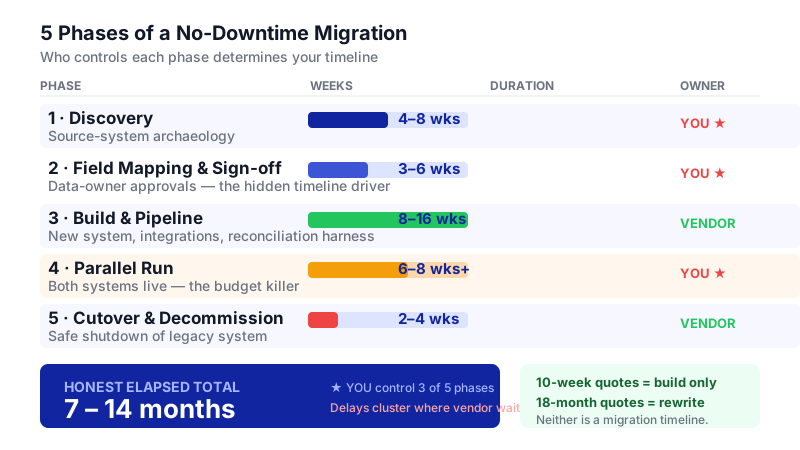
- The five phases, and who actually controls each
- Adding it up: what 7 to 14 months actually looks like
- The three things that most often add weeks
- Why the parallel run is the budget killer, not the build
- What to do in week zero to shorten the whole thing
- Phased, not big-bang — and why the board should hear this
- Turning the range into a real number
- Frequently Asked Questions
For a 300-person enterprise moving off a ten-year-old on-premise system without halting operations, the honest elapsed-time range is 7 to 14 months from kickoff to the day you can safely decommission the old system. Anyone promising 10 weeks is quoting the build, not the migration. Anyone quoting 18 months is probably pricing a rewrite. The difference between the two numbers is almost never the code. It is how long your own team takes to sign off on field mappings, how clean your source data actually is, and the parallel-run window — typically 6 to 8 weeks, often longer — that most vendors do not put on the Gantt chart until after you have signed.
This post breaks the elapsed time into the five phases a buyer can actually recognize, flags which phases depend on you rather than the vendor, and names the three things that reliably add weeks. If you are defending a timeline to a CFO this week, read the phase breakdown and the week-zero checklist at the end first.
Why the quotes you have range from 10 weeks to 18 months
The 10-week quotes are almost always for the first usable slice — a single module, one integration, a subset of users. The 18-month quotes usually include a full rewrite, multiple integrations, and a cautious phased rollout across business units. Both can be accurate for what they describe. Neither is a migration timeline.
The underlying research is unforgiving. Bloor Research found that only 16% of data migrations finish on their original timeline and budget, with the overrun cohort averaging 41% late and 30% over cost. McKinsey's survey of 450 CIOs found 38% had seen migrations delayed by more than a full quarter, with inefficiencies adding 14% to annual migration spend. And across 5,400 large IT projects tracked by McKinsey and Oxford's BT Centre, the average ran 45% over budget and delivered 56% less value than predicted.
These overruns do not cluster in the build phase. They cluster at two seams: the moment the vendor needs something from your team, and the parallel-run window where both systems are live and have to agree.
The five phases, and who actually controls each
Phase 1 — Discovery and source-system archaeology (4 to 8 weeks)
This is where a vendor reads your old system. Not the documentation — the actual database, the stored procedures, the undocumented fields that someone added in 2017, the CSV exports that one team relies on and nobody else knows about. For a ten-year-old on-prem system, expect the vendor to find 20 to 40% more entities, triggers, or integrations than your internal inventory lists. That is not sloppiness on your side. It is what a decade of patches looks like.
Client-side dependency: read-only database access, credentials for every upstream and downstream integration, and a named engineer on your side who can answer questions within 48 hours. If any of these takes two weeks to arrange — and in a regulated enterprise it often does — the vendor's four-week discovery becomes six.
Early warning signal: if your security team has not yet scheduled the access-review meeting by the end of week one, this phase will slip.
Phase 2 — Field mapping, data-owner sign-off, and target design (3 to 6 weeks)
This is the phase that quietly determines your entire timeline, and the one most vendors do not schedule explicitly. Every field in the old system has to be mapped to a field in the new one, or explicitly dropped, or transformed. Someone on your side — not the vendor — has to sign off on that mapping, because only your side knows whether the cust_status_2 field is still used by the finance team's monthly close.
The sign-off is where parallel-run scope gets locked in. If you cannot name a data owner for every domain (customers, orders, invoices, inventory, audit log) by the end of week one, this phase will stretch. The most common failure mode is the vendor presenting a 400-row mapping spreadsheet to a steering committee that then takes three weeks to find the right person for each row.
Client-side dependency: one named data owner per domain, empowered to make irreversible calls. Not a committee.
Phase 3 — Build, migration pipeline, and first usable slice (8 to 16 weeks)
Here the vendor builds the new system, the data pipeline, the integration adapters, and the reconciliation harness that will later compare the two systems record by record during the parallel run. At the end of this phase, you should have a working slice — one module or one business unit — running in a staging environment with real, migrated data.
This is the phase vendors are best at estimating because it depends mostly on them. It is also the phase where AI-assisted code understanding is starting to compress timelines meaningfully — Gartner projects that by 2027, generative AI tools will cut legacy modernization costs by up to 70% by explaining legacy applications and generating replacements. In practice, we are already seeing 20 to 40% compression on the reverse-engineering portion of this phase when the source system is in a mainstream language. COBOL, Delphi, and heavily customized ERPs see less benefit.
Phase 4 — Parallel run and reconciliation (6 to 12 weeks, sometimes more)
This is the phase that breaks timelines. Both systems run live. Every transaction flows through both. A reconciliation harness compares outputs — order totals, invoice numbers, inventory counts, audit entries — and surfaces every discrepancy. Each discrepancy is triaged: is it a bug in the new system, a bug in the old one (yes, these surface constantly), or a legitimate difference that needs business sign-off?
The textbook plan is four weeks of parallel operation. The reality, per industry analysis in 2026, is that parallel runs planned for four weeks frequently extend to three or four months, with every extra week carrying the cost of operating both systems. The extension is almost never because the new system is broken. It is because the business discovers edge cases it did not know it depended on — a quarterly report, a year-end close procedure, a customer-specific pricing rule — and nobody will sign the cutover until those cases reconcile cleanly.
Client-side dependency: daily (not weekly) triage of reconciliation reports by someone with authority to accept small variances. If triage is weekly, every bug takes a week to confirm.
Phase 5 — Cutover, hardening, and decommission (2 to 6 weeks)
Once parallel run is clean, cutover itself is anticlimactic in a phased migration — you simply stop writing to the old system for one domain at a time. Hardening addresses the issues that only appear under full production load. Decommissioning the old system requires finance, audit, and legal sign-off that you have retained whatever records regulators expect.
This phase is why big-bang migrations fail 50–70% of the time against original scope, while phased migrations succeed 73% of the time. Phasing lets you contain damage. A single cutover means every bug surfaces at once.
Adding it up: what 7 to 14 months actually looks like
Illustrative only — assumes a 300-person enterprise, one on-prem system of record, three integrations (payments, email, one data warehouse), roughly 2 to 5 million records to migrate, no regulated-industry audit beyond standard SOC 2, and a named data owner available per domain from week one.
| Phase | Elapsed time | Who controls it |
|---|---|---|
| Discovery | 4–8 weeks | Vendor, gated on your access provisioning |
| Mapping & sign-off | 3–6 weeks | You |
| Build & first slice | 8–16 weeks | Vendor |
| Parallel run | 6–12 weeks | Shared; you triage |
| Cutover & decommission | 2–6 weeks | You, with vendor support |
| Total elapsed | 23–48 weeks |
Phases overlap — build begins while mapping finalizes, parallel run begins per-domain as slices ship — so calendar time lands closer to 7–11 months for a clean project and 12–14 months when one or more of the delay triggers below fires.
The three things that most often add weeks
1. Source data is dirtier than the inventory says
Ten-year-old systems accumulate duplicate records, orphaned foreign keys, free-text fields where enums should be, and date formats that change halfway through the table because someone migrated from one database version to another in 2019. Every one of these needs a cleanup rule, and every rule needs business sign-off.
Early signal: ask the vendor at the end of week two for a data-quality report on the top five tables by row count. If the report shows more than 5% of rows requiring manual rules, add four weeks to your timeline.
2. The data owner is a committee, not a person
If sign-off on the customer-record mapping requires sales, finance, and legal to agree in the same meeting, you have already lost three weeks. The highest-leverage move a COO can make before contract signature is naming one empowered person per data domain and telling them this is now part of their job.
Early signal: if the first mapping-review meeting has more than six attendees from your side, the phase will slip.
3. Parallel-run triage is weekly instead of daily
A reconciliation harness that produces a daily discrepancy report is only useful if someone triages it daily. In most slipped migrations we see, the business decided it could only afford a weekly triage meeting. Every bug then took at least seven days to classify, and the parallel run doubled in length.
Early signal: if the parallel-run RACI does not name a daily triage owner before the phase begins, pre-book the extension on your CFO's calendar now.
Why the parallel run is the budget killer, not the build
During parallel operation you are paying four things at once: the old system's license and infrastructure, the new system's cloud bill at near-production load, the vendor's support retainer, and your internal team's attention. A four-week extension of parallel run is the single largest avoidable line item in a modernization budget. It is also the line item CFOs are least prepared for because the vendor proposal usually shows parallel run as a short tail at the end of the Gantt chart rather than a fully-staffed phase.
Scope this phase like a product launch, not an afterthought. Budget 6 to 8 weeks as the planned duration with explicit triggers for extension, and make the triggers business-owned (e.g., "month-end close must reconcile to within 0.01% for two consecutive cycles before cutover"). This gives you something to show the CFO when someone proposes extending.
What to do in week zero to shorten the whole thing
Before you sign a vendor contract, five things on your side are free to prepare and compress the timeline by 4 to 10 weeks:
- Name one data owner per domain. Write it down. Tell them. Get their calendar.
- Pre-approve read-only database and integration access. Run it through security now, not in week three.
- Produce a current-state integration inventory. List every system that reads from or writes to the legacy system. Include the shadow ones.
- Define the cutover reconciliation criteria. What tolerance is acceptable on which reports? Get finance and audit to agree before build begins, not after.
- Decide the phasing unit. Per module? Per business unit? Per geography? This drives the entire sequencing plan.
Done well, these five items turn a 14-month worst case into a 9-month realistic case and give the CFO a defensible phase-gated budget instead of a lump-sum guess. Teams building custom legacy modernization and transformation programs for US enterprises generally spend the first two weeks of any engagement helping the client complete exactly these five items — you can do them before anyone starts a clock.
Phased, not big-bang — and why the board should hear this
If your board or CFO is pushing for a single cutover to "rip the bandaid off," the data is on your side to push back. Phased migrations succeed 73% of the time; big-bang migrations fail 50–70% of the time. The elapsed time for a phased approach is longer on paper but materially shorter when you include the probability-weighted cost of recovering from a failed big-bang cutover. This is the single most important conversation to have before contract signature, because the architecture of the migration — which locks in at mapping sign-off — follows from this decision.
Turning the range into a real number
Three specifics collapse the 7-to-14-month range into something you can defend line-by-line to a CFO: the number of integrations the legacy system has in and out, the row count and estimated dirtiness of the top ten tables, and whether your industry's regulators require an auditable retention plan for the decommissioned system. Any vendor that gives you a fixed timeline without asking those three questions is quoting a build, not a migration. A short scoping conversation — two or three working sessions — is usually enough to replace the range with a phase-gated plan your finance team can approve.
Frequently Asked Questions
How long does a zero-downtime legacy migration actually take for a mid-size enterprise?
For a 300-person enterprise with one legacy system of record and a few integrations, elapsed time typically lands between 7 and 14 months end to end, with the wider end driven by data-cleanliness issues and parallel-run extension rather than build complexity. The three specifics that turn that range into a real number are your integration count, the dirtiness of your top ten tables, and your regulatory retention requirements.
Why do vendors underestimate the parallel-run phase?
Most vendor Gantt charts show parallel run as a short tail because the vendor's own effort during parallel run is low — the heavy lifting shifts to the client's triage team. The phase extends when business users discover edge cases (quarterly reports, year-end closes, customer-specific rules) that nobody documented and that only surface under real transaction load.
Is a big-bang cutover ever faster than a phased migration?
On paper, yes. In outcomes, rarely. Standish Group data shows big-bang migrations fail against scope and timeline 50 to 70% of the time, while phased migrations succeed 73% of the time. The elapsed time of a phased approach is longer, but the probability-weighted total cost — including recovery from a failed cutover — is lower for almost any system-of-record migration.
What drives the cost range for a legacy migration?
The biggest cost drivers are the number and complexity of integrations, the volume and dirtiness of data to transform, the length of the parallel-run window (every week runs both systems at full cost), and whether regulatory audit requirements force a specific retention or evidence pipeline. The single largest avoidable cost is parallel-run extension, so scoping that phase realistically up front is the highest-leverage budgeting decision. A short scoping conversation with a modernization partner is usually required to move from a range to a quote.
Can AI tools genuinely shorten legacy migration timelines?
Yes, in the reverse-engineering and code-explanation portions of discovery and build, where current tools are compressing effort by 20 to 40% on mainstream languages. Gartner projects up to 70% cost reduction on modernization by 2027 as these tools mature. AI does not meaningfully shorten the mapping-sign-off phase or the parallel-run phase, because both are governed by human decision-making and business reconciliation rather than code.
Sources & further reading
- Legacy Data Migration: Strategy, Steps, Costs & Pitfalls (Standish Group CHAOS data, PM World Journal Jan 2026)
- Legacy Modernization: The Definitive Business Case Data Guide (2024–2026) — Bain, McKinsey, Gartner, Kyndryl
- How Much Does Cloud Migration Cost in 2026? (McKinsey CIO survey, Gartner per-VM range)
- 50+ Headless CMS Migration Statistics in 2026 (McKinsey/Oxford 5,400-project study)
- PLM CAD Data Migration: The 5 Critical Risks (Bloor Research cost/schedule overrun data)
- Zero-Downtime ERP Migration: How to Replace a Business-Critical System While It Is Still Running (Standish Group; phased vs. big-bang success rates)
- ERP Modernization Guide: Migrate Legacy Systems Without Risk (Gartner 2024 Enterprise Technology Survey; phased vs. big-bang)
- Data Migration Cost in 2026: What You're Actually Paying For (parallel-run extension reality; McKinsey 14% overrun)
Get one practical guide a week
Costs, AI tools, partner selection — written for people who make the decision. No spam, unsubscribe anytime.
Thanks — you're on the list. One practical guide a week, nothing else.
That didn't work — please check the email address and try again.
Building something in Software & Technology?
CodeNicely partners with founders and tech teams to ship AI-native products that move metrics. Tell us about the problem you're solving.
Talk to our team Book a 30-min call