Taking Over a Codebase From a Previous Vendor

 Published by CodeNicely, the product studio founded by Meghal Agrawal and Ujjwal Agrawal in 2017
For: A COO or VP of Engineering at a 200–500-person US enterprise who just terminated a development vendor contract and needs to onboard a new partner without losing months of momentum or discovering mid-transition that the codebase is unmaintainable
In this guide
- Step 1: Freeze the perimeter before you announce the change
- Step 2: Run a paid discovery with a shortlist of two, not an RFP with ten
- Step 3: Audit the third-party integrations before transfer, not after
- Step 4: Make the compliance paper trail explicit
- Step 5: Structure a paid pilot that proves maintainability, not velocity
- Step 6: Set the long-term handover standard before you need it
- What a realistic timeline and cost model looks like
- How CodeNicely can help
- Frequently Asked Questions
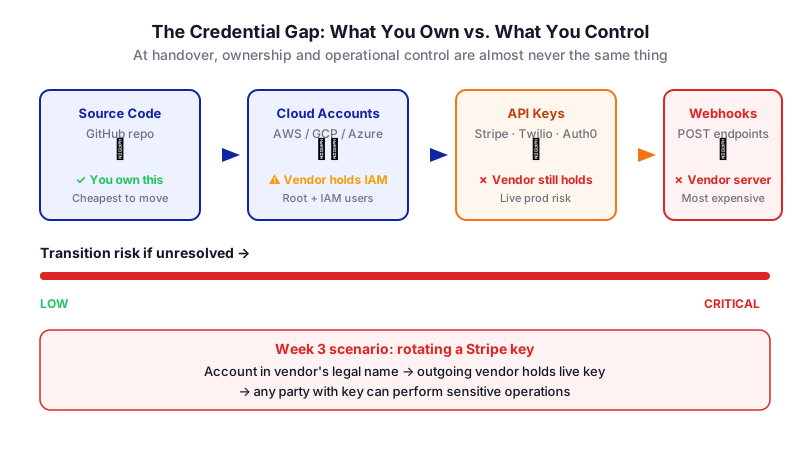
The riskiest moment in a vendor transition is not the handover call — it is week three, when your new team tries to rotate a Stripe key and discovers the account is in the previous vendor's legal name. Before you grant repo access to the new partner, you need to run a buyer-side process that separates code ownership from operational control, because they are almost never the same thing. This playbook is the sequence that gets you both.
Context on why this matters: Gartner data cited in recent outsourcing research puts the failure rate of IT outsourcing engagements at 21% within the first 24 months, and the total cost of failed engagements — rework, rebidding, lost time — averages 240% of the original project budget. A botched transition is how a healthy project becomes one of those numbers.
Step 1: Freeze the perimeter before you announce the change
Before the outgoing vendor knows they are being replaced, inventory every system they can touch. Not every system they should touch — every system they can. This is the single checkpoint that most buyers skip, and it is the one that creates audit failures and silent outages later.
Build a four-column spreadsheet: system, account owner of record, who holds the credentials today, what breaks if the credential is rotated. Walk it for: source control, cloud (AWS/GCP/Azure root plus IAM users), CI/CD, package registries, DNS and domain registrars, SSL/TLS cert issuers, error monitoring (Sentry, Datadog), analytics, feature flags, and — this is where people get hurt — every third-party API integration. Stripe. Twilio. Plaid. SendGrid. Segment. Auth0. OpenAI. Each one has an account owner, a billing contact, a webhook destination, and often a rate-limit tier negotiated with the provider's sales team.
Anti-pattern: treating the GitHub org transfer as the completion of the transition. Source code is the cheapest thing to move. The webhook endpoints pointing at a server the outgoing vendor controls are the expensive thing.
You'll know this step is done when every row in the spreadsheet has a named human at your company — not the vendor — listed as account owner of record, or has a dated action item to become so.
Step 2: Run a paid discovery with a shortlist of two, not an RFP with ten
A traditional RFP wastes a quarter and selects for vendors good at writing RFPs. Instead, shortlist two candidates based on relevant domain experience (not logos — actual engineers who have shipped in your stack and vertical), and pay each of them for a two-to-three-week discovery.
The discovery deliverable is not a proposal. It is a written assessment of the inherited codebase covering: architecture map, dependency and version audit, test coverage reality check, CI/CD state, security posture, and a ranked list of the technical debt they would address in the first 90 days. McKinsey's work on technical debt finds organizations typically spend 20–40% of their technology budget servicing debt, and that 10–20% of budget earmarked for new product gets diverted. You want to see how each candidate thinks about that tradeoff on your code, not in the abstract.
Pay fairly for the discovery. If a vendor will do it for free, they are either amortizing the cost into an inflated build estimate or they are not sending senior people.
Anti-pattern: running a beauty parade of five vendors over Zoom and choosing on rapport. You are hiring a team that will see production incidents at 2am; you need to see how they think when they are allowed to read the code.
You'll know this step is done when you have two written assessments of the same codebase in your inbox and you can see which team actually opened the repo and which one wrote a template.
Step 3: Audit the third-party integrations before transfer, not after
This is the step that this entire post exists for. Your enterprise owns the code. It very likely does not own the production dependencies that code calls out to.
For every third-party integration, document four things:
- Account ownership. Whose legal entity is on the account? Whose credit card is being charged? Whose email receives the security alerts?
- Credential inventory. How many API keys exist, where are they stored (env vars, secrets manager, a Notion page, someone's laptop), and when were they last rotated?
- Webhook topology. Where does the provider POST to? Is it a URL on your infrastructure or a URL on the outgoing vendor's?
- Negotiated terms. Rate-limit tiers, volume discounts, sandbox environments, and support SLAs are often attached to the account, not the code.
Payment integrations are the sharp edge. Analysis of documented Stripe credential exposure incidents notes that Stripe secret keys are not bound to a single IP or environment — any party in possession of an active key can perform sensitive operations unless the merchant has layered additional controls. An outgoing vendor with a copy of your live key is, until the key is rotated and ownership transferred, a live production risk.
Budget for the possibility that some integrations will need to be re-provisioned under your account rather than transferred. CIO Dive's reporting on the CloudBees DevOps Migration Index pegs the average cost of platform migration issues at $315,000 per project, with 57% of IT leaders spending over $1M on migrations in a single year and an average 18% overrun. Separately, industry teardowns of API migration costs put a Stripe or Braintree replacement in the $20K–$80K range and a Twilio replacement at $5K–$25K — meaningful numbers that only show up on your plan if you look for them now.
Anti-pattern: assuming "we'll just transfer the account later." Providers have formal account transfer processes that require the current legal owner to cooperate. A vendor you just fired is not a cooperative counterparty.
You'll know this step is done when every third-party integration has a documented transfer path with a date, and every production credential in use has been rotated at least once under your control.
Step 4: Make the compliance paper trail explicit
If you operate under SOC 2 or HIPAA, the vendor transition is an audit event whether you treat it as one or not.
SOC 2 Common Criteria CC9.2 requires that vendor risk be assessed before access is granted, and CC6.6 requires that third-party access be restricted and monitored during the engagement. A departing vendor who retains active API credentials — even for a week — breaks CC6.6 on its face. Security Boulevard's compliance comparison is a readable summary of how these controls interact across frameworks.
HIPAA is stricter. A signed Business Associate Agreement is required with every vendor that touches PHI, and the BAA must specify access control requirements. AccountableHQ's comparison of SOC 2 and HIPAA makes the point that a vendor accessing systems through a shared login without MFA renders the covered entity non-compliant even if the covered entity's own controls are perfect.
Before the outgoing vendor loses access, you need: (1) a dated access-revocation log, (2) a new signed BAA with the incoming vendor if PHI is in scope, (3) an updated vendor risk assessment for the incoming vendor, and (4) a credential rotation log showing what was rotated, when, and by whom. Your auditor will ask for all four. None of this is legal or audit advice specific to your situation — have your counsel and your auditor review the specifics.
Anti-pattern: rotating keys and revoking GitHub access without capturing the timestamps. The absence of a log is, to an auditor, indistinguishable from the absence of the control.
You'll know this step is done when you can produce a one-page timeline of access events that would survive an auditor's question "show me exactly when the outgoing vendor lost production access."
Step 5: Structure a paid pilot that proves maintainability, not velocity
The temptation after a bad vendor experience is to pick the new partner who promises the fastest first ship. Resist it. Structure the first four to six weeks as a paid pilot with one specific goal: prove the codebase is maintainable by the new team.
Good pilot scope: fix a non-trivial bug that requires understanding two or more subsystems, add a small feature that touches data model and UI, stand up a reproducible local dev environment, and raise test coverage on one critical path to a specified threshold. Ship each of these through the real CI/CD pipeline with real review.
What you are actually measuring: how long it takes a senior engineer on the new team to answer the question "why does this code do what it does?" without calling the old vendor. If that answer stays stuck at "we don't know," you have an unmaintainable codebase and no amount of feature-roadmap optimism will fix it. Better to find out in week four than month four.
Anti-pattern: pilot scope that is a new greenfield microservice. That proves the new team can write code. It does not prove they can inherit yours.
You'll know this step is done when the pilot deliverables are in production and the new team has written an onboarding document that a future engineer could use to get productive in a week.
Step 6: Set the long-term handover standard before you need it
You just lived through a bad handover. Do not inherit the same problem in reverse 18 months from now. In the contract with the new partner, write the handover standard that would make the next transition painless: documentation kept in-repo and updated as part of the definition of done, all accounts and integrations owned by your entity, credentials in your secrets manager, a quarterly architecture review document, and a written runbook for every production incident class.
This is cheap to agree to upfront and expensive to retrofit.
You'll know this step is done when the contract specifies handover artifacts as deliverables, not as goodwill.
What a realistic timeline and cost model looks like
Buyers always ask "how long and how much." The honest answer is a model, not a number.
The timeline is driven by: how many third-party integrations exist and whether accounts transfer cleanly, whether the codebase has a working local dev environment, the state of test coverage, whether the outgoing vendor is cooperative or adversarial, and whether you are under an active compliance audit cycle. A transition on a well-documented codebase with cooperative offboarding and five integrations is a different calendar than an uncooperative handover of a ten-year-old system with 30 integrations and a pending SOC 2 Type II window. CloudBees' data noting that 61% of IT leaders report migration fatigue causing delays of six months or more is a reasonable outer bound for how bad this can get when the upfront work is skipped.
The cost is driven by: the paid discovery, the pilot, any third-party integration re-provisioning, the technical debt remediation that the discovery surfaces, and audit remediation if compliance gaps are found. Industry analysis of technical debt, citing CISQ, pegs accumulated U.S. software technical debt at $1.52 trillion inside a $2.41 trillion annual cost of poor software quality — the point being that inherited codebases almost always carry more debt than the handover docs admit, and the discovery step is what surfaces it before it surprises you.
Illustrative worked example, with assumptions stated: a mid-sized SaaS with eight third-party integrations, a working but undocumented dev environment, no active audit, and a cooperative outgoing vendor could reasonably run Steps 1–4 in parallel over three to five weeks, pilot in weeks four through nine, and reach full operational control between weeks ten and twelve. Change any of those assumptions — adversarial handover, HIPAA scope, Stripe account stuck in the outgoing vendor's name — and the calendar moves materially.
Three specifics turn this model into a real quote: (1) a current integration inventory with account ownership status, (2) a candid read on the outgoing vendor's willingness to cooperate, and (3) your current compliance obligations and audit window. Those are the conversation to have with a prospective partner, and they are the conversation CodeNicely starts with on transitions of this kind.
How CodeNicely can help
The engagement pattern that most resembles this situation in our portfolio is GimBooks, a YC-backed accounting SaaS where we took over a production fintech system with live customers, active payment flows, and compliance obligations. The transition work — inventorying integrations, re-provisioning credentials under the correct legal entity, standing up a maintainable CI/CD pipeline, and surfacing the technical debt the previous team had not documented — is the same shape of work this playbook describes. We took over code without breaking production, and the client retained full IP ownership throughout, with no vendor lock-in written into the new engagement.
For enterprises specifically evaluating a US-market partner for this kind of work, our US engagement model and transformation practice are where to start. We are honest about what we are bad at too: we will not take over a codebase sight-unseen without a paid discovery, and we will not quote a fixed price on a transition where the integration inventory has not yet been completed. Both of those are the sharp edges that cause the 240%-of-budget failures Gartner documented.
Frequently Asked Questions
How long does it take to take over a codebase from a previous vendor?
The honest range is driven by integration count, outgoing vendor cooperation, test coverage, and whether you are under an active audit. A small, well-documented system with a cooperative offboarding can transition in a few weeks; a decade-old system with uncooperative handover and HIPAA scope can take two to three quarters. The three inputs that narrow the range are your current integration inventory, the outgoing vendor's posture, and your compliance obligations — share those and a partner can give you a real estimate.
What should be in a vendor transition checklist for enterprise software?
At minimum: a frozen perimeter inventory of every system the outgoing vendor can access, documented account ownership for every third-party integration, a credential rotation log, a signed BAA or updated vendor risk assessment if compliance applies, a paid discovery deliverable from the incoming partner, and a pilot scope that proves maintainability rather than velocity. Code transfer is the smallest line item on this list, which is why so many transitions treat it as the whole job and get burned.
Who owns the Stripe or Twilio account when we switch vendors?
Whoever is named as the account owner of record with the provider owns it — and that is frequently the outgoing vendor, not the enterprise paying for the service. Transferring ownership requires the current owner to initiate the process with the provider. If the relationship is adversarial, you may need to re-provision the integration under a new account, which carries real cost and the risk of breaking live webhooks. Audit this before you terminate the contract, not after.
How do we evaluate an inherited codebase without trusting the outgoing vendor's documentation?
Pay a shortlisted incoming vendor for a two-to-three-week discovery whose deliverable is a written architecture map, dependency audit, test coverage reality check, security posture review, and a ranked technical debt list. You are buying an independent read on the code, not a proposal. Running this on two candidates in parallel costs more but tells you which team actually opened the repo.
What are the SOC 2 and HIPAA risks of a vendor transition?
SOC 2 CC6.6 and CC9.2 require that third-party access be assessed before granting and monitored during the engagement — a departing vendor with lingering credentials breaks that control. HIPAA requires a signed BAA with specified access controls for any vendor touching PHI, and shared logins without MFA can make the covered entity non-compliant regardless of its own posture. Document access revocation timestamps and credential rotations as you go, and have your auditor and counsel review the specifics for your situation.
Sources & further reading
- Software Development Outsourcing Statistics 2026 (citing Gartner 2024 on failed outsourcing cost)
- IT Outsourcing Statistics 2026: Market Size, Cost Savings & Trends (citing Gartner 2024 on 21% failure rate)
- Migration issues cost businesses $315K per project — CIO Dive (CloudBees DevOps Migration Index 2025)
- Technical Debt Statistics 2026: Every Number That Matters (CISQ, McKinsey)
- The Real Cost of Technical Debt and When to Pay It Down — Full Scale (CISQ + McKinsey CIO survey)
- 11 SSO Compliance Requirements Compared: SOC 2, ISO 27001, HIPAA, PCI DSS, and GDPR — Security Boulevard
- SOC 2 vs HIPAA: Key Differences, Overlap, and How to Comply with Both — Accountable HQ
- Leaked Stripe Merchant Keys Expose Payments and Payouts — Cypro
Get one practical guide a week
Costs, AI tools, partner selection — written for people who make the decision. No spam, unsubscribe anytime.
Thanks — you're on the list. One practical guide a week, nothing else.
That didn't work — please check the email address and try again.
Building something in Software & Technology?
CodeNicely partners with founders and tech teams to ship AI-native products that move metrics. Tell us about the problem you're solving.
Talk to our team Book a 30-min call