How US Enterprises Are Billed for AI Dev Work — and Where the Model Breaks

 Published by CodeNicely, the product studio founded by Meghal Agrawal and Ujjwal Agrawal in 2017
For: A VP of Engineering or CIO at a 500-person US enterprise who has received three AI dev partner proposals with incompatible pricing structures and cannot evaluate them on a like-for-like basis before the board review in two weeks
In this guide
- Why AI work breaks traditional pricing models
- The vendor landscape, honestly
- The three pricing models and how each one actually behaves
- How to normalize three incompatible proposals
- Where each model actually breaks
- The hidden variable: who owns what at the end
- How CodeNicely fits — and when it doesn't
- What to take into the board review
- Frequently Asked Questions
Short answer: the three proposals on your desk are priced differently because each vendor tier is hedging a different risk — the Big Four is hedging brand exposure, the nearshore body shop is hedging utilization, and the AI-first studio is hedging scope drift on a model it has not yet profiled. To compare them like-for-like before your board review, normalize every proposal to three numbers: blended hourly rate, expected change-order expansion, and who pays when the model behaves worse than the spec assumed. That last column is where most fixed-bid AI contracts quietly break.
This post gives you the framework to do that normalization, a table of the real vendor categories and how each charges, and an honest view of where each model fits — and where it falls apart.
Why AI work breaks traditional pricing models
Enterprise software procurement has spent twenty years refining fixed-bid contracts for deterministic work: build a form, integrate an API, migrate a database. The scope can be written down because the output is predictable. AI work is different in one specific way that matters for pricing: the cost and behavior of the system are not knowable until the data is profiled and the model is tuned.
McKinsey's own research warns that cost variance between agentic AI runs can be up to 30x. That is not a rounding error. That is a structural uncertainty that no pre-engagement scope document can eliminate. Layer on the finding that 93% of enterprise AI teams exceed their budgets, and the picture gets uncomfortable: every pricing model you are being quoted is attempting to price something that has not yet been measured.
This is the context behind the proposals on your desk. The vendors are not pricing the work. They are pricing their risk of being wrong about the work.
The vendor landscape, honestly
There are five real categories of AI development partner competing for enterprise budget in 2026. They differ in rate card, delivery model, risk posture, and — critically — what they are bad at. Pretending otherwise is how buyers end up with the wrong partner.
| Vendor category | Typical rate (blended, USD) | Primary pricing model | Right for | Where it breaks |
|---|---|---|---|---|
| Elite strategy firms (McKinsey, BCG, Bain) | $300–$500/hr | Fixed-fee advisory + increasingly outcomes-based | Board-level AI strategy, portfolio prioritization, change management across a 10,000-person org | Actual engineering delivery — most hand off build work to subcontractors you did not choose |
| Big Four & mid-market SIs (Accenture, Deloitte, Cognizant, Capgemini) | $150–$300/hr | Fixed-bid milestones with change-order clauses | Multi-year enterprise programs, SAP/Salesforce-adjacent AI, regulated industries where a brand-name auditor matters | Change-order inflation, staffing swaps mid-project, lowest-bid pyramid staffing on the actual code |
| Nearshore / offshore body shops | $40–$120/hr | Pure time & materials, monthly staff augmentation | Augmenting an existing in-house team that already owns architecture and product decisions | Owning outcomes. If no one on your side is the architect, you are buying hours, not a product |
| AI-first product studios | $80–$180/hr blended, or fixed-per-sprint | Sprint-based or milestone-based with shared discovery phase | Enterprises that need a working product, not a report — MVPs, modernization pilots, AI embedded into one business workflow | Scope that spans more than ~18 months or requires 100+ engineers simultaneously |
| In-house build | Fully-loaded $180–$280/hr per senior ML engineer | Capex + ongoing opex | Core IP that will be a durable competitive moat for 5+ years | Hiring timelines. KPMG found 61% of CEOs worry they cannot recruit the required technical expertise |
Rate ranges above are from publicly reported 2025–2026 blended rates across the industry. Treat them as orientation, not quotes.
The three pricing models and how each one actually behaves
Fixed-bid milestones
This is what the Big Four proposal almost certainly looks like. A scope document, a timeline, a fixed price, and a payment schedule tied to deliverables. On paper, it transfers risk to the vendor. In practice, it transfers risk to a change-order clause buried on page 47.
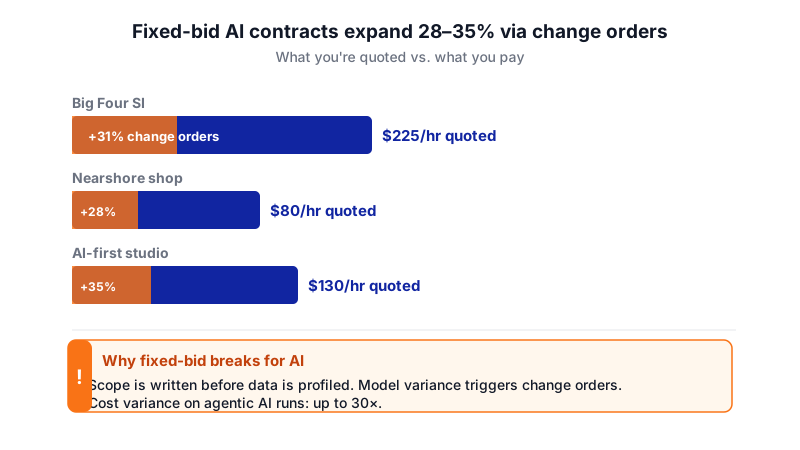
Here is the mechanism: the vendor writes the scope before profiling your data. The moment reality deviates from the spec — the embedding model behaves differently on your claims data than it did on their demo corpus, or your identity provider does not return the attributes the RAG pipeline assumed — that deviation triggers a change order. The change order is repriced at the vendor's current rate, often with urgency markup.
Forrester research cited in 2025 found that fixed-price AI contracts expand by an average of 28–35% via change orders before delivery. The Standish Group's longstanding CHAOS data shows waterfall/fixed-scope projects fail or are significantly challenged 59% of the time versus 11% for agile — a 5x gap that gets wider when the work itself is non-deterministic.
Fixed-bid is good at: procurement sign-off, board-friendly numbers, transferring reputational risk to a brand-name vendor.
Fixed-bid is bad at: actually costing what the proposal says it will cost.
Time & materials
This is what the nearshore body shop is offering. Hourly or monthly billing, no fixed scope, no outcome commitment. You pay for hours worked and you own the result.
T&M is honest about the uncertainty. It does not pretend the vendor can price what cannot yet be measured. But it also does not reward the vendor for efficiency, and it puts the entire burden of project management, architecture, and scope discipline on your side. If you do not have a strong in-house tech lead, T&M becomes an open-ended monthly invoice with no natural endpoint.
T&M is good at: staff augmentation, long-running platform work where your team sets direction, flexibility.
T&M is bad at: outcome accountability, cost predictability for the CFO, situations where the vendor knows more than you do about the technical approach.
Outcomes-based and hybrid sprint pricing
The emerging middle path. Payment is tied to working software delivered per sprint, or to a defined business outcome (loan applications processed, support tickets deflected, time-to-diagnosis reduced). Scope is allowed to flex within a fixed budget per sprint, with explicit re-planning checkpoints.
This model is not new, but it is now mainstream enough that McKinsey derives roughly 25% of its global fees from outcomes-based pricing. When the Big Four is moving this direction, the industry benchmark for "fair" pricing is shifting underneath the proposals you are evaluating.
Hybrid sprint pricing is good at: aligning vendor incentives with your incentives, absorbing AI unpredictability without triggering change orders, keeping optionality to stop.
Hybrid sprint pricing is bad at: giving procurement a single big number to sign off on, long-horizon projects where sprint-by-sprint replanning creates fatigue.
How to normalize three incompatible proposals
Before the board review, do this for each of the three proposals:
- Convert every price to a blended hourly rate. Fixed-bid ÷ estimated hours = the implied rate. If the vendor will not share the hours assumption, that itself is a signal.
- Add the expected change-order expansion. For fixed-bid, add 28–35% per the Forrester benchmark above. For T&M, add nothing but double-check the hours estimate against your own tech lead's view.
- Add the change-management multiplier. Research cited by McKinsey finds that for every $1 spent building a generative AI model, companies often spend about $3 on change management. Not all of that lands with the vendor, but ask each proposer who owns training, rollout, and adoption. If the answer is "you," budget for it separately.
- Map who pays when the model misbehaves. Specifically: if the first production run shows the model's accuracy is 71% and the business needs 85%, who pays for the retraining work? Fixed-bid proposals usually say the vendor pays — until you read the clause defining "materially different from assumed baseline."
- Check for IP and lock-in. Does your company own the trained weights, the prompts, the evaluation harness, the fine-tuning data? Does the proposed architecture require ongoing dependency on the vendor's hosted tooling? This is the single most expensive variable over a five-year horizon and the one procurement scoring matrices most consistently miss.
An illustrative worked example
Illustrative only — every assumption is stated in the same breath. Suppose you are evaluating a 6-month AI document-processing MVP with two system integrations and no existing labeled data.
- Big Four fixed-bid: headline $1.8M, implied $225/hr across 8,000 hours. Add 30% change-order expansion = ~$2.34M landed cost. Change management owned by you, add separately.
- Nearshore T&M: headline $85/hr across an estimated 7,500 hours = $637K. But add the loaded cost of a senior in-house architect on your side ($250K for 6 months) and realistic 25% hours overrun = ~$950K landed. Outcome accountability sits with you.
- AI-first studio, sprint-based: headline $140/hr blended across 6 two-week sprints, ~$780K. Scope flexes within sprint budgets. No change-order mechanic because replanning is built in. Change management partially embedded.
None of these are quotes. They are what the normalization exercise might surface. The point is that the headline $1.8M is not the highest number, and the headline $85/hr is not the lowest landed cost.
Where each model actually breaks
Fixed-bid breaks when the data differs from the demo. It always does.
T&M breaks when you do not have a strong product owner on your side setting weekly priorities. The invoice keeps coming.
Outcomes-based breaks when the outcome metric is poorly defined. "Reduce support ticket volume by 20%" sounds great until Q3, when ticket volume drops because your product shipped a bug fix, not because the AI agent worked.
Sprint pricing breaks when either side loses discipline on the demo-driven cadence. Without a working-software review every two weeks, it quietly becomes T&M with extra meetings.
The hidden variable: who owns what at the end
Buried under the pricing debate is a question that matters more over five years than any rate card: at the end of the engagement, what do you own?
With many Big Four engagements, you own the output but not the reusable components — the evaluation framework, the prompt library, the data pipeline tooling often remains the vendor's IP, licensed back to you. With offshore body shops, you usually own everything but inherit code that may not have been written with your long-term architecture in mind. With AI-first studios, the terms vary widely — some ship with full IP transfer and open-source infrastructure, others lock you into their hosted platform.
Ask every proposer, in writing: "On day one post-engagement, can we move this entire system to a different vendor or bring it in-house without your cooperation?" The answers will separate the proposals faster than the pricing will.
How CodeNicely fits — and when it doesn't
CodeNicely is an AI-first product studio. We bill on a sprint basis with a shared discovery phase up front, full IP transfer at delivery, and no proprietary runtime lock-in. We have shipped 50+ products reaching more than 5 million end users since 2017.
The engagement most relevant to your situation depends on what the proposals in front of you are actually trying to build. If it is an AI-enabled workflow inside a regulated industry — say, clinical or healthcare operations — the work we did with HealthPotli (e-pharmacy with AI drug-interaction checking) is the closest parallel: scoped in sprints, shipped with full ownership, and structured so that the AI components could be tuned post-launch without triggering commercial renegotiation. If it is a fintech or lending modernization, the Cashpo engagement on KYC and AI credit scoring is closer. If it is marketplace or logistics optimization, see Vahak.
CodeNicely is not the right choice if you need a brand-name auditor's signature on the deliverable for board or regulatory reasons — a Big Four firm fits that need better. We are also not the right fit if the engagement requires 100+ engineers in parallel across a multi-year transformation — that is a system integrator's shape of work. For enterprises in the US specifically weighing AI build partners, our US AI development page lays out how we structure engagements for buyers in your market.
What to take into the board review
Three things:
- Present each proposal normalized to blended hourly rate plus expected change-order expansion plus change-management cost. The headline price is not the number.
- Flag explicitly which party pays when the AI model's first production run misses the accuracy or latency bar. This is the single clause that determines whether your cost certainty is real or theatrical.
- Require every proposer to answer the IP and portability question in writing, not in the pitch meeting.
Enterprise AI spend is nearly doubling year-over-year — Gartner forecasts worldwide AI services spending to reach $576 billion in 2026. The pricing structures the industry uses to allocate that spend have not caught up with the technical uncertainty of the work being priced. The buyers who do best are the ones who stop trying to pick the "right" pricing model and start pricing the risk inside each model honestly.
Frequently Asked Questions
What is the typical cost range for an enterprise AI development engagement?
Landed costs for a 6-month enterprise AI MVP generally fall between $600K and $2.5M, driven by three main variables: the vendor tier (Big Four vs. AI-first studio vs. nearshore), the number and complexity of system integrations, and whether you have existing labeled data or the engagement includes data preparation. To turn a range into a quote you need a scoped discovery call covering integration count, data readiness, and accuracy thresholds — happy to walk through that with you.
Is fixed-price or time & materials better for AI development?
Neither in isolation. Fixed-price gives procurement a clean number but hides repricing risk in change-order clauses — Forrester data shows average expansion of 28–35%. T&M is honest about uncertainty but requires a strong in-house product owner. Sprint-based or outcomes-based pricing is increasingly the default for AI work because it absorbs model unpredictability without triggering renegotiation.
How do I compare proposals from a Big Four firm and an AI-first studio on the same basis?
Normalize every proposal to three numbers: blended hourly rate (fixed-bid total ÷ implied hours), expected change-order expansion, and who bears the cost when the first production model run misses the accuracy target. The headline price is usually the least useful number. Also require each vendor to answer, in writing, whether you can migrate the system to another vendor on day one post-engagement without their cooperation.
How long does a typical enterprise AI build take?
Most enterprise AI MVPs land between 4 and 9 months from kickoff to first production deployment, with the primary drivers being data readiness, number of integrations, and regulatory review cycles. Engagements shorter than 3 months are usually proofs of concept rather than production systems. The specifics that turn a range into a real timeline are integration count, whether labeled training data exists, and your internal security and compliance review pace.
Why do AI projects so consistently blow their budgets?
McKinsey's July 2026 research found 93% of enterprise AI teams exceed their budgets, driven by three structural factors: cost variance between model runs can be up to 30x, change management costs often run 3x the build cost, and fixed-bid contracts price scope before the data has been profiled. Buyers who build sprint-based replanning into the contract tend to land closer to budget than buyers who insist on a single upfront number.
Sources & further reading
- Gartner Forecasts Worldwide AI Spending to Grow 49.5% in 2026
- Gartner Forecasts Worldwide GenAI Spending to Reach $644 Billion in 2025
- 60% of Agentic AI Costs Go to Response Refinement: McKinsey (via MarketScale)
- McKinsey Warns That AI May Get a Lot More Expensive for Companies (Yahoo Finance)
- AI ROI Costs After McKinsey's New Findings (AbacusNews)
- AI Is Reshaping How McKinsey Makes Money (Yahoo Finance)
- Stack Overflow 2024 Annual Developer Survey
- Stack Overflow: What the AI Trust Gap Means for Enterprise SaaS
Get one practical guide a week
Costs, AI tools, partner selection — written for people who make the decision. No spam, unsubscribe anytime.
Thanks — you're on the list. One practical guide a week, nothing else.
That didn't work — please check the email address and try again.
Building something in Software & Technology?
CodeNicely partners with founders and tech teams to ship AI-native products that move metrics. Tell us about the problem you're solving.
Talk to our team Book a 30-min call