
What US Enterprises Get Wrong When Hiring an AI Dev Partner

 Published by CodeNicely, the product studio founded by Meghal Agrawal and Ujjwal Agrawal in 2017
For: A VP of Engineering or CIO at a 500-plus-employee US company who has budget approved for an AI initiative but no internal team to build it, and is evaluating external AI development partners for the first time
In this guide
If you are a VP of Engineering or CIO hiring an external AI development partner for the first time, the four criteria that will decide the outcome are rarely in a standard vendor proposal: a current SOC 2 Type II attestation, explicit IP assignment language covering fine-tuned models and training artifacts, a model-governance exhibit that defines retraining triggers and version rollback, and a documented process for honoring CCPA/CPRA deletion requests against training data. Portfolio, hourly rate, and time-zone overlap matter, but they are the easy part. This guide walks the US-market criteria in the order a procurement team actually hits them, with the exact question to ask at each step.
The stakes are high enough to justify the discipline. Worldwide generative AI spending is forecast to hit $644 billion in 2025 per Gartner, yet Gartner also reports at least 50% of generative AI projects are abandoned after proof of concept, and RAND found more than 80% of AI/ML projects fail to deliver intended business value — roughly twice the rate of non-AI IT work. Partner selection is one of the few levers a CIO controls that sits upstream of most of those failure modes.
Why the SaaS-era vendor checklist breaks on AI work
A CRM implementation partner delivers software against a known spec. An AI partner delivers a model whose behavior you cannot fully specify in advance, trained on data that may include your customers' personal information, producing inference decisions a regulator or plaintiff may later ask you to explain. The procurement checklist that worked for Salesforce rollouts has no column for "who owns the fine-tuned weights" or "what triggers a retraining event."
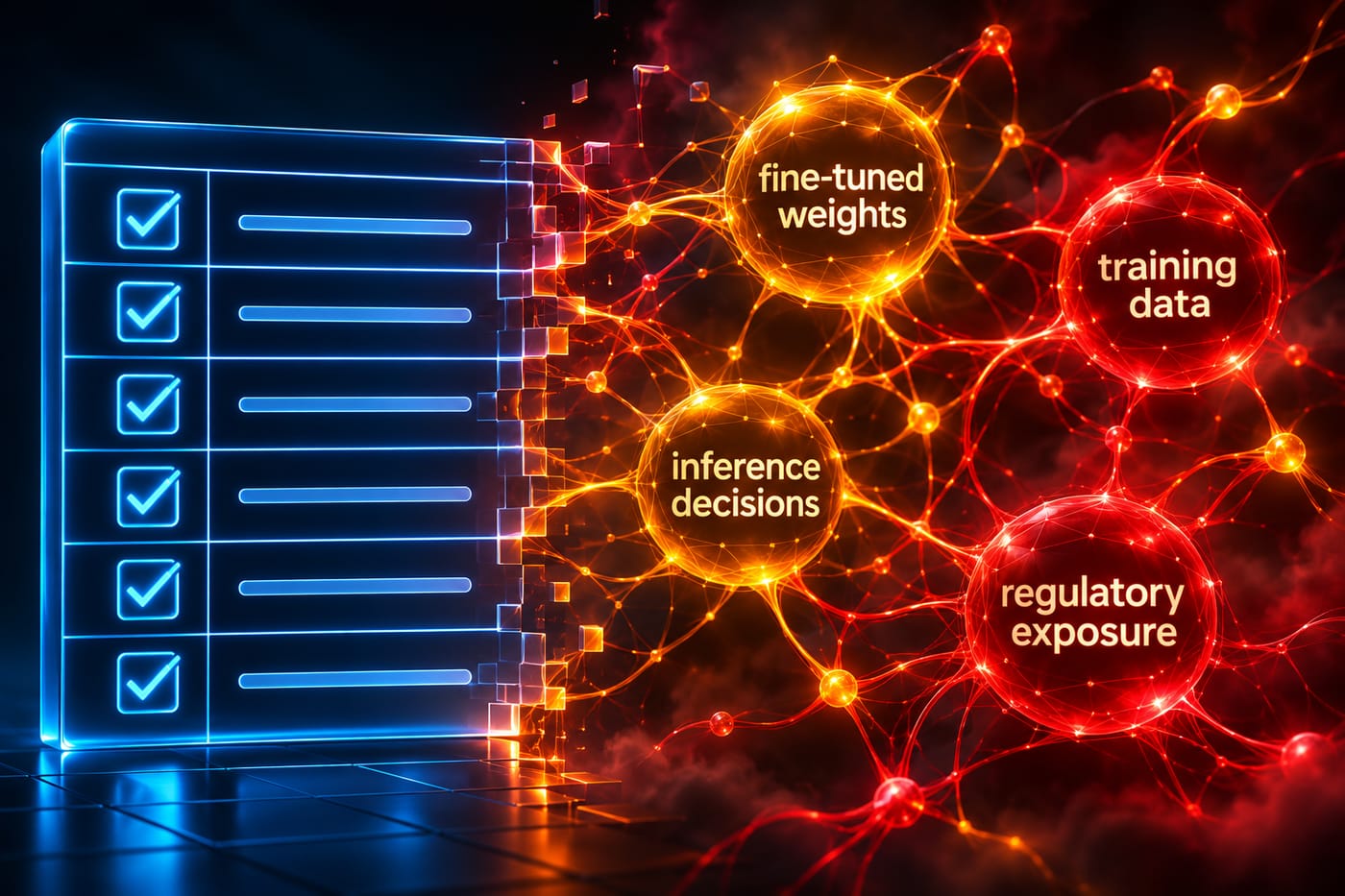
Three gaps show up repeatedly in first-draft contracts. A 2024–2025 review of roughly 20–30 enterprise AI contracts found that default terms favored the vendor on training and IP in most first drafts — output ownership and IP indemnity were silent until the buyer side negotiated them in. A separate gap analysis of enterprise AI agreements found 78% missing a model-deprecation notice clause, 61% lacking an AI outage definition, 43% omitting a training-data opt-out, and 35% containing no IP assignment for fine-tuned models. These are not edge cases. They are the modal contract.
The US-market buyer's guide: criteria in evaluation order
1. SOC 2 Type II attestation — current, not "in progress"
Why it matters. Enterprise procurement teams almost universally require SOC 2 Type II from AI vendors because Type II demonstrates controls operated effectively over a defined observation window, while Type I is a point-in-time design review. A Type I report means a vendor drew the controls on a whiteboard; Type II means an auditor verified they held up for six to twelve months. Yet 79% of AI coding and development platforms lack publicly accessible SOC 2 Type II attestation, which forces compliance teams into 90-plus-day verification cycles that often kill the deal before technical fit is ever tested.
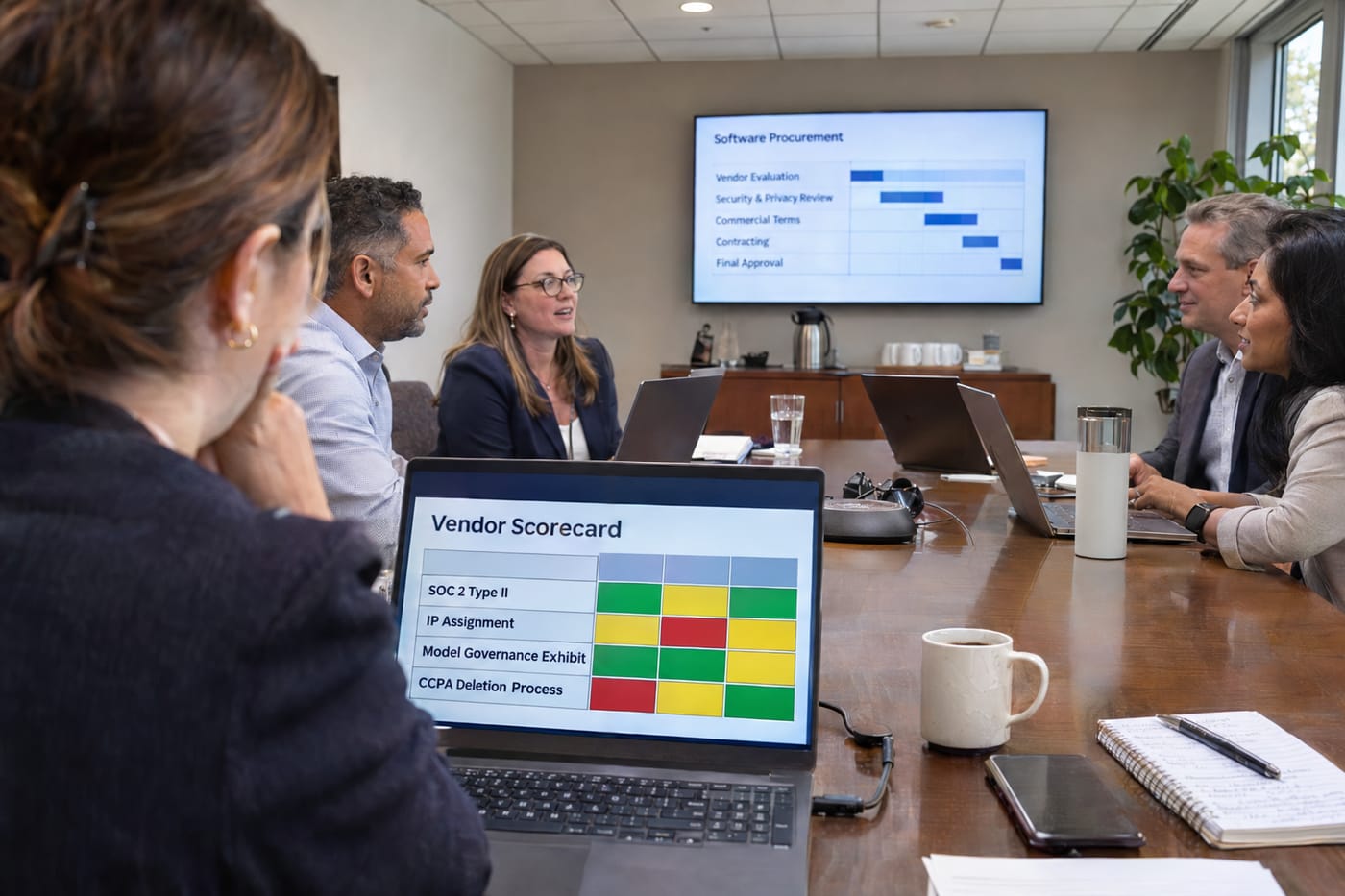
Exact questions to ask. "Can you share your most recent SOC 2 Type II report under NDA, including the observation period dates and the auditor's name?" "Which Trust Service Criteria are in scope — security only, or also availability and confidentiality?" "Are any exceptions or qualifications noted in the report?" If the answer is "we are working toward it," you are the one funding their audit.
2. IP ownership — written in the MSA, not inferred from "work for hire"
Why it matters. "Work for hire" language from a 2015 web-dev template does not cleanly cover model weights, fine-tuning datasets, embeddings, prompt libraries, or evaluation harnesses. If the MSA is silent on these artifacts, the default under most state law favors the party that created them — the vendor. US enterprises have lost downstream flexibility this way: they can use the model, but they cannot take the weights to a different infrastructure provider, cannot re-fine-tune without the original partner, and cannot audit the training set.
Exact questions to ask. "Does the IP assignment clause explicitly name fine-tuned model weights, training datasets we provide or label, synthetic data generated from our data, prompt templates, and evaluation scripts?" "Is assignment automatic on payment, or does it require a separate written transfer?" "What rights does the vendor retain — none, a license-back for internal benchmarking, or something broader?" A good partner answers these in one sentence each. A partner that needs to "check with legal" is telling you the default draft favored them.
Governing law matters too. For a US enterprise buyer, insist on Delaware, New York, or your home state as the governing jurisdiction, even if the development team is offshore. Arbitration seat and venue should be US-based. This is not about distrust — it is about keeping the dispute path short if something goes wrong.
3. Model-governance exhibit — the clause 78% of contracts don't have
Why it matters. This is the non-obvious one. A model-governance exhibit specifies who owns training data, what triggers a retraining event, how model versions are logged and retained, and who holds rollback rights if a new version regresses. Without it, you cannot answer a regulator's question about how a specific inference was produced, you cannot roll back cleanly when a vendor pushes a model update that breaks a workflow, and you cannot prove to an auditor that a customer's deletion request actually removed their data from the model.
The CCPA exposure is concrete. California's CPRA extends the right to deletion to training data — once a consumer's personal information has been used to train a model, honoring the deletion may require retraining, which the CPPA expects to be documented and completed within 45 days, with model versioning logs required as proof. If your vendor cannot produce versioned training manifests on demand, you cannot comply, and penalties run up to $7,500 per intentional violation. Multiply by affected records.
Exact questions to ask. "Will you sign a model-governance exhibit that defines (a) training data provenance logging, (b) retraining triggers and timelines, (c) model version retention — minimum 24 months — and (d) our right to force a rollback within a defined SLA?" "What is your documented process when we forward a CCPA deletion request that touches training data?" "Can you produce a training manifest for a specific model version within 15 business days?"
4. Training-data rights — the clause that is finally becoming standard
Why it matters. Historically, vendor contracts quietly claimed rights to use customer data for model improvement. AI training-data prohibition clauses appeared in under 1% of cloud service agreements in 2024, rising to 11% in 2025 and 14% in 2026 — yet 92% of AI contracts still claim rights beyond service necessity. If your proprietary data is going to train a model that the vendor then offers to your competitor, you have given away the asset you were paying to build.
Exact questions to ask. "Does the contract prohibit use of our data — including prompts, outputs, and feedback signals — to train any model that will serve another customer?" "Is that prohibition permanent or does it expire?" "What happens to our data on termination — deletion within how many days, with what certificate?"
5. Regulatory fluency for your industry
Why it matters. A partner that has shipped AI for healthcare has internalized HIPAA BAAs, de-identification standards, and FDA SaMD classification questions. A partner that has shipped for financial services knows FFIEC model-risk guidance and SR 11-7. Generic AI competence is not a substitute. Ask for a named engagement in your regulated domain and the name of the compliance officer on the client side who will take a reference call.
6. Time-zone overlap — and what it actually buys you
Why it matters. For a US buyer working with an offshore partner, the real question is not "do they speak English" — most do — but "how many hours of live overlap do we get, and when do they fall?" A team in India offers roughly a 2.5-to-4-hour morning overlap for US East Coast afternoons, which is enough for a daily standup, live design review, and incident response if it is structured. A team with no US overlap pushes every decision into an asynchronous 24-hour cycle, which doubles elapsed time on anything requiring iteration.
Exact questions to ask. "Which hours of your team's working day overlap with our business hours, and is that overlap contractually committed or best-effort?" "Who is on-call during our business hours for a Sev-1 incident?" "What is the escalation path if the account lead is unreachable?"
7. Proof of scale and delivery speed
Why it matters. Portfolio decks are table stakes. What separates a real enterprise partner is the ability to describe (a) the largest production system they currently operate, in concrete numbers — daily active users, inference volume, uptime over the trailing 12 months — and (b) a specific instance where a model or feature regressed in production and how they diagnosed and rolled it back. If every case study is a greenfield MVP, the team has not yet run the kind of ongoing operation your initiative will become.
8. What the local price band actually buys
US enterprise buyers typically weigh three partner profiles: US-based boutiques, US-based consultancies, and offshore partners with US delivery leads. The cost gap between them is wide and well-documented in industry surveys, but the number on the invoice is the least useful comparison. What actually drives total cost is scope stability, data readiness, and the number of integrations against systems you do not control.
A useful way to think about the model, not a quote: the biggest variance in an enterprise AI build comes from data — whether it exists, whether it is labeled, whether it lives in systems the partner can reach without a six-week security review. The second-biggest driver is the number of production integrations, each of which carries its own authentication, SLA, and change-management overhead. The third is governance maturity on your side — a client with an existing model-risk committee moves faster than one standing one up for the first time.
Illustrative only: a scoped AI feature embedded into an existing enterprise application, with one upstream data source already in a cloud warehouse and no PHI or PCI data in play, is a different engagement — in cost, timeline, and risk — from a net-new AI product that touches three on-prem systems and requires a new data pipeline. Treat any firm number you see online as the first of those two, not the second. To turn a range into a real quote, a partner needs three specifics: the data inventory (sources, volumes, PII classification), the integration list (systems, auth model, SLAs), and the governance bar (regulated industry? board-visible?). A scoping conversation is where those get established — CodeNicely's US engagement team handles that as a fixed-scope discovery before any build commitment.
How CodeNicely can help
CodeNicely has been building AI-embedded products since well before the current cycle, and the engagements that map most directly to a US enterprise AI initiative are the ones where regulatory posture and data governance were decided before a line of code was written. HealthPotli is the clearest example: an AI-driven drug interaction and e-pharmacy platform where the governance questions — who owns the training data, how model decisions are logged, how deletion requests propagate — had to be answered upfront because the alternative was a non-starter with hospital and insurance partners. The same operating muscle applies whether the regulated domain is healthcare, financial services, or any US enterprise handling consumer PII under CCPA.
On the IP and contracting side, CodeNicely's default position is full IP assignment to the client on payment — including fine-tuned model weights, training artifacts, and evaluation harnesses — with no vendor lock-in on infrastructure or re-engagement. That is the opposite of the first-draft contract described in the redresscompliance.com review, and it is deliberate. If you want to see how the capability set maps to a specific build, the AI Studio page covers the model-selection, fine-tuning, evaluation, and deployment practice in more detail.
A short pre-signature checklist
- Current SOC 2 Type II report in hand, observation period reviewed, exceptions understood
- IP assignment clause explicitly names weights, datasets, prompts, and evaluation code
- Model-governance exhibit attached, with retraining triggers, version retention, and rollback SLA
- Training-data prohibition clause for use beyond your engagement
- CCPA deletion-propagation process documented, with training-manifest production SLA
- Governing law and venue in a US jurisdiction you can enforce in
- Named reference in your regulated domain, with a compliance officer willing to take a call
- Contractually committed business-hours overlap and Sev-1 on-call coverage
None of these items will appear on their own in a first-draft proposal. All of them are negotiable if you raise them before signature. None of them are negotiable after.
Frequently Asked Questions
What is the single most common mistake US enterprises make when hiring an AI development partner?
Treating IP ownership as boilerplate. "Work for hire" language written for web development does not clearly cover fine-tuned model weights, training datasets, or prompt libraries, and in a review of enterprise AI contracts, most first drafts were silent on these artifacts and favored the vendor by default. The fix is a one-paragraph IP assignment clause that names each artifact explicitly.
Is SOC 2 Type I enough if the vendor is pursuing Type II?
No. Type I confirms controls were designed at a point in time; Type II confirms they operated effectively over a period, typically six to twelve months. Enterprise procurement teams treat Type I as the start of a conversation, not the end of one, and a vendor with only Type I has not yet produced the evidence an auditor or regulator will ask for.
What drives the cost of an enterprise AI build the most?
Three things, roughly in order: the state of your data (exists, labeled, accessible without lengthy security reviews), the number of production integrations against systems the partner does not control, and the governance maturity on your side. Published rate cards vary widely by region and firm type, but those three factors move total cost more than hourly rate does. Scoping those three is the conversation that turns a range into a real quote.
How long does a typical enterprise AI initiative take from signature to production?
Timeline is driven by the same factors as cost, plus two more: whether the model is off-the-shelf with fine-tuning versus trained from scratch, and whether the deployment is into an existing application or a net-new one. Gartner data suggests many enterprises stall at the proof-of-concept stage specifically because governance, data readiness, and integration work were underestimated. A partner that gives you a confident timeline before seeing your data inventory is guessing.
Do I really need a separate model-governance exhibit, or can standard MSA language cover it?
You need a separate exhibit. Standard MSA language does not address retraining triggers, version retention windows, rollback rights, or the process for honoring CCPA deletion requests that touch training data — and a gap analysis found 78% of enterprise AI agreements missing a model-deprecation clause alone. Have a lawyer familiar with AI contracting review the exhibit before signature; this is not an area to rely on a template.
This post is general guidance, not legal advice. Contract terms, regulatory obligations, and governance requirements should be reviewed by qualified counsel and your compliance function against your specific situation.
Sources & further reading
- Gartner Forecasts Worldwide GenAI Spending to Reach $644 Billion in 2025
- Why Enterprise AI Fails: The Real Numbers (RAND, MIT, S&P Global citations)
- Enterprise AI Failure Rate: Why Projects Die Between Pilot and Production (Gartner, McKinsey)
- AI Coding Tools SOC2 Compliance: Enterprise Security Guide (79% lack SOC 2 Type II stat)
- SOC 2 Type II for AI Systems: Applying AICPA Trust Service Criteria to LLMs
- AI Governance in Enterprise Deals: Privacy and IP (2024–2025 contract review findings)
- SaaS Contracts: The 2026 Guide — AI Training Prohibition Clause Data (Stanford Law CodeX / TermScout)
- CCPA/CPRA AI Compliance: Automated Decision-Making Rights and $7,500 Per-Violation Penalties
Get one practical guide a week
Costs, AI tools, partner selection — written for people who make the decision. No spam, unsubscribe anytime.
Thanks — you're on the list. One practical guide a week, nothing else.
That didn't work — please check the email address and try again.
Building something in Software & Technology?
CodeNicely partners with founders and tech teams to ship AI-native products that move metrics. Tell us about the problem you're solving.
Talk to our team Book a 30-min call