

Planning a Phased Launch Before You Brief Anyone

 Published by CodeNicely, the product studio founded by Meghal Agrawal and Ujjwal Agrawal in 2017
For: A seed-to-Series A Indian startup founder who has an MVP nearly ready but is under investor pressure to show early traction — and is about to launch everything to everyone at once because no one has told them what a phase boundary actually is or what it costs to roll back a bad one.
In this guide
A phased product launch plan is a founder-owned decision tree that defines, before anyone writes code or buys ads, exactly which cohort, geography, and feature slice will prove the single riskiest assumption in your business — and what evidence closes each phase so the next one begins with earned confidence, not hope. If you cannot describe the phase boundary in one sentence ("we move to Phase 2 when CAC payback in Indore is under 14 months on 200 paying users"), you do not have a phased launch. You have a staggered big-bang, which is worse than a real one because it looks disciplined to your board while burning the same cash.
This playbook is for a founder with an MVP nearly ready and investors asking for traction. It is six steps you run yourself, before you brief engineering, growth, or a build partner. It takes a weekend if you are honest with yourself and three weeks if you are not.
Why phasing matters more in India in 2026 than it did two years ago
Two numbers set the stakes. The median seed-to-Series A gap for Indian startups has stretched to roughly 696 days, and Series A rounds in 2025 required either a clear path to profitability inside 12 months or net revenue retention above 110% (Kae Capital, 2025 India VC Review). You are not raising on growth anymore. You are raising on evidence that each rupee of CAC comes back.
Meanwhile Indian startups cut average burn by roughly 35% across 2024–2025, and seed burn multiples above 3.0x are now flagged as high-risk. A big-bang launch into three cities with paid media is the fastest way to post a 3.5x burn multiple the quarter before you go out to raise.
And the base rate is unforgiving: roughly 90% of Indian startups fail within five years per IBM IBV. Most of them do not fail because the product was wrong. They fail because they scaled a product that was almost right.
The non-obvious trap: expansion before closure
The costliest phase-boundary mistake we see Indian founders make is not sequencing features wrong. It is launching in a second city before the unit economics of the first city are actually closed.
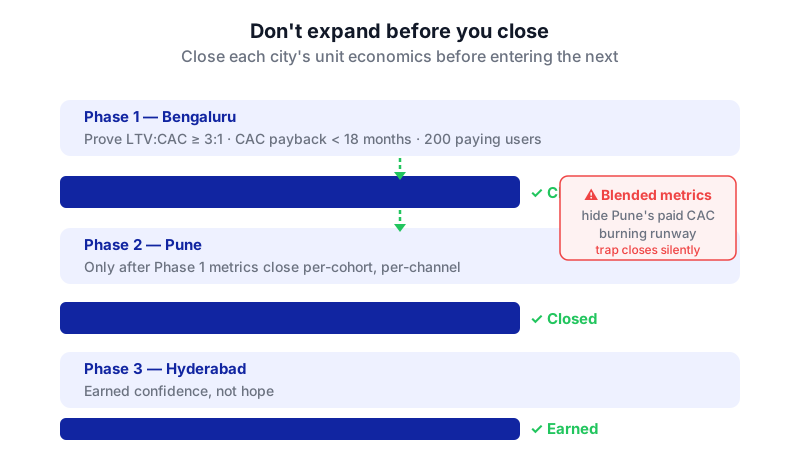
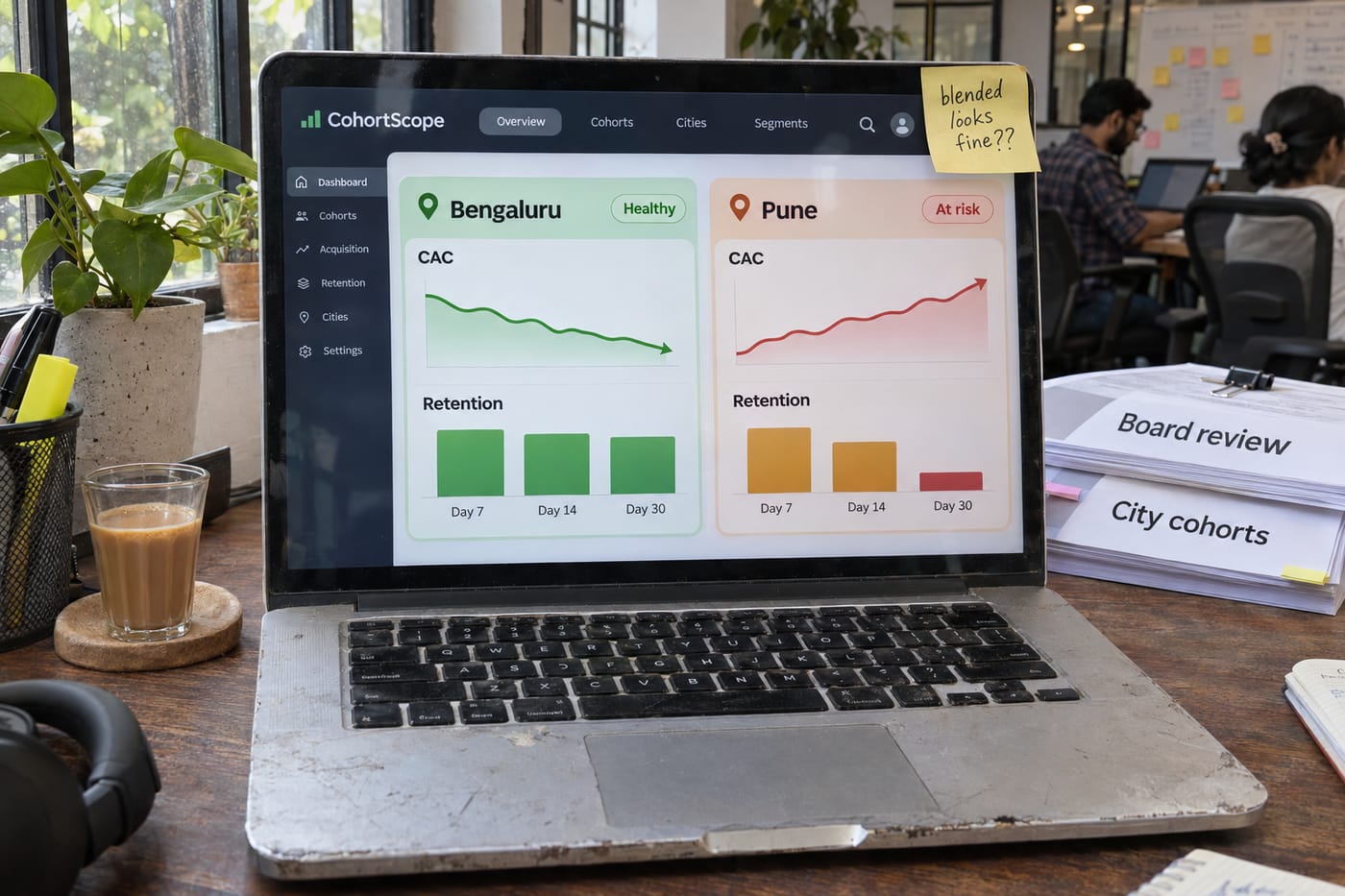
Here is how it dies silently. Bangalore is "working" — CAC looks fine, retention looks fine, the founder has a WhatsApp group of happy users. The board deck says "ready to expand." You turn on Meta ads in Pune and Hyderabad. The blended CAC stays acceptable because Bangalore organic is subsidising paid Pune. Blended retention stays acceptable because Bangalore power users are masking Pune's 30-day drop-off. Razorpay settlement data and your GST-registered buyer count only make the per-city picture visible 60–90 days in. By then you have burned a quarter of runway proving a city you should not have entered.
The investor benchmark has not moved: LTV:CAC of at least 3:1 and CAC payback under 18 months, measured per cohort, per channel, per city. If you cannot show that per-city, you have not closed a city.
The 6-step founder playbook
Step 1 — Write the single assumption each phase exists to test
Before anything else, write down — on one page — the three to five assumptions your business depends on, ranked by how badly you die if they are wrong. For most seed-stage Indian startups the list is some version of: (a) this audience will pay this price, (b) we can acquire them for less than they are worth, (c) they will stay long enough for the economics to work, (d) we can deliver without the gross margin collapsing.

Now assign each assumption to a phase. Phase 1 tests the riskiest one. Not two. One.
Anti-pattern: "Phase 1 is the MVP launch." That is a shipping milestone, not a hypothesis. If someone on your team can answer "what would make Phase 1 a failure?" with four different answers, you have not defined the phase.
You'll know this step is done when you can finish this sentence in under 20 words: "Phase 1 exists to prove that ____, measured by ____, and we will kill or pivot if ____."
Step 2 — Draw the cohort boundary before the feature boundary
Founders instinctively phase by feature ("Phase 1 is booking, Phase 2 is payments, Phase 3 is reviews"). This is backwards. Phase by who first, then by what. The question is not "what do we ship in Phase 1" — it is "which 500 users, in which pin codes, acquired through which channel, are we willing to be judged by?"
Concretely, write down: one city (not a region), one or two acquisition channels (not "digital marketing"), one user persona defined tightly enough that you could list 50 of them by name, and a cohort size large enough to produce statistically readable retention — typically 200–500 paying users for consumer, 20–40 for B2B SaaS.
Anti-pattern: "Pan-India soft launch." Pan-India is not a cohort. It is an absence of a cohort. The NASSCOM data showing 35% YoY startup growth in Tier-2/3 cities is real, but it is not permission to launch in all of them simultaneously.
You'll know this step is done when you can name the city, the channel, the persona, and the target cohort size on a single Post-it.
Step 3 — Define the "close" criteria for the Phase 1 cohort — in numbers, before you launch
This is the step founders skip and investors notice. Before you ship, write down the per-cohort numbers that mean Phase 1 is closed and you are allowed to move to Phase 2. Not aspirational numbers. Minimum numbers.
For a consumer product in one city, a defensible Phase 1 close looks something like: 300 paying users acquired through two specific channels, 30-day retention above a threshold you have pre-committed to, CAC payback trending under 18 months on the dominant channel, and a qualitative signal — say, 40% of surveyed users saying they would be "very disappointed" if the product disappeared (the Sean Ellis bar).
For B2B, it is tighter: 15–25 paying customers in one ICP slice, logo retention at 90 days, one reference customer willing to be on a sales call, and gross margin above 60% after support cost.
Only 55% of product launches hit their schedule and just 11% hit all their internal targets per Gartner's product manager survey cited by ProductFruits. Pre-committed numbers are the single largest lever you have against being the 89%.
Anti-pattern: "We'll know it when we see it." No, you will rationalise it when you see it. Founders in month-four of Phase 1 with mediocre numbers will always find a reason to move to Phase 2 because Phase 2 feels like progress and Phase 1 feels like failure. Pre-commit on paper, with your co-founder's signature, before launch.
You'll know this step is done when a reasonably hostile board member could read your Phase 1 close criteria and not argue with them.
Step 4 — Decide what Phase 1 does NOT include, and write it down separately
A phased plan is defined by its exclusions, not its inclusions. Make a "Not in Phase 1" list that is at least twice as long as the "In Phase 1" list. Payment methods you will not accept yet. Geographies you will not advertise in. Integrations you will not build. User segments you will politely refuse. Features users will ask for that you will say no to.
This list is your firewall against scope creep from three directions: your own engineers (who want to build the clever thing), your sales lead (who wants to close one weird enterprise deal that distorts the ICP), and your investors (who, paradoxically, often push for premature expansion because their fund model wants velocity signal).
Anti-pattern: Keeping the exclusion list in your head. If it is not written down and shared, it is not a decision — it is a preference, and preferences lose to pressure.
You'll know this step is done when you have said no, in writing, to at least one thing you genuinely wanted to build.
Step 5 — Budget the phase as a burn multiple, not as a feature cost
Translate Phase 1 into a cash number and a time window, and check that number against your burn multiple. Seed burn multiples average 2.5–3.4x, with above 3.0x flagged as high-risk by Indian VCs.
The budget model has three parts: build cost (engineering, design, infra for Phase 1 scope only — not the full product vision), go-to-market cost (CAC budget for the target cohort, with a ceiling), and operate cost (support, ops, founder time priced at opportunity cost). Add them. Divide by expected net new revenue at Phase 1 close. If that number is north of 3, you are planning to fail your next board meeting.
What a founder controls: the cohort size (smaller = cheaper), the channel mix (organic/community in Tier-2 is materially cheaper than metro paid), the feature scope, the geography. What a founder does not control: true channel CAC until you test it, and conversion from trial to paid.
The specifics that turn a budget range into an actual plan are the three things to scope with a build partner: integration count, whether there is existing data or infrastructure to migrate, and the compliance surface (payments, health data, lending — each adds a different kind of month). That conversation is where ranges collapse into numbers.
You'll know this step is done when your Phase 1 budget, divided by your Phase 1 expected net new ARR, is a number you would show an investor.
Step 6 — Design the rollback before you design the rollout
The last step before briefing anyone: write the "kill Phase 1" plan. What does the team do, what do you tell users, what do you tell investors, what gets refunded, how do you preserve learnings, if the close criteria from Step 3 are not met at month three?
This matters for two reasons. First, if rolling back feels existentially expensive, you have over-invested in Phase 1 and should cut scope now. A phase you cannot kill is not a phase. Second, telling your team on day one that killing Phase 1 is an acceptable, planned outcome is the single biggest predictor of whether they will tell you the truth about the numbers in month three.
Anti-pattern: Treating Phase 1 as launch and Phase 2 as inevitable. Phase 2 is a decision you earn, not a milestone you reach.
You'll know this step is done when you can describe, in two paragraphs, what killing Phase 1 looks like — and it does not end the company.
How CodeNicely can help
Most of this playbook is founder work and no agency can do it for you. What we do help with is the thing immediately after: translating a disciplined Phase 1 definition into a buildable scope that does not accidentally include Phase 2.
The engagement that most resembles this is GimBooks, a YC-backed accounting SaaS for Indian MSMEs. The work there was not building everything an accounting product eventually needs — it was shipping the narrowest slice that proved a specific SMB persona would pay, then layering invoicing, GST, and inventory as separate, measured phases. The discipline that matters is the willingness to say "not in this phase" to things the long-term product obviously needs.
For founders launching into Tier-2 cities or regulated spaces, Vahak (logistics marketplace with per-geography rollouts) and HealthPotli (e-pharmacy with phased drug-interaction AI) are closer analogues. The common thread: the first launch cohort was deliberately smaller than the market opportunity suggested it "should" be, because closing one cohort is worth more than opening three.
The one thing to remember
A phased launch is not a delay tactic. It is a decision architecture. If you cannot name the single assumption Phase 1 is testing, the specific cohort you are testing it on, the numbers that mean you have closed it, and the plan if you have not — then launching in phases will cost you the same as a big-bang, with extra meetings.
Do the six steps on paper first. Then brief the team.
Frequently Asked Questions
How long should Phase 1 of a startup launch last?
Long enough to produce statistically readable cohort data on retention and CAC payback — typically 8–14 weeks for consumer products and 12–20 weeks for B2B, depending on sales cycle. The right question is not duration but sample size: can you read 30-day and 60-day retention on a cohort large enough to not be noise? If your Phase 1 ends before 60 days of retention data exists on the target cohort, you are not closing a phase, you are ending one.
Should I launch in one city or go pan-India from day one?
One city, almost always, for anything that touches ops, delivery, or community-led acquisition. Pan-India launches hide per-geography unit economics inside blended numbers, and by the time your Razorpay and GST data make per-city CAC and churn visible, you have burned 60–90 days of runway. Pan-India is defensible only for pure digital products with negligible marginal cost per user and no geographic ops footprint — and even then, channel-by-channel phasing still applies.
What does a phased MVP build actually cost to scope in India?
The honest answer is that cost is driven by four things a founder controls — feature scope, integration count, compliance surface (payments, KYC, health data each add weeks), and whether there is existing data or infrastructure to migrate — and two things they do not: the quality bar of the target user and how much iteration the market demands post-launch. Ranges without those specifics are theatre. A real quote requires a scoping conversation that pins down integrations, compliance, and the Phase 1 cohort definition — that conversation is where the range becomes a number.
What's the right burn multiple to plan Phase 1 against?
Indian seed-stage burn multiples average 2.5–3.4x and anything above 3.0x is flagged as high-risk by VCs per Kae Capital's unit economics guidance. Plan Phase 1 so that your projected spend divided by projected net new ARR at phase close sits below 3.0, ideally below 2.5. If the math does not work, cut cohort size or feature scope before you cut the close criteria.
How do I convince investors that phasing is not slowness?
Show them the close criteria for each phase, in numbers, before you launch. Investors push for speed when they cannot see what you are learning; they relax when they can see that Phase 1 will produce specific, decision-grade evidence by a specific date. Given that Series A rounds in 2025 required either a profitability path inside 12 months or NRR above 110% per Kae Capital, a phased plan that produces per-cohort LTV:CAC evidence is more fundable in 2026 than a big-bang launch with blended vanity metrics.
Sources & further reading
- Unit Economics for Indian Startups: When to Prioritize Profitability vs Growth — Kae Capital
- India VC 2025 Review & 2026 Outlook — Kae Capital
- Why VCs Want Net Burn, Not Growth, at Board Meetings — StartupFeed.in
- Product Launch Strategy: The Complete 2026 Framework — ProductFruits
- Why 90% of Indian Startups Fail — A Data-Driven Post-Mortem — FirstUnicornStartup
- Startup Funding in India 2025: Will the Decline Continue? (NASSCOM Tier-2 data) — Marqzy
- Analyzing Factors Contributing to Startup Failures in India — Educational Administration: Theory and Practice (Peer-reviewed, 2024)
- India's Startup Reckoning 2025: Data-Driven Analysis of Market Correction — Deutsche.dk
Get one practical guide a week
Costs, AI tools, partner selection — written for people who make the decision. No spam, unsubscribe anytime.
Thanks — you're on the list. One practical guide a week, nothing else.
That didn't work — please check the email address and try again.
Building something in Software & Technology?
CodeNicely partners with founders and tech teams to ship AI-native products that move metrics. Tell us about the problem you're solving.
Talk to our team Book a 30-min call