
What Your Modernization ROI Number Is Missing

 Published by CodeNicely, the product studio founded by Meghal Agrawal and Ujjwal Agrawal in 2017
For: A CIO or COO at a 500-plus-employee Indian enterprise whose CFO has approved a modernization discovery but is now demanding a credible ROI model before releasing the full programme budget — and whose existing ROI calculation counts only direct cost savings, not the three categories of return that actually make the number defensible.
In this guide
- Why the standard ROI model keeps failing the CFO test
- Category 1: GST audit exposure as a rupee liability
- Category 2: Revenue the system is actively blocking
- Category 3: Ind AS 38 capitalisation — the one that changes the cash flow
- Sequencing: strangler-fig vs big-bang, in CFO terms
- What the business has to supply
- How to phase the spend so the first increment pays for the next
- What the market is spending on this
- How CodeNicely can help
- Frequently Asked Questions
If your modernization ROI case counts only licence savings and headcount reduction, your CFO is right to reject it. A defensible number for an Indian enterprise has to add three categories your current model almost certainly omits: GST audit exposure converted into rupee liability, revenue blocked by throughput ceilings in the legacy stack, and the portion of the build that qualifies as a capitalisable intangible asset under Ind AS 38. Put those on the page and the net cash impact the CFO is signing off on changes materially — often by enough to flip the decision.
This post is the argument you take into the next review. It assumes discovery is approved, the full programme budget is not, and the blocker is the ROI model itself.
Why the standard ROI model keeps failing the CFO test
The typical Indian enterprise modernization business case has three lines: AMC and licence savings on the system being retired, FTE reduction from automating manual workarounds, and a vague "productivity uplift" number nobody defends. The CFO's objection is almost never that the savings are wrong. It is that the savings are too small to justify the programme on their own, and the rest of the model is handwaving.
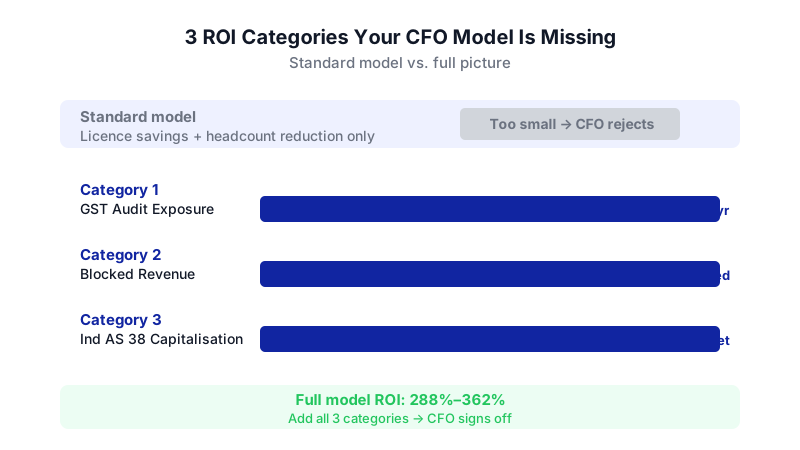
That is because the real returns from modernization in an Indian enterprise are not primarily cost takeout. Kyndryl's 2025 mainframe modernization survey puts the ROI range at 288% to 362% depending on approach, and Microsoft's Forrester TEI work on Azure PaaS deployments shows 228% to 304% over three years with 50% faster application development. Those numbers are not driven by AMC savings. They are driven by things the standard model does not count.
Here are the three categories that close the gap.
Category 1: GST audit exposure as a rupee liability
Your legacy ERP or spreadsheet-driven reconciliation process is not just inefficient. It is a measurable tax risk, and the CFO already knows this — they are the one signing the notices.

CBIC data shows more than 1.2 lakh GST notices issued in FY 2024-25, with ITC mismatches and turnover under-reporting as the dominant drivers. The State of Tax Assurance Report 2026, surveying over 100 CFOs at firms with revenues above ₹500 crore, found that roughly 35% of GST notices stem from ITC filing mismatches that are preventable. Preventable, in that context, means a system issue — GSTR-2B not reconciling against the purchase register because the data lives in three systems and gets stitched together in Excel on the 18th of every month.
The exposure is not hypothetical. LIC received a GST demand of ₹479.88 crore for FY2020-21 — ₹242.23 crore tax, ₹213.43 crore interest, ₹24.22 crore penalty — arising from wrong ITC availment and short reversal. That is one financial year, one taxpayer, and the interest component alone nearly matches the tax.
How to put this in the ROI model
You are not claiming modernization eliminates GST risk. You are claiming it reduces the probability-weighted exposure. The calculation has four inputs the CFO can challenge line by line:
- Annual ITC claimed — pull from GSTR-3B filings
- Current mismatch rate — what percentage of ITC gets flagged in internal reconciliation before filing, and what percentage slips through
- Base rate of notice conversion — use the 35% figure from the Tax Assurance Report as the share of your mismatch volume that is the kind of error systems prevent
- Loaded cost of a notice — tax demanded plus interest (18% per annum, compounding across the years between filing and notice) plus penalty (typically 10–100% of tax depending on section)
The output is a rupee number per year of continued legacy operation. For a mid-size enterprise with ₹100 crore of annual ITC and a 2% unreconciled rate, the arithmetic produces a figure in crores once interest is loaded over a three-to-four-year notice lag. That is the line item your CFO wants.
The honest caveat: this is probability-weighted, not certain. Your CFO will discount it. Discount it yourself first, present the undiscounted and discounted numbers, and the model gains credibility.
Category 2: Revenue the system is actively blocking
The second missing category is revenue your legacy stack prevents you from booking. This is not productivity. It is orders you cannot process, customers you cannot onboard, SKUs you cannot launch, and markets you cannot enter because the system will not support them.
Industry data suggests companies typically lose 15–30% of potential revenue through legacy system inefficiencies, and Deloitte's work links completed modernization to 2.5x higher revenue growth over the subsequent three years. Those are directional numbers. For your business case, you need the specific throughput ceilings in your own operation.
The four throughput ceilings to document
- Transaction-rate ceiling. Peak orders per hour, peak concurrent users, peak API calls before the system degrades. Sales teams usually know exactly which days of the quarter the order management system times out.
- Onboarding ceiling. How long it takes to add a new dealer, SKU, warehouse, GSTIN, or pricing tier. If it takes six weeks of IT work to launch a new product variant, that is a revenue block with a measurable cost.
- Channel ceiling. Which sales channels you cannot integrate because the legacy system has no usable API. Every marketplace, every D2C storefront, every B2B portal you have declined to support is a bounded revenue number your commercial team can estimate.
- Reporting ceiling. How often finance and commercial decisions get delayed because the number is not available in time. This one is softer but a CFO will accept it when tied to specific delayed decisions.
For each ceiling, you need two numbers: the revenue currently blocked (orders lost, customers not onboarded, channels not supported) and the incremental revenue unlocked in the first year post-modernization. Keep the second number conservative. The CFO will stress-test it.
Category 3: Ind AS 38 capitalisation — the one that changes the cash flow
This is the category most modernization business cases miss entirely, and it is the one that most changes the net cash impact the CFO is actually approving.
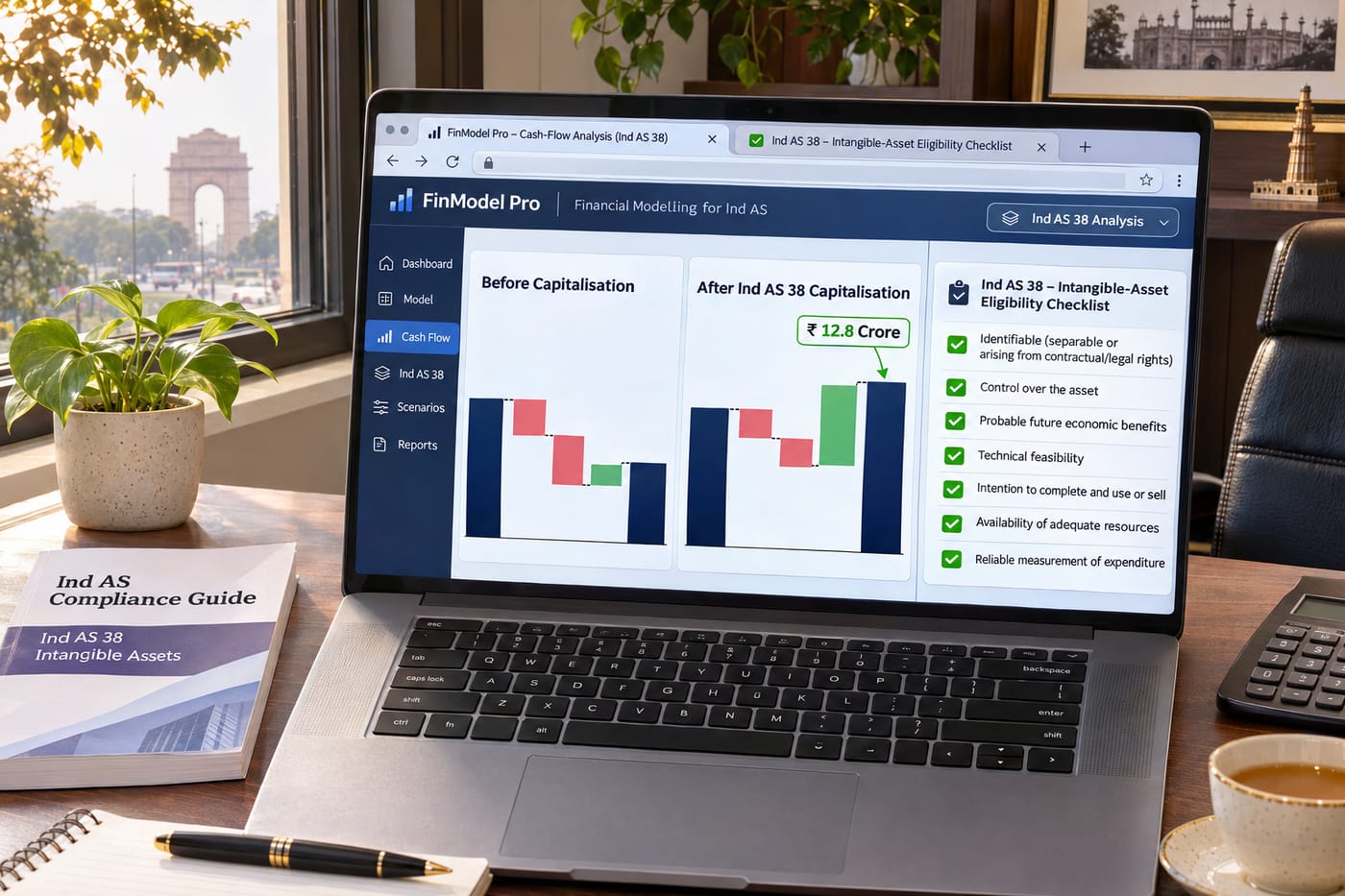
Under Ind AS 38, software development spend that meets the six development criteria — technical feasibility demonstrated, intention to complete, ability to use or sell, probable future economic benefits, availability of resources, and reliable measurement of expenditure — is capitalised as an intangible asset. Coding, testing, and preparing the software for its intended use move off the P&L and onto the balance sheet, amortised over the asset's useful life.
Under old Indian GAAP, this was optional. Under Ind AS, it is mandatory when the criteria are met. Many Indian companies had to retrospectively reassess balance sheets on Ind AS adoption for this reason.
What this does to your ROI model
Consider the P&L impact of a modernization programme where, illustratively, 60% of the build spend qualifies for capitalisation (this percentage is a worked assumption, not a benchmark — it depends on how much of the work is research-phase, operational, or maintenance). If the total programme spend across two years is, say, ₹X:
- The research-phase and non-qualifying portion — discovery, requirements, failed experiments, post-go-live operational support — hits the P&L in the year incurred.
- The qualifying development spend is capitalised and amortised over the useful life (typically 3–7 years for enterprise software, auditor-dependent).
- Year-one P&L impact drops substantially. EBITDA looks materially different. Cash out is the same, but the earnings profile the CFO reports to the board is not.
This is not accounting trickery. It is the standard applied correctly. But it requires three things your programme must do from day one:
- Clean phase separation in the project plan. Research versus development has to be documented. The auditor will ask when technical feasibility was established, and your Jira history has to answer.
- Timesheet-level cost attribution. Which engineer-hours went to qualifying development versus non-qualifying work. Vendors who bill fixed-price without this breakdown make capitalisation harder to defend.
- Auditor alignment upfront. Not after the fact. Walk your statutory auditor through the capitalisation plan before the first invoice. They will tell you what documentation they need.
A standing caveat: this is a general description of Ind AS 38, not advice on your specific facts. Your statutory auditor and tax advisor need to sign off on the treatment for your particular programme. Get that in writing before you put the capitalised figure in the board pack.
Sequencing: strangler-fig vs big-bang, in CFO terms
Once the ROI model is credible, the next question is how to phase the spend. The CFO cares about two things here: when the programme turns cash-positive, and how exposed the balance sheet is if something goes wrong halfway through.
Strangler-fig (incremental replacement)
You stand up new services around the legacy core, route traffic progressively, and retire the old system module by module. Each increment ships to production and starts producing returns.
- Payback profile: industry data suggests phased modernization typically reaches positive ROI in 12–14 months, because each increment earns while the next is being built.
- Risk profile: lower. If increment three fails, increments one and two are already in production and earning.
- Bad at: situations where the legacy data model is so broken that incremental replacement means permanently maintaining translation layers. Also harder when the old system has no usable API surface at all.
Big-bang rewrite
Full parallel build, cutover on a defined date, retire legacy.
- Payback profile: same source suggests 36–48 months to positive ROI, because nothing earns until cutover.
- Risk profile: high. The project either completes or it does not, and partial completion has no business value.
- When it is actually the right call: when the legacy architecture makes incremental coexistence genuinely impossible, when a regulatory deadline forces a hard cutover, or when the legacy system is so small that phasing adds overhead without reducing risk.
For most 500-plus-employee Indian enterprises moving off an unsupported ERP or a decade-old .NET monolith, strangler-fig is the defensible answer. It also happens to be the answer that pairs best with Ind AS 38 capitalisation, because each increment has clear technical feasibility, clear development phase, and clear go-live.
What the business has to supply
The ROI model holds only if the business side provides inputs the technology team cannot generate alone. Line this up before the next CFO review:
- From finance: ITC claimed per year, historical notice history, current AMC and licence spend, auditor's written view on Ind AS 38 treatment.
- From commercial: revenue-blocked numbers per throughput ceiling, conservative uplift estimates for year one and year two post-modernization.
- From operations: FTE hours currently absorbed by workarounds, with named roles and named processes.
- From IT: the legacy support contract expiry, known vulnerabilities, compliance gaps, and a defensible build-cost range for the phased approach.
Missing any of these and the model reverts to handwaving.
How to phase the spend so the first increment pays for the next
The sequencing question the CFO will actually ask is: which increment do we do first? The answer is whichever one has the highest ratio of (return within 12 months) to (build cost). In practice, for most Indian enterprises, that is the module that closes a specific GST reconciliation gap or unblocks a specific revenue channel — not the one that is architecturally cleanest to replace.
Build the first increment to produce measurable rupee return within two quarters of go-live. Use that return to fund the second increment in the next financial year. The CFO is not approving a three-year programme. They are approving increment one, with a stated plan for increments two and three contingent on increment one delivering.
What the market is spending on this
For context on where the broader market sits: India's application modernization services market is valued at USD 626.68 million in 2025 and projected to reach USD 1,746.63 million by 2030 at an 18.6% CAGR. That growth is not driven by AMC savings. It is driven by enterprises doing the full ROI arithmetic — including the three categories above — and concluding that staying on legacy is the more expensive option.
How CodeNicely can help
Our work with GimBooks — a YC-backed accounting and GST SaaS — is the closest analogue to what an Indian enterprise rebuilding its tax and reconciliation stack is dealing with. The engagement centred on exactly the problem the GST exposure category in this post describes: making ITC reconciliation, GSTR matching, and audit-trail documentation work at scale without the manual Excel layer that produces the mismatches CBIC is issuing notices for. The architectural decisions there — clean separation of ingestion, reconciliation, and filing layers — translate directly into the kind of phased modernization an enterprise can defend to an auditor under Ind AS 38.
On the sequencing side, our work is set up for strangler-fig replacement with full IP ownership and no vendor lock-in, which matters when your auditor is asking who owns the intangible asset on your balance sheet. If the ROI model in this post is the shape of what you are trying to build, the digital transformation and enterprise pages have the engagement model, and a conversation is the fastest way to turn the ranges above into numbers specific to your legacy stack, your ITC exposure, and your capitalisation position.
Frequently Asked Questions
How do I estimate GST audit exposure for an ROI model without overstating it?
Start with your annual ITC claimed, apply your current unreconciled rate (the share that slips past internal checks before filing), apply the 35% figure from the State of Tax Assurance Report as the share of mismatches that are the kind systems prevent, and load the result with 18% compounding interest over the typical three-to-four-year notice lag plus a penalty assumption. Present both the undiscounted number and a probability-discounted version so the CFO can see you have stress-tested it yourself.
Does Ind AS 38 capitalisation apply to all modernization spend?
No. Research-phase work, discovery, requirements, failed experiments, and post-go-live operational support stay on the P&L. Only spend that meets all six development criteria — technical feasibility, intention to complete, ability to use, probable future benefit, resource availability, reliable cost measurement — qualifies as a capitalisable intangible asset. The specific split for your programme is an auditor's call, not something your technology partner or a blog post can decide for you. Get it in writing before the first invoice.
What drives the cost range for an enterprise modernization programme in India?
The main drivers are the number of integrations with surrounding systems, whether the legacy data model can be migrated cleanly or needs transformation, how much custom business logic lives in the old system versus in process documentation, the compliance scope (GST, Ind AS, sector-specific regulation), and whether the programme runs as strangler-fig increments or a big-bang rebuild. The two or three specifics that turn a range into a real quote are the integration count, the data migration scope, and the number of distinct business modules in scope for the first increment. A scoping conversation is the way to get there.
How long before a modernization programme turns cash-positive?
Industry data suggests phased modernization typically reaches positive ROI in 12–14 months versus 36–48 months for a big-bang rewrite, because each increment starts earning while the next is being built. For your specific programme, the payback timing depends on which increment you sequence first, how quickly the first increment can be scoped and shipped, and whether the return is measured on cost takeout alone or includes the GST exposure and blocked revenue categories. The honest answer requires scoping — the ranges above are directional.
Should the ROI model be built before or after discovery?
Both. A directional model built before discovery is what gets the discovery budget approved. A defensible model built during discovery — with real integration counts, real data volumes, real ITC exposure numbers, and the auditor's view on Ind AS 38 capitalisation — is what gets the programme budget approved. If the CFO is pushing back now, the fix is not a better pre-discovery model; it is to use discovery to build the three missing categories into the real one.
Sources & further reading
- India Application Modernization Services Market (2025–2030) — MarketsandMarkets
- India Mainframe Modernization Market (2025–2030) — MarketsandMarkets
- Legacy System Modernization ROI: A CFO's Guide for Budget — ViitorCloud
- Legacy System Modernization in 2026: Strategy, Cost and ROI — YUSMP Group
- 5 Signs Your Legacy System Kills Revenue — Horizon.dev
- 5 Reasons Why Enterprises Are Getting Notices in 2026 — ClearTax
- Internal Mismatches Are the Major Reason Behind GST Notices: State of Tax Assurance Report 2026 — A2Z Taxcorp
- GST Notices in 2025: CBIC Data on 1.2 Lakh Notices in FY2024-25 — TaxesQuire
Get one practical guide a week
Costs, AI tools, partner selection — written for people who make the decision. No spam, unsubscribe anytime.
Thanks — you're on the list. One practical guide a week, nothing else.
That didn't work — please check the email address and try again.
Building something in Enterprise Software?
CodeNicely partners with founders and tech teams to ship AI-native products that move metrics. Tell us about the problem you're solving.
Talk to our team Book a 30-min call