

Why Your Legacy ERP Blocks UAE Vision 2031 Compliance

 Published by CodeNicely, the product studio founded by Meghal Agrawal and Ujjwal Agrawal in 2017
For: COO or CIO of a UAE-headquartered multi-entity conglomerate running a 10-year-old on-premise ERP who has just received a mandatory e-invoicing or ESR filing requirement from the FTA that the current system cannot produce without a manual workaround consuming two finance headcount every quarter
In this guide
- The compliance clock your ERP cannot beat
- The cost of doing nothing, in the CFO's language
- The Vision 2031 context the board already understands
- Sequencing: strangler-fig vs big-bang
- What the modernization actually costs — and what moves the number
- What the business has to supply
- How to phase the spend so Phase 1 funds Phase 2
- How CodeNicely can help
- The argument you take into the meeting
- Frequently Asked Questions
If your ERP predates 2018, it cannot natively produce the structured PINT-AE XML invoice the UAE Federal Tax Authority now requires, which means every B2B and B2G invoice you issue after your phase deadline is a per-transaction penalty event — not a workaround problem. That is the single sentence that reframes this from a discretionary IT refresh into a compliance exposure the CFO has to price. The rest of this post gives you the numbers, the sequencing options, and the argument to take into the budget meeting.
The compliance clock your ERP cannot beat
The UAE's e-invoicing framework, formalised under Ministerial Decisions 243 and 244 of 2025, requires all B2B and B2G invoices to be issued as structured PINT-AE XML (built on UBL 2.1) and transmitted through an FTA-Accredited Service Provider over the Peppol 5-corner network, reported to the FTA in near-real time (Wafeq). A PDF emailed to a customer is no longer a tax invoice. Neither is a scanned image, a signed printout, or a CSV extract bolted to an email.
The phased deadlines matter because they determine which fiscal year this lands in your capex:
- Phase 1 — businesses with annual revenue of AED 50 million or more: ASP appointment deadline 31 July 2026, mandatory go-live 1 January 2027
- Phase 2 — all remaining VAT-registered businesses: go-live 1 July 2027
Both timelines are confirmed in the ClearTax AE regulatory summary and the Middle East Briefing checklist. If you are a Phase 1 entity, your ASP appointment is roughly 20 months out and your production XML pipeline needs to be live 25 months out. That sounds comfortable until you remember you also need parallel-run invoicing, a reconciled customer master, and a finance team that is not spending its quarter-ends doing ESR workarounds by hand.
The cost of doing nothing, in the CFO's language
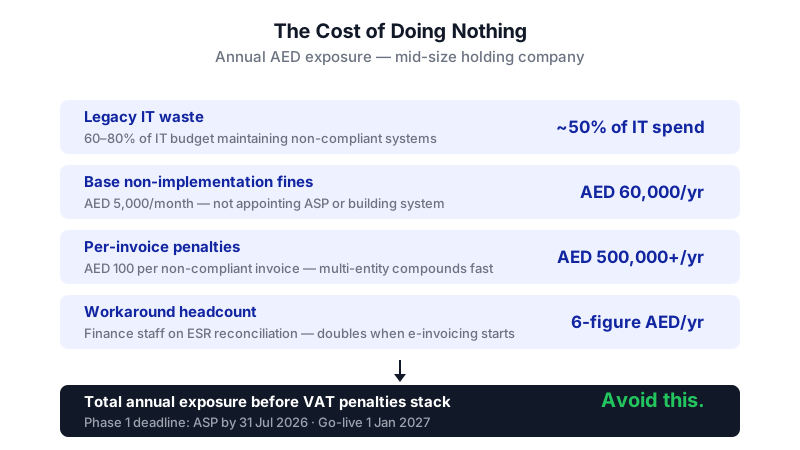
The reason modernization business cases die in UAE finance committees is that the 'cost of doing nothing' is presented as risk-adjusted narrative — "exposure to penalties", "increased audit risk" — rather than as a line item. Cabinet Decision No. 106 of 2025 makes the line item explicit. The BDO UAE regulatory summary sets out the schedule:
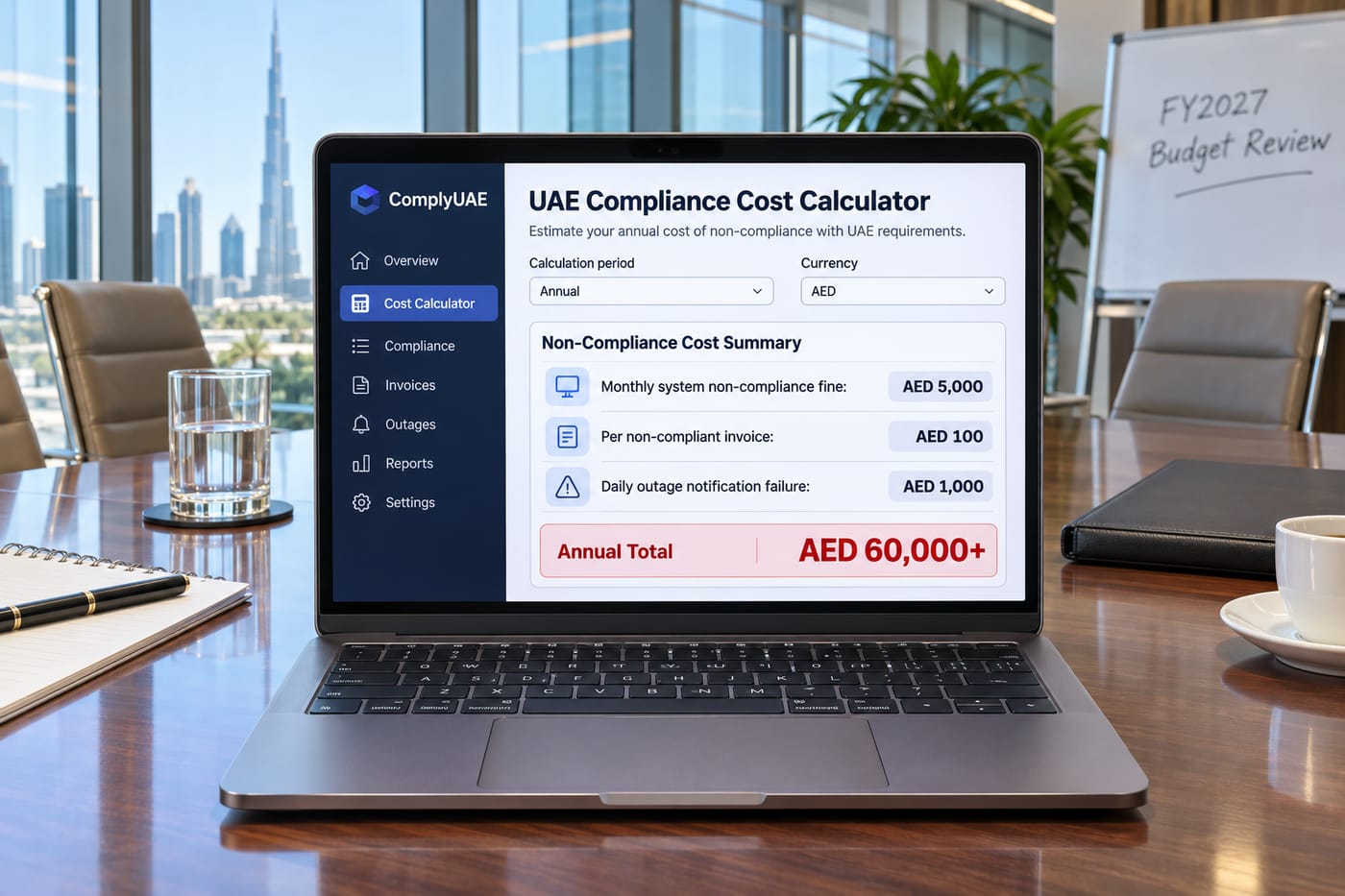
- AED 5,000 per month for failing to implement the system or appoint an Accredited Service Provider
- AED 100 per non-compliant invoice, capped at AED 5,000 per month per document type
- AED 1,000 per day for failing to notify the FTA of a system outage
That is AED 60,000 in annual fines before per-invoice exposure begins, just for not implementing. Per-invoice exposure compounds fast at any volume. SpendConsole's analysis works a scenario of 200 non-compliant invoices per month reaching AED 25,000/month in combined penalties and AED 100,000 cumulative exposure by month three. A multi-entity conglomerate issuing thousands of invoices across subsidiaries hits those caps on multiple document types — tax invoices, credit notes, debit notes — which is how a mid-size holding company can clear AED 500,000 in annual penalty exposure on the compliance fine alone, before VAT penalties stack on top under Cabinet Decision 129 of 2025.
Now layer the costs that are already happening:
1. The maintenance tax on your IT budget
Gartner and Deloitte figures cited across enterprise IT research put legacy maintenance at 60–80% of IT budgets, leaving very little for growth. McKinsey puts the direct cost of technology debt at 40–50% of total IT investment spend (McKinsey via CommercePundit). Translate this for your CFO: whatever your IT run-rate is today, roughly half of it is paying to keep something alive that still cannot produce a compliant invoice.
2. Headcount absorbed by workarounds
You know your number here. The reader of this post told us the number in the brief: two finance headcount per quarter on ESR reconciliation. Annualised at a mid-market UAE finance analyst fully-loaded cost, that is a six-figure AED line that produces no reporting improvement, no analytics, no customer value — just a manually reconciled spreadsheet that cannot be audit-signed without a partner's heavy qualification. When e-invoicing goes live, this number roughly doubles, because the workaround now includes generating XML surrogates for a system that does not speak XML.
3. Revenue the ERP blocks
A 10-year-old on-premise inventory module almost certainly cannot support real-time omnichannel stock, cannot expose an inventory API to a marketplace integration, and cannot do consignment or drop-ship accounting without a parallel ledger. If any of your entities sell to retailers, marketplaces, or through a D2C channel, there is a revenue number attached to that gap. It is usually larger than the modernization cost. CFOs rarely see it because it never appears in a variance report — you cannot be "below budget" on revenue you were structurally incapable of booking.
4. The vendor support cliff
Most on-premise ERPs from the 2013–2015 generation are either already out of mainstream support or on extended support at a premium. Extended support contracts do not include regulatory updates for jurisdictions the vendor does not treat as tier-one. The UAE FTA e-invoicing spec is unlikely to be back-ported to a product your vendor is winding down. You will be paying a premium to run a system the vendor will not make compliant.
The Vision 2031 context the board already understands
Your board has read the We the UAE 2031 Vision. It sets the goal of doubling GDP from AED 1.49 trillion to AED 3 trillion, and the parallel Digital Economy Strategy targets raising the digital economy's contribution from 9.7% to over 20% of GDP — a $140 billion digital economy by 2031. The FTA e-invoicing mandate is the operational execution of that vision at the transaction layer. The board does not need to be convinced that UAE enterprise is moving to structured digital reporting; they have already signed public commitments to that direction. Your job is to show them that the ERP is the blocker.
Sequencing: strangler-fig vs big-bang
There are two realistic paths, and the choice is driven more by your risk tolerance and parallel-run capacity than by technical preference.
Option A: Big-bang replacement
Cut over to a new ERP (cloud-native, API-first, with a compliant e-invoicing module or a clean ASP integration point) on a target date, with a parallel run of 60–90 days. This is what most SI partners will propose because it is easier to scope and price.
When it works: Single entity, clean master data, limited custom logic in the legacy system, a finance team with bandwidth for parallel run, and a go-live date that is at least six months before your FTA deadline.
When it fails: Multi-entity conglomerate with 10 years of custom logic, workflow exceptions baked into the current system that nobody has documented, and a go-live date that collides with year-end or a regulatory deadline. Big-bang failures in this profile tend to show up as a four-week revenue recognition gap and an audit qualification, both of which are worse than the problem you were solving.
Option B: Strangler-fig modernization
Keep the legacy ERP running as the system of record. Stand up the new platform around it, module by module, starting with the module that is causing the most compliance pain — invoicing and AR — and route transactions through the new system while the legacy ERP is progressively decommissioned. The strangler-fig pattern is the default modernization approach for enterprises with real transaction volume and audit obligations because it never has a "flag day" where the old system is off and the new one has to work.
When it works: Multi-entity setups, long operational tail, finance teams already stretched, deadlines that make a big-bang risky. Each increment produces a compliance or revenue win that funds the next.
What it is bad at: Total cost of program is usually higher than a successful big-bang because you run two systems in parallel for 12–24 months. Integration layer complexity is real — you need a well-designed event bus or integration fabric, and the team to run it. If your organisation cannot sustain a modernization program across two fiscal years without losing executive sponsorship, strangler-fig will stall in year two.
The sequencing argument for the CFO
Phase 1 of a strangler-fig program should be the AR and invoicing module — because it is the one with a hard regulatory deadline and a quantifiable penalty exposure. The business case for Phase 1 is not "we are modernizing the ERP"; it is "we are eliminating AED X of annual penalty exposure and Y headcount of manual reconciliation, with a cutover before the FTA deadline." That is a case the CFO can defend to the board. Phase 2 (GL and reporting), Phase 3 (inventory and procurement), and Phase 4 (HR and payroll) each have their own ROI case, and each can be deferred or accelerated based on cash position and operational readiness.
What the modernization actually costs — and what moves the number
There is no honest single number for an enterprise ERP modernization because the range is driven by variables the business controls. What is useful is to understand the shape of the number and what moves it.
The McKinsey December 2024 analysis found that generative-AI-assisted modernization now delivers 40–50% faster timelines and roughly 40% lower costs than a 2022-era traditional modernization. Kyndryl's 2025 State of Mainframe Modernisation Survey puts well-executed modernization ROI at 228–362% over three years, with cloud-native approaches reaching break-even in 18–24 months. Those are the benchmarks to bring into the room.
What drives your specific number:
- Number of legal entities and whether they share a chart of accounts. This is the single biggest cost driver in a UAE conglomerate context.
- Master data quality — customer, vendor, item, and tax code. Dirty master data is the hidden cost. Budget a discovery and cleanup phase before any build.
- Integration surface — every bank, every tax portal, every warehouse management system, every POS, every marketplace. Each one is scoped work.
- Customizations in the legacy ERP that encode business logic nobody has written down. Expect a reverse-engineering phase.
- Whether you are also appointing a new ASP or using one the new ERP ships with. Bundled is cheaper; best-of-breed gives you optionality.
Illustrative only: a two-entity UAE trading group with a clean customer master, five integrations (two banks, FTA portal, one WMS, one marketplace), no major legacy customizations, running a strangler-fig Phase 1 covering AR and e-invoicing, is a materially smaller program than a seven-entity conglomerate with a decade of custom G/L logic and unreconciled intercompany positions. The ratio between the two can easily be 5x, before any ongoing licensing differential.
To turn the shape into a quote, three specifics have to be scoped: (1) the entity and chart-of-accounts map, (2) the integration inventory with current message volumes, and (3) the master data audit. Those three artefacts are what any credible modernization partner — including CodeNicely — will ask for before putting a number on paper. If a vendor quotes without them, the number is fiction.
What the business has to supply
Modernization programs fail more often on the client side than the vendor side. Before you commit budget, confirm you can supply:
- An executive sponsor with authority across finance, operations, and IT. If the CFO sponsors and the COO is passive, inventory and procurement modules will stall.
- Dedicated finance SMEs — not "20% of their time", actually dedicated for the duration of their module. Fractional allocation is the most common cause of scope drift.
- A data owner per master — customer, vendor, item, GL — who can make canonical decisions.
- A parallel-run budget for the finance team. Parallel run is work. It cannot happen on top of month-end.
- A clear decision on ASP before Phase 1 starts. This is a procurement decision, not a technical one.
How to phase the spend so Phase 1 funds Phase 2
The argument that lands with a sceptical CFO is not "trust us on the three-year ROI." It is "Phase 1 pays for itself inside its own window, and here is how." Phase 1 (AR, invoicing, ASP integration) retires:
- The AED 60,000+ annual compliance fine baseline
- Per-invoice penalty exposure (which, at any serious volume, is the dominant number)
- The two-headcount quarterly workaround on ESR and VAT reconciliation
- Any extended-support premium on the legacy AR module
Phase 2 (GL, consolidation, management reporting) gets funded from the Phase 1 run-rate savings and the elimination of the month-end close overtime. Phase 3 (inventory, procurement, omnichannel) is funded by the revenue the current inventory module is blocking — and this is the phase where you stop having a conversation about compliance and start having one about growth. That is the sequencing a board will approve, because each phase has its own ROI and its own kill switch.
How CodeNicely can help
CodeNicely builds and modernizes transaction-heavy financial systems for regulated markets. The engagement most relevant to this reader is GimBooks, a YC-backed accounting and invoicing SaaS where we built the structured-invoice generation, tax reporting, and reconciliation layer that an Indian GST regime requires — the same architectural problem as PINT-AE XML generation, ASP transmission, and FTA near-real-time reporting, in a different jurisdiction. The patterns transfer directly: a canonical invoice model, a transformation layer to the regulator's schema, a transmission queue with retry and outage notification, and an audit trail that survives examiner scrutiny.
For UAE-headquartered conglomerates, we work from our Dubai engagement model with full IP ownership and no vendor lock-in — which matters because your next ERP decision is a 10-year decision, and you should not be rebuying it from a vendor who holds the source. Our enterprise modernization practice leads with strangler-fig sequencing for multi-entity groups because big-bang in your profile usually fails.
Legal, tax, and audit specifics — the exact VAT treatment of your intercompany flows, the ASP contract terms, the penalty reserve on your balance sheet — need to be reviewed by your tax advisor and auditor. We build the system; your advisors confirm the filing position.
The argument you take into the meeting
Three sentences for the CFO:
- "Our current ERP cannot produce a PINT-AE XML invoice, which means after our FTA phase deadline, every invoice we issue is a per-transaction penalty event under Cabinet Decision 106 of 2025."
- "A strangler-fig Phase 1 covering AR and e-invoicing retires that exposure, eliminates the quarterly reconciliation headcount, and is funded by the penalty and headcount savings inside its own window."
- "Phases 2 and 3 are separately justified and separately killable — we are not asking for a blank cheque on a three-year program."
That is the business case. The numbers behind it are specific to your entity map, your invoice volumes, and your current workaround cost — and those are the numbers worth sitting down to scope.
Frequently Asked Questions
Can we just bolt an e-invoicing middleware onto our existing ERP instead of replacing it?
Sometimes, for Phase 1 only, and only if the ERP can expose a clean, complete invoice record to the middleware — including all line items, tax codes, customer tax registration numbers, and credit note linkages in a structured form. Most pre-2018 on-premise ERPs cannot, because the data model was never designed for the fields PINT-AE XML requires. A middleware bolt-on also leaves the underlying maintenance tax, workaround headcount, and blocked-revenue problems untouched, so it buys compliance without producing the business case savings that fund the rest of the modernization.
How long does a UAE ERP modernization typically take?
Timeline is driven by entity count, master data quality, integration surface, and whether you choose strangler-fig or big-bang. Phase 1 of a strangler-fig program (AR and e-invoicing) is a materially shorter scope than a full replacement, and the McKinsey benchmark of 40–50% faster timelines with AI-assisted modernization applies here. To turn a shape into a date you need the entity map, the integration inventory, and the master data audit — those three artefacts are what a credible partner will ask for before committing to a timeline.
What happens if we miss our FTA e-invoicing phase deadline?
Cabinet Decision 106 of 2025 applies AED 5,000/month for failing to implement or appoint an ASP, plus AED 100 per non-compliant invoice (capped at AED 5,000/month per document type), plus AED 1,000/day for failing to notify the FTA of outages. VAT return inaccuracies caused by the same failure stack on top under Cabinet Decision 129 of 2025. Your tax advisor should confirm your specific exposure based on invoice volume and document types.
Is it cheaper to upgrade our current ERP to the vendor's latest version than to replace it?
Sometimes on licence cost, rarely on total cost of ownership, and almost never if the latest version still requires a re-implementation of your custom logic — which it usually does for 10-year-old on-premise deployments. The real question is whether the vendor's latest version has a certified PINT-AE output and a UAE ASP integration on their roadmap with a date that beats your phase deadline. If yes, a vendor upgrade is worth pricing. If the roadmap is vague, you are buying time, not a solution.
Who owns the source code and data after a CodeNicely modernization?
You do. CodeNicely engagements are structured with full client IP ownership and no vendor lock-in, which matters because an ERP is a 10-year decision and you should not have to rebuy it from the vendor who built it. Specific contractual terms, escrow arrangements, and data residency commitments should be confirmed in your MSA and reviewed by your legal counsel.
Sources & further reading
- 'We the UAE 2031' Vision — official UAE government page
- UAE's national digital economy set to grow to $140 billion by 2031 — Gulf News (citing Dubai Chamber of Digital Economy report)
- UAE FTA e-invoicing: what your accounting system must support before the deadline — Wafeq
- e-Invoicing in UAE 2026: Deadline, Requirements and FTA Guidelines — ClearTax AE
- UAE E-Invoicing Mandate: A Step-by-Step Compliance Checklist — Middle East Briefing
- UAE e-Invoice update: Cabinet Decision No. 106 of 2025 — BDO UAE (primary regulatory summary)
- e-Invoicing Penalties Under Cabinet Decision 106/2025 — ClearTax AE
- UAE E-Invoicing Penalties and Enforcement: What CFOs Should Expect — SpendConsole
Get one practical guide a week
Costs, AI tools, partner selection — written for people who make the decision. No spam, unsubscribe anytime.
Thanks — you're on the list. One practical guide a week, nothing else.
That didn't work — please check the email address and try again.
Building something in Enterprise Software?
CodeNicely partners with founders and tech teams to ship AI-native products that move metrics. Tell us about the problem you're solving.
Talk to our team Book a 30-min call