
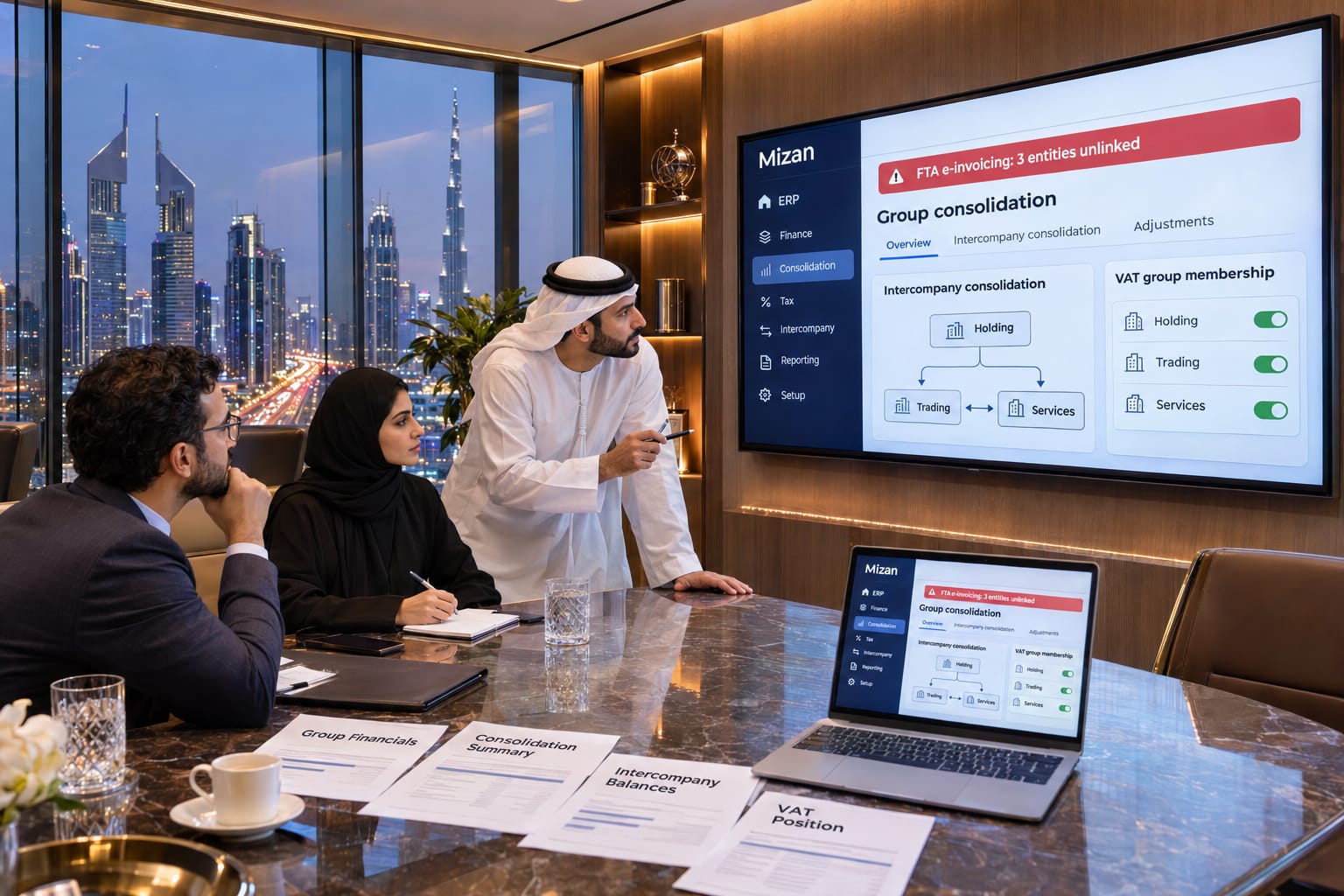
Pricing a Custom ERP for a UAE Multi-Entity Group

 Published by CodeNicely, the product studio founded by Meghal Agrawal and Ujjwal Agrawal in 2017
For: COO or Group CFO at a UAE-headquartered conglomerate — 3–8 legal entities across trading, real estate, or logistics — whose NetSuite or SAP instance was licensed for one entity and is now held together with inter-company Excel workarounds that collapse every VAT filing quarter
In this guide
- Why your current quotes are not comparable
- The cost drivers, in order of impact
- Illustrative worked example
- What pushes this up, what pulls it down
- The compliance deadline is doing work in your budget
- Build vs buy, honestly
- How CodeNicely can help
- The three questions that turn a range into a quote
- Frequently Asked Questions
A credible budget for a custom multi-entity ERP for a UAE group of 3–8 entities lands in a wide range — anywhere from the mid six figures USD to well over seven, depending on three decisions that most vendor quotes do not price: how many entities need their own Accredited Service Provider link for FTA e-invoicing, whether your VAT group and your Corporate Tax group have the same members, and how much of your current NetSuite or SAP footprint has to keep running during cutover. The cost model below separates what you control from what the regulator controls, so you can take a defensible range to the board before anyone writes an SOW.
The non-obvious part: UAE compliance surface typically adds 25–35% to the integration budget alone, and almost none of it shows up in a first-draft vendor proposal. It surfaces during chart-of-accounts mapping, four to six weeks after the contract is signed, which is why so many of these projects end up in the 189% overrun bracket Panorama's 2025 ERP report describes.
Why your current quotes are not comparable
If you have asked three vendors and received three numbers that are 4x apart, the vendors are not wrong. They are pricing different things. A conglomerate CFO we spoke with recently had quotes ranging from AED 1.1M to AED 6.4M for what looked like the same scope: a replacement for a single-entity NetSuite instance stretched across five trading and real estate entities, with VAT filing done in Excel.
The quotes diverged on assumptions the vendors never wrote down:
- Whether e-invoicing meant one ASP integration or five
- Whether the Corporate Tax group and the VAT group had the same members (they didn't)
- Whether historical intercompany balances in the old system would be migrated or written off at cutover
- Whether Arabic-English bilingual reporting was "localisation" or "custom development"
- Who owned the chart-of-accounts redesign — the vendor's functional consultant or the client's finance team
Every one of those is a six-figure line item. None of them appear in a standard ERP RFP template.
The cost drivers, in order of impact
1. Number of entities that need their own ASP link
Under the FTA regime, e-invoicing becomes mandatory for businesses with revenue ≥ AED 50 million from 1 January 2027, and for all other VAT-registered businesses from 1 July 2027. Only invoices in the structured PINT-AE XML format, transmitted through an FTA-accredited Service Provider, are legally valid tax invoices. PDFs and Excel exports are not.
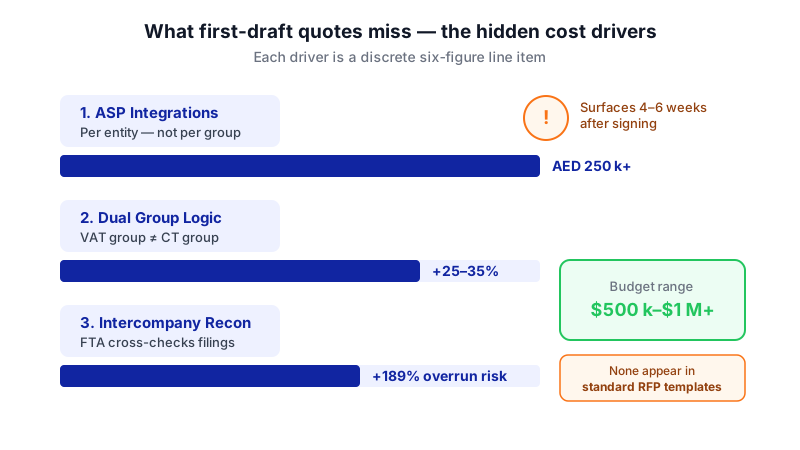
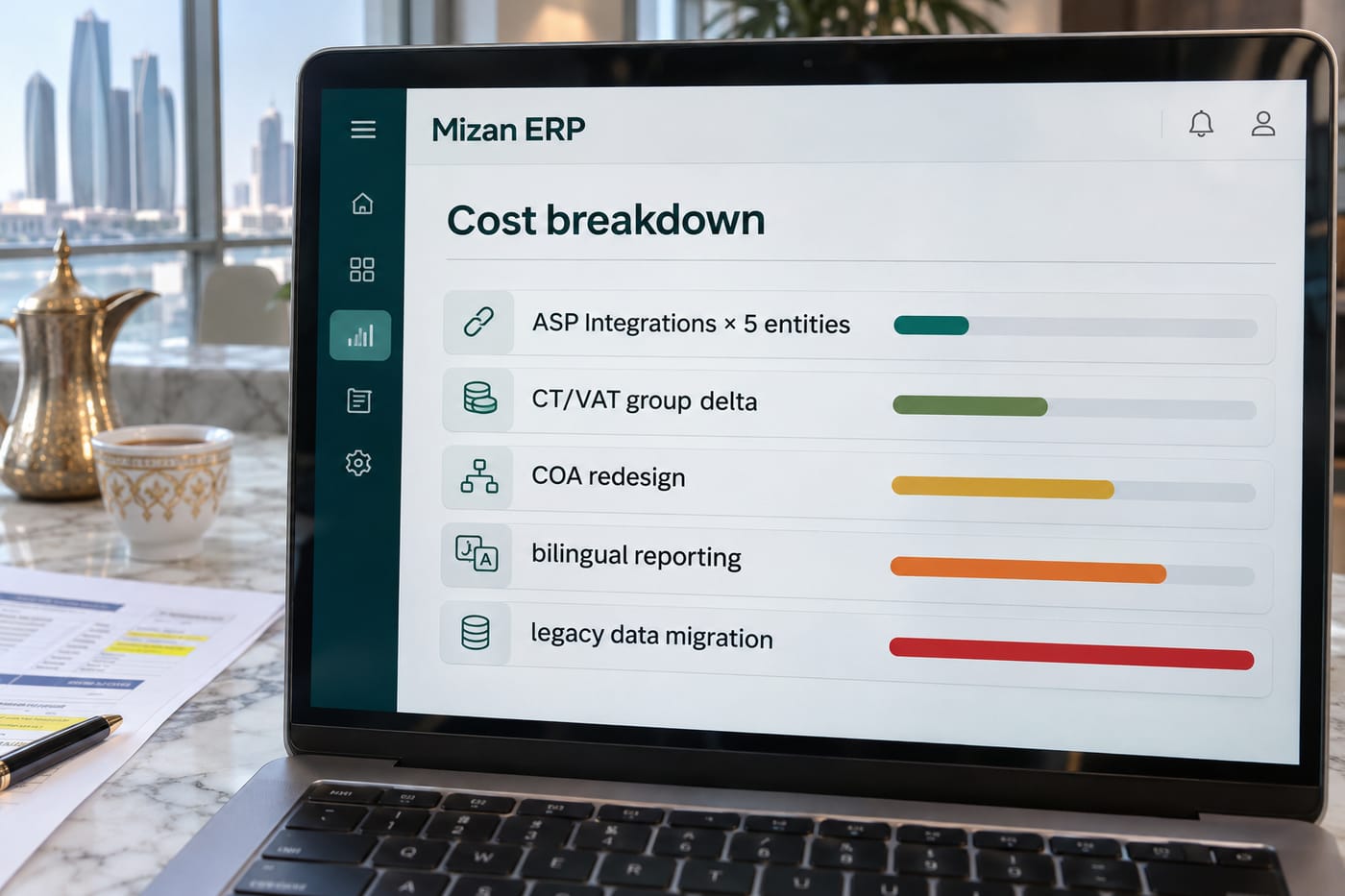
The subtle part for a conglomerate: each entity in a VAT group must maintain its own link to an ASP separately, even if the group files one consolidated return. A five-entity group needs five discrete ASP integrations, five sets of digital certificates, five sets of outbound and inbound validation flows, and five entity-specific error-handling queues. This is the single largest driver that first-draft quotes miss.
Market data from UAE implementers suggests enterprise e-invoicing rollouts across multiple entities land at AED 250,000+ in Year 1 with ongoing annual costs of AED 120,000+, and that is before you build the ERP it connects to.
2. Mismatch between your VAT group and your Corporate Tax group
A UAE Corporate Tax Group under Article 40 of Federal Decree-Law 47/2022 requires ≥95% common ownership. A VAT Tax Group is a separate registration with different eligibility. In practice, conglomerates end up with two different group structures running simultaneously, each with its own consolidation logic.
What this means for the build: your ERP has to produce entity-level P&Ls that roll up two different ways — once for the Corporate Tax return (9% on taxable profits above AED 375,000, plus the 15% Domestic Minimum Top-Up Tax for groups with global revenue above €750 million) and once for the consolidated VAT return. The intercompany eliminations are different in each view. If your real estate SPV is in the CT group but not the VAT group, every intercompany management fee moves through the ledger twice with different treatment.
Pricing this honestly: budget a dedicated consolidation module and a separate transfer pricing documentation workflow. Off-the-shelf multi-entity modules in SAP B1 or NetSuite assume one group definition. UAE conglomerates typically need two.
3. Intercompany reconciliation and the FTA cross-check
The FTA can and does cross-check entity-level VAT filings against consolidated Corporate Tax numbers. Unreconciled intercompany balances are one of the most common triggers for an FTA review query. If your current state is "quarterly VAT filings held together with Excel," the ERP has to automate what Excel was papering over — matching intercompany invoices, foreign currency revaluation at entity level, and elimination entries that reconcile to the AED on both sides.
This is the part where custom builds pull ahead of off-the-shelf. The matching rules for a trading entity selling to a logistics entity that invoices in USD but reports in AED are specific enough that most packaged intercompany modules need heavy customisation anyway. At that point the build-vs-buy maths changes.
4. Legacy system runway
How much of your current NetSuite or SAP instance has to keep running during the build is often the second-biggest line item after e-invoicing. If the answer is "everything, until we are fully live," you are paying for parallel operations, dual data entry tooling, and a reconciliation layer that exists only to keep the two systems in agreement for six to nine months. If the answer is "we will cut over one entity at a time, starting with the smallest," the cost drops sharply but the timeline extends.
5. Data migration and the historical ledger
Three questions decide this line item: how many years of transactional history move into the new system, whether open intercompany balances are migrated as-is or reconciled first, and whether you keep the old VAT filings auditable in the new ERP or leave them in the old system as a read-only archive. The FTA's audit window makes the third question non-trivial — losing access to historical filings during a review is not a situation you want to be in.
6. Who supplies the UAE tax domain expert
If the vendor supplies the FTA-literate functional consultant, you pay for it in the day rate. If you supply them from your finance team or a Big Four advisory, the vendor cost drops but your internal cost rises and your project depends on that person's availability. Neither is wrong, but the choice has to be made before scoping, not during.
7. Bilingual reporting and Arabic UX
Not optional for most government-facing reports and often required for board packs if any shareholder is a UAE national. GCC localisation — bilingual reporting, PINT-AE readiness, multi-entity consolidation — is typically 15–25% of total implementation cost. Treat it as a line item from day one, not a phase-two polish.
Illustrative worked example
This is illustrative. Every assumption is stated. Your numbers will differ.
The group: Five legal entities — two trading (AED-functional), one logistics (USD-invoicing, AED-reporting), one real estate SPV (ADGM-registered), one holding company (DIFC). Combined revenue AED 420M. Currently on a single NetSuite instance licensed for the holding company, with the other four entities running as classes and segments. VAT filed quarterly via a workbook that imports NetSuite exports and manually recalculates intercompany.
What they want: A custom multi-entity ERP with native entity-level ledgers, five ASP integrations for FTA e-invoicing, dual group consolidation (one VAT group of four entities, one CT group of all five), bilingual Arabic-English statutory reporting, and a 50% functional overlap with the existing NetSuite modules in sales, procurement, and inventory.
What they are keeping: NetSuite CRM for the trading entities (not replaced). Existing payroll on a separate GCC-specific vendor (integration only). Three years of transactional history migrated; years 4–7 archived read-only.
Shape of the budget under these assumptions:
- Core ERP build (ledger, AP/AR, procurement, inventory, consolidation engine): the largest line, usually 45–55% of total
- Five ASP integrations and PINT-AE invoice generation: 15–20%
- Dual-group consolidation logic and transfer pricing documentation: 10–12%
- Data migration and historical reconciliation: 8–12%
- Bilingual reporting and statutory report pack: 5–8%
- Change management, training, parallel-run support: 8–10%
For comparison, Panorama's 2025 ERP Report puts the average implementation cost for a mid-sized organisation at approximately USD 450,000, but that average includes single-entity deployments with no e-invoicing surface and no bilingual requirement. UAE multi-entity custom builds sit meaningfully above that benchmark.
What pushes this up, what pulls it down
| Pushes the number up | Pulls the number down |
|---|---|
| Each additional entity requiring its own ASP link | Reducing the migration window to the last 2 years, archiving the rest |
| VAT group and CT group having different members | Phased cutover, one entity at a time, starting with the smallest |
| Foreign-currency functional entities (not just AED) | Keeping existing CRM/payroll and integrating rather than replacing |
| DIFC or ADGM entities with their own statutory report formats | Client-supplied FTA functional consultant from existing finance team |
| Keeping the old ERP live in parallel for >6 months | Standardising the chart of accounts across entities before the build starts |
| Real-time intercompany settlement vs end-of-day batch | Accepting packaged bilingual report templates vs custom board-pack design |
| Being in scope for the 15% Domestic Minimum Top-Up Tax (adds Pillar Two reporting) | Starting the ASP accreditation conversation before ERP scoping, not after |
The compliance deadline is doing work in your budget
One point worth stating plainly: the FTA e-invoicing dates are not aspirational. Cabinet Decision No. 106 of 2025 sets penalties at AED 100 per invoice not issued or transmitted on time (capped at AED 5,000 per month per entity) and AED 1,000 per day for failing to notify the FTA of a system malfunction. For a five-entity group filing thousands of invoices a month, the monthly cap is reached quickly, and the system-malfunction notification obligation is a 24/7 operational requirement, not just a software feature.

This matters for budgeting because it compresses your decision window. A build that lands in Q4 2026 is a different project — and a different risk profile — than one that lands in Q3 2027. The closer you get to the mandate, the more vendors price in risk premiums and the fewer good ASPs have capacity to onboard you.
Build vs buy, honestly
A custom ERP is not always the right answer. If your group is three entities, all AED-functional, all in the same VAT and CT group, with no DIFC/ADGM entity and no foreign-currency complexity, a well-configured NetSuite OneWorld or SAP S/4HANA Cloud deployment with a strong UAE localisation partner will almost always be cheaper and faster to compliance.
Custom builds pull ahead when:
- You have five or more entities with meaningfully different operating models (trading vs real estate vs logistics have different revenue recognition, inventory, and WIP logic)
- Your VAT and CT groups differ
- You have DIFC or ADGM entities with their own statutory formats
- You have workflows the packaged modules force you to break (common in trading with letters of credit and commodity hedging)
- You want full IP ownership and no per-user license escalation on a 500+ user base
The honest downside of custom: you own the maintenance roadmap. When the FTA publishes a new PINT-AE schema version, your team patches it. When Corporate Tax rules evolve, your team implements. A packaged vendor amortises that work across thousands of customers. Factor an ongoing engineering retainer into your TCO, not just the Year 1 build.
How CodeNicely can help
We build custom enterprise software for multi-entity groups where the packaged options force unacceptable compromises. The engagement closest to this reader's situation is GimBooks — a YC-backed accounting and compliance SaaS where we built the e-invoicing, GST, and multi-entity ledger engine from scratch, including the government API integrations and the entity-level reconciliation logic that keeps regulators and auditors in agreement. The technical shape of UAE FTA e-invoicing with multiple ASP endpoints is close enough to the Indian GSTN and e-invoicing architecture that the engineering patterns transfer directly: structured XML generation, digital signing, async acknowledgement handling, failure replay, and per-entity audit trails.
What a CodeNicely engagement looks like for a UAE conglomerate: a two-to-three week scoping sprint that produces a defensible budget range with assumptions written down (not after the SOW — before it), followed by a phased build with full IP ownership and no vendor lock-in. See our Dubai and Middle East practice or enterprise offerings for how we structure these engagements.
The three questions that turn a range into a quote
Before you ask any vendor — us or anyone else — for a real number, have answers to these:
- How many of your entities will need their own ASP integration? Count every entity that issues tax invoices, including SPVs and dormant entities you plan to reactivate. This single number swings the integration budget by 25–35%.
- Are your VAT group and your Corporate Tax group identical, or do they differ? If they differ, you are buying a dual-consolidation ERP and the architecture decisions change on day one.
- What stays live from your current stack, and for how long? Full parallel run, phased cutover, or big-bang replacement — each is a different budget and a different risk profile.
Specific regulatory, tax, and licensing questions in this post should be reviewed with your auditor and a UAE tax advisor against your actual entity structure. The compliance surface changes often and your facts matter.
When you have working answers to those three — even directional ones — a scoping conversation with us can turn them into a budget range you can take to the board, with the assumptions written down so the number does not drift once the SOW is signed.
Frequently Asked Questions
Can we extend our existing NetSuite instance to cover all entities instead of building custom?
Often yes, and it is worth pricing against a custom build. NetSuite OneWorld handles multi-entity natively, and a strong UAE localisation partner can add PINT-AE e-invoicing through an accredited ASP. The question is whether your operating models across trading, real estate, and logistics fit NetSuite's assumptions or force enough customisation that you end up with a semi-custom build at NetSuite license prices. Price both. The decision usually turns on 10-year TCO including user license escalation, not Year 1 cost.
How long does a UAE multi-entity ERP build typically take?
Timelines are driven by the same factors as cost: entity count, number of ASP integrations, parallel-run duration, and whether the chart of accounts is standardised before the build starts. A phased, entity-by-entity cutover generally extends calendar time but reduces risk. Compressing the timeline to meet the 2027 FTA mandate adds cost and risk premiums. We would not quote a duration without knowing the three questions in the final section.
Does our DIFC or ADGM entity need separate ERP logic from our mainland entities?
In practice, yes — statutory report formats, audit requirements, and in some cases accounting standards differ, and the ERP needs to produce entity-specific report packs. Whether this is a configuration layer or genuinely separate logic depends on which free zone and which activity. This is a specific-advice question for your auditor, not a generic ERP question.
What happens if we miss the FTA e-invoicing deadline?
Penalties under Cabinet Decision No. 106 of 2025 are AED 100 per non-compliant invoice capped at AED 5,000 per month per entity, plus AED 1,000 per day for failing to notify the FTA of a system malfunction. For a five-entity group, the per-entity monthly cap compounds quickly, and the reputational risk with the FTA for sustained non-compliance is harder to quantify but real. Starting the ASP conversation 12–18 months before your applicable deadline is the market-standard runway.
Should we build the e-invoicing layer first and the ERP later?
Sometimes, yes. If your current ERP is functional enough to survive another two years and the gating risk is the 2027 mandate, a thin e-invoicing middleware that sits between your existing system and an accredited ASP can buy you time to scope the ERP properly. The tradeoff is that you are building something you will throw away. Done well, that disposable layer still costs less than a rushed ERP build that misses the compliance deadline.
Sources & further reading
- UAE E-Invoicing Regulations 2026: What Changed (invoiceuae.ae)
- UAE E-Invoicing Phase 2 and Phase 3: 2026 to 2027 Timeline Guide (asadabbastechnologies.com)
- E-invoicing in the UAE: timeline, business actions and penalties (Hawksford)
- UAE E-Invoicing Cost & Pricing Guide 2026: What Businesses Actually Pay (businex360.com)
- VAT in UAE: 5% Rate, Registration Threshold, Exemptions and Filing Rules — VAT Group e-invoicing ASP obligations (ClearTax UAE)
- Intercompany Accounting in UAE: CT, VAT & Transfer Pricing Guide (taxadepts.com)
- UAE Tax & Compliance 2026: CT, VAT, ESR and FTA Explained — CT Tax Group 95% threshold (henryclub.ae)
- UAE Corporate Tax Reform 2026: Key Changes and Timeline (Alaan)
Get one practical guide a week
Costs, AI tools, partner selection — written for people who make the decision. No spam, unsubscribe anytime.
Thanks — you're on the list. One practical guide a week, nothing else.
That didn't work — please check the email address and try again.
Building something in Enterprise Software?
CodeNicely partners with founders and tech teams to ship AI-native products that move metrics. Tell us about the problem you're solving.
Talk to our team Book a 30-min call