

Build vs. Buy Enterprise Software: A Budget Holder's Framework

 Published by CodeNicely, the product studio founded by Meghal Agrawal and Ujjwal Agrawal in 2017
For: A COO or CIO at a 500–2,000-person US company who has just received a $400K–$1.2M SaaS renewal quote and is being asked by the CFO to justify it — or greenlight a custom build instead — before the next board meeting
In this guide
Before you sign the renewal or greenlight the build, pull the current vendor's MSA and find the data export clause. If it does not grant you a machine-readable export of your production data on termination, the real decision in front of you is not build vs buy enterprise software — it is pay the renewal, or pay the renewal plus a six-figure data extraction project. That one clause moves the TCO math more than license cost, implementation timeline, or headcount assumptions combined. Everything else in this post is how to score the rest of the decision honestly once you know where you actually stand on exit.
This is written for the budget holder — the COO or CIO staring at a $400K–$1.2M renewal quote with a CFO asking why — not the architect. Microservices vs monolith is not your problem. Whether to spend seven figures on something your team cannot maintain in two years is.
Define the decision crisply
There are really only four options on the table, and most build-vs-buy debates fail because people conflate them:
- Renew the incumbent SaaS at the quoted price, possibly after a negotiation.
- Switch to a competing commercial product (another SaaS or COTS).
- Build custom — either in-house, with a development partner, or hybrid.
- Do nothing material — extend month-to-month, cut licenses, defer the decision a quarter.
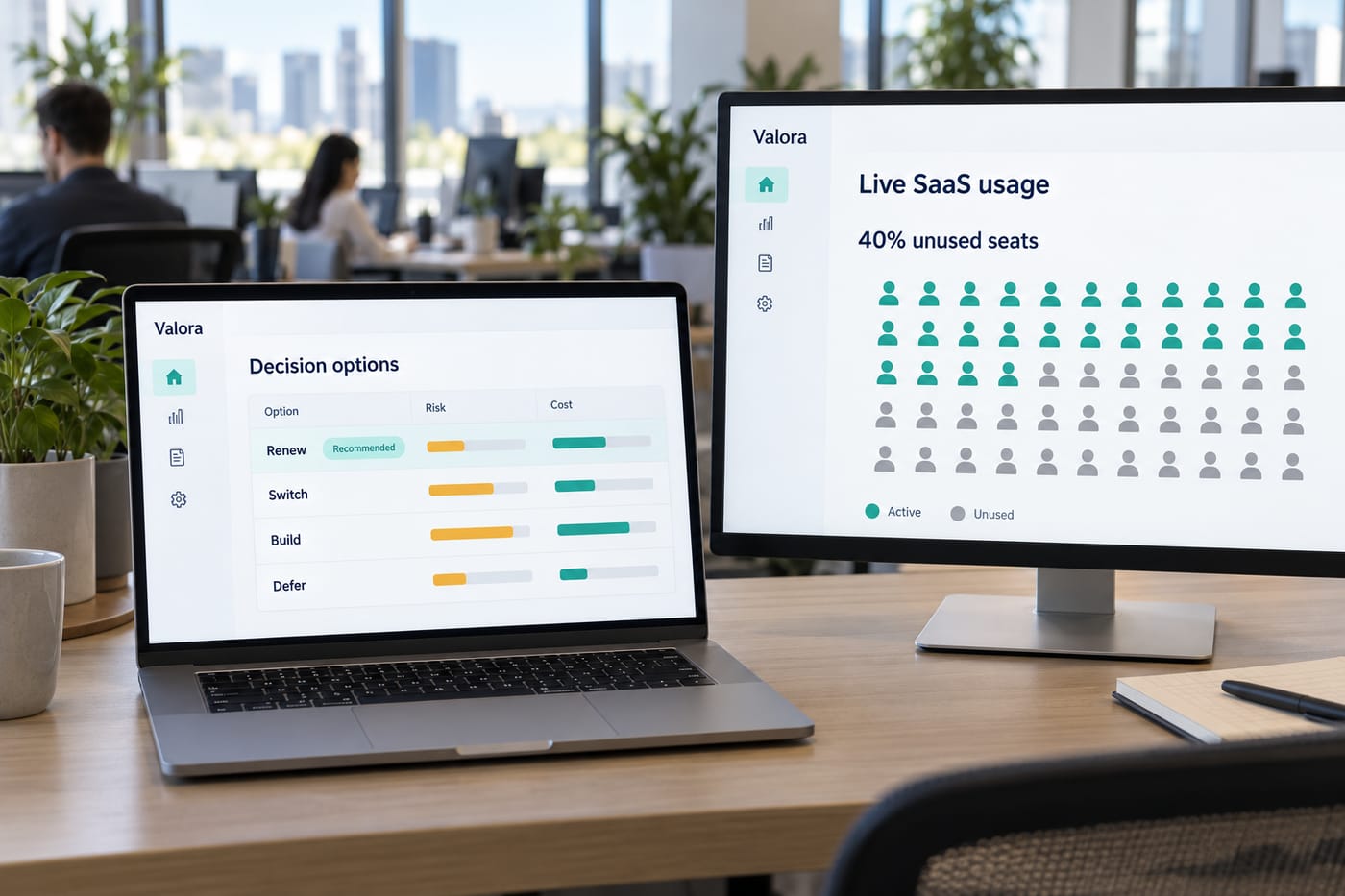
Option 4 is almost always underweighted. Zylo's 2025 SaaS Management Index found that 52.7% of purchased SaaS licenses sit idle and organizations waste an average of $21M annually on unused seats. Before you decide between build and buy, run the usage report. A renewal that is 40% smaller is a different decision.
The five axes that actually decide it
Score each option on these five. Not more. More axes let people hide the ones that matter.

1. Total cost of ownership, including the hidden lines
Sticker price is the smallest number in this decision. On the buy side, Gartner's work (summarized by Altexsoft) finds that integration, training, and mandatory customization push true SaaS TCO 150–200% beyond the license line. On the build side, Forrester's 2024 TEI model puts 78% of lifetime software cost after launch, with annual maintenance running 15–20% of initial build budget — forever.
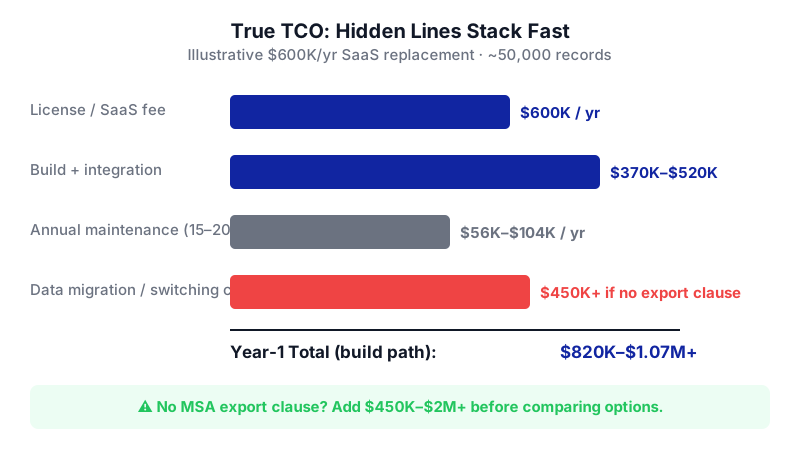
And the number people never put in the spreadsheet: switching cost. A mid-market enterprise with 100,000+ customer records in a proprietary SaaS can face a $450,000+ data migration bill on exit. Fortune 500 extractions from Workday or Oracle CX run $2M+. If you are building to replace a system with no clean export path, that migration is part of the build cost, whether your proposal says so or not.
Illustrative shape, not a quote: a two-integration internal tool replacing a $600K/year SaaS, with ~50,000 records to migrate from a vendor whose MSA grants export rights, with no new regulatory scope. Year-one cost is dominated by build + migration. Years 2–5 are dominated by the 15–20% annual run-rate plus whatever you add. Change any assumption — say the MSA has no export clause, or you need HIPAA scope — and the number moves by six figures. Which is the point.
2. Speed to first value
SaaS wins this axis almost every time. COTS and SaaS deploy 40–60% faster than custom builds for comparable scope. If the business case depends on value in the current fiscal year, buy. If you are solving something the business will depend on for a decade and your competitors all use the same SaaS, speed to first value is the wrong axis to optimize.
Honest counterweight: 55–75% of enterprise software implementations fail to meet stated objectives (Gartner / Panorama), and overruns among failing projects average 178% on cost and 230% on schedule — with delivered functionality at 41% of plan. Those numbers apply to both SaaS implementations and custom builds. Fast to deploy is not the same as fast to value.
3. Compliance surface area
This is where custom builds get quietly expensive. 78% of enterprise clients now require SOC 2 Type II from their SaaS vendors — meaning if you build and your product touches customer data, you may be inheriting an audit obligation your incumbent was absorbing for you. A recent industry analysis found that custom software cost estimates miss 30–40% of the real number, and compliance is the single line item most likely to be omitted from initial proposals.
Score honestly: if buy means the vendor carries SOC 2, HIPAA, PCI, or SOX scope on your behalf, that is worth real money. Price out what your own Type II audit, pen tests, and continuous monitoring would cost before you call build the cheaper option. (And nothing in this post is legal or audit advice — have your counsel and auditor review specifics before signing anything.)
4. Key-person risk
SaaS concentrates risk in the vendor. Custom concentrates it in three to five engineers who understand the codebase. Both are real. The question is which one you can manage.
Vendor risk is diversifiable through contract (SLAs, source code escrow, data export rights). Key-person risk inside your own org is harder — it requires documentation discipline, pair programming, and a hiring pipeline most mid-market companies do not have. If your IT org cannot name the two people who would need to stay for a custom build to survive a reorg, you are not ready to build.
5. Reversibility — what happens in month six if you are wrong
The axis nobody scores. If you buy and regret it, you are in a 12–36 month switching project constrained by the data export clause. If you build and regret it, you own a half-finished codebase and the opportunity cost of 6–12 months.
Reversibility is largely determined by contract design on the buy side and architecture discipline on the build side. On buy: insist on machine-readable export rights, defined SLAs for export delivery, and (under the EU Data Act, in force September 2025) note that from January 12, 2027, switching and egress fees are prohibited for IaaS/PaaS/SaaS providers serving EU customers. If you have any EU footprint, that regulation changes your leverage at the next renewal.
Scoring the four options honestly
| Option | TCO | Speed | Compliance | Key-person risk | Reversibility |
|---|---|---|---|---|---|
| Renew incumbent | Known, usually inflating 8–15%/yr | Immediate | Vendor-absorbed | Vendor-side | Governed by MSA — check now |
| Switch SaaS | License + migration (often $150K–$450K+) | 6–18 months | Vendor-absorbed, re-diligenced | Vendor-side | Resets the clock on exit terms |
| Build custom | Build + 15–20%/yr forever + compliance | 9–24 months to parity | Yours to own | Internal, concentrated | Full control, high sunk cost |
| Do nothing / cut licenses | Lowest | N/A | Unchanged | Unchanged | Fully reversible |
The case against hiring a development partner at all
You should not hire anyone — us included — if any of the following is true:
- Your usage audit shows >40% idle licenses. Fix the renewal first. You may not need a project at all.
- The functionality is undifferentiated. If your competitors run the same SaaS and win on other dimensions, building your own version is paying to catch up to parity.
- You have no product owner internally. A development partner can build what you specify. They cannot replace the person who decides what to specify. Projects without a dedicated internal owner are in the 55–75% failure cohort before kickoff.
- You need it in under four months and the scope is non-trivial. Buy, even if the fit is 70%. Build the differentiating 30% later.
- Regulatory scope is new to your org. First-time HIPAA or SOC 2 Type II while also building new software is two hard projects stacked. Buy the first instance, learn the compliance surface, then consider building v2.
If you're in situation A, do X
Situation A — renewal is inflated, usage is low, incumbent MSA has clean export rights: Negotiate hard on renewal (cite the Zylo waste benchmark, bring usage data), right-size seats, defer the build-vs-buy decision 12 months. You just saved six figures and bought time.
Situation B — functionality is a commodity, timeline is tight, no strategic differentiation: Buy. Pick the vendor with the strongest data portability clause and SOC 2 Type II scope. Accept the 150–200% TCO premium — it is still cheaper than the all-in cost of building something non-differentiating.
Situation C — the software is a core differentiator, you have an internal product owner, and the incumbent either has no export rights or is pricing you out: Build, but phase it. Rebuild the differentiating workflow first, keep the incumbent for everything else, migrate incrementally. This is the only build path with reversibility.
Situation D — incumbent has no export clause and you want to leave: Budget the migration as a separate project before you scope the replacement. Get the data out first (or legally established as exportable) and then decide build vs buy with a clean baseline. This is the step most teams skip and most regret.
Situation E — you have EU customers: Factor the EU Data Act into your renewal negotiation now. From January 2027, switching fees go to zero for in-scope services. Your leverage at the next renewal will be structurally higher. Price accordingly.
How CodeNicely can help
We are useful on this decision in two specific situations. The first is when you have decided to build and need a partner who will deliver the differentiating workflow without pulling you into a vendor-lock-in on the development side — full IP ownership, documented handover, your engineers can take it over. The second is when you have decided the incumbent SaaS is pricing you out but the replacement is also unclear, and you need someone to run the data extraction and intermediate state while you decide.
The engagement most relevant to this reader is GimBooks, a YC-backed accounting SaaS where we built the production platform and the compliance surface alongside it — the kind of work that mirrors a mid-market enterprise rebuilding a workflow currently rented from a vendor. For regulated-data workloads, HealthPotli is closer to the shape: HIPAA-adjacent data flows, AI on top of structured records, with the compliance architecture designed in rather than retrofitted.
If you are a US-headquartered buyer, our US delivery page has the engagement model. If this is part of a broader modernization — multiple legacy systems, not just one renewal — the transformation hub is the right starting point. We will tell you if we think you should renew instead of build. We have done that before.
Frequently Asked Questions
How do we calculate true SaaS TCO beyond the license cost?
Add integration, data migration (at onboarding and exit), training, mandatory customization, admin headcount, and audit cost if you inherit any compliance scope. Gartner's benchmark says these push true TCO 150–200% above the license line. The single biggest hidden number is exit migration — budget it on day one, not when you want to leave.
What does a custom enterprise software build actually cost?
The honest answer is a range driven by scope, integration count, regulatory surface, and data migration volume — and even careful estimates miss 30–40% of the real number, with compliance the most-omitted line item. The three specifics that turn a range into a quote are: how many systems it must integrate with, what regulatory scope applies (HIPAA, SOC 2 Type II, PCI, SOX), and how much legacy data must be migrated and in what shape. Scope those three before any vendor can give you a defensible number.
What's the one contract clause we should check before any renewal?
The data export / portability clause. Many SaaS MSAs grant only the right to use the service, not the right to export your data in a machine-readable format on termination. Without that right, every future decision is constrained by what the vendor will let you take with you. If you have EU operations, also note the EU Data Act timelines on switching fees.
When is building clearly the wrong answer?
When the functionality is undifferentiated, when you lack a dedicated internal product owner, when the timeline is under four months for non-trivial scope, or when you are taking on new regulatory scope for the first time. In all four cases, the failure rate is high enough that the sticker-price savings of building rarely survive year two.
How long does a buy-vs-build decision take to execute once we decide?
The decision horizon depends on your renewal date, data migration scope, and procurement cycle. Switching SaaS vendors with clean export rights is typically a multi-month exercise; a custom build to functional parity is substantially longer and runs well past launch given that most lifetime cost is post-launch. The specifics that collapse this range are: current MSA export terms, data volume, and whether you can run both systems in parallel during cutover. Any firm timeline needs that scoping conversation first.
Sources & further reading
- Zylo 2025 SaaS Management Index — License Waste & Spend Benchmark
- itestra: Custom Software, Reconsidered — Enterprise Implementation Failure Rates (Gartner / Panorama Consulting)
- Neontri: Build vs. Buy Software — McKinsey & Forrester TCO Benchmarks
- VendorBenchmark: Data Portability Clauses in SaaS Contracts — Enterprise Benchmark Data
- EU Data Act Cloud Switching — Rules, Fees, and Exit Checklist (PrivyCDP)
- Caeves: The End of Cloud Switching Fees Changes the Math on Long-Term Enterprise Data
- Secure.com: SOC 2 for SaaS — The Complete Type II Checklist (78% enterprise requirement stat)
- DealAlert AI: Data Portability and Export Risks in SaaS Acquisition Due Diligence
Get one practical guide a week
Costs, AI tools, partner selection — written for people who make the decision. No spam, unsubscribe anytime.
Thanks — you're on the list. One practical guide a week, nothing else.
That didn't work — please check the email address and try again.
Building something in Enterprise Software?
CodeNicely partners with founders and tech teams to ship AI-native products that move metrics. Tell us about the problem you're solving.
Talk to our team Book a 30-min call