
AI Support Agent Budget: Where the Money Actually Goes

 Published by CodeNicely, the product studio founded by Meghal Agrawal and Ujjwal Agrawal in 2017
For: COO or VP of Customer Experience at a UAE-based enterprise — telecom, BFSI, or government-adjacent — running a 50–200 seat support centre who has been told by the board to 'do something with AI' and is now holding three wildly different vendor quotes with no way to evaluate them
In this guide
- The shape of the number, before any figure
- The six cost drivers, in order of impact
- An illustrative worked example
- What pushes the budget up, what pulls it down
- How to read the three quotes on your desk
- The market context, briefly
- How CodeNicely can help
- The three questions that turn a range into a quote
- Frequently Asked Questions
If three AI support agent quotes have landed on your desk with a 4× spread, the gap is almost never the LLM. In a UAE enterprise deployment — telecom, BFSI, or a government-adjacent entity — Arabic-language adaptation and DIFC-compliant data residency typically absorb 35–50% of first-year spend, and neither usually appears as a named line item. Integrations to your CRM, telephony, and core banking or billing stack take another large slice. Model API fees — the thing everyone argues about — are usually the smallest recurring cost once you are past pilot volumes. This post breaks the budget down the way a procurement committee needs to see it, so you can read a proposal and know which vendor is quietly carrying which risk.
The shape of the number, before any figure
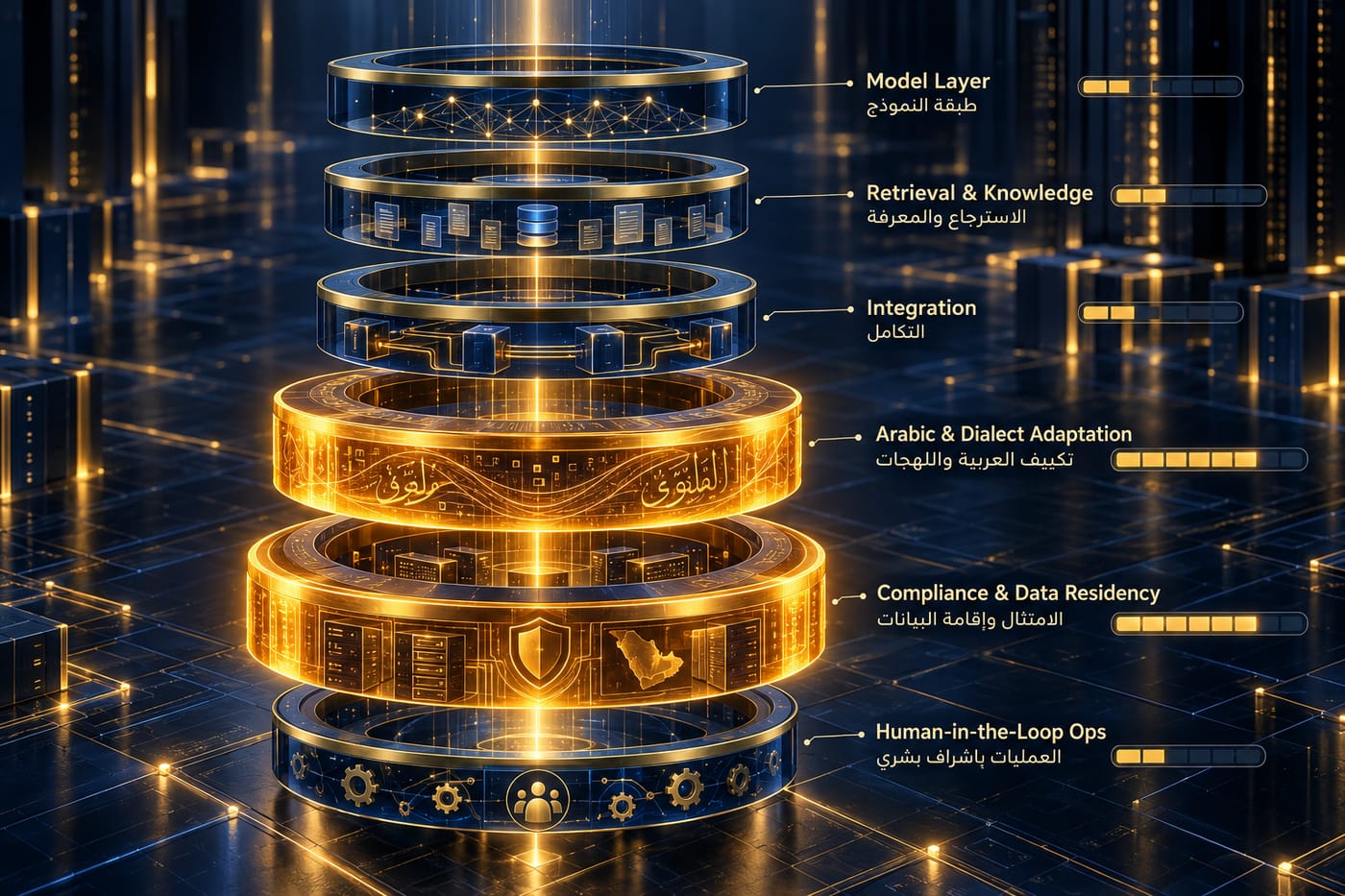
An AI support agent for a 50–200 seat UAE contact centre is not one product. It is six purchases glued together: a model layer, a retrieval and knowledge layer, an integration layer into your systems of record, an Arabic and dialect adaptation layer, a compliance and governance layer, and a human-in-the-loop operations layer. Each one has its own vendor economics, its own refresh cycle, and its own failure mode.
That is why the quotes you are holding diverge so wildly. The cheap one has almost certainly scoped out Arabic dialect handling, assumes you will do your own CRM integration, and treats DIFC Regulation 10 as your problem. The expensive one has priced in on-premise Arabic speech recognition, a full impact-assessment package, and a managed service wrapper. Neither is wrong. They are answering different questions.
The structural business case underneath all of this is well established. Gartner's 2024 benchmark pegs the median agent-assisted contact at $13.50 versus $1.84 for self-service — roughly a seven-to-one cost gap that funds every AI deflection business case written in the last two years. Gartner also projects conversational AI will take $80 billion out of global contact centre labour costs by 2026, but with the important caveat that only about one in ten interactions will be fully automated. The savings come from partial deflection, shorter handle times, and tier-one triage — not replacement. Budget for augmentation, not substitution, or your ROI model will not survive its first quarterly review.
The six cost drivers, in order of impact
1. Arabic-language and dialect adaptation
This is the line item that most consistently blindsides UAE buyers. English-trained frontier models handle Modern Standard Arabic passably and Gulf dialect poorly. Published benchmarks on dialectal Arabic legal terminology show roughly 72% accuracy from general-purpose LLMs before fine-tuning — unusable for a bank or a telco where a misread intent cascades into a compliance incident.
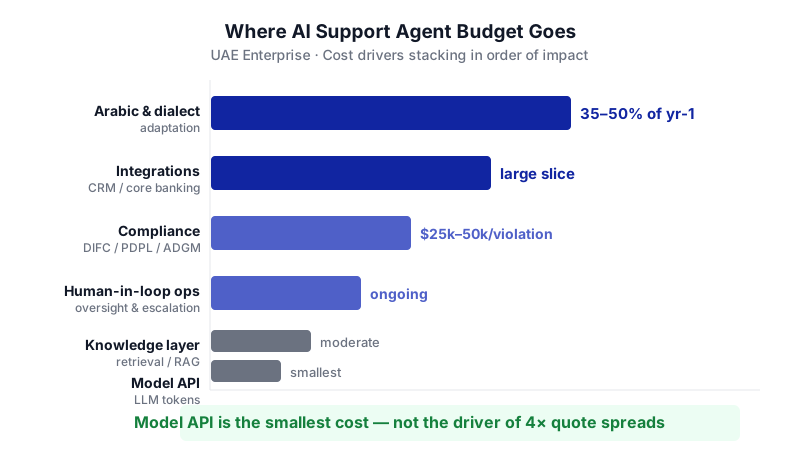
Closing that gap costs real money. Full fine-tuning of a 70B-parameter model runs $5,000–$30,000 per training run, and you will do several. If your customers call rather than chat, you will also need Arabic speech recognition hardened for compliance and on-prem deployment, which sits in the $150,000–$300,000+ range for an enterprise-grade build. A vendor who quotes you a single flat monthly figure and does not break out dialect handling is either eating this cost (and will raise prices at renewal) or has not scoped it.
2. Integrations into systems of record
An AI agent that cannot read a customer's account state is a toy. For a UAE telco that usually means Amdocs or Netcracker. For a bank, it is Finacle, Flexcube, or Temenos plus a card-management system and a KYC vault. For a government-adjacent entity, it is a mix of SAP, legacy mainframe wrappers, and sector-specific registries.
Integration cost scales with three things: the number of systems the agent must read from, the number it must write to (writes are far more expensive because they need approval workflows and rollback), and whether modern APIs exist or you are building adapters over SOAP, flat files, or screen-scraping. A read-only integration against a documented REST API is a two-week job. A write-capable integration against a core banking system with a four-week change-control window is a six-month programme. Vendors who have never touched your specific stack will underquote this by a factor of three.
3. Compliance and governance surface
DIFC Regulation 10 on AI and autonomous systems moved to full enforcement from 1 January 2026, with mandatory AI impact assessments, transparency obligations, documentation of high-risk use cases, and fines of USD 25,000–50,000 per violation. ADGM has its own guidance. The federal PDPL overlays both. If you are government-adjacent, add sector-specific rules on data residency and audit logging.
Translated into budget, compliance adds four categories of spend: a one-time impact assessment and documentation package, ongoing audit tooling (prompt logging, output review, bias testing), data residency infrastructure (an in-region deployment of the model or a sanctioned API endpoint), and legal review time on every material change to the agent's behaviour. None of this is optional, and a lawyer or compliance officer at your firm needs to sign off on the specifics — nothing in this post is legal advice.
4. Knowledge base construction and maintenance
AI agents answer from a retrieval layer, and the retrieval layer is only as good as the content you feed it. Most enterprises discover their internal knowledge base is a mess of outdated PDFs, contradictory policy documents, and tribal knowledge trapped in agent macros. The one-time cleanup is a project in itself — typically four to twelve weeks of a small content team working alongside subject-matter experts.
Ongoing maintenance is the part buyers forget. Policies change, tariffs change, product bundles change. If no one owns weekly content updates, agent accuracy decays within a quarter and your deflection rate collapses. Budget for a half-time content operations role from day one.
5. Human-in-the-loop operations
Every production AI agent needs humans watching it. That means a QA function reviewing a sample of conversations daily, an escalation desk handling the handoffs the AI gets wrong, and a prompt-and-policy team iterating on the agent's instructions as edge cases surface. For a 100-seat contact centre, this is usually three to six FTEs — some redeployed from existing roles, some new.
Vendors who sell "fully autonomous" agents are selling you an ROI model, not a system. The Gartner finding bears repeating: only around 10% of interactions will be fully automated. The other 90% are assisted, triaged, or escalated, and that work needs staffing.
6. Model and infrastructure
This is the line item everyone obsesses over and it is usually the smallest. At enterprise volumes, API costs for the major frontier models run a few cents per conversation. Even at a million conversations a month, you are in five figures of monthly spend, not six. If you are self-hosting an open-weights model for data residency reasons, infrastructure cost rises but is still bounded.
The reason this feels larger in proposals is that vendors mark it up — sometimes 3× to 5× over their own cost — because it is the line buyers scrutinise. Push for pass-through pricing on model usage with a transparent margin, and move the vendor's profit into the services layers where their actual value sits.
An illustrative worked example
To make the proportions concrete, here is one worked example. Treat it as illustrative only — your numbers will differ based on scope.
Scenario: A UAE retail bank, 120 contact-centre seats, roughly 400,000 customer interactions per month across voice and WhatsApp, Arabic and English, three core systems to integrate (Finacle, a card-management platform, and a CRM), DIFC-regulated, targeting 25% deflection on tier-one queries in year one.
Assumptions stated plainly: no existing knowledge base cleanup done, no prior AI governance framework, Arabic speech handled through a compliance-hardened on-prem ASR, write access limited to two low-risk transaction types in year one, one-year initial contract.
In a build like this, you would typically see first-year spend distributed roughly as follows: Arabic adaptation and ASR in the 35–45% band, integration work 20–25%, compliance and governance setup 10–15%, knowledge base and content ops 8–12%, human-in-the-loop staffing 10–15%, and model plus infrastructure 5–10%. The exact figures depend on whether you build or buy each layer, whether you have existing MLOps capability, and how much of the governance work your internal risk team absorbs. What matters is the shape: the LLM is the small slice, and anyone whose pie chart looks different is quoting a different scope.
What pushes the budget up, what pulls it down
| Pushes it up | Pulls it down |
|---|---|
| Heavy dialect coverage (Emirati + Levantine + Egyptian callers) | MSA-only or English-primary customer base |
| Voice as primary channel (ASR + TTS + telephony integration) | Chat and WhatsApp-only deployment |
| Write access to core systems (payments, account changes) | Read-only agent with human-approved writes |
| Legacy systems without modern APIs | Existing API gateway and documented endpoints |
| On-prem deployment for data residency | Sanctioned in-region cloud endpoint acceptable to your DPO |
| Multiple business units, each with distinct policies | Single product line, single policy set |
| No existing knowledge base | Clean, maintained help centre already in production |
| 24/7 managed service wrap from the vendor | Internal ops team absorbs L2 and prompt tuning |
| Monthly model retraining cadence | Quarterly retraining with continuous retrieval updates |
How to read the three quotes on your desk
Walk through each proposal with four questions and the spread usually explains itself.
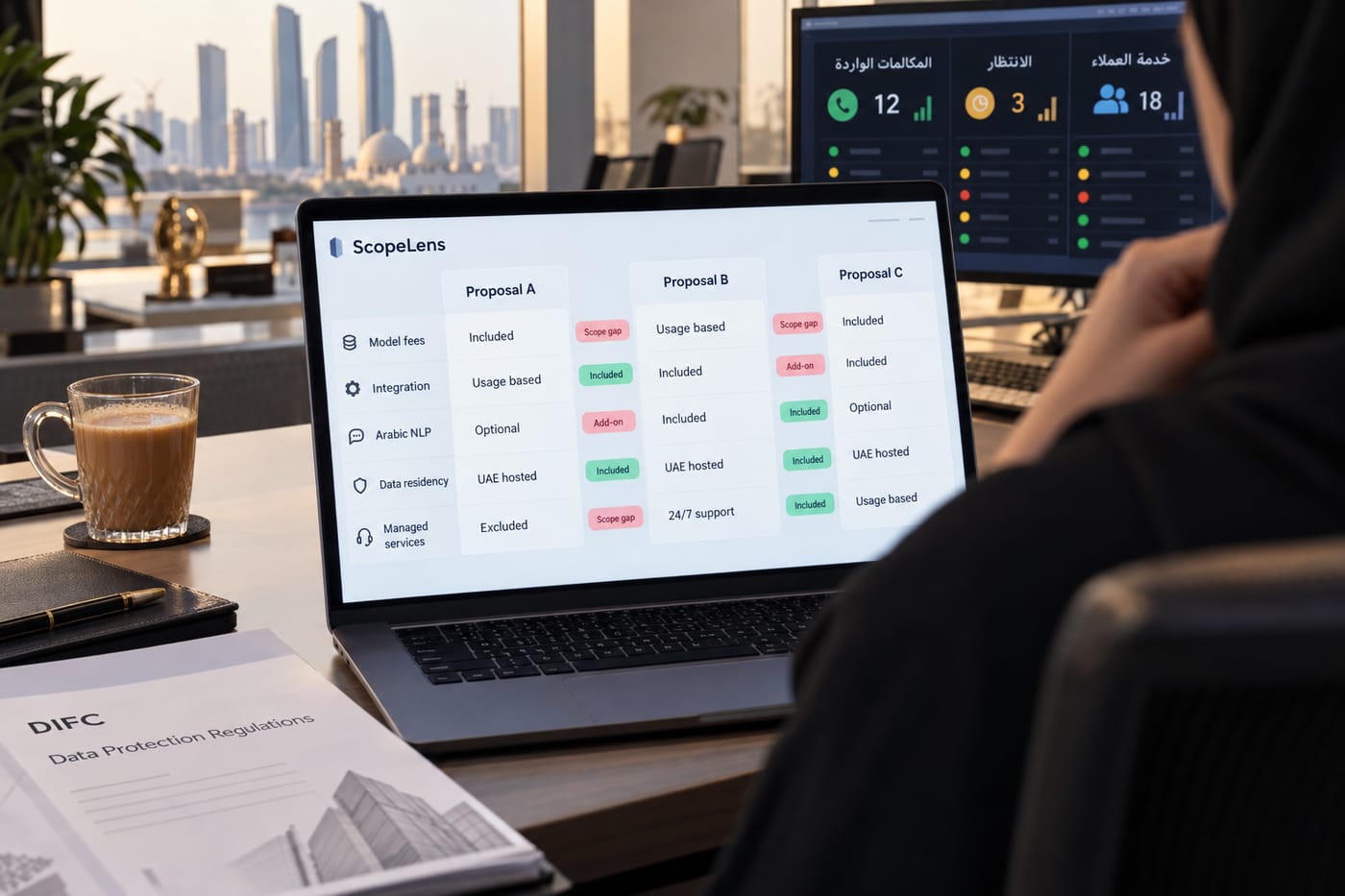
First, where does Arabic sit in the architecture? If the vendor relies on a general-purpose multilingual model with no fine-tuning or domain adaptation, their quote will be low and their accuracy on Gulf dialect will embarrass you in week three. If they are building a custom ASR and fine-tuning on your transcripts, the quote is higher and the risk is lower.
Second, who owns DIFC Regulation 10 compliance? Ask for the impact assessment template, the prompt-logging architecture, and the escalation path when the regulator asks for a conversation transcript. If the vendor cannot show you these artefacts, compliance is your problem and you need to add it to their quote before comparing.
Third, how are integrations priced? Fixed-fee per integration is cleaner than time-and-materials but only if the scope is specified down to the field level. "Integrates with your CRM" is not a scope. "Reads customer tier, last five interactions, and open-ticket status from Salesforce via documented REST endpoints" is.
Fourth, what is the exit cost? If the vendor owns the fine-tuned model weights, the prompt library, and the conversation data, your switching cost is the entire programme. If you own all three, you can renegotiate at renewal. This is the single clause that moves five-year total cost of ownership the most, and it rarely appears in a headline price comparison.
The market context, briefly
The UAE is not a cautious buyer of AI. Microsoft's AI Economy Institute puts the country at the top of 147 tracked economies for generative AI adoption, with 64% of the working-age population using the tools in the second half of 2025 — more than double the US rate. Government entities reported 97% AI utilisation at the November 2025 UAE Government Annual Meetings, and the federal Agentic AI framework is targeting 50% of government services within two years. The UAE conversational AI market itself was valued at $423.3 million in 2025 and is projected to hit $1.27 billion by 2030.
What this means for your budget conversation: your board is right to push, and the vendor landscape is crowded enough that you have real negotiating leverage. It also means your competitors are already two deployments in, and the window for a slow, cautious pilot is narrower than it was eighteen months ago.
How CodeNicely can help
The engagement closest to your situation is HealthPotli, where we built an AI layer — including drug-interaction checks — on top of an existing pharmacy operation that could not tolerate downtime, incorrect outputs, or regulatory ambiguity. The parallels to a UAE bank or telco contact centre are direct: a high-stakes domain, an existing operational workflow that cannot break, a regulatory surface that demands auditability, and a knowledge base that had to be cleaned before the AI could read it. The build decisions we made there — write access gated behind human approval, retrieval over fine-tuning for policy content, logging architecture designed with the eventual auditor in mind — are the same decisions you will be making.
Our team works with enterprises on this kind of programme from our Dubai practice, with the AI Studio handling model selection, fine-tuning, and the Arabic adaptation work. If you want someone to sit on your side of the table while you read the three quotes, we do that engagement as a fixed-scope assessment before any build conversation.
The three questions that turn a range into a quote
Before you can get a defensible number — from us or anyone else — three things need to be specified:
- Scope of autonomy. Which intents is the agent allowed to resolve end-to-end, which does it triage to a human, and which does it refuse? This decision alone moves the budget by a factor of two.
- Integration depth and write access. List every system the agent must read from, every system it must write to, and the change-control window for each. This decides how long the programme runs and how much of the cost is one-time versus ongoing.
- Compliance posture. On-prem versus in-region cloud, who owns the impact assessment, who signs off on prompt changes, and how long conversation data must be retained. Your DPO and legal counsel need to answer these before any vendor can price the governance layer accurately.
Once those three are specified, the 4× spread in your current quotes will collapse to something closer to 1.3×, and the remaining difference will be real vendor-to-vendor variation you can negotiate on. If you want to work through those three questions with someone who has priced this build before, talk to our Dubai team.
Frequently Asked Questions
Why do AI support agent quotes vary so much between vendors?
Because each vendor is quoting a different scope under the same label. The main variables are Arabic dialect handling, DIFC compliance ownership, integration depth into your core systems, and whether the vendor retains or transfers the model weights and prompt library. Two vendors can quote the same monthly figure for radically different deliverables. Normalise the scope using the four questions in the section above before comparing numbers.
Is the LLM API cost the biggest line item in an enterprise AI support deployment?
Usually not. At enterprise interaction volumes, model API costs are typically the smallest recurring expense — often under 10% of first-year spend. The large items are Arabic-language adaptation, integration work into systems like Finacle or Amdocs, and the compliance and governance layer required under DIFC Regulation 10. Vendors sometimes mark model costs up heavily because buyers scrutinise that line; push for pass-through pricing with a transparent margin.
How long does it take to deploy an AI support agent in a UAE enterprise?
The timeline is driven by integration complexity, compliance review cycles, and whether your knowledge base is production-ready. A read-only chat deployment against documented APIs with an existing content base can go live in a quarter. A voice deployment with Arabic ASR, write access to core banking, and a full DIFC impact assessment is a multi-quarter programme. The specific duration depends on your systems of record, your internal change-control calendar, and how many business units are in scope — those are the inputs we would need to give you a real schedule.
Do we need a separate Arabic language model, or will a frontier model handle it?
Frontier models handle Modern Standard Arabic reasonably well and Gulf dialect poorly. Published benchmarks show general-purpose LLMs achieving around 72% accuracy on dialectal Arabic legal terminology before fine-tuning, which is below the threshold a regulated enterprise can accept. Most UAE deployments combine a frontier model with retrieval over Arabic-language policy content and some degree of fine-tuning or dialect adaptation. If you handle voice, Arabic ASR is a separate and significant cost.
What happens to our data under DIFC Regulation 10?
From 1 January 2026, DIFC Regulation 10 requires AI impact assessments, transparency obligations, documentation of high-risk AI use, and specific handling for personal data processed by autonomous systems, with fines of USD 25,000–50,000 per violation. The practical implications for an AI support agent include logging all conversations, documenting the model's decision logic, running regular bias and accuracy audits, and ensuring data residency complies with your DPO's determination. Your compliance team and external legal counsel need to review the specifics — this post is not legal advice.
Sources & further reading
- Gartner Puts an $80 Billion Number on Call Center AI. Here's the Fine Print — ICTBroadcast
- 45 Call Center Statistics You Need to Know in 2026 — Ringly.io
- Contact Center Outsourcing Statistics: 64 Key Stats (2026) — Shyftoff (citing Gartner 2024 Benchmarks)
- Global AI Adoption in 2025 — Microsoft AI Economy Institute
- UAE Hits 97% AI Utilization With New National Readiness Index — Beam.ai
- From AI Momentum to AI Returns: Advancing the UAE's Competitive Edge — PwC Middle East
- UAE Conversational AI Market (2025–2030) — MarketsandMarkets
- UAE AI Regulation 2026: PDPL, DIFC & ADGM Compliance Guide — WCR Legal
Get one practical guide a week
Costs, AI tools, partner selection — written for people who make the decision. No spam, unsubscribe anytime.
Thanks — you're on the list. One practical guide a week, nothing else.
That didn't work — please check the email address and try again.
Building something in Enterprise Software?
CodeNicely partners with founders and tech teams to ship AI-native products that move metrics. Tell us about the problem you're solving.
Talk to our team Book a 30-min call