_1751731246795-BygAaJJK.png)

What DIFC Data Protection Actually Demands of Your Vendor

 Published by CodeNicely, the product studio founded by Meghal Agrawal and Ujjwal Agrawal in 2017
For: COO or General Counsel at a DIFC-licensed financial services firm who has just been asked by their Compliance Officer to confirm that their offshore software development partner is contractually and architecturally compliant with DIFC Law No. 5 of 2020 before the firm's annual regulatory review
In this guide
- What triggers the obligation
- What the contract actually has to say
- The transfer mechanism is a separate obligation
- What the law demands of the architecture, not just the policy binder
- What the law demands of the vendor you hire
- How long readiness takes, and what drives it
- What teams discover far too late
- How CodeNicely can help
- Frequently Asked Questions
If your offshore development partner touches personal data belonging to a DIFC-licensed firm, you need three things on file before your next regulatory review: a written Controller-Processor Agreement that names the permitted processing purposes, a lawful transfer mechanism (DIFC-adopted SCCs or an adequacy finding), and evidence that the vendor's architecture enforces the processing limits the contract declares. An NDA does not cover any of this. The exposure sits with the Controller — the DIFC-licensed firm — not the vendor, and the July 2025 amendments to DIFC Law No. 5 of 2020 raised the fine for an unlawful transfer to USD 50,000 per violation and gave data subjects a direct right of action in court.
This post walks through what the law actually demands, where boilerplate MSAs fail, and what evidence an auditor or the Commissioner will ask to see. It is written for a COO or General Counsel who has just been handed this question by their Compliance Officer and needs to answer it concretely before the annual review.
What triggers the obligation
DIFC Law No. 5 of 2020 applies if your firm is established in the DIFC, or if you process personal data in the DIFC as part of stable arrangements, regardless of where the processing physically occurs. The moment an offshore developer is granted access to a database, a log file, a support ticket, or a staging environment containing personal data of DIFC data subjects — customers, employees, counterparties — you have created a Controller-Processor relationship under the Law. The access itself is the trigger. It does not matter whether the developer reads the data, whether the data is encrypted at rest, or whether access is "read-only." If they can see it, they process it.
Two common misreadings get firms in trouble. The first is assuming that masking or pseudonymisation removes the obligation — it does not, because pseudonymised data is still personal data under the Law. The second is assuming that if the offshore team only works on "non-production" systems, the Law does not apply. If production data has ever been copied to a staging or sandbox environment the developer can reach, the obligation is live.
The scale matters because the exposed population is large and growing. DIFC crossed 8,844 active registered companies by end of 2025, including 1,052 regulated financial services firms — all of which have offshore vendor relationships of some form, and nearly all of which will face this question at review time.
What the contract actually has to say
Article 24 of DIFC Law No. 5 of 2020 requires the Controller to put in place a legally binding written agreement with each Processor. The Commissioner has the power to publish standard contractual clauses that satisfy this requirement, as summarised in the Linklaters DIFC data protection guide. The absence of this agreement is a standalone statutory violation — not something that can be patched by an NDA, an MSA with a confidentiality clause, or a verbal understanding.
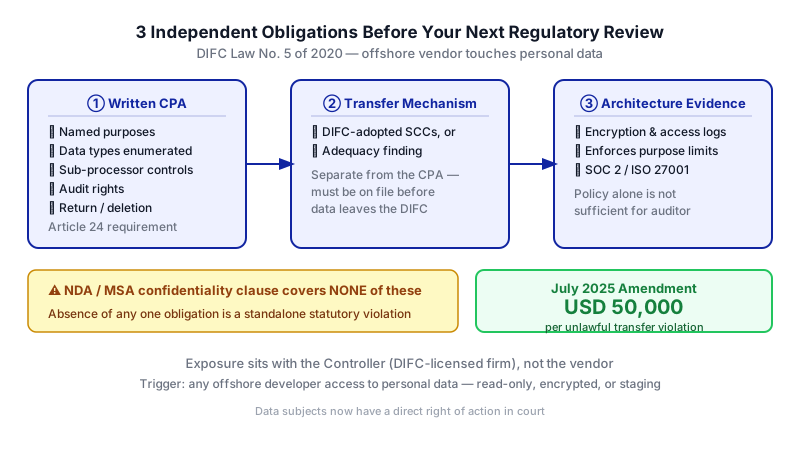

The agreement must set out, at minimum:
- The subject-matter and duration of processing — not "software development services" in the abstract, but the specific datasets, environments, and the period for which access is granted.
- The nature and purpose of processing — explicit purposes. "Development, testing, and support of the Controller's lending platform" is a purpose. "Any purpose incidental to the services" is not and will fail audit.
- The types of personal data and categories of data subjects — enumerated. If special categories (health data, biometrics, criminal data) are in scope, they must be named.
- Processing only on documented instructions from the Controller, including with regard to international transfers.
- Confidentiality obligations on each individual with access — the vendor must warrant that every developer, QA engineer, and sysadmin with access is under a written confidentiality obligation.
- Security measures appropriate to the risk, described concretely (encryption, access controls, logging, segregation) rather than by reference to "industry standard practices."
- Sub-processor controls — the vendor cannot engage a sub-processor (an AWS region in a new jurisdiction, a translation service, an offshore QA house) without the Controller's prior written authorisation, and must flow down equivalent terms.
- Assistance obligations — the vendor must help the Controller respond to data subject rights requests, conduct DPIAs, and manage breach notifications.
- Return or deletion of all personal data at the end of the engagement, with evidence.
- Audit rights — the Controller must be entitled to audit the vendor, or to accept third-party audit reports (SOC 2 Type II, ISO 27001) in lieu.
The non-obvious clause — the one most commonly missing from offshore development MSAs — is the explicit purpose limitation. If the agreement does not say the Processor may only process personal data for the specific, enumerated purposes instructed by the Controller, the vendor's access during development is not covered by any lawful basis. Every day of that access is an unlawful processing event, and under the amended Law, each one is attributable to the Controller.
The transfer mechanism is a separate obligation
The Controller-Processor Agreement establishes the lawful basis for the processor to process. It does not, on its own, establish a lawful basis for the data to leave the DIFC. That is a second, independent requirement under Article 26.
If your offshore vendor is in a jurisdiction on the DIFC adequacy list — the EU, the UK, Switzerland, and a limited set of others — transfer is permitted without further mechanism. If not (and India, the Philippines, most of South-East Asia, and most of the US outside California are not on the list), you need one of:
- DIFC model Standard Contractual Clauses adopted by the Commissioner, incorporated into the Controller-Processor Agreement as an exhibit.
- Binding Corporate Rules, which are only realistic for intra-group transfers in large multinationals.
- An explicit derogation (data subject consent, contractual necessity) — narrow and rarely defensible for ongoing development work.
A frequent and expensive mistake: using EU or UK SCCs on the assumption they are "equivalent." The Baker McKenzie Cloud Compliance Center guidance for DIFC is explicit that EU/UK SCCs are only accepted if the exhibit expressly describes the DIFC transfers in scope and the parties agree that the DIFC Commissioner has jurisdiction. A vanilla EU SCC with no DIFC-specific annex does not qualify.
The onshore versus DIFC distinction trips firms up constantly. As a 2026 analysis by Kayrouz & Associates notes, even transferring personal data from a DIFC entity to a mainland UAE affiliate is an international transfer requiring its own lawful basis. If your group architecture replicates data from a DIFC-licensed subsidiary to a Dubai mainland holding company for consolidated reporting, that is in scope.
What the law demands of the architecture, not just the policy binder
Compliance that lives only in a Word document fails first contact with a regulator. The architectural controls that make the contract defensible:
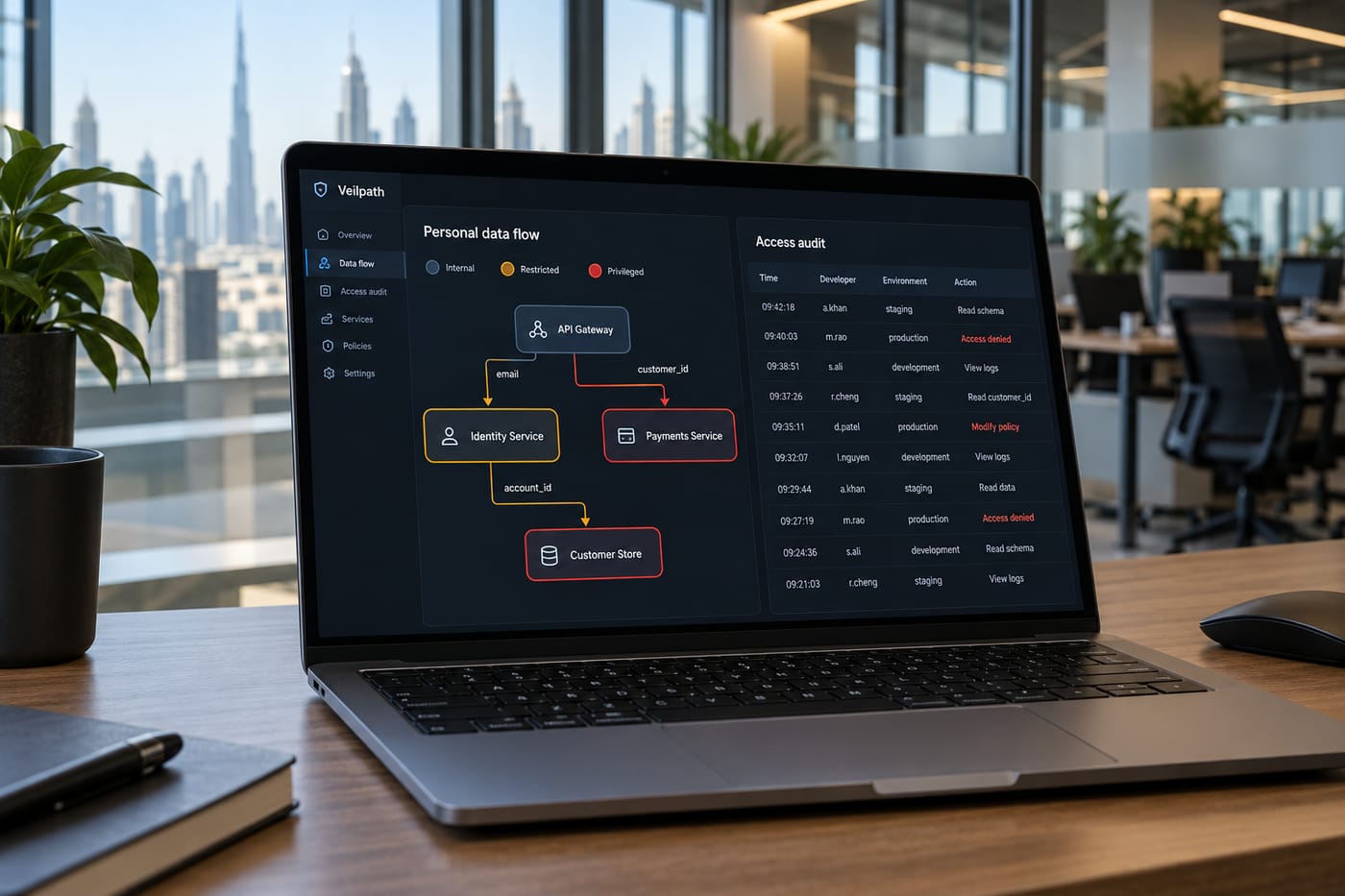
Data minimisation at the environment boundary
Offshore developers should not have access to production personal data. Full stop, in most cases. The defensible architecture provisions synthetic or irreversibly anonymised datasets for development and QA environments, with a documented data generation pipeline. Where production data must be used — for a specific debugging session, a migration, a performance test — access should be time-boxed, logged, approved by name, and the data destroyed or rotated after.
Role-based access with named individuals
The Commissioner can and does ask for the list of named individuals at the Processor with access to the Controller's personal data. Shared service accounts, generic "dev-team" roles, and standing root access to production databases will not survive audit. Access provisioning and deprovisioning must be logged, with evidence tying each access grant to a named engineer and an approved purpose.
Logging and tamper-evident audit trails
Every access to personal data by the Processor should be logged with user, timestamp, dataset, and action, and those logs should be held outside the Processor's control — typically shipped to a Controller-owned log sink. If the vendor's own infrastructure holds the only copy of the access logs, the Controller cannot prove what happened.
Residency and sub-processor map
A living document — not an annex updated at MSA signature and forgotten — that lists every physical location where personal data is stored, processed, backed up, or cached. This includes the vendor's cloud regions, their SaaS tooling (ticketing, CI/CD, error monitoring, AI coding assistants), and any sub-processors. If a developer runs a production log file through a US-hosted LLM to diagnose an error, that is a transfer, and if it is not in the map, it is unlawful.
Breach detection and 72-hour notification capability
The Processor must notify the Controller of a personal data breach without undue delay. The Controller then has 72 hours to notify the Commissioner where the breach is likely to result in high risk. If the vendor's incident response plan does not have a defined notification channel to the Controller and a committed internal SLA, the Controller cannot meet its own obligation.
What the law demands of the vendor you hire
Beyond the architecture, the vendor itself needs to demonstrate operational maturity in specific areas:
- A named point of contact for data protection matters — not necessarily a DPO (the vendor may not be required to appoint one), but a single accountable individual.
- Documented security certifications — SOC 2 Type II or ISO 27001 are the two the market accepts. Type I reports and self-attestations do not substitute.
- Vendor DPIA inputs — the vendor must be able to describe their processing in enough detail for the Controller to complete a DPIA. Under the July 2025 amendments, failing to conduct a required DPIA before high-risk processing now carries a fine of up to USD 50,000 (up from USD 20,000).
- Flow-down to sub-processors, including cloud providers. The AWS, Azure, or GCP Data Processing Addendum must be in effect and must cover DIFC-equivalent terms.
- Insurance — cyber liability and professional indemnity cover sized to the data volume at risk. The IBM Cost of a Data Breach Report 2024 puts the global average at USD 4.88 million per breach, with third-party vendor access ranking consistently among the top attack vectors.
How long readiness takes, and what drives it
There is no universal timeline for getting an existing offshore relationship DIFC-ready, because the work splits into three streams that can run in parallel but each have their own critical path:
The contract stream — drafting or amending the Controller-Processor Agreement, incorporating DIFC SCCs, and getting both legal teams aligned — is typically the fastest, but it depends entirely on how far the current MSA is from compliant and whether the vendor's legal team pushes back on audit rights or sub-processor controls. Firms with a sophisticated in-house legal function and a cooperative vendor move faster than firms relying on external counsel for every redline.
The architectural stream — building the synthetic data pipeline, implementing time-boxed production access, standing up Controller-owned logging, mapping sub-processors — is the slowest, because it requires engineering work on the vendor side. The driver is the current state: a vendor that already has mature environment segregation and SOC 2 Type II controls needs weeks of work; a vendor whose developers have standing root access to production needs months and a change of operating model.
The evidence stream — collecting access logs, named-user lists, deletion certificates, sub-processor inventories, and training records in a form an auditor will accept — is usually underestimated. Firms discover at the last minute that the vendor has the controls but has never been asked to produce the evidence, and the retroactive collection takes longer than expected.
Illustrative example, with assumptions stated: a DIFC-licensed scaleup with one existing offshore development partner, a single production database containing personal data, no current CPA in place, and a vendor already holding SOC 2 Type II, would typically run the contract stream and the evidence stream in parallel over a few weeks, with the architectural stream taking longer if production access needs to be re-engineered. A regulated bank with three vendors, special category data, and no SOC 2 on the vendor side is a different conversation entirely.
The specifics that would turn this shape into a real timeline for your firm: the number of offshore vendors in scope, whether the vendor already holds a recognised security certification, whether production data has been copied into non-production environments the vendor can reach, and whether the data includes special categories under Article 10. Those are the four questions worth answering before you commit to a review date.
What teams discover far too late
AI coding assistants are sub-processors. If your offshore developers use GitHub Copilot, Cursor, or similar tools, and those tools transmit code context — which may include personal data in log files, test fixtures, or SQL — to a US or EU-hosted LLM, that is a sub-processing arrangement and a cross-border transfer. Most firms discover this during a security questionnaire, not during contracting.
Backups and disaster recovery copies are in scope. A backup held in a vendor cloud region not listed in the transfer annex is an unlawful transfer, even if no one has ever restored from it.
Enforcement is active and escalating. The DIFC Commissioner issued 200 Preliminary Notices and 64 Decision Notices for administrative fines in 2024, up from 150 Preliminary Notices in 2023. The pattern is not warning letters; it is fines.
The direct right of action is new and material. Since the July 2025 amendments, a data subject can go directly to the DIFC Court for compensation — including for non-financial loss such as distress — without first filing a complaint with the Commissioner. Class exposure in a breach scenario is now higher.
None of this is legal advice. The architecture and contract patterns described here are what auditors and the Commissioner look for in practice, but your specific obligations depend on your firm's licence, the data categories in scope, and your vendor's jurisdiction. Have DIFC-qualified counsel review the Controller-Processor Agreement and the transfer mechanism before you sign.
How CodeNicely can help
We build custom software for financial services firms, including DIFC-licensed clients, and we structure our engagements as compliant Processors from day one — named-individual access controls, Controller-owned logging, synthetic data for development environments, and a sub-processor map that includes every AI tool and SaaS dependency our engineers touch. The engagement that most closely matches a DIFC-licensed firm scoping offshore development is Cashpo, a regulated lending product where KYC data, credit bureau records, and borrower PII required us to design environment segregation, auditable access, and a defensible transfer architecture from the first sprint rather than retrofitting it before an audit.
If you are preparing for a regulatory review and need to validate what your current vendor arrangement actually covers — or you are scoping a new build and want the Processor side done right the first time — our Dubai and UAE team can walk through the contract, architecture, and evidence requirements with your Compliance Officer. We retain no IP, impose no lock-in, and the compliance artefacts you need belong to you.
Frequently Asked Questions
Does an NDA with our offshore vendor satisfy DIFC Law No. 5 of 2020?
No. An NDA addresses confidentiality but does not contain the mandatory Processor obligations under Article 24 — purpose limitation, documented instructions, security measures, sub-processor controls, audit rights, deletion obligations, and breach notification. Without a Controller-Processor Agreement containing these specific terms, the vendor's processing is unlawful regardless of what the NDA says, and the exposure sits with the Controller.
Can we use the EU Standard Contractual Clauses for our DIFC data transfers?
Only conditionally. EU or UK SCCs are accepted by the DIFC Commissioner only if the exhibit expressly describes the DIFC transfers in scope and the parties agree the DIFC Commissioner has jurisdiction over disputes. A vanilla EU SCC with no DIFC-specific annex does not qualify, and the Commissioner has published DIFC-specific model clauses that are the cleaner path.
What are the fines if we get this wrong?
The July 2025 amendments set a USD 50,000 fine for unlawful transfers of personal data outside the DIFC and USD 50,000 for failing to conduct a required DPIA before high-risk processing, among other updated penalties. Data subjects can now also sue directly in the DIFC Court for compensation, including for distress, without first going through the Commissioner — so civil exposure is additional to regulatory fines.
How much does it cost to make an existing offshore vendor relationship DIFC-compliant?
The cost is driven by the gap between the vendor's current operating model and the required controls: the state of the existing MSA, whether the vendor holds SOC 2 Type II or ISO 27001, whether production data currently sits in environments offshore developers can reach, and the number of sub-processors (including AI tools) to be mapped and papered. A vendor with mature controls and a cooperative legal team is a contracting exercise; a vendor without either is a re-architecture. The specifics that would turn this into a real estimate are the number of vendors in scope, their current certification status, the data categories involved, and whether a DPIA has been done — worth a scoping conversation with CodeNicely before you commit to a budget.
Does DIFC data protection law apply if our vendor only works on development and test environments?
Yes, if those environments contain personal data of DIFC data subjects — including data copied from production for debugging, migration, or performance testing. Pseudonymised data is still personal data under the Law. The only reliable way to take non-production environments out of scope is to use fully synthetic or irreversibly anonymised data and to document the generation pipeline.
Sources & further reading
- DIFC announces landmark annual results for 2025 — 8,844 active companies, 1,052 regulated firms
- Data Protected: DIFC — Controller-Processor agreements, SCCs, and fines schedule (Linklaters)
- Overseas Hosting / Cross-border transfers under DIFC DPL (Baker McKenzie Cloud Compliance Center)
- DIFC Commissioner of Data Protection — Supervision & Enforcement (Decision Notices and Administrative Fines)
- Updates to DIFC Data Protection Law No. 5 of 2020 — July 2025 amendments (DLA Piper)
- DIFC Data Protection Law No. 5 of 2020 — Consolidated Version and Comprehensive Guide (official DIFC assets)
- IBM Cost of a Data Breach Report 2024 — $4.88M average cost, third-party access as top vector
- Cross-Border Data Transfers Under UAE Law in 2026 — DIFC vs. federal PDPL regime comparison (Kayrouz & Associates)
Get one practical guide a week
Costs, AI tools, partner selection — written for people who make the decision. No spam, unsubscribe anytime.
Thanks — you're on the list. One practical guide a week, nothing else.
That didn't work — please check the email address and try again.
Building something in Enterprise Software?
CodeNicely partners with founders and tech teams to ship AI-native products that move metrics. Tell us about the problem you're solving.
Talk to our team Book a 30-min call