

Internal ERP Budgets: Where the Money Actually Goes

 Published by CodeNicely, the product studio founded by Meghal Agrawal and Ujjwal Agrawal in 2017
For: A UK Series A founder or COO whose spreadsheets and disconnected SaaS tools are visibly breaking under headcount growth — they have budget authority and need to know whether a custom ERP is a £50K project or a £500K one before they brief anyone
In this guide
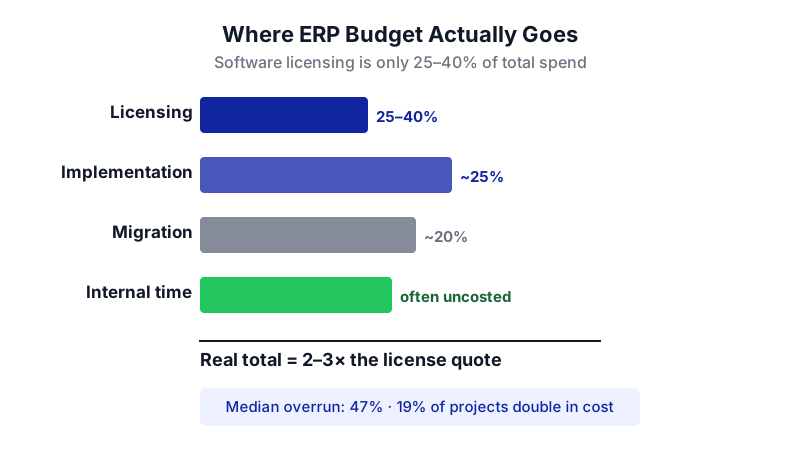
A custom internal ERP for a UK Series A business is almost never a £50K project and rarely a clean £500K one — it's a range, and the range is driven far more by what you're migrating from, what you have to integrate with for HMRC compliance, and how much of your own team's time you can carve out, than by the core application itself. Industry data puts software licensing at just 25–40% of total ERP spend, with implementation, migration, integration and internal time making up the rest (Godlan, citing Panorama Consulting). If a vendor's quote is dominated by the build line, they are either absorbing the rest invisibly or passing it to you after signature. This piece explains where the money actually goes, so you can read the next proposal that lands with an informed eye.
Why there is no single number
Three facts set the shape of any honest ERP budget conversation. First, Gartner expects more than 70% of recently implemented ERP initiatives to miss their original business case by 2027, with 25% failing catastrophically (Flectic, citing Gartner). Second, a 640-project audit covering January 2024 to June 2025 found 68% of ERP implementations exceeded their approved budget, with a median overrun of 47% and 19% of projects more than doubling in cost (Flectic). Third, roughly half of organisations significantly underfund data migration at the planning stage (ERP for Private Equity, citing Panorama).
Read those together and the pattern is clear: the number you approve at the start is almost never the number you end up paying, and the gap is almost always in the same three places. Data migration. Integrations. The internal time nobody costed. Everything in this post is aimed at pricing those three honestly, before you brief vendors rather than after they've invoiced.
The seven cost drivers, ranked by impact
1. Scope: how many modules, how custom
The single biggest lever is what you're actually asking the ERP to do. Finance plus inventory plus a basic CRM is a different animal from finance plus inventory plus manufacturing BOMs plus field service plus multi-entity consolidation. Every module you add brings its own data model, its own user roles, its own reports, and its own integration surface. Series A founders typically underestimate this by assuming "we'll just do finance first" — then discover finance can't be meaningfully useful without the operational data that lives in three other systems.
What this means in practice: a tightly scoped MVP ERP covering two or three functions can land at a small fraction of what a wall-to-wall replacement costs. The ratio is not 2x or 3x — it is routinely 5–10x. Decide early whether you are replacing spreadsheets or replacing a platform, because the cost structures are not comparable.
2. Integrations, especially the UK compliance ones
This is where vendor quotes most often mislead. Any internal ERP that touches VAT must integrate with HMRC's Making Tax Digital API — the online VAT portal has not been available to most VAT-registered businesses since April 2022, and submissions must now flow through HMRC-recognised compatible software or a bridging layer (ICAEW). Penalties for filing without functional compatible software reach up to £400 per return, with additional £5–£15 daily penalties for breaking the digital-record and digital-link requirements (Bishop Fleming).
If your directors or founders are above the self-assessment thresholds, MTD for Income Tax Self Assessment also starts biting: mandatory from April 2026 for gross income over £50,000, dropping to £30,000 in April 2027 and £20,000 in April 2028 (ICAS, Avalara). A proposal that doesn't mention MTD, bridging software, or an HMRC-recognised API path is not cheap — it is incomplete. You will build that integration either way; the only question is whether it's inside the fixed price you signed or a change request six months later.
Beyond HMRC, the usual suspects are payroll (Xero, QuickBooks, BrightPay, Sage), banking (Open Banking APIs, Stripe, GoCardless), identity (Google Workspace or Microsoft Entra SSO), and whichever CRM or ops tool you keep. Each integration is a mini-project with its own auth model, its own rate limits, its own error handling, and its own ongoing maintenance when the upstream API changes.
3. Data migration from legacy tools
Panorama Consulting's data on this is blunt: around half of organisations underfund migration, and heavy migrations across multiple legacy systems typically run $30,000–$75,000 on their own (ERP for Private Equity). For a UK Series A with three years of accumulated spreadsheets, a Xero history, a HubSpot pipeline, a Notion ops wiki and probably an Airtable or two, the migration is rarely trivial.
The costs hide in reconciliation. Extracting data is the easy part. Deciding which customer record is the real one when the same company appears four ways across three systems, cleaning product SKUs that marketing and ops have been naming differently for two years, reconciling opening balances so the accountants will sign off — that is the work. Budget it as a workstream, not a task.
4. Internal subject-matter-expert time
This is the line nobody puts on a proposal and everyone pays. Industry benchmarks suggest subject-matter experts give 20–50% of their working time to an ERP project, with an opportunity cost in the region of $30,000–$80,000 for a mid-market firm (ERPResearch.com). For a Series A COO or finance lead, that is time taken from running the business.
You cannot outsource this. Vendors do not know how your month-end actually works, which customer gets the non-standard discount, or why your warehouse manager insists on a particular pick order. If you don't commit the SME time, the vendor will either guess (badly) or stop and wait (expensively). Price the capacity in from day one. If your head of finance is going to lose 30% of her week for four months, that is a real cost even if it never shows up in cash.
5. Compliance surface beyond MTD
Depending on what the ERP touches, you may also be looking at UK GDPR obligations around personal data in CRM and HR modules, PCI DSS scope if you're handling card data directly, and sector rules (FCA for anything near financial services, MHRA for medical devices, FSA for food). Each adds process, documentation and sometimes architecture — encrypted-at-rest requirements, audit logs, right-to-erasure workflows, data residency.
These are not usually show-stoppers but they are cost-multipliers on specific modules. The question to ask every vendor: which compliance regimes are in scope, and what evidence do you deliver that we have met them?
6. What has to keep running during the build
Big-bang cutovers are rare and dangerous. Most Series A ERP rollouts run the new system alongside the old spreadsheets and SaaS for three to nine months, which means dual data entry, reconciliation jobs, and the real risk of divergence. The longer the parallel run, the higher the operating cost — but the shorter you compress it, the higher the delivery risk.
Phased rollouts (finance first, then ops, then CRM) are the common middle ground. They cost more in total than a single build because of the integration glue between phases, but they are far less likely to be in the 19% of projects that more than double their budget.
7. Who supplies the domain expert on the vendor side
A vendor who has built three UK ERPs with MTD, Xero sync and multi-entity consolidation already knows the traps. A vendor pricing their first one is guessing, and their guess will be wrong in your direction, not theirs. The premium for genuine domain fluency is real and usually worth it — the catastrophic 25% of ERP failures Gartner forecasts are not evenly distributed across vendors.
An illustrative worked example
This is illustrative only. Every assumption is stated so you can see which ones apply to you.
Scenario: A UK Series A SaaS company, 45 staff, VAT-registered, currently running Xero for accounting, HubSpot for CRM, BambooHR for people, Airtable for ops dashboards, and roughly 40 interlinked Google Sheets for everything the SaaS tools don't cover. They want an internal ERP covering finance consolidation, customer lifecycle (quote-to-cash), basic inventory for the hardware side of their product, and operational reporting.
Assumptions:
- Four core modules, not ten
- Four integrations: Xero (two-way), HMRC MTD for VAT, HubSpot (read-mostly), BambooHR (read-only)
- Three years of historical data to migrate, needing material cleaning
- Finance lead and head of ops each give ~30% of their time for the duration
- Six-month build, three-month parallel run
- UK GDPR applies; no PCI, no FCA scope
- No existing custom software to retire — just SaaS and spreadsheets
Where the budget goes, as a rough shape:
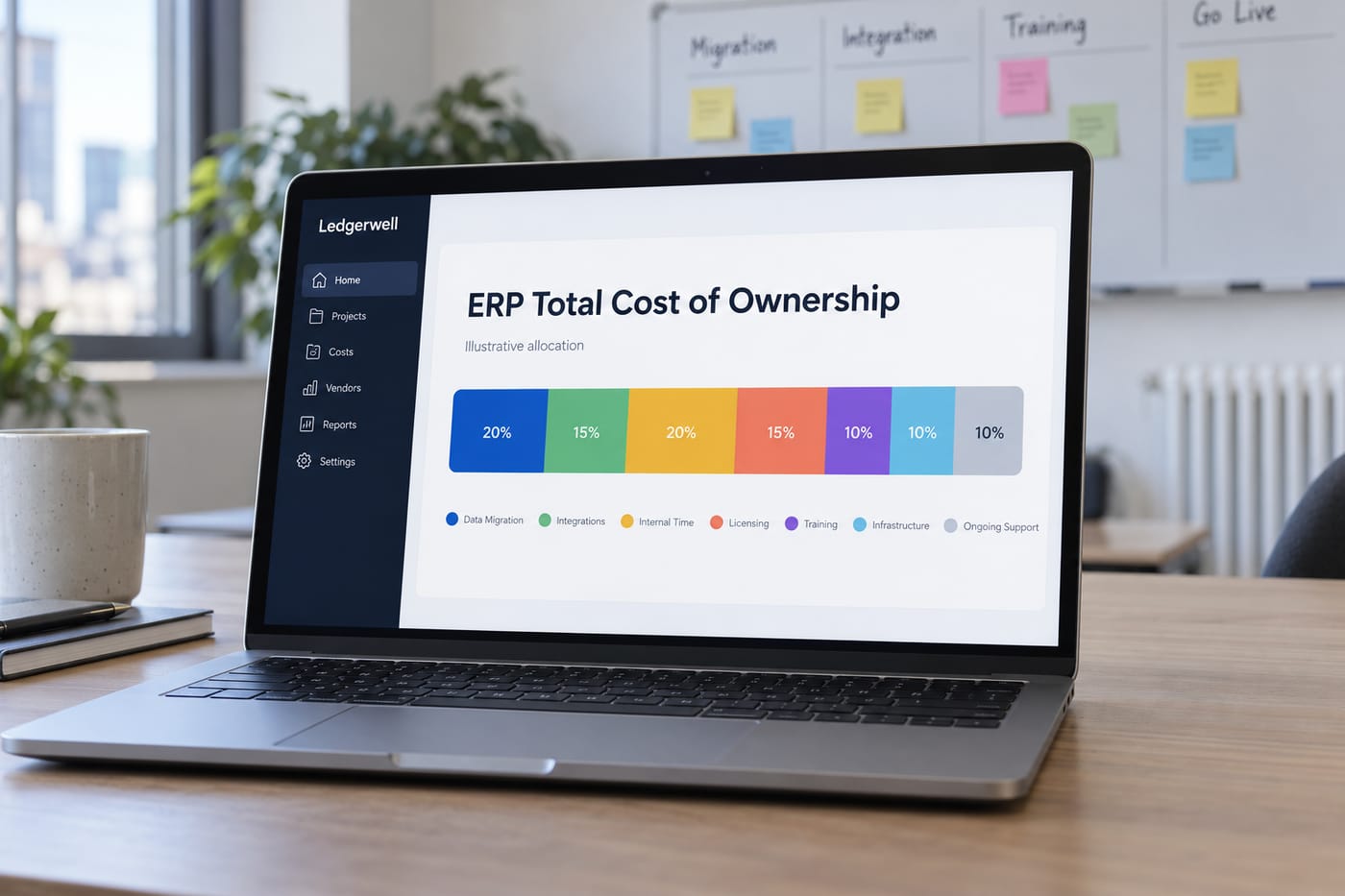
| Line item | Share of total spend |
|---|---|
| Core application build (frontend, backend, data model) | 30–40% |
| Integrations (incl. MTD, Xero, HubSpot, BambooHR) | 15–25% |
| Data migration and reconciliation | 10–20% |
| Testing, UAT, compliance evidence | 8–12% |
| Training, change management, documentation | 5–10% |
| Infrastructure, licensing, year-one hosting | 5–10% |
| Contingency (reserved, not spent by default) | 10–15% |
Not shown but real: 20–50% of two senior people's time for six to nine months. If you cost that at loaded salary, it is often the largest single line in the whole programme.
What pushes the number up vs. what pulls it down
| Pushes up | Pulls down |
|---|---|
| Multi-entity or multi-currency consolidation | Single legal entity, GBP only |
| Manufacturing BOMs, serial tracking, warehouses | Services-only business, no physical inventory |
| Dirty historical data across many systems | Clean Xero history, one source of truth per domain |
| Heavy custom workflows unique to the business | Willingness to adopt standard patterns |
| Sector compliance (FCA, MHRA, PCI DSS) | Standard UK GDPR + MTD only |
| Hard deadline (year-end, funding round) | Phased rollout over 9–12 months |
| Vendor supplying all domain knowledge | Strong internal SME capacity committed |
| Big-bang cutover | Parallel run with planned decommission |
| Replacing custom legacy software | Replacing spreadsheets and SaaS only |
Build vs. buy, honestly
For most Series A companies the right first question is not "how much does a custom ERP cost" but "why isn't NetSuite, Odoo, Microsoft Dynamics 365 Business Central, or a stack of best-of-breed SaaS the answer?" Off-the-shelf ERPs come with MTD-compatible modules out of the box, published integration catalogues, and implementation partners who have done your sector before. The build-vs-buy honest answer:

- Buy if your processes are 80% standard and you can bend the remaining 20% to the software. This is most companies.
- Build if your competitive advantage lives in a workflow no packaged ERP models well — a bespoke manufacturing process, a novel marketplace mechanic, a regulated process the standard tools don't support. In that case, custom pays back by preserving the thing that makes you different.
- Hybrid is often the real answer: packaged ERP for finance and HR, custom-built operational layer on top. This is where a lot of our legacy modernization and custom software work for scale-ups ends up — not replacing the ERP, but building the differentiated operational layer around it.
What custom is bad at: standard finance workflows. If what you need is accounts payable, accounts receivable, VAT returns and payroll, you are paying a large premium to rebuild what Xero and Sage already do well. Don't.
The three questions that turn a range into a quote
Before any vendor can give you a defensible number — and before you can judge the ones already in your inbox — you need honest answers to three things:
- What is the minimum viable scope? Which modules go live in phase one, and which processes stay on the current tools until phase two? A vendor who agrees to everything in phase one is not negotiating hard enough with you.
- What is the integration list, with MTD explicitly named? Every integration costed, every API documented, every compliance obligation (MTD for VAT at minimum, MTD for ITSA if directors trigger it) assigned to an owner. If MTD isn't on the list, the quote is incomplete.
- What internal capacity are you committing? Which named people, for what percentage of their time, for how long. If you can't commit this, the project is not ready to start regardless of budget.
Answer those three and almost any competent vendor can give you a range narrow enough to make a decision on. Skip them and you are buying a lottery ticket on which 19% of projects double in cost.
If you want a second opinion on a quote already in your inbox, or help scoping the three questions above before you brief vendors, that is the kind of conversation worth having with us — see how we work with scale-ups on exactly this.
Frequently Asked Questions
Is a custom ERP ever cheaper than NetSuite or Dynamics 365 over five years?
Sometimes, but less often than custom-ERP advocates suggest. Over five years, packaged ERPs win on finance, HR and standard reporting because the ongoing R&D is amortised across thousands of customers. Custom wins when your operational workflow is genuinely non-standard and the packaged alternative requires so much customisation that you lose the upgrade path anyway. Run the comparison on your actual processes, not on a feature matrix.
Does our internal ERP legally need to handle MTD for VAT itself, or can we keep filing through Xero?
You can absolutely keep filing VAT returns through Xero, QuickBooks or another HMRC-recognised piece of software — many companies do. What matters legally is that the submission flows through compatible software with unbroken digital links from your records to HMRC. If your custom ERP becomes the primary record and Xero only receives summary data, the digital-links requirement means that handoff itself has to be compliant. Have your accountant or auditor confirm the specific setup — this is the kind of thing a professional needs to sign off on, not a blog post.
How long does an internal ERP build typically take for a Series A company?
The honest answer is a range driven by scope and internal capacity, not by vendor speed. A tightly scoped two or three module build with committed internal SMEs can move materially faster than a multi-module replacement with part-time stakeholders. What narrows the range is deciding phase one scope, naming your internal SMEs and their time commitment, and locking the integration list before kickoff — the same three questions that narrow the budget range.
What is the single most common reason ERP projects go over budget?
Data migration being underestimated at the planning stage, followed closely by scope creep from stakeholders who weren't in the original requirements workshops. The Panorama data suggests roughly half of organisations underfund migration specifically (ERP for Private Equity), and the Flectic audit found a median 47% overrun across 640 projects (Flectic). Both are symptoms of the same thing: not spending enough time scoping before contracting.
Should we hire an internal product manager before engaging a vendor?
For a Series A ERP programme, yes — or allocate someone senior who already understands the business into that role for the duration. The vendor cannot be their own client. Someone on your side needs to own prioritisation, resolve conflicts between stakeholders, and make the dozens of small trade-off decisions that come up weekly. Without that role filled, every decision escalates to the COO or founder and the project slows down.
Sources & further reading
- MTD and VAT — ICAEW Technical Guidance
- Making Tax Digital HMRC VAT Compliance Checks — Bishop Fleming
- Latest Answers to MTD for Income Tax Self Assessment Questions — ICAS
- Making Tax Digital 2026: Deadlines, Thresholds, and How to Prepare — Avalara
- ERP Implementation Statistics & Success Rates (640-project audit) — Flectic
- ERP Implementation Cost Calculator (Panorama Consulting data on migration underfunding) — ERP for Private Equity
- ERP Hidden Costs: 20 Unexpected Expenses That Blow Budgets — ERPResearch.com
- ERP Implementation Cost Breakdown 2026 Data (Panorama / ERP for Private Equity figures) — Godlan
Get one practical guide a week
Costs, AI tools, partner selection — written for people who make the decision. No spam, unsubscribe anytime.
Thanks — you're on the list. One practical guide a week, nothing else.
That didn't work — please check the email address and try again.
Building something in Enterprise Software?
CodeNicely partners with founders and tech teams to ship AI-native products that move metrics. Tell us about the problem you're solving.
Talk to our team Book a 30-min call