
What SOC 2 Readiness Actually Demands of a Software Build

 Published by CodeNicely, the product studio founded by Meghal Agrawal and Ujjwal Agrawal in 2017
For: CIO or VP Engineering at a UAE-headquartered enterprise whose US or European customer has just made SOC 2 Type II a contract condition and who has never commissioned a compliant build before
In this guide
- What actually triggers the obligation
- What SOC 2 demands of the architecture (not the policy binder)
- What SOC 2 demands of the vendor you hire
- How long readiness actually takes
- What it costs — the shape, not a number for you
- The three things UAE teams discover too late
- A note on what this post is not
- Frequently Asked Questions
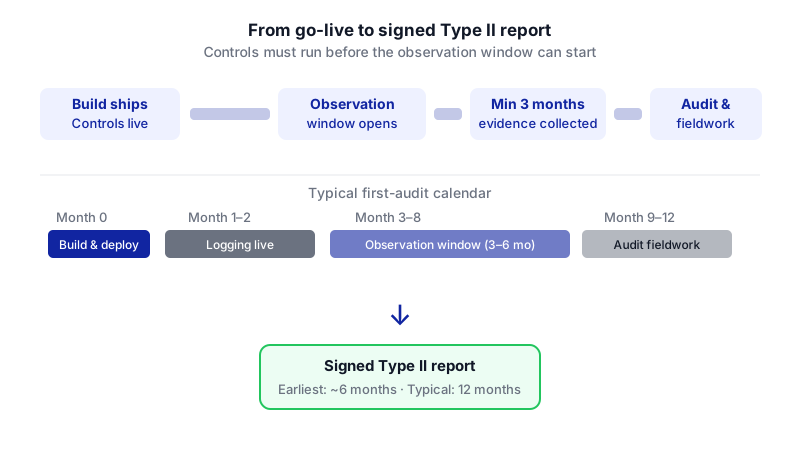
If a US or European customer has made SOC 2 Type II a contract condition, the single hardest fact to absorb is this: your observation window cannot start until logging, alerting, and change-management controls are already running in production, and that window itself is 3 months at an absolute minimum, 6 months for most first audits. So even if your build ships every control on day one of go-live, the earliest a signed Type II report lands in your customer's inbox is roughly 6 to 12 months later. Most UAE enterprise procurement timelines do not budget for this gap. That is the problem this post is about.
The rest of what SOC 2 demands — the architecture, the vendor behaviour, the evidence discipline — flows from that one constraint. A Type II report is not a certificate you earn by filling a questionnaire. It is an independent auditor's opinion that your controls operated effectively over a defined historical period. No history, no opinion. No continuous evidence, no history.
What actually triggers the obligation
Nothing in UAE law requires you to hold SOC 2. The obligation is contractual, pushed down by your customer's own vendor risk team. Secureframe's survey found 61% of companies said compliance was required to win or renew a contract, and 71% of ISC2 respondents require security audits or attestations from vendors. If you sell SaaS, host customer data, or sit anywhere in a regulated buyer's supply chain, you will hit this wall.
The trigger matters because it dictates scope. The customer's procurement team is usually asking for Type II across the five Trust Services Criteria — Security is mandatory, and then some combination of Availability, Confidentiality, Processing Integrity, and Privacy depending on what you do for them. Read the contract clause carefully. A clause that says "SOC 2 Type II covering Security and Availability" is a very different scope from one that names all five. The difference is months of engineering work and a materially larger audit.
What SOC 2 demands of the architecture (not the policy binder)
Auditors do not accept screenshots and good intentions. They sample evidence across the observation window and check that the control operated every time it should have. That means your architecture has to produce evidence as a byproduct of normal operation, not as a special project when the auditor arrives.
Concretely, a SOC 2-ready build has to do the following from day one of the observation window:
Identity and access
- Single sign-on with MFA enforced for every human who touches production — engineers, support, admins. No shared accounts.
- Role-based access with the roles defined in code or IaC, not in a spreadsheet. Auditors will ask you to prove that "engineer" cannot read customer PII unless the role grants it.
- Quarterly access reviews with documented sign-off. If someone left the company in month 2 and their GitHub access was revoked in month 4, that is a finding.
- Just-in-time production access with session recording for break-glass events.
Logging, monitoring, alerting
- Centralised, immutable logs covering authentication, authorisation changes, data access, infrastructure changes, and application errors. Retention of at least 12 months is standard.
- Alerts that fire to a named on-call rotation, with evidence that alerts were acknowledged and resolved. "No alerts triggered during the period" is not the answer an auditor wants — they want to see the ones that did fire and how you handled them.
- A SIEM or equivalent correlation layer. Raw CloudWatch or Azure Monitor output is not enough on its own for most auditors.
Change management
- Every production change travels through a pull request with a second reviewer. Direct pushes to main are blocked at the repo level, not by policy.
- CI/CD pipelines run automated tests, SAST, and dependency scanning on every merge. Evidence is the pipeline log, not a developer's word.
- Infrastructure changes via Terraform or equivalent, with the same review discipline. Clicking around in the AWS console to fix prod is a finding.
Vulnerability and patch management
- Continuous dependency and container scanning with documented SLAs for remediation by severity. If your policy says critical vulnerabilities are patched within 7 days, every critical in the observation window needs an evidence trail showing that happened.
- Annual penetration test by an independent third party. Report and remediation tickets become evidence.
Data handling
- Encryption at rest and in transit, with key management via a managed KMS. Customer-managed keys if your contract demands it.
- Documented data flow diagrams. You will be asked where customer data is stored, who processes it, and which subprocessors touch it. If you cannot draw that diagram from memory, your architecture is not ready.
- Backup and restore tested on a schedule, with the test itself as evidence.
Vendor and subprocessor management
- A register of every third party that processes customer data, each with a current SOC 2 or equivalent attestation on file.
- Annual review of each vendor's posture, with evidence.
None of this is exotic. What catches teams is that every single item has to produce evidence continuously — not when the auditor shows up, but every day the observation window is running. A control that worked in month 1 but was silently broken in month 4 is worse than one that was never deployed, because now you have a reportable exception on your Type II report.
What SOC 2 demands of the vendor you hire
If you are outsourcing the build — common for UAE enterprises moving fast on a customer deadline — the vendor's own practices become your practices in the auditor's eyes. A few things are worth pinning down in writing before signing:
- Source control and CI/CD ownership. The pipelines, repos, and secrets must live in your tenancy, or be transferable to it, before the observation window begins. An auditor cannot accept evidence from a vendor-controlled GitHub org you do not administer.
- Engineer access to production. Vendor engineers with prod access are in scope. They need SSO, MFA, access reviews, and offboarding evidence just like your employees. If the vendor cannot produce this, their access becomes a finding.
- IP and artifact ownership. You need unambiguous rights to the code, infrastructure definitions, and operational runbooks. Evidence packs for an audit draw from all three. Vendor lock-in on any of them is a compliance risk, not just a commercial one.
- Documentation discipline. Architecture diagrams, data flow diagrams, incident runbooks, and threat models are audit artifacts. Ask to see examples from a comparable engagement.
- Experience with the specific controls. A vendor who has shipped under SOC 2 or ISO 27001 before will instinctively write the logging, alerting, and change-management layer correctly the first time. One who has not will retrofit it later — and retrofitting is where observation-window delays come from.
The question to ask any shortlisted development partner is simple: show me the evidence pack you produced for your last SOC 2 Type II customer. If they cannot, assume you will be paying them to learn on your engagement. For UAE buyers specifically, a regional partner who understands both the local regulatory context and the North American audit regime saves a layer of translation.
How long readiness actually takes
There are two clocks running in parallel, and buyers consistently conflate them.
Clock 1: readiness. This is the engineering and policy work to get controls operating. For a greenfield build with a competent team and a compliance platform (Vanta, Drata, Secureframe) in place, this is typically 2 to 4 months. For an existing product with messy access, no centralised logs, and manual deploys, it can run 4 to 8 months of remediation before the observation window can even start.
Clock 2: observation. Once controls are live, the AICPA floor is 3 months, and 6 months is the most common first-audit window. Then the auditor needs 4 to 8 weeks of fieldwork and report drafting.
Add them up. A disciplined greenfield team can plausibly hand a customer a signed Type II in 6 to 9 months from kickoff. A team starting from a messy existing codebase is realistically 9 to 15 months. The compressed path people hope for — a Type I report at 3 months to buy time, then Type II after — is legitimate and auditors recognise it, but most enterprise customers now specifically ask for Type II and will not accept Type I as a substitute for long.
The two things that move this timeline most are the maturity of your current access-and-logging stack, and whether your engineering team can keep shipping product while remediation work happens in parallel. If you have to freeze the roadmap, the calendar wins.
What it costs — the shape, not a number for you
Audit fees are the most visible line but rarely the largest. Across 182 firms tracked by soc2auditors.org, the median Type II audit fee is $55,000, with 80% of firms falling between $30,000 and $100,000, and Big Four engagements running to a median of $137,500. Total first-year cost including auditor fees, compliance platforms, security tooling, and engineering remediation labor typically ranges from $73,000 to $215,000.
What drives where you fall in that range:
- Scope — number of Trust Services Criteria and number of in-scope systems.
- Starting posture — a build already using SSO, IaC, and centralised logging needs far less remediation than one that does not.
- Audit firm choice — a regional firm versus a Big Four name is a 2–3x fee difference for broadly the same opinion.
- Compliance platform — Vanta, Drata, and similar automate evidence collection and cut both engineering hours and audit hours, but add a subscription line.
- Whether you retain a readiness consultant separately from the auditor (you cannot use the same firm for both).
To turn that range into a real number, you need three specifics: which Trust Services Criteria your customer is actually demanding, a current-state assessment of your access/logging/change-management posture, and a view on whether you will use a compliance automation platform. Those three decisions move the first-year cost more than anything else. A scoping conversation with your prospective build partner should produce them before anyone quotes anything.
The three things UAE teams discover too late
1. The observation window is the critical path, not the build
Procurement timelines in the UAE routinely assume "build complete = customer ready to buy". For a SOC 2-gated deal, build complete is the start of a 3-to-6-month waiting period before an auditor can even begin fieldwork. If your customer's contract has a go-live date tied to a signed Type II report, work backwards from that date and you will usually find the project needed to start a quarter earlier than it did. The only legitimate accelerant is a Type I report at the start of the observation window, which some customers will accept as interim evidence.
2. Subprocessors in scope include your own cloud region choices
UAE enterprises moving to AWS and Azure sovereign regions launched in 2024–2025 sometimes assume the sovereign region simplifies compliance. It does for UAE data residency law. It does not change SOC 2 scope — AWS and Azure are still subprocessors you must list, with their SOC 2 reports on file. More importantly, if your customer's data residency clause forces you into the UAE region specifically, confirm that every managed service you use is actually available there. Teams discover in month 4 that a service they designed around is only in Ireland.
3. Logs you did not retain cannot be retroactively created
This is the single most common cause of a delayed audit. A team flips on centralised logging at the start of the observation window, discovers in month 2 that one critical system was not routed to the SIEM, fixes it, and now has a gap. The auditor will either extend the window or write an exception. Both are bad. The fix is a pre-observation dry run: run your evidence collection as if the audit started, for two weeks, before it actually does. Every gap you find is cheap. Every gap the auditor finds is expensive.
A note on what this post is not
SOC 2 Type II is an attestation, not a legal compliance regime. Nothing here substitutes for advice from a qualified auditor on your specific scope, or from counsel on the contractual language your customer is pushing. Get both engaged early. The engineering work this post describes is necessary but not sufficient.
Frequently Asked Questions
Can we accept a SOC 2 Type I report instead of Type II to meet the customer deadline?
Sometimes, as an interim. Type I attests that controls are designed correctly at a point in time; Type II attests they operated effectively over a period. Many enterprise customers accept Type I at contract signing with a commitment to deliver Type II within 6–12 months. Others, particularly in regulated sectors, will not. Read the clause and negotiate before you sign.
How long does SOC 2 readiness take if we already have ISO 27001?
Materially less. ISO 27001 covers most of the same control families — access, change management, incident response, vendor management — though the evidence format differs. Teams with a mature ISO 27001 posture often reach SOC 2 readiness in 6–10 weeks, then face the same 3-to-6-month observation window as anyone else. The observation floor does not shrink because of prior certifications.
What does SOC 2 demand of a development partner we hire for the build?
That their engineers operate under your SSO, MFA, and access review regime for anything in scope; that source control, CI/CD, and infrastructure definitions sit in tenancy you control; that they produce documentation artifacts — data flow diagrams, runbooks, threat models — as part of delivery, not as an afterthought; and that they can show evidence packs from prior SOC 2 engagements. If they cannot do these, you are paying for their learning curve on your observation window.
What does a realistic first-year SOC 2 Type II budget look like for a mid-sized UAE enterprise?
The cost model has four parts: audit fees (median $55,000 per soc2auditors.org, with a wide range by firm), a compliance automation platform subscription, engineering remediation labor, and often a readiness consultant. Total first-year spend across the market runs $73,000 to $215,000. Where you fall depends on scope, starting posture, and audit firm choice. A scoping session with your build partner and a shortlist of auditors will convert this range into a real figure.
Does the UAE have its own equivalent we should pursue instead?
UAE regulations like the NESA/UAE Information Assurance standards and sector-specific frameworks from the Central Bank and DHA cover overlapping ground but do not satisfy a US or European customer asking for SOC 2 specifically. If your customer base spans both regions, plan for both. The architectural controls overlap substantially — the audit artifacts and attestation bodies do not.
Sources & further reading
- SOC 2 Audit Statistics (2026): Costs, Timelines & Firm Data — soc2auditors.org
- SOC 2 Type 2 Audit Timeline: Engineering Guide — Next Gen Coding Company
- How Long Does SOC 2 Compliance Take? (2025 Timeline Guide) — TryComp.ai
- SOC 2 compliance timeline: How long does it really take? — Scrut.io
- SOC 2 in Stats: Costs, Timelines and Who Requires It — CloudSAP
- SOC Compliance Market to Witness Stunning Growth — HTF Market Intelligence / OpenPR
- Cloud Security Challenges: 6 Critical Risks UAE Businesses 2026 — FactoSecure
- UAE Cybersecurity Market Report — Mordor Intelligence
Get one practical guide a week
Costs, AI tools, partner selection — written for people who make the decision. No spam, unsubscribe anytime.
Thanks — you're on the list. One practical guide a week, nothing else.
That didn't work — please check the email address and try again.
Building something in Enterprise Software?
CodeNicely partners with founders and tech teams to ship AI-native products that move metrics. Tell us about the problem you're solving.
Talk to our team Book a 30-min call