_1751731246795-BygAaJJK.png)

Warning Signs in a Dev Partner Pitch You Should Not Ignore

 Published by CodeNicely, the product studio founded by Meghal Agrawal and Ujjwal Agrawal in 2017
For: A pre-Series A founder in Dubai who has received three competing pitches for their MVP and cannot tell whether the lowest-priced vendor is genuinely lean or simply hiding scope risk behind a confident deck
In this guide
- Why this matters more than the price delta
- Questions for the technical deep-dive
- Questions for the commercial conversation
- Questions for the reference call
- Questions for the security and compliance review
- Question for the pilot debrief
- How to score the three pitches
- How CodeNicely can help
- Frequently Asked Questions
The most dangerous red flag in a dev partner pitch is not a suspiciously low price. It is a vendor who cannot name three requirements they deliberately chose not to include in your MVP scope. Real scoping always produces deliberate exclusions. A proposal with none is a template with your logo on it, and the gap between what the deck promises and what the contract covers will become your scope creep problem — the single biggest cause of software budget overruns in peer-reviewed studies of IT projects.
If you are a pre-Series A founder in Dubai weighing three competing pitches, this is your interview prep. Fifteen questions, grouped by where in the sales process to ask them, with what a good answer sounds like and what should make you walk. Use them in the technical deep-dive, on the reference calls, and in the pilot debrief — not in the first sales call, where every vendor still sounds the same.
Why this matters more than the price delta
Only 29% of software projects are delivered on time, on budget, and on scope. 52% are late, over budget, or missing features. 19% are cancelled outright — per the Standish Group CHAOS Report 2024. The top drivers of outright failure are unclear requirements (39%) and scope creep (33%). For outsourced work specifically, 25–50% of projects fail because of goal misalignment and unclear expectations.
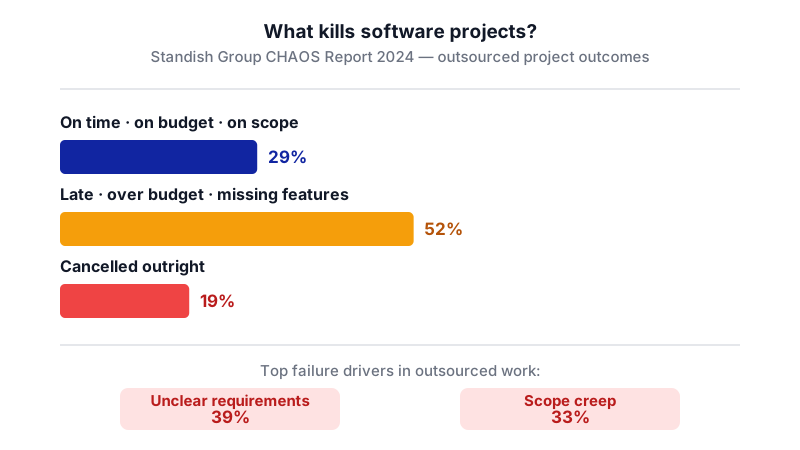
The pitch is where almost all of that risk is either surfaced or hidden. The lowest bid is not the enemy. The confidently vague bid is.
Questions for the technical deep-dive
1. "Which three requirements did you deliberately leave out of the MVP scope, and why?"
Why it matters: This is the single most diagnostic question in the whole process. Pendo's product analytics data shows 80% of software features are rarely or never used, and only 12% drive 80% of daily usage. A scoped MVP has exclusions by design.

Good answer: "We cut multi-currency, admin role management, and in-app chat. Multi-currency because your first market is UAE-only, admin roles because you have three people and don't need RBAC yet, chat because WhatsApp Business will do the job for six months."
Red flag: "We've included everything you need." Or a long pause, then a generic answer about "nice-to-haves in phase two."
2. "Walk me through the data model you'd build for our core entity."
Why it matters: You will know in ninety seconds whether they listened. A vendor pattern-matching to a previous build will describe their last client's data model with your words sprinkled in.
Good answer: A whiteboard sketch, two or three questions back at you about edge cases, and an admission of what they'd need to confirm.
Red flag: A pre-built diagram pulled from their deck. Or no diagram at all — "we'll figure that out in the discovery phase."
3. "Which parts of this build are you least sure about, and what would you prototype first to de-risk them?"
Why it matters: Every real build has uncertainty. A vendor who claims none is either lying or hasn't thought about yours specifically.
Good answer: Two or three named risks — a third-party API that's historically flaky, a performance assumption they want to load-test, an integration they've never done before — plus a specific spike or proof-of-concept to resolve each.
Red flag: "Nothing — we've built this many times." You are not their previous client.
4. "Show me the last pull request your proposed tech lead merged."
Why it matters: The named tech lead in the pitch deck is often not the person who writes your code. This question tells you whether they are a real contributor or a title on a slide.
Good answer: They open GitHub on the call. The PR has comments, tests, and a reviewer other than themselves.
Red flag: "I'll send that over later." It never arrives, or it arrives from six months ago.
5. "What's your branching strategy, and who approves a merge to main?"
Why it matters: A boring process answer tells you they have a process. The absence of one tells you your code quality depends on individual discipline.
Good answer: Specific: trunk-based or GitFlow, PR reviews required, CI must pass, named approver roles.
Red flag: "We're flexible — we adapt to the client's workflow." Translation: there is no workflow.
6. "How do you handle a requirement that arrives mid-sprint?"
Why it matters: Scope creep accounts for 40–60% of overruns even on projects that started with a clear scope, and can push final cost to four times the original estimate. The vendor's change-control muscle is what protects you.
Good answer: "It goes into the backlog, gets estimated, and you decide what it displaces in the current sprint. We don't silently absorb it."
Red flag: "We're flexible, we'll fit it in." You are hearing the sound of your budget leaving the room.
Questions for the commercial conversation
7. "What are the three decisions I could make next week that would most change your estimate?"
Why it matters: A real estimate has a cost model behind it — specific drivers the vendor can name. McKinsey found median cost overruns on large IT projects exceed 45%, and 17% of large projects threaten the company's existence. Understanding the drivers is how you avoid being in that 17%.
Good answer: "Number of third-party integrations, whether you need SOC 2 from day one, and whether your data migration is clean CSVs or a live production database. Each of those can swing the number materially."
Red flag: A flat price with no sensitivity analysis, or "it depends on a lot of things" without naming them.
8. "Show me a change order from a past project — with the client name redacted."
Why it matters: You want to see how they document and price change. The format tells you whether changes are governed or improvised.
Good answer: A one-page document with scope delta, hours, cost, impact on timeline, and client sign-off.
Red flag: "We handle changes informally over email." Or they can't produce one.
9. "What happens to the IP, repos, and infrastructure accounts if we end the engagement after month three?"
Why it matters: Vendor lock-in is a hidden tax. You want everything in your name, in your cloud account, from day one.
Good answer: "Repos are in your GitHub org from commit one. AWS/GCP accounts are yours. We get seat access, not ownership. The MSA assigns all IP to you on payment."
Red flag: "We'll transfer everything at the end of the project." You are now a hostage.
Questions for the reference call
Reference calls are where most founders waste their most useful 30 minutes. Do not ask "were you happy?" Ask these.
10. "What did they get wrong in the first 60 days, and how did they handle it?"
Why it matters: Every engagement has a bad week. The reference's answer tells you how the vendor behaves under stress — the only thing that actually matters.
Good answer: A specific story. "They misread our auth requirement, we lost a week, their PM flagged it on day three and ate the cost of the rework."
Red flag: "Honestly, nothing went wrong." Either the reference is coached or the project was trivial.
11. "Who on their team actually shipped your code — and are they still at the company?"
Why it matters: Agencies with high churn sell you senior people and staff you with juniors three months later. The reference will know.
Good answer: Two or three names, still at the firm, and the reference remembers what each one worked on.
Red flag: "I mostly dealt with the account manager." You will too.
12. "What did their invoice look like in month four versus the original estimate?"
Why it matters: This is the honest version of "did they hit budget?" and the reference can answer it specifically.
Good answer: "Within 10%, and the delta was two change orders we approved."
Red flag: Vague answer, or a number materially above the original. Ask what drove it.
Questions for the security and compliance review
13. "Where will our data physically sit, and who on your team can access production?"
Why it matters: If you plan to sell into UAE financial services, healthcare, or government, data residency is not optional. For a Dubai-based startup, your regulator will ask this before your customers do.
Good answer: Specific regions (UAE North, Bahrain, Frankfurt), named access controls, audit logs, and a list of roles with production access.
Red flag: "Wherever is cheapest" or "all our devs have access." Both are disqualifying for anything regulated.
14. "Walk me through how you'd handle a credential leak discovered on a Saturday night."
Why it matters: Incident response is a muscle, not a document. The quality of the answer tells you whether they have the muscle.
Good answer: Named on-call rotation, specific first steps (rotate, revoke, audit), who notifies you and inside what SLA.
Red flag: "We'd handle it." Or a reference to a policy document they can't summarize from memory.
Question for the pilot debrief
Where possible, run a small paid pilot — two to four weeks on a scoped slice of the work — before the main contract. Then ask this.
15. "What did you learn about our product during the pilot that changes your original proposal?"
Why it matters: This is the final test. A vendor who ran a real pilot found things they didn't expect. A vendor who treated the pilot as a sales exercise will tell you everything is on track.
Good answer: Three or four specific updates. "Your Postgres schema is messier than you described — migration is now 2x the original estimate. Your Stripe setup already handles multi-currency, so we can delete that from scope. Your users on the test build hit a flow we didn't anticipate; we want to redesign the onboarding step."
Red flag: "Nothing changes — we're on track to the original plan." They either didn't look or won't tell you.
How to score the three pitches
Run all three vendors through these fifteen questions. Score each answer as green, yellow, or red. Then look at the pattern — not the total.
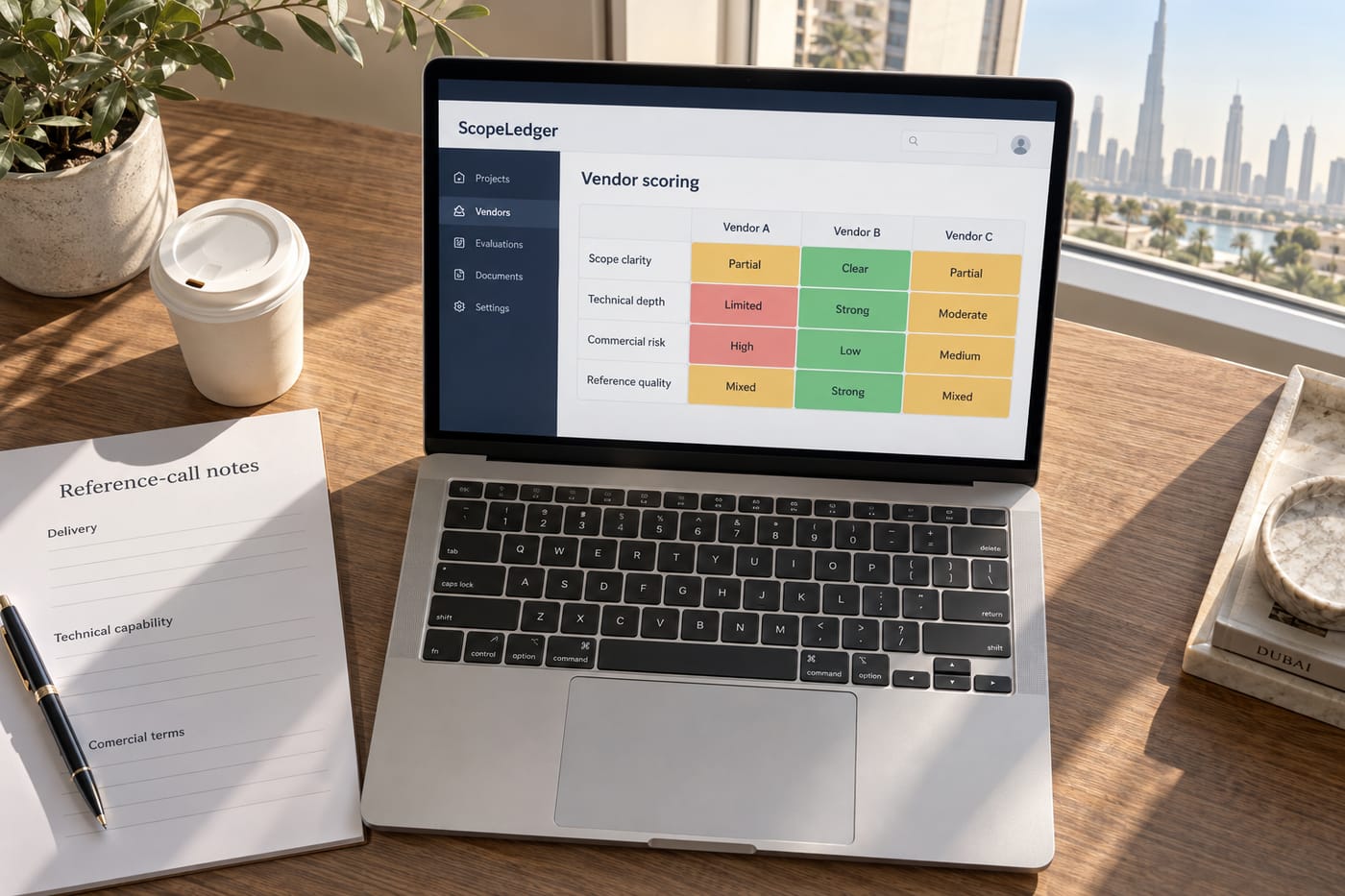
- Mostly green with two reds in the same area (e.g., both security questions) — a specialist gap. Fixable with a contract clause or a second vendor for that slice.
- Mostly yellow across the board — a vendor who gives careful, hedged answers to things they haven't thought about yet. Worst-case scenario, because they'll do the same thing to your deadlines.
- A few greens, scattered reds, and one spectacular answer — usually a smaller shop with real engineers in the room. Often the best bet if the reds are commercial rather than technical.
The lowest price is a red flag only if it is paired with the inability to name exclusions, risks, and estimate drivers. A lean team that has genuinely scoped the work can be cheaper and still deliver. A team that is cheap because they haven't done the scoping will be the most expensive vendor you ever hired by month six — the 4x cost multiplier from scope creep is not a theoretical risk.
How CodeNicely can help
We built GimBooks — a YC-backed accounting SaaS for Indian SMBs — from MVP through scale. The reason the engagement held together across years of feature expansion was that the original scope had explicit exclusions, documented change control, and a shared backlog that let the founders decide what shipped and what waited. That is the same posture we bring to a Dubai founder evaluating MVP pitches today: a scoping conversation that produces a list of what we are deliberately not building, named technical risks and the spikes to de-risk them, and a change-order format you see before you sign. If you want a second pair of eyes on the three pitches you already have — not a competing bid, just a review of what each one is hiding — that is a 45-minute conversation we are happy to have. See how we work across our offerings or AI Studio.
Frequently Asked Questions
How much should an MVP cost in Dubai in 2025?
The honest answer is that MVP cost is driven by four things: number of third-party integrations, whether you need any regulated-data handling from day one, data migration complexity, and whether your design is ready or needs to be produced. A vendor who gives you a flat number without asking about those four has not scoped your product. The way to turn a range into a quote is to spend two to four weeks on a paid discovery or pilot engagement; any serious vendor will offer that path.
How long does it take to build an MVP?
Timeline is driven by scope, team size, and the dependencies you cannot control — third-party API approvals, app store review, payment gateway onboarding in the UAE, and whether you have design assets ready. A tightly-scoped MVP with two integrations and no regulated data moves faster than one with five integrations and a KYC flow. Ask the vendor to name the three dependencies most likely to slip, and judge them on the specificity of the answer.
Is the cheapest vendor always the riskiest?
No. The riskiest vendor is the one who cannot explain why they are cheaper. Genuine leanness — a small team, offshore pricing, reused component library, deliberate exclusions — produces a defensible lower number. Hidden scope risk produces the same number with no explanation. Question 1 and question 7 in this post are how you tell them apart.
Should I sign an NDA before showing a vendor my full spec?
Yes, as a baseline hygiene step, but do not expect it to protect your idea — it protects your specific documents and data. For anything involving regulated data, customer lists, or proprietary algorithms, have a UAE-qualified lawyer review the NDA and the MSA; this post is not legal advice and the specifics of enforceability vary by free zone and jurisdiction.
What should a paid pilot cost and cover?
A pilot's job is to force both sides to learn something they could not learn from the sales process — a real integration, a real data migration dry-run, a real design round. It should be scoped to produce a tangible artifact you own regardless of what you decide next, and priced as a fixed fee rather than time-and-materials. The specifics depend on your stack and the slice of work you choose; that is a conversation to have with the vendor directly once you've narrowed the shortlist to two.
Sources & further reading
- The Impact of Scope Creep on Project Success: An Empirical Investigation
- Custom Software Development Statistics 2026: 40+ Data Points (Standish Group, McKinsey, Forrester data)
- Software Project Failure Statistics: 2026 Verified Stats & Trends (Gitnux)
- The True Cost of Software Project Failures (Callibrity)
- MVP Development Statistics 2026: Cost, Speed, Success & AI Data (Technource, citing Pendo)
- SaaS MVP Development Cost in 2026: What Actually Drives the Budget
- Expert: Dubai's Startup Ecosystem Gives Early-Stage Founders a Strategic Global Advantage (Seed Group)
- UAE Free Zones for Tech Startups: Your 2025 Guide to the Middle East's Silicon Valley (MobileMall)
Get one practical guide a week
Costs, AI tools, partner selection — written for people who make the decision. No spam, unsubscribe anytime.
Thanks — you're on the list. One practical guide a week, nothing else.
That didn't work — please check the email address and try again.
Building something in Technology?
CodeNicely partners with founders and tech teams to ship AI-native products that move metrics. Tell us about the problem you're solving.
Talk to our team Book a 30-min call