_1751731246795-BygAaJJK.png)

Who Builds Indian Startup Software: A Buyer's Map

 Published by CodeNicely, the product studio founded by Meghal Agrawal and Ujjwal Agrawal in 2017
For: A first-time founder in Bengaluru or Delhi-NCR who has raised a pre-seed or seed round, has no in-house engineers yet, and is trying to decide which category of development partner to hire before their runway clock starts ticking
In this guide
- The five categories, honestly compared
- Why tier-1 IT services firms are not an option (even though they will take your call)
- Boutique agencies: the obvious default, with real limits
- Freelance platforms: for tasks, not products
- Offshore staff augmentation: wrong stage for a seed startup
- AI-first product studios: the newest category, and the most relevant one
- How to think about cost and timeline before you talk to anyone
- How CodeNicely fits — and when it does not
- A 10-minute decision framework
- Frequently Asked Questions
If you have raised a pre-seed or seed round in India and need a shippable product in six to twelve weeks, your real choice is between a boutique agency and an AI-first product studio. The other three visible options — tier-1 IT services firms (TCS, Infosys, Wipro), freelance marketplaces, and offshore staff-augmentation shops — are structurally built for a different buyer, and signing with them will cost you months of runway before a single screen ships. This post explains why, category by category, so you can shortlist in a week instead of a quarter.
The founder problem is not a lack of vendors. India produces over 1.5 million software engineers a year, and the IT services market was worth USD 25.59 billion in 2024. The problem is that large enterprises captured 64.3% of that spend, and the vendor landscape is organised around their buying patterns, not yours. A founder with ₹60L in the bank and 18 months of runway is shopping in a market priced for a CIO with a $5M budget and a three-year transformation mandate.
The five categories, honestly compared
Here is the shortlist of who actually exists, what they are good at, how they price, and — the question most vendor pages skip — what they are structurally bad at.
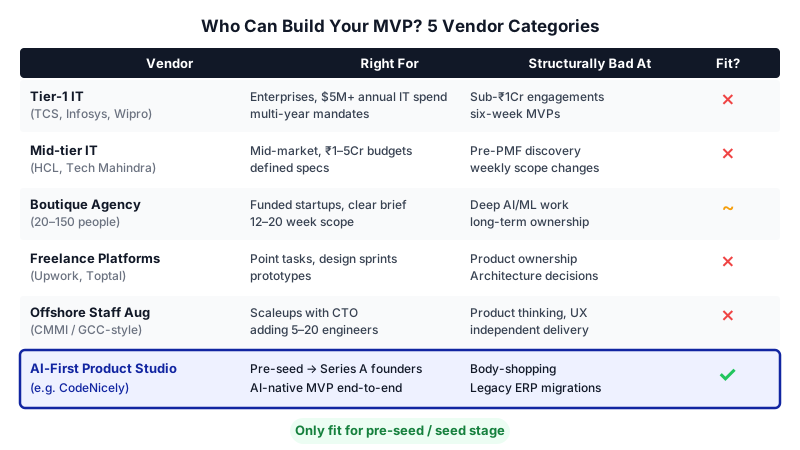
| Category | Right for | Pricing model | Structurally bad at |
|---|---|---|---|
| Tier-1 IT services (TCS, Infosys, Wipro) | Enterprises with $5M+ annual IT spend and multi-year roadmaps | Time & materials on 20–25+ engineer pods, long contracting cycles | Sub-₹1Cr engagements, six-week MVPs, founder-led iteration |
| Mid-tier IT (HCL, Tech Mahindra, LTIMindtree) | Mid-market and large SMEs with ₹1–5Cr budgets and defined specs | Fixed-bid for scoped projects, T&M for staff aug | Pre-product-market-fit discovery and weekly scope changes |
| Boutique agencies (20–150 people) | Funded startups with a clear brief, in-house PM, and a 12–20 week scope | Fixed-bid per milestone or monthly retainer | Deep AI/ML work, long-term ownership, round-the-clock support |
| Freelance marketplaces (Upwork, Toptal, Flexiple) | Point tasks, a specific feature, a design sprint, a prototype | Hourly, per-engineer | End-to-end product ownership, architectural decisions, team continuity |
| Offshore staff aug (CMMI shops, GCC-style vendors) | Scaleups that already have a CTO and need to add 5–20 engineers fast | Monthly per-seat, usually 12-month minimums | Product thinking, UX decisions, independent delivery without a client-side tech lead |
| AI-first product studios | Pre-seed to Series A founders building an AI-native MVP end-to-end | Fixed-scope sprints, outcome-based, or hybrid retainer | Pure body-shopping, decade-long legacy ERP migrations |
Why tier-1 IT services firms are not an option (even though they will take your call)
This is the most expensive misunderstanding a first-time founder can have. TCS, Infosys, and Wipro will take a discovery meeting. They will send a deck. They will not ship your MVP.
The numbers explain why. TCS's typical minimum engagement is 25+ engineers with a contracting cycle measured in months. Infosys won't take engagements under 20 engineers and rarely offers fixed-bid pricing for a tightly scoped MVP. Tier-1 vendors require roughly $5M+ in committed spend before they prioritise your account; sub-$1M engagements get routed to HCL or Tech Mahindra tier, if they get picked up at all.
The clientele data confirms this is not an accident of pricing — it is a market-fit mismatch. 85.7% of Infosys's G2 reviewers come from enterprises with 1,000+ employees, and zero are from small businesses with 50 or fewer. The sales motion, the SOW templates, the legal review, the pod-staffing model — all of it is built for Fortune 500 CIOs.
The hidden cost most founders miss: the first 90 days of a tier-1 engagement are staffed with pre-sales consultants and solution architects, not the engineers who will build the product. By the time the actual build team is onboarded, you have paid for discovery twice — once in the proposal phase, again in the internal handoff — and your 18-month runway is now 15.
If a tier-1 BD rep is pursuing you aggressively, assume they are stretching to hit a quarterly target and that your account will be deprioritised the moment a real enterprise deal lands.
Boutique agencies: the obvious default, with real limits
Boutique agencies — the 20-to-150-person studios you find on Clutch, GoodFirms, and founder WhatsApp groups — are the default pick for a reason. They will take a ₹25–80L engagement. They will ship something in 10–16 weeks. They have portfolio pages full of apps that look like what you want to build.
The honest limits:
- They are generalists. Most boutique agencies optimise for React Native, Node, and a standard web stack. Ask about on-device ML, LLM evals, RAG pipelines, or vector databases, and the answer is usually "we can learn." You do not want to pay for someone's learning curve on your core differentiator.
- They need a brief. A good agency executes a well-scoped spec faster than anyone. A bad fit is a founder who is still figuring out the product — because every scope change renegotiates the contract, and the agency's margin lives in change orders.
- Ownership gets fuzzy post-launch. The team that built your app is now on three other projects. Bug fixes queue up. The senior engineer who knew your codebase has rotated off.
Rule of thumb: if your product is a mobile-first marketplace or a dashboard SaaS with conventional integrations, a boutique agency is a fine pick. If your product's core value is an AI model's output, keep reading.
Freelance platforms: for tasks, not products
Upwork, Toptal, Flexiple, and the India-specific equivalents are genuinely useful — for a specific feature, a design sprint, a plugin, a two-week prototype, or filling a gap on an existing team. They are a disaster for end-to-end product ownership.
The failure mode is predictable. A pre-seed founder hires a top-rated freelance full-stack engineer at ₹2,500/hour. Six weeks in, the engineer takes a full-time offer and disappears. There is no documentation, no CI/CD, no second person who understands the architecture. The founder restarts.
Use freelancers to augment, not to own.
Offshore staff augmentation: wrong stage for a seed startup
Staff-augmentation shops rent you engineers by the month, usually on 12-month minimums, usually ₹1.5–4L per engineer per month depending on seniority. They are built for scaleups and foreign enterprises that have a CTO and a product manager in-house and just need hands.
If you do not have a technical co-founder or a senior engineering lead on payroll, staff aug will fail. There is no one on your side to make architectural decisions, review PRs, or push back on scope. You will have paid for engineers and still not have a product.
This is the right category when you are Series A, have a CTO, and need to go from 3 to 15 engineers in a quarter. It is the wrong category at seed.
AI-first product studios: the newest category, and the most relevant one
The Indian GenAI startup base grew 3.6x between H1 2023 and H1 2024, and most of those founders are capital-constrained — they need a partner that treats AI as the product's core, not a feature bolted on in sprint 7.

What distinguishes an AI-first studio from a boutique agency that has added "AI services" to its website:
- Model selection is part of discovery. Which LLM, hosted or self-hosted, what the eval harness looks like, what the fallback is when the model is wrong — these are week-one conversations, not week-ten surprises.
- The team ships product, not just code. UX, prompt engineering, data pipelines, and backend are one pod, not three vendors coordinating.
- Pricing is outcome-oriented. Fixed-scope sprints with clear deliverables, not open-ended time and materials.
The honest limits apply here too. AI-first studios are not the right pick for a pure legacy modernisation project with no AI component, or for a 50-engineer multi-year contract. They are built for the 6–20 week zero-to-one build.
How to think about cost and timeline before you talk to anyone
Every vendor will refuse to quote until they have scoped. That is correct behaviour. But you can model the shape of the number before you take meetings.
Three things drive 80% of the cost and timeline variance:
- Integration count. Payments, KYC, maps, SMS, WhatsApp, bank APIs — each one adds 1–3 weeks and real integration risk, especially in India where sandbox quality varies wildly.
- Data gravity. Starting from zero is fast. Migrating an existing user base, historical transactions, or a legacy database doubles or triples timelines.
- Model complexity. A thin GPT-4 wrapper is a two-week build. A domain-tuned model with evals, guardrails, and human-in-the-loop review is a two-quarter project.
Illustrative only: a two-integration MVP (payments + SMS), no data to migrate, a single LLM call per user action, no custom model training, built by a focused 4-person pod, is a short, scoped engagement. Add a fourth integration, a custom RAG pipeline, and a migration from an existing WordPress backend, and you are in a different conversation entirely.
A good runway for an Indian seed-stage startup is 18–24 months. If a vendor's proposal consumes more than 25% of your runway before you have user feedback, the engagement model is wrong for your stage — regardless of the vendor's quality.
What turns a range into a real quote: your integration list, whether you have existing data or users to migrate, and whether the AI component is a generic model call or a custom-trained pipeline. Those three questions get you from "it depends" to a scoped SOW. Talk to CodeNicely if you want to walk through them.
How CodeNicely fits — and when it does not
CodeNicely is an AI-first product studio. We have shipped 50+ products reaching 5M+ end users, and the founder-stage work we are proudest of is the kind where the AI is the product, not decoration.
Two concrete fits:
GimBooks — a YC-backed accounting SaaS for Indian small businesses. We built the mobile-first product that let non-accountant founders run invoicing, GST, and books from a phone. This is the right reference if you are a seed-stage founder with a clear wedge in a regulated, India-specific vertical and need a partner that understands the local compliance surface.
HealthPotli — an e-pharmacy with AI-powered drug interaction checking. The AI is not a feature; it is why the product is safer than a WhatsApp pharmacy. This is the right reference if your product's defensibility is an AI model's quality.
Full IP ownership transfers to you, we work NDA-first, and there is no vendor lock-in — the code, infrastructure, and documentation are yours to walk away with. See the India AI development offering for scope.
When CodeNicely is not the right pick: if you need 30 engineers on a legacy SAP migration, a tier-1 IT services firm is built for that and we are not. If you need a one-week landing page, hire a freelancer. If you already have a CTO and just need staff aug, pick a staff-aug shop with transparent per-seat pricing.
A 10-minute decision framework
Answer these in order:
- Is your budget under ₹1Cr for the first build? If yes, tier-1 IT services are out. Full stop.
- Do you have a technical co-founder or senior engineering lead on payroll? If no, staff augmentation is out.
- Is AI the product's core differentiator? If yes, prioritise AI-first studios over general boutique agencies.
- Is the scope one feature or a prototype under four weeks? If yes, a freelancer is probably the right pick.
- Everything else — a 10–20 week zero-to-one build, funded seed stage, India-specific product — comes down to a boutique agency with the right domain references, or an AI-first studio if AI is central.
Frequently Asked Questions
What is the difference between a software development agency and an AI product studio in India?
A general agency builds whatever stack you ask for; AI is usually one of many services. An AI product studio treats model selection, evaluation, and the data pipeline as first-class discovery questions, and the same pod does UX, prompts, and backend together. If your product's value depends on an AI model being right most of the time, the studio model is built for that; if you are building a conventional SaaS or marketplace, a general agency is often cheaper and faster.
Can I hire TCS, Infosys, or Wipro to build my startup MVP?
Technically yes, practically no. Their minimum engagements are 20–25+ engineers and tier-1 vendors prioritise accounts with $5M+ in committed spend. A seed-stage startup with ₹50L–₹1Cr in the bank is below the floor where these firms allocate senior engineers, and the first 90 days get consumed by pre-sales consultants rather than builders.
How much should a seed-stage Indian startup spend on its MVP?
The right question is not the absolute number but the share of runway. A reasonable guardrail: your first build should not consume more than 25% of total runway before you have user feedback, because you will need the remaining capital for iteration, hiring, and go-to-market. What drives the actual figure is integration count, whether you are migrating existing data, and the complexity of the AI component. Those three variables are what any serious vendor will scope before quoting.
How long does it take to build an MVP with an Indian development partner?
For a scoped mobile or web MVP with two or three integrations and no legacy data migration, a focused pod can typically ship a usable first version in a short, defined sprint window. Add custom AI model work, more integrations, or a migration from existing systems and the timeline extends in known increments. Vendors who promise fixed delivery dates before scoping either pad massively or miss — ask instead for a weekly demo cadence and a written definition of done.
Should I use Upwork or Toptal to build my startup product?
Use freelance platforms for discrete tasks — a design sprint, a feature, a prototype — not for end-to-end product ownership. The failure mode is predictable: your top freelancer takes a full-time job six weeks in, leaves no documentation, and you restart. For continuous ownership of a shipped product, a studio or agency with a bench and documented handover processes is a safer bet, even if the hourly rate looks higher.
Sources & further reading
- Top Software Development Companies in India 2025 — ScalaCode (TCS, Infosys, Wipro engagement size analysis)
- 9 Wipro Competitors & Alternatives to Consider in 2026 — 1840 & Co. (minimum spend thresholds by vendor tier)
- G2: Infosys vs. Wipro — Reviewer company-size breakdown
- India IT Services Market Size, Share & Growth — TechSci Research (USD 25.59B market size, 2024)
- India IT Services Market Size & Share Analysis — Mordor Intelligence (large enterprise 64.3% share; SME CAGR)
- India's IT Services Contracts for 2024 — Omdia / Informa (70% of contracts = application dev & management)
- Why Outsource Software Development to India? — VrinSofts (NASSCOM talent pipeline; $1.80B domestic software outsourcing market)
- How to Raise Your Seed Round in India — Kae Capital (18–24 month runway benchmark; $1.56M average seed raise 2022–2024)
Get one practical guide a week
Costs, AI tools, partner selection — written for people who make the decision. No spam, unsubscribe anytime.
Thanks — you're on the list. One practical guide a week, nothing else.
That didn't work — please check the email address and try again.
Building something in Technology?
CodeNicely partners with founders and tech teams to ship AI-native products that move metrics. Tell us about the problem you're solving.
Talk to our team Book a 30-min call