

What SOC 2 Type II Actually Demands of Your Codebase

 Published by CodeNicely, the product studio founded by Meghal Agrawal and Ujjwal Agrawal in 2017
For: A Series A B2B SaaS founder whose first enterprise deal is conditional on a SOC 2 Type II report and who has never been through the process before
In this guide
- Why this is now on your desk
- The one thing that drives the timeline: the observation window
- What SOC 2 actually demands of your architecture
- What SOC 2 demands of a dev partner (if you use one)
- The three things teams discover too late
- How to think about cost and the shape of the bill
- How CodeNicely can help
- The one thing to do this week
- Frequently Asked Questions
SOC 2 Type II is not a policy exercise with some engineering sprinkled on top. It is an engineering exercise with policies wrapped around it. The report you hand your enterprise prospect is an auditor's attestation that specific technical controls — access logging, change management, alerting, backup integrity — operated continuously over a three-to-twelve-month window. That window cannot start until those controls are live in production and producing evidence an auditor can read. If you are a Series A founder who just got asked for a Type II report to close your first enterprise deal, the clock has almost certainly not started yet, and no amount of consultant hours will compress calendar time.
This is the part nobody tells you in the Slack threads and vendor demos. Below is what Type II actually demands of your codebase, your vendors, and your calendar — written for someone who has to make build-vs-buy-vs-defer decisions this quarter.
Why this is now on your desk
Between 70 and 85 percent of enterprise B2B SaaS RFPs now require SOC 2, according to Agency Insights' 2026 compliance roundup. That makes it a prerequisite, not a differentiator. Of those buyers, 78 percent specifically require Type II — not Type I — before signing, per Sprinto's analysis via Secure.com. Enterprise procurement teams have stopped accepting Type I reports as sufficient because a Type I is a point-in-time snapshot. Type II proves the controls worked every day for months.
The deal-loss data is blunt. 29 percent of organizations have lost specific deals because they lacked a required security certification (Secure.com). And Bessemer's data, cited in SaaS Mag's summary, shows 72 percent of enterprise SaaS startups now hold SOC 2 before their Series A — up from 31 percent in 2020. The credential has moved earlier in the company lifecycle, which means the engineering work has moved earlier too.
The one thing that drives the timeline: the observation window
Here is the mechanic most founders miss. A Type II report covers a period of time. The auditor asks: did these controls operate effectively from, say, March 1 to August 31? They then pull samples of evidence — access logs, pull request approvals, incident tickets, backup restore tests — spread across those six months.
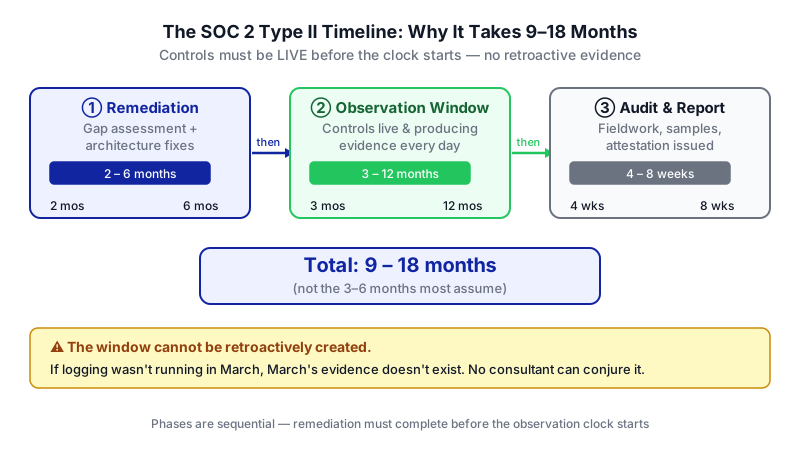
The AICPA does not formally mandate a minimum window length. In practice, three months is the accepted floor, six months is what AICPA recommends and most first-time Type II reports use, and twelve months is what enterprise buyers increasingly expect at renewal. Pick anything shorter than six months for your first report and expect sophisticated buyers to push back.
That window cannot be retroactively created. You cannot, in September, generate March's access logs. If the logging pipeline wasn't running, the evidence does not exist, and no consultant can conjure it. This is why a realistic end-to-end timeline for a company starting from zero is 9 to 18 months, not the 3 to 6 months most founders assume when they first read a compliance vendor's homepage (Platops, ValueMentor).
Breaking that down, roughly:
- Gap assessment and remediation: 2 to 6 months. This is where architecture changes happen. Longer if you have technical debt in auth, logging, or deployment.
- Observation window: 3 to 12 months. Calendar time. Non-negotiable.
- Audit fieldwork and report delivery: 4 to 8 weeks after the window closes.
The remediation and the observation window do not overlap. Controls have to be live before the clock starts.
What SOC 2 actually demands of your architecture
The Trust Services Criteria read like a management document. The implementation is code. The 2024 SOC Benchmark Report, which analyzed 193 reports, found control counts ranging from 34 to 382 with an average of 124 per report (Bright Defense). Most of those controls either are, or depend on, something your engineers build.
Here is the minimum set you will need live in production before the observation window can plausibly begin.
1. Immutable, queryable access logs across the stack
Every authentication event, every privileged action, every production database query by a human — logged, timestamped, tamper-evident, retained for at least a year. Most startups have CloudTrail or the GCP equivalent turned on but nothing above the infrastructure layer. Auditors will ask for application-level logs too: who viewed which customer record, who exported what. If your app does not emit those events, add them before the window starts. Shipping them to a WORM-style store (S3 with Object Lock, or a dedicated log platform) is what makes them "immutable" in an auditor's eyes.
2. A documented, enforced change-management pipeline
Every production code change has to be traceable to a ticket, a peer review, and an approval. In practice this means branch protection rules on main, mandatory PR reviews, CI that cannot be bypassed, and deploy logs that tie a commit SHA to a deployed artifact to a timestamp. If a developer can push directly to production, or if your CI has a "skip tests" flag anyone can use, you will fail this control. The fix is boring: GitHub branch protection, required reviewers, signed commits, and a deploy tool that logs who triggered what.
3. Role-based access control with quarterly reviews
Not just RBAC in the app. RBAC everywhere — AWS/GCP IAM, GitHub, your database, your observability tools, your CI, your SaaS stack (Notion, Linear, 1Password). Every quarter, someone has to review who has access to what and attest, in writing, that it is still appropriate. This generates one of the easiest pieces of evidence to produce late and one of the easiest to fail. The architectural ask is: can you, in under an hour, produce a report of who has production access right now? If no, fix the tooling.
4. Automated alerting with documented response
Failed login spikes, privilege escalations, unexpected data exports, prod deploys outside the change window — each needs an alert, each alert needs a runbook, and each triggered alert needs a paper trail showing someone acknowledged it and acted. Auditors will sample alerts from month three of your window and ask what you did. "We saw it in Datadog" is not an answer. A ticket with a resolution is.
5. Encryption, key management, and data inventory
Encryption at rest and in transit is table stakes. The part teams miss is the data inventory: a current, maintained document of what personal data you store, where it lives, who can access it, and how long you keep it. If you cannot produce that in a sentence per data category, you will stall in the gap assessment.
6. Vendor and subprocessor management
Every third party in your data path — hosting, email, analytics, AI APIs — needs a review, ideally their own SOC 2, a DPA, and a record of when you last checked. This is where OpenAI, Anthropic, Pinecone, and the rest of the AI stack now show up uncomfortably in your audit. If you are routing customer data through an LLM provider without a signed BAA or DPA, address that before the window.
7. Backup, restore testing, and incident response drills
Backups that have never been restored are not backups. Type II wants evidence that you tested a restore during the observation window and that you ran at least one tabletop incident response exercise. Both need to be scheduled, executed, and documented inside the window.
What SOC 2 demands of a dev partner (if you use one)
If an outside team writes or operates any part of your production system, their practices are in scope. An auditor will ask whether your vendor follows your change management process, whose laptops touch your code, how access is revoked when a contractor rolls off, and whether the vendor itself has SOC 2 or an equivalent.
Questions to ask a dev partner before they touch a repo:
- Do you push through our PR process, or do you have a bypass path?
- Are your engineers on managed, encrypted devices with MDM?
- Do you use shared accounts for anything — AWS, GitHub, our database?
- What is your offboarding SLA when someone leaves your team?
- Do you hold SOC 2, ISO 27001, or can you point to equivalent controls?
- Will you sign our DPA and the subprocessor terms in our customer contracts?
If a vendor cannot answer these without hedging, they will cost you weeks of remediation during your audit.
The three things teams discover too late
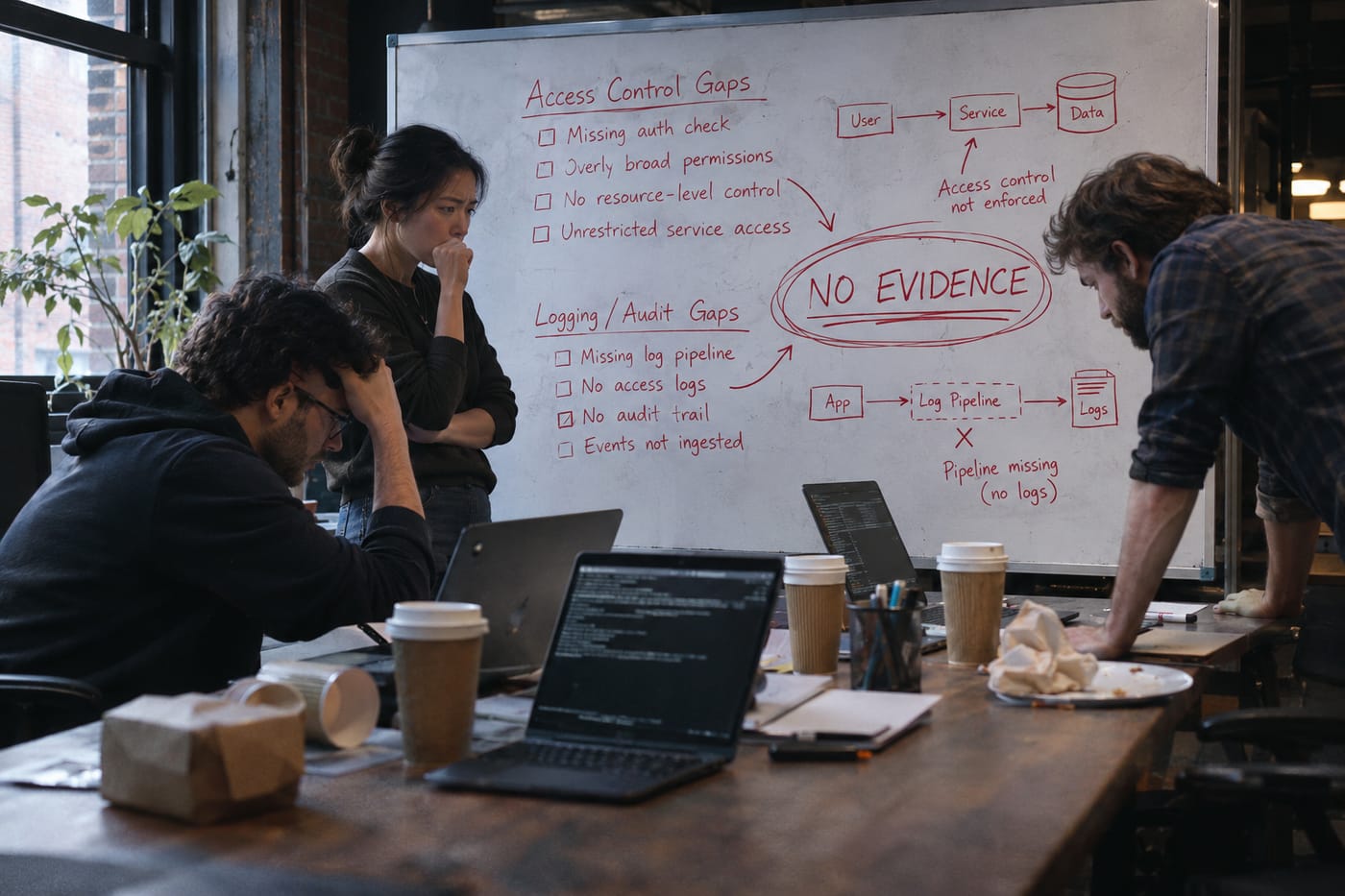
1. Your logging gap is bigger than you think
Most startups log errors well and user actions poorly. The gap assessment surfaces this in week two. You then need engineering sprints to add event emission across your app, which pushes the window start by a month or two. Budget for it upfront.
2. Shared credentials are everywhere
The shared AWS root account. The company-wide Postgres read-only password in 1Password. The Stripe API key three engineers have on their laptops. Each of these is an access-control failure the auditor will catch. Rotating credentials, moving everyone to SSO, and enforcing per-user API keys takes longer than you expect because every integration breaks once.
3. The founders' access is the hardest to constrain
The CTO who ssh's into prod to debug. The CEO with admin on every SaaS tool. Auditors care about this more than you would think, because Type II is partly about demonstrating that no single person can bypass controls. Expect to document founder access with the same rigor as everyone else's, and expect some uncomfortable conversations about least privilege applying to you too.
How to think about cost and the shape of the bill
SOC 2 Type II spend has three components, and the ranges vary wildly by company shape, so the honest answer is to describe the drivers rather than quote a number.
- The audit itself — paid to a licensed CPA firm. Driven by your scope (which Trust Services Criteria you include beyond Security), the complexity of your environment, and the length of your window.
- Compliance automation tooling — Vanta, Drata, Secureframe, Sprinto and similar. Priced per employee or flat, driven mostly by headcount and how many integrations you need.
- Engineering remediation — the biggest and least predictable line item. Driven by how far your current architecture is from the controls above. A team already on AWS with SSO, branch protection, and CloudTrail is weeks of work away. A team with shared accounts, no central logging, and direct prod access is months.
The global SOC reporting services market was valued at $5.39 billion in 2024 and is projected to hit $10.47 billion by 2032, which gives you a sense of the pricing pressure: supply is growing, but so is demand, and audit-firm capacity is the bottleneck.
Three specifics turn the range into a real quote: (1) your current architecture's distance from the control list above, (2) the Trust Services Criteria you need in scope — Security alone, or also Availability, Confidentiality, Processing Integrity, Privacy — and (3) your target window length. A conversation with a team that has done this before will narrow all three in an hour.
How CodeNicely can help
Most of CodeNicely's work with venture-backed SaaS teams starts well before SOC 2 is on the table — but the architectural decisions made then are the ones that determine how painful the audit becomes later. The GimBooks engagement is the closest analogue to a Series A founder in your situation. GimBooks is a YC-backed fintech SaaS where financial data controls, auditable change management, and tight access boundaries are not optional — they were built in from the architecture up, not retrofitted when a customer asked. That meant immutable logging, environment separation, per-user access to sensitive stores, and a deploy pipeline that produced evidence by default.
For a founder staring down a Type II deadline, the practical help looks like three things: a gap read against the control list above, remediation sprints that get logging, access control, and change management to an auditor-ready state, and handoff documentation your compliance platform and audit firm can consume directly. CodeNicely does not sell the audit — a CPA firm does that, and a lawyer should review your contractual commitments. What we do is get the codebase to the state where the observation window can actually start. If that is where you are, a conversation with our engineering team or a look at our broader offerings is the right next step.
The one thing to do this week
Pick a target window start date. Work backward. For every control in the seven categories above, answer: is this live in production today, yes or no? Every "no" is engineering work that has to finish before the clock starts. That list, not the policy binder, is your real SOC 2 project plan.
Treat the paperwork as the output of a working system, not the system itself. Buyers can tell the difference, and increasingly, so can auditors.
Frequently Asked Questions
How long does SOC 2 Type II really take from a standing start?
Realistically 9 to 18 months end to end, not the 3 to 6 months many founders expect (Platops). That breaks into 2–6 months of gap assessment and remediation, 3–12 months of observation window (6 is the practical standard for a first report), and 4–8 weeks of audit fieldwork. The observation window is calendar time and cannot be compressed by spending more.
Can we start with SOC 2 Type I to close the deal faster?
Sometimes, but check first. 78 percent of enterprise buyers specifically require Type II (Secure.com), and procurement teams increasingly reject Type I as insufficient. Type I can work as a bridge — proving controls exist at a point in time — while you accumulate the Type II observation window, but confirm with the specific buyer before betting the deal on it.
What does SOC 2 require of a dev partner or outsourced engineering team?
Any vendor touching production code is in scope. They need to work inside your change management process (not around it), use managed devices, avoid shared credentials, offboard engineers quickly, and ideally hold SOC 2 or ISO 27001 themselves. Ask them concrete questions about PR workflow, device management, and access revocation before signing — vague answers predict audit pain.
How much does SOC 2 Type II cost for a Series A SaaS company?
The bill has three parts: the CPA audit itself, a compliance automation tool (Vanta, Drata, Sprinto, Secureframe), and engineering remediation — which is usually the largest and least predictable. The main drivers are how far your current architecture is from standard controls, which Trust Services Criteria you include in scope, and your window length. A scoping conversation with an engineering partner and an audit firm together is the fastest way to turn the range into a real number.
Do we need SOC 2 before Series A fundraising?
Increasingly yes. Bessemer data shows 72 percent of enterprise SaaS startups now hold SOC 2 before Series A, up from 31 percent in 2020 (Agency Insights). Enterprise-focused investors read it as a signal that the company can sell to large buyers without a 9-month procurement stall. If your GTM depends on enterprise logos, treat SOC 2 as a fundraising input, not an output.
Sources & further reading
- SOC 2 Statistics: The Definitive Roundup — Agency Insights
- SOC 2 for SaaS: The Complete Type II Checklist for Compliance Teams — Secure.com
- SOC 2 Compliance Timeline: How Long Does It Really Take? — Scrut.io
- How Long Does SOC 2 Really Take? A Realistic Timeline — Platops
- Can SOC 2 Be Done in 2 Weeks? AICPA 2026 Scrutiny — ValueMentor
- SOC 2 Type I vs Type II: Which Report Should You Get First? — AuditSuisse
- How Long Does It Take To Get SOC 2 Compliance? — Bright Defense
- Global SOC Reporting Services Market Size & Forecast 2025–2032 — Verified Market Reports
Get one practical guide a week
Costs, AI tools, partner selection — written for people who make the decision. No spam, unsubscribe anytime.
Thanks — you're on the list. One practical guide a week, nothing else.
That didn't work — please check the email address and try again.
Building something in SaaS / Software?
CodeNicely partners with founders and tech teams to ship AI-native products that move metrics. Tell us about the problem you're solving.
Talk to our team Book a 30-min call