

Hiring a Dev Partner for a HIPAA or SOC 2 Build: US Startup Guide

 Published by CodeNicely, the product studio founded by Meghal Agrawal and Ujjwal Agrawal in 2017
For: A seed-to-Series-A SaaS or health-tech founder in the US who needs to ship a HIPAA-compliant patient portal or SOC 2-ready product and is evaluating whether an offshore dev partner can actually own the regulated build — or whether that risk disqualifies them entirely
In this guide
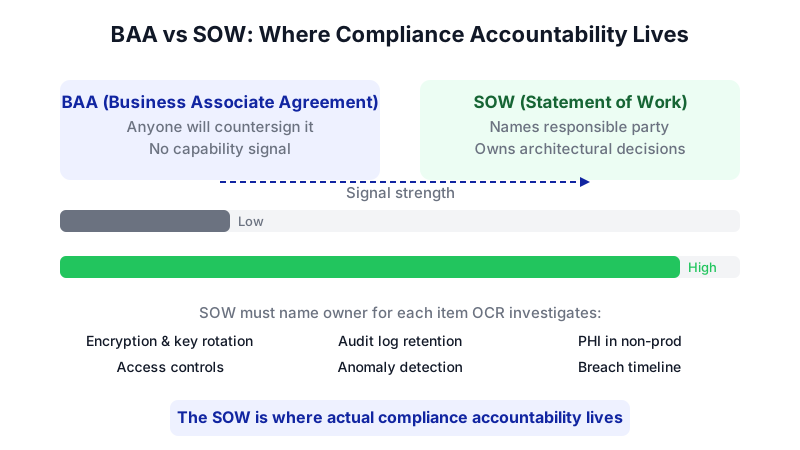
Look for a dev partner whose SOW — not their BAA — names them as the party responsible for encryption-at-rest decisions, audit-log retention, minimum-necessary access controls, and PHI handling in non-production environments. Anyone will countersign a BAA. Very few will accept contractual ownership of the architectural choices that OCR actually investigates when something breaks. That one distinction is the entire framework for hiring a dev partner for a HIPAA-compliant build, and it is almost identical for SOC 2-ready work.
This guide is written for US seed-to-Series-A founders in health-tech and regulated SaaS who are evaluating offshore or nearshore partners for builds that touch PHI or need to pass a SOC 2 Type 2 audit. It covers what to look for in the contract, what to ask on the first call, and what the market price band actually buys you.
Why the BAA is the wrong document to anchor on
Founders over-index on the BAA because it is tangible and signable. It is also close to useless as a capability signal. A covered entity can still be held liable for a business associate's violation if it 'knew, or by exercising reasonable diligence, should have known' of the BA's non-compliance (HIPAA Journal, citing 45 CFR). Translation: you cannot outsource the diligence. You can only outsource the work.

The scale of enforcement is worth sitting with. OCR collected over $9 million in HIPAA penalties and settlements in 2024 alone, and 2024 produced the most final civil money penalty determinations in OCR's enforcement history (LegalHIE). Cumulatively through October 2024, OCR has settled or imposed penalties in 152 cases totaling $144.8 million, with 2,419 criminal referrals to the DOJ (HHS.gov). And roughly 30% of breached patient records between 2009 and 2014 involved a business associate, not the covered entity itself (HHS data via SecurityMetrics).
Vendors cause a disproportionate share of breaches, and covered entities eat the liability anyway. That is the problem the SOW has to solve.
The ten criteria that actually decide it
1. Who writes the compliance architecture section of the SOW
Ask the partner to send you the compliance section of their last three regulated SOWs with names redacted. If they cannot, they have not written one. You want to see named responsibility for:
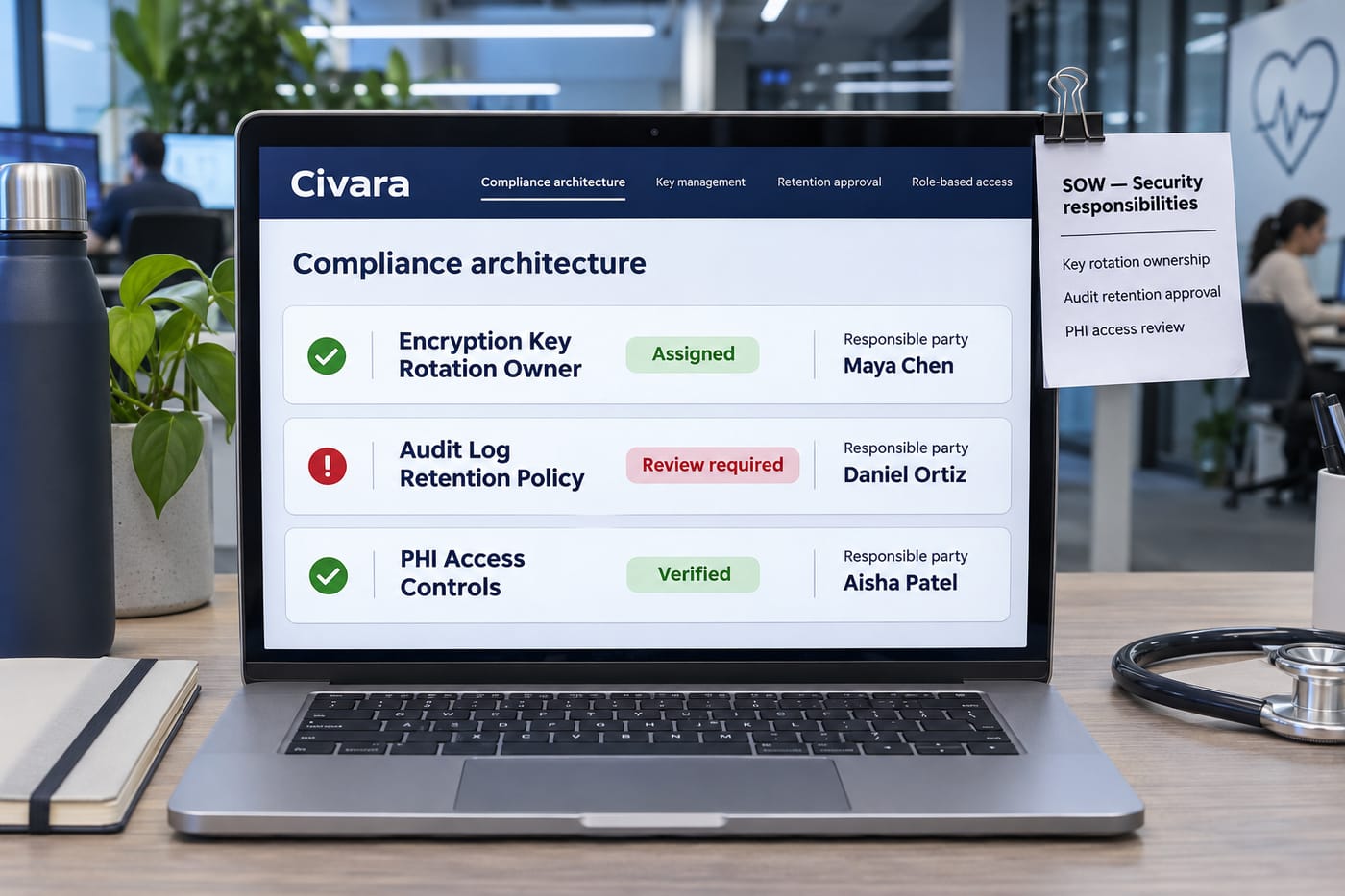
- Encryption-at-rest algorithm and key management (who rotates keys, where they live)
- Audit log retention period, immutability, and who holds the review cadence
- Minimum-necessary access controls — role definitions, break-glass procedures
- PHI handling in dev, staging, and QA environments (synthetic data vs. masked production)
- Anomaly detection and alerting ownership
- Breach notification timeline inside the vendor, not just to you
If any of these are missing or hand-waved to 'industry best practice', the partner is planning to build what you ask for and leave the audit to you. The four most common HIPAA risks in distributed development are PHI in non-production environments, inadequate BAA provisions, missing anomaly detection, and reliance on VPN alone. Your SOW should close all four by name.
2. Time-zone overlap, and what it does to your incident response
For a regulated build, time-zone math is not about standup convenience — it is about how fast a suspected PHI exposure gets triaged. India-based teams typically offer 3–5 hours of live overlap with US Eastern time in a morning-US / evening-IST window. Ask: 'If PagerDuty fires at 2am Eastern because our audit log pipeline stopped writing, who picks it up, and what is their commit path to prod in the next hour?' You want a named on-call rotation, not a Slack channel.
3. IP ownership and which contract law governs it
For US founders working with offshore partners, the single most-dodged question is governing law. Default vendor templates often specify Indian or UAE jurisdiction. For a regulated US product that may be acquired or raise institutional capital, you want Delaware or your state of incorporation as governing law, full assignment of IP on invoice payment, and no retained license-back for the vendor to reuse code with other clients. Ask for a redline-ready MSA before the first paid engagement — vendors who refuse this are telling you something.
4. NDA posture and sub-processor transparency
A partner who uses subcontractors — including freelance designers, QA pools, or offshore teams-of-teams — is introducing sub-processors under HIPAA. You need a written list, BAAs flowing down to each, and the right to approve additions. If the sales rep says 'we handle that internally, don't worry about it', assume there are three subcontractors you don't know about.
5. Regulatory fluency — the first-call test
Fluency reveals itself in minutes. On the first technical call, ask:
- How do you handle PHI in Sentry or Datadog logs?
- What's your pattern for giving a data-science team access to de-identified data for model training?
- How do you scope a BAA when the LLM provider is OpenAI vs. a self-hosted model?
- For SOC 2 Type 2, which Trust Services Criteria do you usually own vs. push to the client?
A fluent partner has answers with product names in them. An unfluent one will say 'we follow all required standards'. That phrase is a red flag.
6. SOC 2 Type 2, not Type 1
If your buyer is a hospital system, an insurer, or any Fortune 500, Type 1 will not clear procurement. 85% of mid-market buyers and 98% of Fortune 500 firms require a SOC 2 Type 2 report from vendors (ComplyJet). Type 2 requires an observation window, usually 3–12 months, which means the controls your dev partner implements in month one are the controls the auditor samples later. You cannot retrofit this. Ask: 'Which controls will you implement in sprint one, and can you produce evidence artifacts the auditor will accept?'
7. Proof of scale in regulated builds, not generic portfolio
A fintech build is not a health-tech build. Logistics does not translate to PHI. Ask for case studies where the partner shipped against HIPAA, HITRUST, SOC 2, PCI-DSS, or GDPR — and where the end client passed the audit. CodeNicely has shipped in healthcare (HealthPotli, an e-pharmacy with AI drug-interaction checks), fintech KYC (Cashpo), and YC-backed accounting SaaS (GimBooks) — the common thread across these is regulated data handling at production scale, which is the portfolio shape you want to see from any partner.
8. Delivery speed vs. compliance drag — ask about the tradeoff honestly
A good partner will tell you a HIPAA-ready MVP ships slower than a non-regulated one. If they promise the same timeline, they are either padding the non-regulated estimate or cutting corners on the regulated one. Ask: 'What does HIPAA readiness add to the critical path of a two-integration patient-portal MVP?' A reasonable answer names specific tasks — threat model, BAA chain, log pipeline, encryption review, pen test — and the weeks each one eats.
9. What the India-based price band actually buys
US founders considering India-based partners are usually comparing to a US agency band of roughly $150–$250/hr blended and an India band closer to $25–$65/hr blended. The honest read:
- The India band buys you more engineering hours for the same dollar. It does not automatically buy you compliance fluency — that is a filter you apply on top.
- Audit-grade documentation, pen-test coordination, and auditor-facing evidence collection are often not in the base rate. Ask what is included.
- Founder-level architectural review by a senior with regulated-build history is the line item that most distinguishes a $40/hr team from a $65/hr team. Pay for it.
On the SOC 2 side, first-year all-in costs for a startup land between $25,000 and $82,000+, with the auditor fee typically only 12–38% of total spend (The Sector Post, citing Drata). The hidden costs — penetration testing, compliance platform (Vanta, Drata, Secureframe), internal labor — are where founders under-budget. A good dev partner will tell you which of these they absorb into their SOW and which you pay separately. A bad one will let you discover it in month four.
These are illustrative market ranges, not CodeNicely figures. The two or three specifics that turn any range into a real quote: the number of third-party integrations that touch PHI, whether you have an existing data estate to migrate, and whether you need Type 1 fast and Type 2 later or are going straight to Type 2. A scoping conversation is the only way to get from range to quote.
10. Exit terms and no vendor lock-in
The last question on the evaluation call: 'If we part ways in month six, what do we walk away with?' You want full source, infra-as-code, documented runbooks, a credential-handoff checklist, and no proprietary framework you cannot self-host. Vendor-specific CMSes, bespoke orchestration layers, and 'our internal AI platform' are lock-in dressed as acceleration.
The market context you're buying into
US digital health startups raised $14.2 billion in 2025, up 35% from $10.5 billion in 2024 and the highest since 2022, against roughly 5,860 active HealthTech SaaS companies (Rock Health via Intuition Labs; Tracxn). Two implications for how you hire:
- Dev partners with real regulated-build throughput are capacity-constrained. The good ones have a 6–12 week lead time. Start conversations before you need to start the build.
- Enterprise buyers — hospital systems, payers, pharma — are more procurement-mature than two years ago. SOC 2 Type 2, HITRUST, and a defensible HIPAA posture are table stakes for the sales conversation, not differentiators.
A short evaluation checklist
Copy this into your vendor scorecard:
- Can they send a redacted compliance section from a prior regulated SOW?
- Do they name a specific person responsible for encryption, logging, and access controls?
- Is governing law Delaware (or your state), with full IP assignment on payment?
- Do they disclose all sub-processors and flow BAAs down to each?
- Can they pass the first-call fluency test with product-specific answers?
- Do they have a plan for SOC 2 Type 2 evidence artifacts starting in sprint one?
- Have they shipped at least two regulated builds where the client passed the audit?
- Do they honestly quantify the compliance drag on timeline?
- Is pen-test and auditor coordination in the SOW or billed separately?
- Do you walk away with everything in month six if you leave?
If a partner clears eight of ten, they are a real candidate. Below six, you are hiring audit liability, not a dev team. For US founders specifically, the US-market engagement model and the broader services overview are the starting points for a scoping conversation.
Frequently Asked Questions
Does signing a BAA with my dev partner make my product HIPAA-compliant?
No. A BAA establishes a legal relationship between a covered entity and a business associate — it does not evaluate or certify the partner's technical controls. HIPAA compliance is a function of the architecture, operational practices, and documentation your partner actually implements, and your covered entity remains liable if you 'knew or should have known' of their non-compliance (HIPAA Journal). Have a healthcare attorney review both the BAA and the technical SOW together.
Can an offshore dev partner actually own a HIPAA-regulated build?
Yes, if the SOW names them as the party responsible for specific architectural controls and they have shipped regulated builds before. The disqualifier is not geography — it is contractual ambiguity. An offshore partner with a tight SOW, named sub-processors, a US-overlapping on-call rotation, and prior HIPAA shipping history is lower-risk than a US agency without those traits.
How much does a HIPAA-compliant MVP cost, and how long does it take?
The honest answer is a range, because cost is driven by the number of PHI-touching integrations, whether you need Type 1 or Type 2 SOC 2, how much production data you migrate, and whether pen-testing and compliance-platform fees are inside or outside the SOW. For context on one component, first-year SOC 2 spend for startups runs $25K–$82K+ all-in, with auditor fees only 12–38% of that (The Sector Post). The three specifics that turn a range into a real quote: PHI-touching integration count, data migration scope, and your SOC 2 Type 1-vs-Type 2 sequencing. A scoping call is the only path to a real number.
Do I need SOC 2 Type 1 or Type 2 to sell to hospitals and enterprises?
Type 2. Roughly 85% of mid-market buyers and 98% of Fortune 500 firms require a Type 2 report, which means Type 1 will clear few enterprise procurement gates (ComplyJet). Type 2 requires a 3–12 month observation window, so the controls your dev partner implements early become the controls the auditor samples later. Start the control implementation before you start the sales conversation.
What should I do if my current dev partner is building a HIPAA product without a real compliance plan?
Stop new feature work, commission a gap assessment against the HIPAA Security Rule and the SOC 2 Trust Services Criteria you plan to attest against, and get a healthcare attorney to review your BAA chain and sub-processor list. This is a legal and audit question, not just an engineering one — a qualified attorney and a licensed auditor should review the specifics before you decide whether to remediate with the current partner or re-platform.
Sources & further reading
- A Look Back at 2024: HIPAA Enforcement Year in Review
- HIPAA Enforcement Highlights — HHS.gov (October 2024)
- HIPAA Business Associate Agreement — HIPAA Journal (2026 Update)
- HIPAA Business Associate Agreement: Who's Really Responsible? — SecurityMetrics
- How Do You Build a HIPAA-Compliant Nearshore Healthcare Development Team? — Nearshore Business Solutions (2026)
- SOC 2 for Startups (2026 Guide): Costs, Timeline & Best Vendors — The Sector Post
- SOC 2 for Startups: Costs, Timing & Fastest Path (2026) — ComplyJet
- AI Digital Health Landscape: Big Tech, Pharma & Startups — Intuition Labs (citing Rock Health 2025)
Get one practical guide a week
Costs, AI tools, partner selection — written for people who make the decision. No spam, unsubscribe anytime.
Thanks — you're on the list. One practical guide a week, nothing else.
That didn't work — please check the email address and try again.
Building something in Healthcare / SaaS?
CodeNicely partners with founders and tech teams to ship AI-native products that move metrics. Tell us about the problem you're solving.
Talk to our team Book a 30-min call