

Custom E-Commerce vs. Shopify: Where the Budget Actually Goes

 Published by CodeNicely, the product studio founded by Meghal Agrawal and Ujjwal Agrawal in 2017
For: Head of Digital or COO at an Indian retail or D2C enterprise with 500–5000 SKUs, currently on Shopify or evaluating it, who has received a custom-build proposal and cannot explain the 10x price difference to their CFO
In this guide
- The answer, in one paragraph
- Where the Shopify Plus budget actually goes
- Where the custom build budget actually goes
- One illustrative worked example
- What pushes the gap up vs pulls it down
- The three Shopify limitations Indian enterprises hit hardest
- The market context that matters for this decision
- How CodeNicely can help
- The three questions that turn this range into a real quote
- Frequently Asked Questions
If you are staring at a Shopify Plus quote and a custom-build proposal that differ by ₹40–80 lakh, here is the short answer: roughly 60–70% of that gap is not the storefront. It is the middleware, the ERP and GST reconciliation layer, the data model you own versus rent, and the compliance surface you inherit. The storefront itself — product pages, cart, checkout — is the cheapest part of either build. The expensive part is everything behind it, and that is where the two options diverge sharply for an Indian retailer with 500–5000 SKUs.
This post is a cost-driver breakdown, not a quote. We will walk through what actually sits inside each line item, where Shopify Plus saves you money, where it quietly costs you more by year three, and the specific scope decisions that move the number the most.
The answer, in one paragraph
Shopify Plus in India runs ₹1,75,000–1,90,000/month in platform fees alone, before apps, themes, implementation, or integration middleware. A custom build has effectively zero recurring platform fee but a large upfront engineering cost and ongoing infrastructure plus maintenance. The two curves cross somewhere between year two and year four for most mid-market Indian retailers — but the crossover is almost never driven by GMV or traffic. It is driven by the first serious ERP or GST e-invoicing integration, because that one project forces architectural choices that are cheap in a custom stack and structurally expensive on Shopify.
Where the Shopify Plus budget actually goes
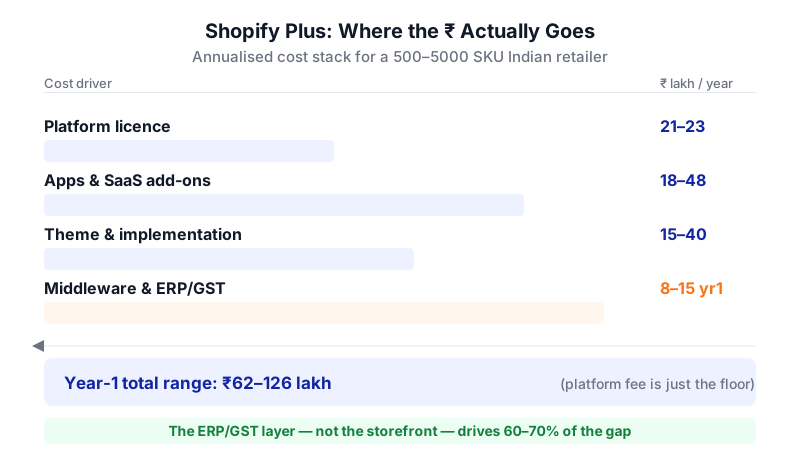
Treat the ₹1,75,000/month as the floor, not the number. The real annualised spend for a 500–5000 SKU Indian retailer usually looks like this in shape:
1. Platform licence (fixed, predictable)
Shopify's own pricing page lists Plus at ₹1,75,000/month on a 3-year commit or ₹1,90,000/month on annual. That is roughly ₹21–23 lakh/year before anything else. Above $1M monthly GMV, variable revenue-share kicks in. This is the line item CFOs anchor on, and it is the least interesting one.
2. Apps and recurring SaaS add-ons
A mid-market Indian catalogue typically ends up with 15–30 paid apps: subscriptions, bundles, loyalty, reviews, advanced search, B2B wholesale portal, India-specific GST invoice generation, COD verification, logistics aggregators (Shiprocket, Delhivery API wrappers), returns management. Each is $20–500/month. Realistic bundled app spend lands in the ₹1.5–4 lakh/month range for a serious operator. That is another ₹18–48 lakh/year — often matching or exceeding the platform fee itself.
3. Theme, implementation, and design
A Shopify Plus implementation by a competent agency — custom theme, migration, basic integrations, launch — is typically a one-time cost in the ₹15–40 lakh band depending on design ambition and how much of the catalogue, customer, and order history has to migrate cleanly.
4. Middleware and ERP integration — the quiet cost
This is where the Shopify economics change character. Shopify is a hosted platform. You do not get direct database access. Every integration with an ERP (SAP B1, Oracle NetSuite, Tally, Zoho Books, Microsoft Dynamics), a WMS, or a GST reconciliation system has to go through the Admin API and webhooks. Shopify delivers webhooks on an at-least-once basis and does not guarantee delivery order. That is a single technical sentence with a very expensive consequence: any production-grade ERP integration must build idempotency logic, deduplication, event replay, and periodic reconciliation jobs to catch missed or duplicated events.
Industry build guides put the initial middleware layer between ₹2–5 lakh, and separate Shopify-ERP integration write-ups flag the same architectural requirement. In practice, for an Indian enterprise with GST e-invoicing, e-way bills, multi-warehouse inventory sync, and returns reconciliation, we see total middleware + integration build cost land in the ₹8–15 lakh range in year one, with ₹3–6 lakh/year of ongoing maintenance as Shopify's API versions deprecate on a 12-month cycle and ERP schemas drift.
5. GST and compliance surface
GST e-invoicing is mandatory for all Indian businesses with aggregate annual turnover above ₹5 crore since August 2023, and from 1 April 2025, businesses above ₹10 crore AATO must upload e-invoices to the IRP within 30 days. Shopify does not natively generate IRN-compliant invoices with QR codes. You bolt it on — either via an app (recurring fee, limited flexibility on edge cases like partial returns, bundled products, inter-state stock transfers) or custom middleware (one-time ₹2–6 lakh plus maintenance). None of this shows up in the platform comparison slide your sales rep presented.
Where the custom build budget actually goes
A custom e-commerce platform is not one project. It is roughly six, and the proportions matter more than the total.

1. Core commerce engine (25–30% of build)
Product catalogue, variants, pricing rules, cart, checkout, order state machine, customer accounts, search. If you build this from scratch you are wasting money. Nobody serious builds this ground-up anymore — you start from a headless commerce base (Medusa, Saleor, Vendure, or a commercetools-style stack) or a stripped Magento/Spree core and customise. The engine is the cheapest, most commoditised part of the build.
2. Admin and operations tooling (15–20%)
This is where custom builds quietly bloat. Your merchandising team wants bulk editors. Your category managers want staged publishing. Your ops team wants a returns console that matches your actual SOP, not someone else's. Shopify gives you a generic admin for free. Custom means you build the admin that matches how your business actually runs — which is often the real reason teams go custom in the first place.
3. Integrations (20–30%)
ERP, WMS, payment gateways (Razorpay, PayU, Cashfree), logistics (Delhivery, Shiprocket, Blue Dart, Ecom Express, XpressBees), GST/e-invoicing (ClearTax, IRIS, direct IRP), marketing (CleverTap, MoEngage, WebEngage), analytics, CRM. On a custom stack these are direct API-to-database integrations. No webhook deduplication layer. No API rate limit juggling. No app subscription stacking. Same work, cheaper architecture.
4. Infrastructure and DevOps (10–15%)
CDN, autoscaling, database, caching, observability, CI/CD, staging environments. Realistically ₹50,000–2,00,000/month in cloud spend for the scale we are discussing, plus the initial DevOps setup. This replaces the Shopify platform fee, and for most retailers it is materially cheaper at steady state.
5. Compliance and security (5–10%)
PCI DSS scope (reduced if you tokenise via Razorpay/Stripe), GST e-invoicing, data residency under the DPDP Act, audit logging. This is non-trivial but bounded.
6. Design, QA, launch, data migration (10–15%)
Front-end design system, mobile web, PWA or native app if needed, catalogue and customer data migration, SEO redirect mapping. Migration from Shopify is notably painful because exporting granular order history, customer passwords, and metafield data cleanly takes real engineering.
One illustrative worked example
Illustrative only — every assumption is stated. A D2C apparel retailer with 2,000 SKUs, ₹60 crore annual revenue, four warehouses, SAP Business One as the ERP, GST e-invoicing obligation, Razorpay checkout, Delhivery and Shiprocket for fulfilment, no existing custom code to preserve, and a six-person internal digital team.
Shopify Plus path, year one (illustrative, shape of number only):
- Platform: ~₹21 lakh (per Shopify's published Plus pricing)
- Apps: ~₹24–36 lakh
- Implementation + theme: ~₹20–30 lakh (one-time)
- ERP + GST middleware: ~₹10–15 lakh (one-time build) + ~₹4 lakh/year maintenance
- Year 1 total: roughly ₹75 lakh–1 crore
- Steady-state year 2+: roughly ₹50–65 lakh/year
Custom build path, year one (illustrative):
- Build (engine + admin + integrations + design + migration): one-time ₹80 lakh–1.5 crore depending on scope discipline
- Infrastructure: ~₹10–15 lakh/year
- Maintenance and feature velocity team: ~₹25–45 lakh/year
- Year 1 total: roughly ₹1.2–2 crore
- Steady-state year 2+: roughly ₹35–60 lakh/year
On this specific profile, the crossover arrives between year 3 and year 4. Change the assumptions — less complex ERP, no GST e-invoicing obligation, fewer SKUs, no custom B2B portal — and Shopify stays cheaper indefinitely. Add a second brand, a marketplace model, a subscription business, or a complex returns workflow and the crossover moves to year 2.
What pushes the gap up vs pulls it down
| Decision | Pushes custom-vs-Shopify gap UP (makes custom look more expensive) | Pulls it DOWN (makes custom look cheaper, sooner) |
|---|---|---|
| SKU count | Under 1,000 SKUs, standard variants | 5,000+ SKUs, complex configurable products, bundles |
| ERP | No ERP, or Zoho/Tally only | SAP, Oracle, Dynamics, or custom ERP |
| GST footprint | Single state, under ₹5 cr AATO | Multi-state, e-invoicing mandatory, inter-warehouse transfers |
| B2B / wholesale | Pure B2C only | B2B portal with tiered pricing, credit terms, quote flows |
| Catalogue model | Shopify's product model fits natively | You need rental, subscription, made-to-order, or configurators |
| Internal tech team | No in-house engineers | You already have a 4+ person product engineering team |
| Brand count | Single brand, single domain | Multi-brand, multi-region, shared backend |
| Returns complexity | Standard return-to-origin | Partial refunds, exchanges, refurb flows, serial-number tracking |
The three Shopify limitations Indian enterprises hit hardest
These are the ones that drive most of the custom-build conversations we see in India:
1. Checkout customisation. On Plus you can modify checkout via Checkout Extensibility, but the surface area is deliberately narrow. If your business needs custom KYC fields, B2B credit approval mid-checkout, or non-standard tax logic, you will fight the platform.
2. Data ownership and reporting. You cannot run arbitrary SQL against your order history. For finance teams doing GST reconciliation, cohort analysis, or inventory forecasting across warehouses, every analytical question becomes an export job or a third-party tool subscription.
3. API rate limits and webhook semantics. The at-least-once webhook delivery with no ordering guarantee is manageable at low volume. At 50,000+ orders/month across multiple sales channels syncing to a single ERP, the reconciliation overhead becomes a permanent engineering tax.
The market context that matters for this decision
The D2C segment in India is projected to grow from $10–12 billion today to $60 billion by 2030, nearly 3x faster than marketplace growth, with 53% of surveyed Indian MSMEs favouring D2C over marketplaces. The overall e-commerce market is projected to reach US$345 billion by 2030 from US$125 billion in 2024. If your three-year plan has you adding channels, brands, or geographies, the platform decision today is not about this year's traffic — it is about whether your architecture can absorb three years of structural change without a replatform.
How CodeNicely can help
We have sat on both sides of this decision. The most relevant parallel in our portfolio is GimBooks — a YC-backed accounting and GST invoicing SaaS where the entire product thesis depends on correct, compliant e-invoice generation at scale against the GSTN IRP. The same compliance surface that makes GimBooks a product is the compliance surface that bloats a Shopify integration project for a mid-market retailer. We know where the edge cases live: partial returns against e-invoiced orders, credit notes with correct IRN linkage, multi-state inter-warehouse stock transfers that look like sales to naïve middleware.
For enterprises weighing this decision, our usual engagement is a two-to-four week architecture review: we read your current Shopify setup (or the proposal on your desk), map your actual ERP, GST, and logistics integration surface, and produce a scoped comparison with assumptions you can defend to your CFO. You own the output. If the answer is "stay on Shopify and build a cleaner middleware layer," we will tell you that. See our approach to digital transformation and enterprise engagements for how we scope this kind of work.
The three questions that turn this range into a real quote
Before anyone — us or anyone else — can give you a number worth pasting into a board deck, you need answers to these:
- What is the integration surface, named? Specific ERP (SAP B1 vs NetSuite vs Tally changes the number by 3–4x), specific WMS, specific logistics partners, specific GST e-invoicing path (direct IRP vs ClearTax/IRIS vs app).
- What has to migrate, and how clean is the source data? SKU count is easy. Historical orders, customer accounts with passwords, loyalty balances, and metafields are not. Migration effort scales with data quality, not volume.
- Who owns the product and merchandising roadmap for the next 24 months? If the answer is "we will figure it out," Shopify is almost always the right first move. If you have a signed roadmap that includes B2B, subscriptions, multi-brand, or a configurator, the custom maths starts looking very different on day one.
None of this is legal or tax advice — your GST e-invoicing obligations, DPDP compliance, and contract terms with payment and logistics partners should be reviewed by your tax advisor and legal counsel against your specific turnover and operational model.
Frequently Asked Questions
At what revenue does custom e-commerce become cheaper than Shopify Plus for an Indian retailer?
Revenue is the wrong variable. The crossover is driven by integration complexity, not GMV. A ₹200 crore retailer with a simple catalogue and no ERP can stay on Shopify Plus profitably forever. A ₹40 crore retailer with SAP, mandatory GST e-invoicing, and a B2B portal will often find custom cheaper by year three. Map your integration surface first, then model the economics.
Can we just build GST e-invoicing on top of Shopify with an app?
Yes, for straightforward cases. Apps from ClearTax, IRIS, and similar handle standard B2B invoices well. Where they struggle is edge cases: credit notes linked to original IRNs for partial returns, bundled product invoicing, inter-state stock transfers that are not sales, and reconciling IRP rejections back into Shopify order status. If more than ~10% of your invoice volume hits edge cases, custom middleware pays back quickly.
How long does a custom e-commerce build actually take?
The honest shape: 6–9 months for a focused MVP replacing the storefront and core integrations, 12–18 months for full feature parity with a mature Shopify Plus setup including admin tooling, analytics, and all channel integrations. The variable that moves this most is not engineering capacity — it is how quickly your internal team can make merchandising, ops, and finance workflow decisions. Build projects stall on decisions, not code.
What happens to our SEO if we migrate off Shopify?
Handled correctly, you lose 5–15% of organic traffic for 60–90 days and recover. Handled badly, you lose 40%+ and never fully recover. The determining factor is URL mapping discipline, 301 redirect completeness, structured data parity, and Core Web Vitals on the new stack. Budget for an SEO specialist on the migration team from day one, not as a launch-week afterthought.
Is headless commerce (Shopify Hydrogen, commercetools, Medusa) a middle path?
Sometimes. Headless on Shopify gives you storefront flexibility while keeping the Shopify backend — you still pay the platform fee and still hit the webhook and API constraints on the admin side. Headless on commercetools or Medusa is effectively a custom build with a commerce engine you do not maintain. It is a legitimate middle path for teams who want storefront freedom without owning the whole stack, but the integration cost discussion above does not meaningfully change.
Sources & further reading
- The great unbundling of Indian e-commerce: MSMEs and the direct-to-consumer revolution — McKinsey & Company
- E-commerce Industry in India — IBEF
- Shopify Plus Plan Pricing — Shopify Help Center (Official)
- Mandatory GST E-Invoicing: Rules & Deadlines — TaxGuru
- Who Must Issue GST E-Invoices in India (2026)? — LexComply
- Shopify ERP Integration: Architecture, Costs & Risks — eCommerce Partners
- Integrating Shopify with Your ERP: Common Pitfalls to Avoid — Fontis
- ERP Software Cost in India 2026: ₹2.5L–₹10L+ Pricing — WavX Solutions
Get one practical guide a week
Costs, AI tools, partner selection — written for people who make the decision. No spam, unsubscribe anytime.
Thanks — you're on the list. One practical guide a week, nothing else.
That didn't work — please check the email address and try again.
Building something in E-commerce?
CodeNicely partners with founders and tech teams to ship AI-native products that move metrics. Tell us about the problem you're solving.
Talk to our team Book a 30-min call