
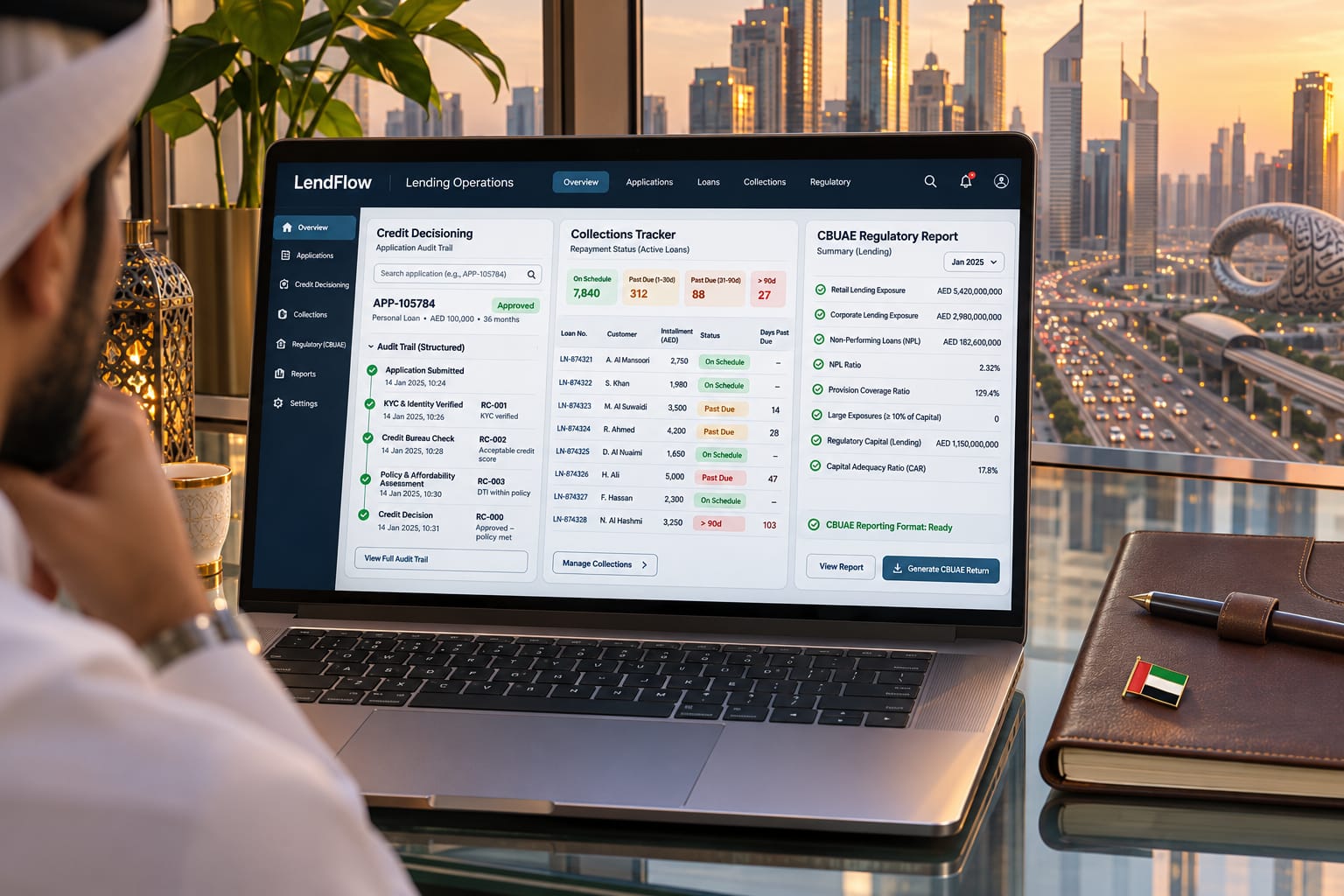
What a UAE Lender Should Build Before Chasing Growth

 Published by CodeNicely, the product studio founded by Meghal Agrawal and Ujjwal Agrawal in 2017
For: A founder or COO of a UAE-licensed NBFC or private lending firm with 500–5,000 active loans, manually reconciling repayments in spreadsheets and facing a CBUAE supervisory review within the next 12 months
In this guide
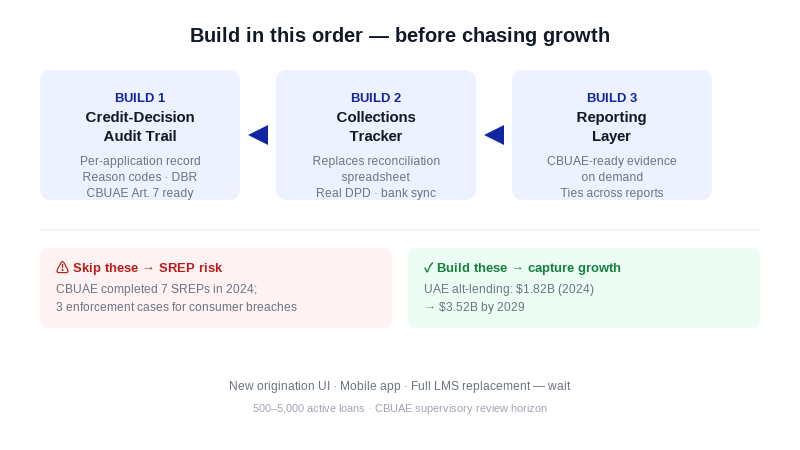
Before chasing more loan volume, a UAE lender with 500–5,000 active loans and a CBUAE supervisory review on the horizon should build three things in this order: an explainable credit-decisioning layer with a per-application audit trail, a collections tracker that replaces the reconciliation spreadsheet, and a reporting layer that produces CBUAE-ready evidence on demand. Everything else — new origination UIs, mobile apps, a full LMS replacement — can wait. Those three gaps are where margin leaks and where a Supervisory Review and Evaluation Process will find something to write up.
This is written for the founder or COO who already knows the spreadsheet is a problem, has been pitched a six-figure loan management suite, and suspects — correctly — that most of it would be shelfware. The market context supports being selective: the UAE alternative lending segment was valued at US$1.82 billion in 2024 and is projected to hit US$3.52 billion by 2029, and the personal loan segment alone supports around 2.85 million active accounts. The opportunity is real. The question is what to build to capture it without being the next enforcement case.
The three problems costing you real money
Ignore the pitch decks for a moment. In a 500–5,000 loan book being run on spreadsheets, the recurring losses almost always come from the same places.
1. Credit decisions that cannot be defended on paper
Credit officers are making calls using a mix of AECB pulls, bank statements, employer checks, and judgment. The decision gets recorded as "approved" or "rejected" with a note. That note is the problem.
CBUAE's Consumer Finance Standards, Article 7, require every Licensed Financial Institution to document the information obtained during the credit record examination and affordability assessment — per application. The Credit Risk Management Standards go further and require credit files to "contain sufficient information to track the decisions made and the history of the credit," including the financial analyses and the internal rating logic. A supervisor asking for 50 random files should see the same structure in each.
If you are already experimenting with an AI scoring model — or plan to — the CBUAE 2023 AI Guidance mandates an immutable audit trail of AI decisions affecting consumers and explainability for customer-facing AI. A gradient-boosted model that spits out a score with no human-readable reason codes is not acceptable evidence. It is a supervisory liability before it is a product feature.
2. Collections tracked in spreadsheets that drift from the bank
Repayments land in operating accounts. Someone downloads a statement, matches it to loan IDs, updates a spreadsheet, and sends reminders from a second spreadsheet. Partial payments, early settlements, and bounced direct debits create exceptions that get handled by email threads.
The margin leak here is twofold: officers spend more time on reconciliation than on calling delinquent borrowers, and the book's real DPD (days past due) distribution is always a few days stale. You under-provision, over-provision, or — most commonly — cannot tell which. Benchmarks from The Mortgage Office suggest automated servicing can save roughly 5,230 staff-hours and $262,000 annually against manual processes at comparable scale. Your numbers will differ, but the shape is right.
3. Reports that take a week to produce and still get questioned
When the regulator, the auditor, or the board asks for a portfolio cut — by product, by vintage, by DPD bucket, by officer — someone pulls three spreadsheets, writes a pivot, and prays. The number comes out. Nobody can fully explain the lineage. When a second report has to tie to the first, it does not.
This is the gap that turns a routine SREP into a bad one. CBUAE completed seven SREPs in 2024 and initiated three enforcement cases specifically for consumer protection breaches, and has signalled a tighter enforcement stance for 2025.
What to build, in order
Build 1: An explainable credit-decisioning layer with per-application audit trail
What it is. A thin decisioning service that sits between your origination intake (whatever it is today — form, broker portal, spreadsheet) and your approval queue. It pulls AECB data, parses bank statements, computes a DBR and affordability result, applies your policy rules, and — if you want a model — runs a scorecard. For every application it writes a single structured record: inputs used, rule results, score, reason codes in plain English, officer override (if any) and justification.
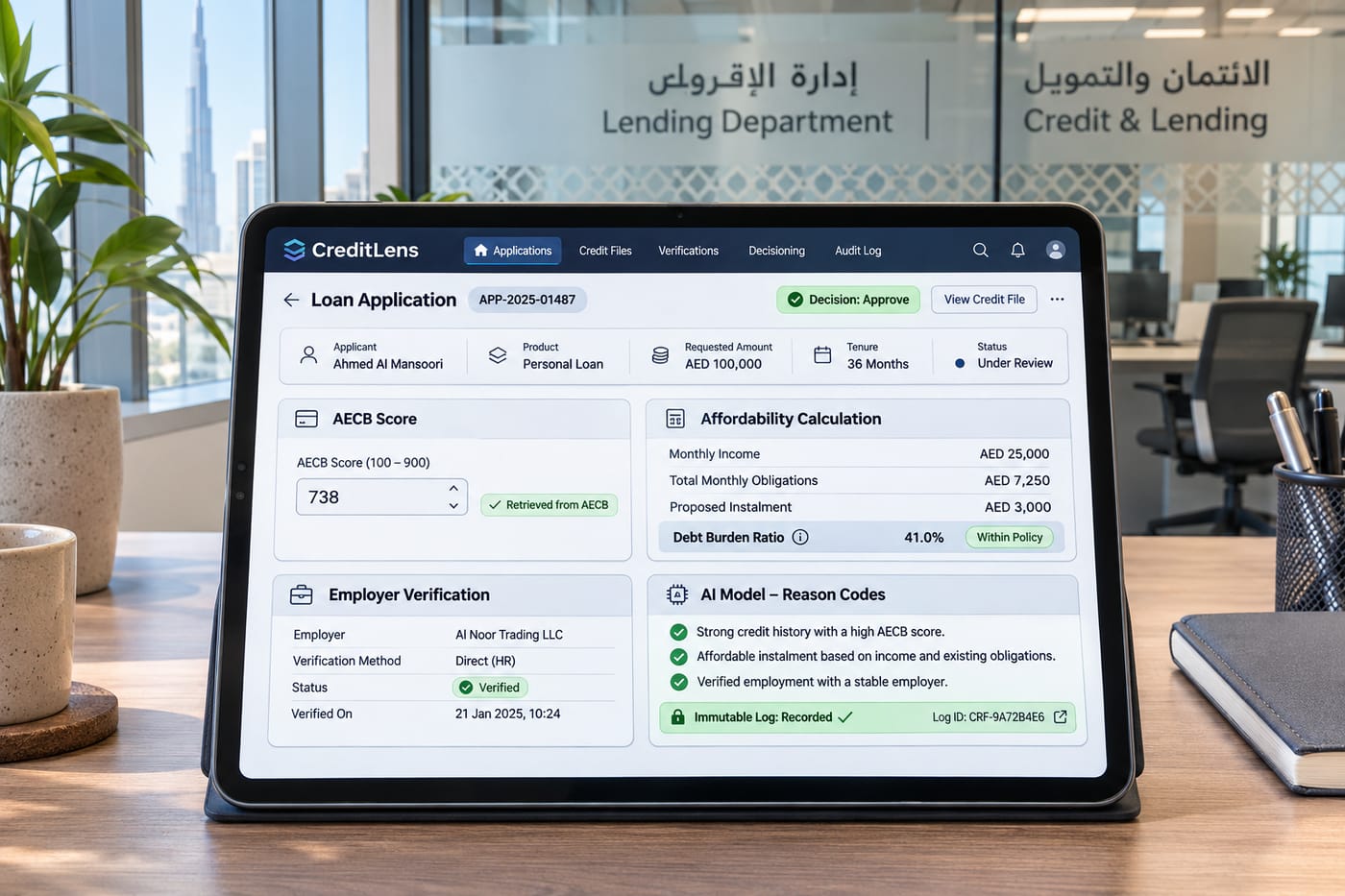
What changes once it exists. Every rejection has a documented reason the borrower can be told and the regulator can audit. Every approval has a documented affordability basis. Policy changes are versioned, so you can answer "what rule applied on 14 March?" in seconds. If you later move to an AI model, you have the explainability scaffolding already — reason codes, challenger-champion logging, override tracking — which is what the CBUAE AI Guidance actually asks for.
What it takes. This is the smallest of the three builds by surface area and the highest leverage. The hard parts are not technical. They are: getting your current credit policy written down in rules a system can execute (most lenders find this takes longer than the coding), integrating with AECB, and deciding which decisions require officer review versus auto-approval. Plan for the policy workshop to be the critical path, not the build.
What it is bad at. It will not improve your approval rate on day one. If your current scorecard is implicit in officers' heads, codifying it makes decisions consistent — not better. Model improvement is a later phase, once you have clean labelled outcomes from 12+ months of logged decisions.
Build 2: A collections tracker tied to a bank feed
What it is. A loan ledger — one row per loan, one row per expected instalment, one row per actual receipt — fed by an automated bank statement import (MT940, CSV, or API where your bank supports it). Matching rules handle the 80% of receipts that reconcile cleanly. An exceptions queue handles the rest with a human. DPD recalculates nightly. Reminder workflows (SMS, WhatsApp, email) trigger from the ledger state, not from someone's calendar.
What changes. Reconciliation stops being a job and becomes an exceptions-only task. Your DPD distribution is current to yesterday. Officers call borrowers who need calling, not borrowers who paid last Tuesday. Provisioning becomes a query, not a project. Cerulli research cited by industry reports suggests officers at automated lenders process around 2.3× more applications than manual peers — the same shape shows up in collections.
What it takes. The ledger model is straightforward. The friction is at the bank — not every UAE bank exposes a clean API, and statement formats vary. Expect to build a parser per bank you use. Settlement products (early closure, restructures, write-offs) also need explicit handling; teams underestimate this.
What it is bad at. It will not fix a book that has already drifted. If your spreadsheet balances do not match your bank, that is a one-time data cleanup before go-live, not something the tracker does for you.
Build 3: A reporting layer the regulator and your auditor can both use
What it is. A read-only reporting database — populated from the decisioning service and the collections ledger — with a fixed set of CBUAE-aligned reports (portfolio by product, vintage curves, DPD buckets, provisioning, concentration, consumer complaint tracking) plus an ad-hoc query interface for your finance team. Every report cites its inputs and its as-of timestamp. Numbers tie across reports because they come from one source.
What changes. The week of spreadsheet work before a board meeting becomes an hour. Supervisory data requests get answered the same day. Your external auditor stops asking the same reconciliation questions every year. When CBUAE asks for the credit file evidence they require under the Credit Risk Management Standards, you can produce it for any loan, in any period, without a manual pull.
What it takes. This build only works if builds 1 and 2 are in place. Reporting on bad data is worse than no reporting. The effort is mostly in defining the reports with your compliance lead and your auditor — not in the technology.
What not to build yet
- A customer-facing mobile app. Unless you are originating direct-to-consumer at volume, this is a distribution bet, not an operations fix. Build it after the three above.
- A full LMS replacement. Your current system — even if it is spreadsheets plus a basic core — can coexist with the three services above via integrations. Replacing the core is a 12–18 month project that distracts from the regulatory clock.
- A sophisticated ML scorecard. You do not have enough clean, labelled outcome data yet. Collect it for 12 months with Build 1, then revisit.
- Broker portals, white-label partner UIs, BNPL extensions. Growth features. Not what a supervisor is going to ask about.
Cost and timeline — the shape, not a quote
The honest answer is that the range for these three builds is wide because four things drive it: how many source systems need integration (AECB is a given; bank feeds vary; core banking integration is the heaviest), how codified your current credit policy already is, how clean your historical loan data is, and whether you need an AI scorecard in scope now or later.
For a sense of the stakes on the other side: industry benchmarks cited for manual origination put total fulfillment cost at $9,000–$11,000 per loan — 15–40% above the $4,000–$6,000 at digitised peers, with redundant data entry alone accounting for $1,500–$3,000 per loan. Multiply by your origination volume and the business case usually writes itself.
Illustrative only — a lender with ~2,000 active loans, one AECB integration, two bank feeds, an existing but undocumented credit policy, and no AI scorecard in scope can reasonably treat the three builds as a phased programme measured in months rather than quarters, with Build 1 live before Build 2 goes into UAT. The specific numbers depend on the four drivers above plus your appetite for parallel vs sequential delivery. To turn this shape into an actual quote, three things need to be scoped: the list of source systems and their API maturity, the current state of your written credit policy, and the condition of your historical loan and repayment data. That is a conversation, not a form.
None of this is legal or regulatory advice. Your compliance lead and external counsel should sign off on how your implementation maps to the CBUAE rulebook.
How CodeNicely can help
The closest parallel in our work is Cashpo, a lending engagement where the core problems were the same shape as the ones above: a credit decisioning pipeline that had to be explainable and auditable, KYC and bureau integrations that had to be reliable at volume, and a collections and reporting stack that had to survive scrutiny. The build order we used there — decisioning and audit trail first, servicing and collections second, reporting last — is what this post recommends, because it is what held up under real regulatory and operational pressure.
For UAE lenders specifically, our Dubai team works with the CBUAE rulebook as a design input, not a compliance afterthought, and our AI Studio builds scoring models with reason-code explainability wired in from day one — because a model you cannot defend in a supervisory review is not a model you can deploy. You keep full IP. No vendor lock-in.
How to sequence the next 90 days
- Weeks 1–3: Write down your current credit policy as executable rules. Do this with your head of credit in a room. This is the hardest step and the one that unblocks everything else.
- Weeks 2–4: In parallel, audit your historical loan and repayment data against your bank statements. Identify the reconciliation gap. Decide on a cutoff date for the new ledger.
- Weeks 4–10: Build and deploy the decisioning service with per-application audit trail. Run it in shadow mode for two weeks against live applications before switching.
- Weeks 8–16: Build the collections tracker and bank feed integration. Migrate the open book. Retire the reconciliation spreadsheet.
- Weeks 14–20: Build the reporting layer against the now-clean data. Walk through it with your external auditor before your next SREP.
Then, and only then, start talking about the mobile app, the broker portal, and the ML scorecard. By that point you have the data to make those bets properly, and a supervisor who finds nothing to write up.
Frequently Asked Questions
Do we have to replace our existing loan management system to do this?
No, and you probably should not. The decisioning, collections and reporting layers described here can sit alongside most existing core systems via integrations. A full LMS replacement is a 12–18 month programme that competes with — rather than solves — the regulatory timeline. Replace the core later, once the three fixable gaps are closed.
Can we use an AI model for credit scoring under CBUAE rules?
Yes, but with conditions. The CBUAE 2023 AI Guidance requires explainability for customer-facing AI and an immutable audit trail of decisions affecting consumers. In practice that means reason codes in human-readable terms for every decision, documented model governance, and the ability to show a supervisor why any specific applicant was rejected. A pure black-box model will not clear this bar. Your compliance team and counsel should sign off on the specific setup.
What does a project like this cost and how long does it take?
The range is driven by four things: the number and maturity of source system integrations (AECB, bank feeds, core banking), whether your credit policy is already written down as rules, the condition of your historical data, and whether an AI scorecard is in scope now or deferred. We do not quote a figure without scoping those — the delta between a clean scope and a messy one is large. A short scoping conversation is what turns the shape into a real number.
How do we prepare for a CBUAE supervisory review in the meantime?
Start with evidence. Pull 30 random recent loan files and check whether each one has the credit record examination and affordability assessment documented as Article 7 requires. Where files are thin, backfill what you can and record what you cannot. That exercise usually tells you — faster than any gap assessment — where Build 1 needs to focus first.
We have fewer than 500 active loans. Is this still relevant?
Mostly yes, but sequence differently. At smaller scale, the collections tracker and reporting layer can often come first because manual decisioning is still manageable. The decisioning build becomes urgent as application volume rises or as you introduce any model-based scoring. The regulatory requirements apply regardless of book size.
Sources & further reading
- UAE Alternative Lending Business Report 2025 — GlobeNewswire (ResearchAndMarkets)
- UAE FinTech Lending & SME Credit Platforms Market — Ken Research
- UAE Personal Loan Market Advances Toward USD 79,657 Million by 2030 — Ken Research / OpenPR
- CBUAE Rulebook — Article 7: Responsible Financing Practice (Consumer Finance Standards)
- CBUAE Rulebook — Credit Risk Management Standards
- UAE CBUAE AI Regulation: AI Guidelines 2023 — LetsAskClaire
- What the CBUAE's AI Guidance Means for Credit Decisioning in the UAE — Finbox Research
- CBUAE Annual Report 2024 (PDF)
Get one practical guide a week
Costs, AI tools, partner selection — written for people who make the decision. No spam, unsubscribe anytime.
Thanks — you're on the list. One practical guide a week, nothing else.
That didn't work — please check the email address and try again.
Building something in Lending & NBFC?
CodeNicely partners with founders and tech teams to ship AI-native products that move metrics. Tell us about the problem you're solving.
Talk to our team Book a 30-min call