
What to Build for Event Management Companies in India

 Published by CodeNicely, the product studio founded by Meghal Agrawal and Ujjwal Agrawal in 2017
For: Owner or COO of a mid-sized Indian event management company — handling 50–200 events a year across corporate, wedding, and MICE segments — whose operations still run on WhatsApp threads, manual vendor POs, and post-event Excel reconciliations, and who is deciding whether to buy an off-the-shelf tool or build something that actually fits how Indian events work
In this guide
If you run a mid-sized Indian event management company doing 50–200 events a year, the software worth building first is not a CRM, not a floor-plan designer, and not another booking widget. It is a vendor payment and TDS reconciliation layer that understands Section 194C, wired to a venue availability system your coordinators actually trust, with a WhatsApp-based approval trail that produces an audit log. Everything else — guest check-in apps, badge printing, lead capture — is commodity you can buy. The three things above are where your margin is leaking, and no off-the-shelf Indian event platform handles them properly.
This post is a build order, not a feature list. It assumes you already know your operations and are trying to decide where to spend the first ₹15–40 lakh of software budget without being sold a generic SaaS seat licence that your ops team will abandon by event three.
Where the money actually leaks
India's event management and exhibitions market is worth USD 5.23 billion in 2024 and projected to hit USD 7.80 billion by 2029. The MICE slice alone generated USD 49.4 billion in 2024 and is expected to double by 2030. And yet the dedicated event management software market in India is valued at just USD 0.49 billion. That gap — a massive industry running on almost no dedicated software — is why you are reading this. Most of your competitors are also on WhatsApp and Excel.
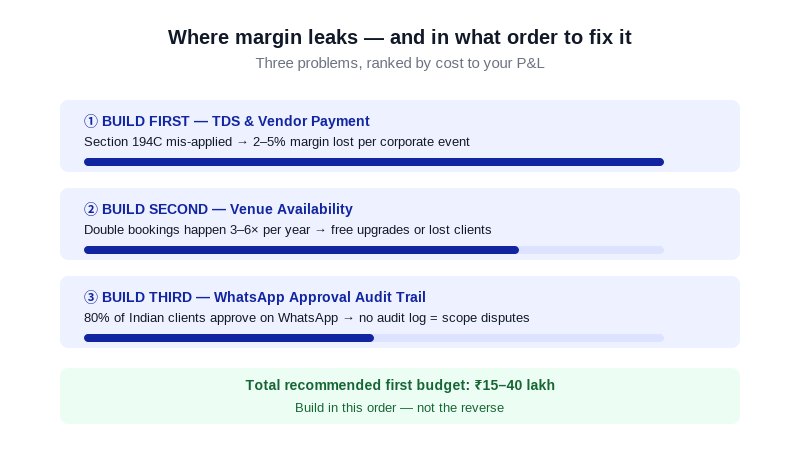
Three operational problems cost real money at your scale. Rank them honestly against your own P&L before you decide the order.
1. Vendor payment reconciliation that breaks against GST TDS
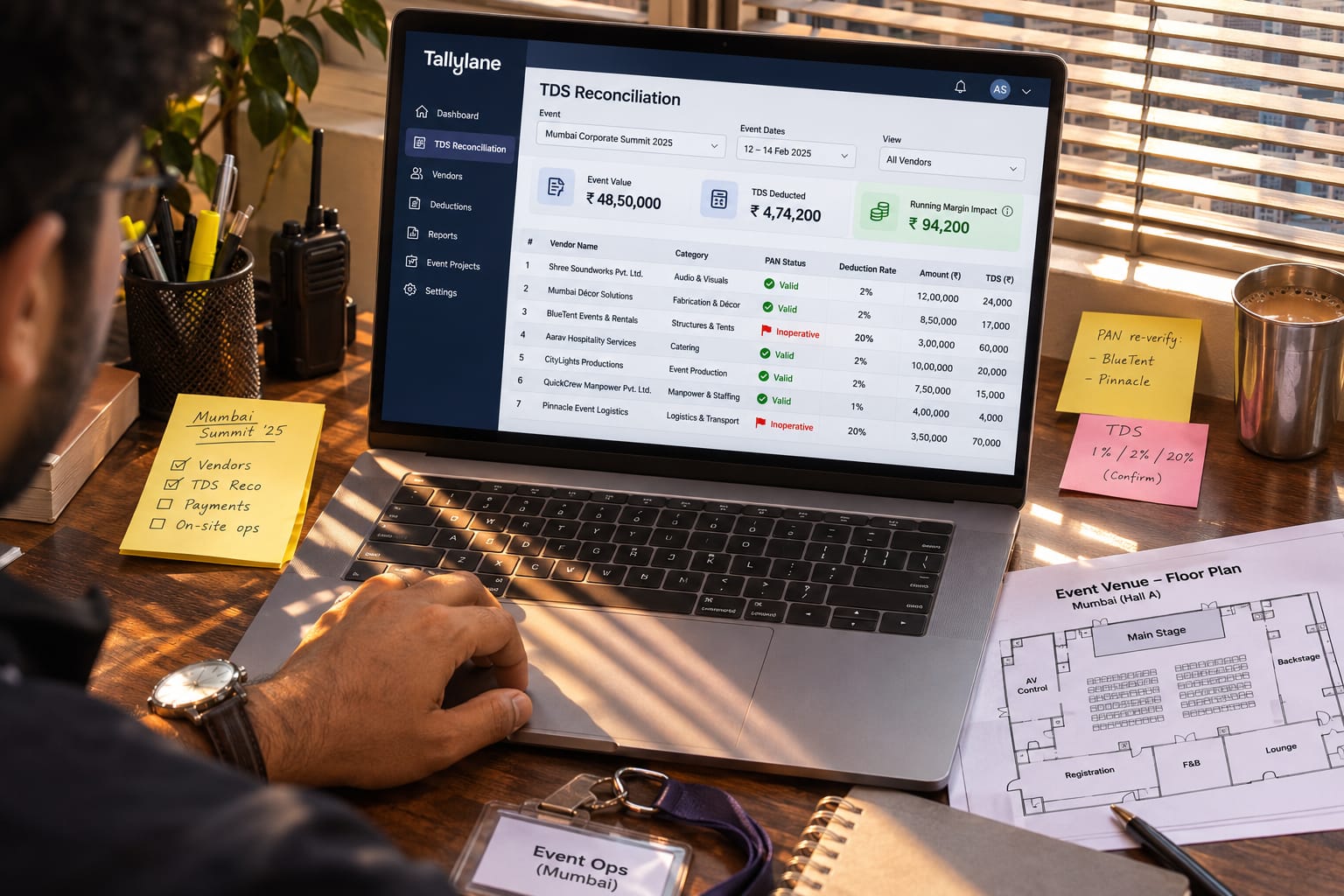
This is the one almost nobody talks about and the one that quietly eats 2–5% of margin on every corporate event. Under Section 194C of the Income Tax Act, when you pay a contractor — your sound guy, your decor vendor, your transport partner — you must deduct TDS at 1% (individual/HUF) or 2% (company/firm/LLP) on payments above ₹30,000 per contract or ₹1 lakh in aggregate annually. If the vendor's PAN is inoperative or missing, the rate jumps to 20% under Section 206AA. Section 194C has also been renumbered to Section 393(1) under the new Income Tax Act 2025, with Form 26Q replaced by Form 140.
The downstream mess is worse. Your client's finance team often applies Section 194J at 10% (professional fees) when the defensible rate is Section 194C at 2% — a 5× over-deduction on the same invoice. You get paid less, your working capital bleeds, and recovering the excess means chasing certificates and filing refund claims months later. Meanwhile, under Section 194C(2), you are also liable to deduct TDS at the sub-contractor layer — a step most event companies skip entirely until an assessment notice arrives.
No generic event platform — not Cvent, not Zoho Backstage, not Hubilo — has TDS deduction logic that matches Indian contractor classification, PAN validation against the income tax portal, and the new Section 393 payment codes. They treat payments as a generic ledger. Your finance team then re-does the whole thing in Tally after every event.
2. Venue inventory that nobody trusts
If you operate owned or exclusive-partner venues — banquet halls, farmhouses, convention spaces — your availability almost certainly lives in a shared Google Sheet or a WhatsApp group where the venue manager posts holds. Double bookings are not a theoretical risk; they happen 3–6 times a year and each one costs you either a client or a free upgrade. The reason SaaS doesn't fix this is that Indian venue holds are not binary. There are tentative holds, blood-relative holds, muhurat-date holds that expire at 48 hours, and advance-paid confirmed bookings — all of which need different override rules and different notification chains to sales.
3. Client approval chains that live in WhatsApp
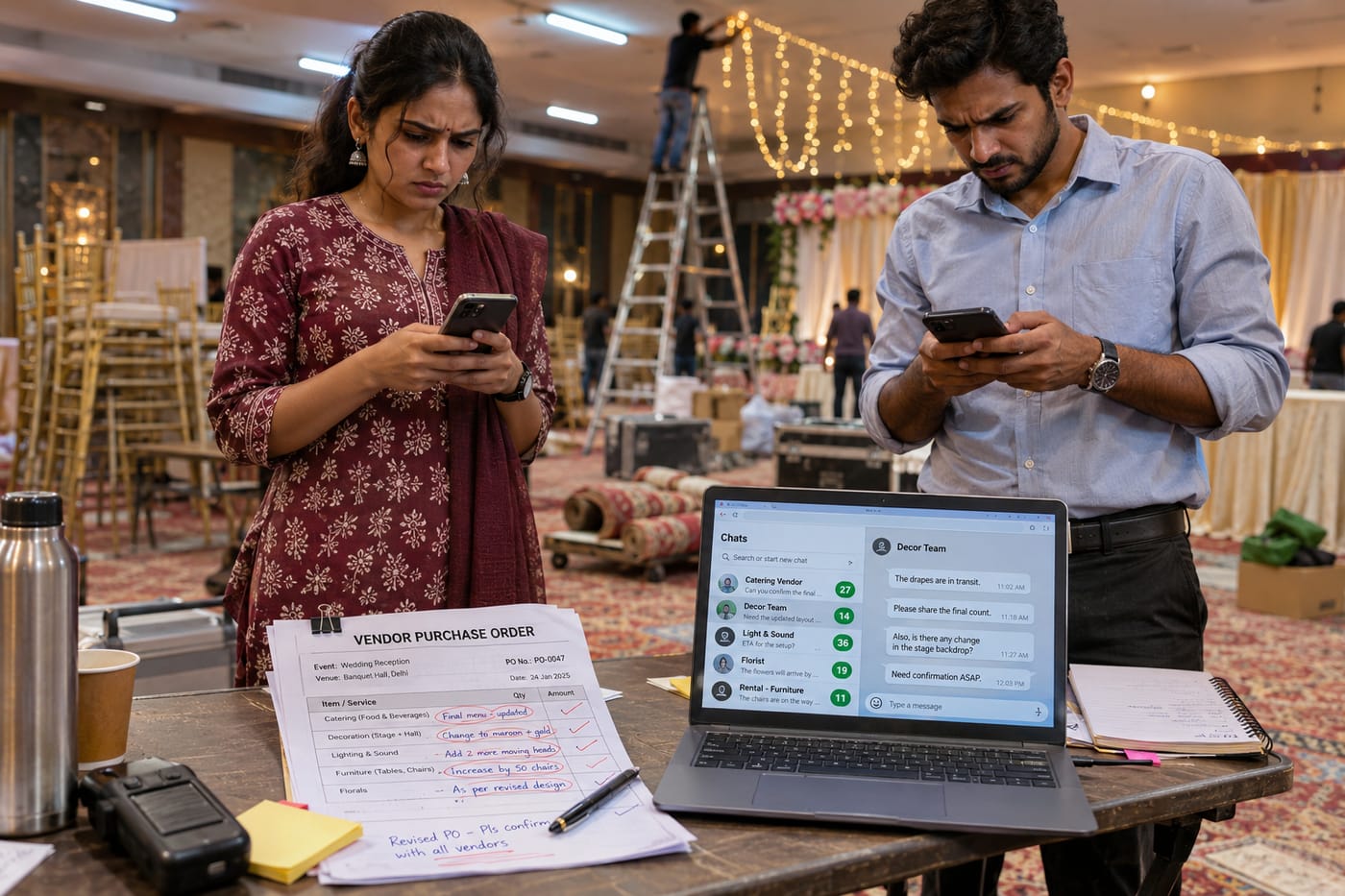
A Morning Consult survey found 80% of Indian businesses see WhatsApp as a helpful tool for client interaction. This is structural. Your clients will approve the stage design, the menu, and the ₹4 lakh overrun on floral decor over WhatsApp whether or not you have a portal. The question is not how to move them off WhatsApp — you cannot — but how to capture those approvals into an audit trail that stands up when the client's finance team disputes a scope change two months later.
The build order
Build first: the TDS-aware vendor payment module
What this is: a vendor master with PAN, GSTIN, contractor classification (individual/HUF vs company/firm), and the right TDS section mapping (194C vs 194J vs 194H) stored per vendor, per contract type. Every purchase order generated calculates expected TDS at the right rate. Every payment release runs a PAN validity check against the government portal and either applies the standard rate or flips to 20% under 206AA. Reconciliation reports export directly into the format your Tally or Zoho Books instance expects, mapped to the new Section 393 codes.
What changes: your finance team stops doing event-close reconciliation as a separate week-long exercise. Vendor disputes over short-paid invoices drop because the deduction logic is visible to them at PO stage, not sprung on them at payment time. Client disputes over which TDS section applies get resolved with a one-page classification memo generated per invoice.
What it takes: this is 10–16 weeks of focused build if you have one person on your side who owns the chart of accounts and vendor master cleanup. The driver of effort is not the software — it is the data migration from however your vendors are currently recorded. A clean vendor master with validated PANs is 40% of the project.
Build second: the venue inventory and hold-management system
What this is: a single source of truth for every date-slot across every venue you operate or control, with hold-type logic (tentative/muhurat/confirmed), auto-expiry, conflict detection, and WhatsApp notifications to sales when a hold is about to lapse. Integrated with a basic quote-to-booking flow so a sales enquiry converts to a hold in one action.
What changes: double bookings go to zero. Your venue utilisation data becomes real, which means you can finally see which Tuesday slots are chronically empty and price them differently. Sales stops calling the venue manager 15 times a day to check availability.
What it takes: 6–10 weeks. Simpler than the TDS module because the logic is contained. The complexity is purely in getting the hold-type taxonomy right for how your business actually sells, which needs two or three workshops with your sales head before any code is written.
Build third: WhatsApp approval capture with audit trail
What this is: a WhatsApp Business API integration where client approvals on quotes, change orders, and scope revisions are requested through structured message templates with yes/no/comment buttons. The response is logged against the event record with timestamp, phone number, and message ID. Nothing fancy on the client side — they still feel like they're on WhatsApp — but you get an immutable record.
What changes: scope dispute resolution time drops from weeks to minutes. You can produce an approval trail for any line item on demand, which matters most during post-event collections when the client's procurement team is looking for reasons to short-pay.
What it takes: 4–8 weeks, mostly spent on WhatsApp Business API provisioning (Meta's approval process is slow and opaque) and template approvals. The actual software is small.
Build fourth, maybe: the event ops layer
Run-sheets, vendor check-in, guest manifests, on-site crew coordination. This is where most event software starts, and it is also where buying beats building. Tools like Zoho Backstage, Explara, or even a well-configured Notion template get you 80% of the way for a fraction of custom build cost. Build here only if you have a genuine differentiator — for example, if you run large MICE events where the exhibitor logistics module of commercial platforms genuinely doesn't fit.
Don't build: anything client-facing and shiny
Event microsites, RSVP apps, branded guest apps, AR seating previews. Clients ask for these, pay for them once, and never use the data. Either white-label a vendor or build a lightweight template system. Not worth engineering time at your scale.
What this costs and how long it takes
The honest answer is that a full build of modules 1–3, properly integrated with your accounting system and deployed with your ops team trained, is a 6–9 month program. The cost model has four drivers, in order of impact:
- Vendor master and chart of accounts cleanup. If your current data is a mess — duplicate vendors, missing PANs, inconsistent contractor classification — this is 30–40% of the project and no software decision changes it.
- Number of accounting integrations. One Tally instance is straightforward. Tally plus Zoho Books plus a client-side SAP feed is a different conversation.
- Number of venues and hold-type complexity. Five venues with three hold types is one build; 40 venues across four cities with franchise-partner override rules is another.
- WhatsApp Business API approval. Not your cost, but it gates your timeline by 3–6 weeks and you cannot compress it.
The India event software market sitting at just USD 0.49 billion against a USD 5+ billion event industry tells you most peers are spending nothing. That is also why most peers are stuck. A custom build in this space is not a vanity project — it is the fastest way to recapture the 2–5% of margin currently lost to TDS disputes and double bookings.
To turn these ranges into an actual quote you would need to pin down three things: how clean your current vendor master is, which accounting system is the source of truth, and how many venue+hold-type combinations the booking logic needs to handle. Those three answers move the number more than anything else.
How CodeNicely can help
The closest analogue in our portfolio is GimBooks, the YC-backed accounting and invoicing platform we built for Indian MSMEs. That engagement was fundamentally about getting Indian tax logic — GST, TDS, e-invoicing — right at the data layer, not bolted on as a report. The same engineering discipline is what a Section 194C-aware vendor payment module needs: the tax rules live in the schema and the workflow, not in a PDF your finance team consults.
We work with scaleups through our digital transformation practice on exactly this kind of operations rebuild — where the problem is not a lack of software but the wrong software, and where generic SaaS has been tried and abandoned. If you are at the 50–200 events a year mark and your finance team spends more than a week per month on post-event reconciliation, that is the signal. Full IP ownership, no vendor lock-in, and the code sits in your repo from day one.
Sequencing summary
- Months 1–4: TDS-aware vendor payment and reconciliation module. Highest margin recovery.
- Months 3–6: Venue inventory and hold management, running parallel once the vendor master is clean.
- Months 5–8: WhatsApp approval capture, after the backend records exist to log against.
- Month 9+: Buy, don't build, for guest check-in and on-site ops. Revisit only if you find a real gap.
The event industry in India directly employs over 10 million people and supports 50 million indirectly, with the organized segment accounting for only about 50% of the market. The companies that will consolidate the next decade of this growth are the ones whose finance ops scale without adding headcount. That is a software problem, and it is a solvable one — as long as you build the right three things first and do not get sold the generic platform.
Frequently Asked Questions
Should an Indian event company buy Cvent or Zoho Backstage instead of building?
Buy them for what they're good at — guest registration, agenda management, basic event websites. Don't expect them to handle Section 194C TDS logic, Indian vendor contractor classification, or the hold-type complexity of Indian venue bookings. The right answer is usually a hybrid: buy the commodity guest-facing layer, build the finance and venue backend.
How much does event management software cost to build in India?
The cost model depends on four things: how clean your existing vendor and venue data is, how many accounting integrations you need, the complexity of your venue hold-type rules, and whether you need WhatsApp Business API provisioning. A focused build of the three high-margin modules is typically a 6–9 month program. To get a real number you need a scoping conversation that looks at your actual chart of accounts, your current vendor master, and your venue portfolio — anyone quoting a flat figure before seeing those is guessing.
Is Section 194C or 194J the correct TDS section for event management invoices?
Section 194C at 2% is the defensible position for most event management work because it is contract-based execution, not professional services. Client finance teams often apply 194J at 10% incorrectly, a 5× over-deduction. A lawyer or chartered accountant should review your specific contract structure — this post is not tax advice — but the industry pattern and recent clarifications support 194C for execution-led scopes.
Can we start with just the venue booking module and add the TDS module later?Yes, and some companies should. If your event mix is heavily venue-driven (wedding venues, banquet halls) and double bookings are your most visible pain, start there. If you run mostly corporate events with heavy vendor spend and thin margins, start with the TDS module because that's where your money is leaking faster. Pick the order based on your P&L, not on what is technically easier.
What's the risk of building custom software versus staying on WhatsApp and Excel?
The risk of custom software is that it goes stale if nobody owns it internally. The risk of staying on WhatsApp and Excel is that you cannot scale past 200 events a year without doubling your ops and finance headcount, and that one bad TDS assessment or one double-booked wedding costs more than the software would have. Build only if you have one operations leader who will own the rollout — without that, buy and stay small.
Sources & further reading
- Understanding the Surge in Demand for Event Management in India — IBEF
- India Event Management Software Market Size, Share & Growth Report 2035 — Market Research Future
- India MICE Market Size & Outlook, 2030 — Grand View Research
- MICE Market in India Set to Double in Size by 2030 — TravelBiz Monitor
- TDS on Contractor Payments (194C): 1% Rate, ₹30,000 Threshold TY 2026-27 — taxrate.in
- TDS on Event Management Services in India (2026 Guide) — signupdesk.in
- 194C TDS Is Now Section 393: Rates and Limits — taxgarden.in
- Section 194C TDS on Contractor Payments 2026 — legalsuvidha.com
Get one practical guide a week
Costs, AI tools, partner selection — written for people who make the decision. No spam, unsubscribe anytime.
Thanks — you're on the list. One practical guide a week, nothing else.
That didn't work — please check the email address and try again.
Building something in Events & Venue Management?
CodeNicely partners with founders and tech teams to ship AI-native products that move metrics. Tell us about the problem you're solving.
Talk to our team Book a 30-min call