
What to Build for Accounting Firms in the UK

 Published by CodeNicely, the product studio founded by Meghal Agrawal and Ujjwal Agrawal in 2017
For: Owner or managing partner of a 5–40-person UK accounting or bookkeeping practice who is losing clients to faster competitors and watching staff drown in MTD admin, client chasing, and manual year-end prep
In this guide
- The three gaps that cost UK firms real money
- Why AML automation is the first build, not the portal
- Second build: an MTD data-capture layer that lives on the client's phone
- Third build: advisory triggers from the data you already hold
- What not to build (yet)
- What this costs and how long it takes — the shape, not the number
- Sequencing: what to do in what order
- Frequently Asked Questions
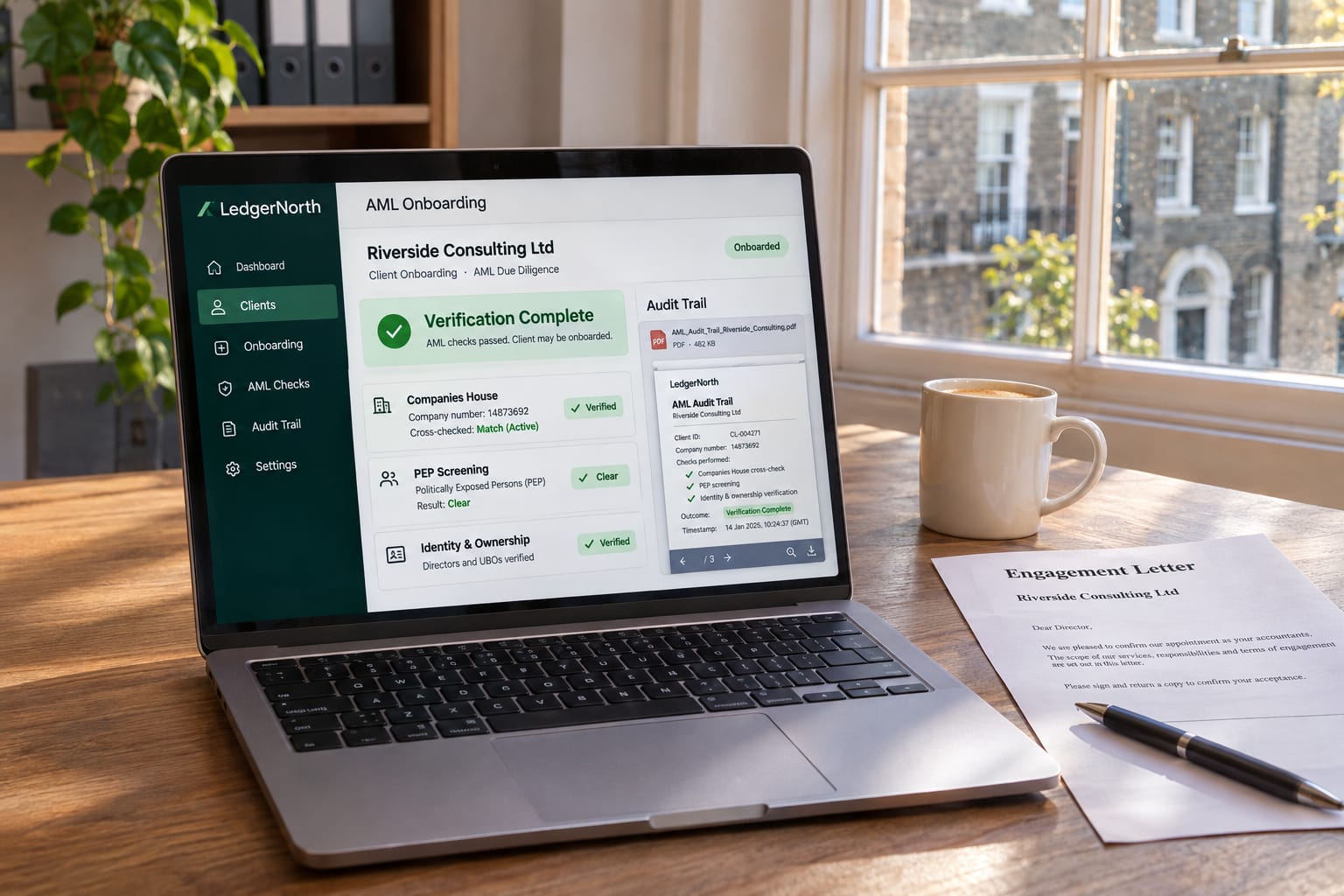
If you run a 5–40-person UK practice and can only fund one build this year, build an automated AML and Companies House verification workflow that attaches a signed, timestamped audit trail to every engagement letter. Not a client portal. Not a document vault. The AML workflow — because it is the one piece of your operation where the regulator, the client, and your margin all point in the same direction, and almost no off-the-shelf tool produces evidence that survives a supervisory review without a partner hand-finishing it.
The reasoning below assumes you already use Xero or QuickBooks, you already have some form of practice management (even if it is Senta, Karbon, or a spreadsheet), and the problem is not that you lack software — it is that the software you have does not touch the three places where you are actually losing hours and clients.
The three gaps that cost UK firms real money
Before deciding what to build, be honest about where the leak is. In practices this size, it is almost always these three:
1. Onboarding takes two weeks and eats a half-day per client
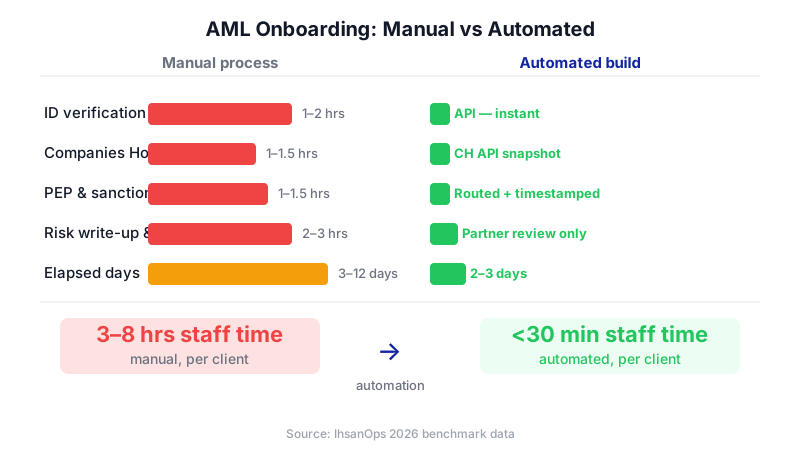
Manual client onboarding at a UK accounting firm runs 3–8 hours of staff time per new client across 3–12 elapsed days, with automation benchmarks showing the same work can be done in under 30 minutes of staff time and 2–3 elapsed days (IhsanOps 2026 benchmark data). That gap is mostly AML: ID verification, PEP and sanctions screening, source-of-funds documentation, UBO identification for corporates, Companies House filings cross-check, and risk assessment write-up.
The cost is not just the hours. It is the 10–15% of prospects who go cold during the wait, and it is partner time spent on checks a junior should have finished.
2. MTD data collection still happens by email
MTD for Income Tax is now mandatory for sole traders and landlords earning over £50,000, with 864,000 individuals required to sign up from April 2026 — but fewer than 3 in 10 had actually signed up by April 2026. The threshold drops to £30,000 in April 2027 and £20,000 in April 2028, and HMRC estimates up to 2.9 million taxpayers will eventually fall into scope.
For a firm with 300 sole-trader clients, that is four quarterly submissions per client instead of one annual return — a 4x increase in touchpoints, most of which currently start with a chasing email for receipts and bank statements. No practice-management tool solves this cleanly because the work is not inside your firm; it is inside your client's phone.
3. Advisory revenue is left on the table because compliance work is not automated
Every partner knows the firms making real margin are selling advisory. The reason yours is not is that your senior people spend their week on bookkeeping review, VAT, and payroll questions that could be resolved by a mid-level with the right tooling. Advisory capacity is a residual — it only shows up when compliance stops consuming it.
Why AML automation is the first build, not the portal
Every vendor demo opens with the client portal because it is the easiest thing to show. It is the wrong starting point for three reasons.
The regulator is tightening, not loosening. ICAEW supervised 9,500 firms in FY2024/25, completed 1,185 AML monitoring reviews, and found 20% of firms non-compliant, with fines more than doubling year-on-year from £92,025 to £197,706. HMRC separately raised AML supervision fees by 33% from December 2025, the first increase in six years, affecting roughly 37,000 UK businesses. The direction of travel is more scrutiny per firm, not less.
The evidence standard is documentary, not procedural. Supervisors do not want to hear that you did the check. They want to see the screenshot, the timestamp, the Companies House snapshot on the date it was taken, the risk-rating logic, and the partner approval. Off-the-shelf AML tools (Credas, SmartSearch, VinciWorks) do the check well, but they do not natively stitch that evidence to the engagement letter and the client file in a shape your supervisor can audit without you preparing a bundle.
This is where the hours actually leak. Portal adoption saves clients time, which is nice but does not change your P&L. AML automation saves partner and senior-manager time, which does.
What the AML build actually looks like
A working version has four pieces:
- An API-driven verification layer that calls an existing KYC provider (Credas, SmartSearch, OnfidoComplyAdvantage) for ID, PEP, and sanctions, plus Companies House API for entity, director, and PSC data. Do not build the verification engines — buy them.
- A risk-scoring workflow that applies your firm's risk matrix (client type, jurisdiction, cash-intensive sector, PEP exposure) and routes high-risk cases to a partner with the specific reasons flagged. This is the part nobody sells well off the shelf because every firm's matrix is different.
- An evidence vault that stores every API response, every document, and every decision with a cryptographic timestamp, linked to the client record and the engagement letter version. This is what survives a supervisory review.
- Engagement-letter integration so the signed letter cannot be issued until AML clears, and so re-verification triggers (annual review, change of directors on Companies House, new PEP hit) auto-raise a task.
What changes once this exists: onboarding time drops from 3–8 hours to roughly 30 minutes of human review; elapsed time falls to 2–3 days; the audit bundle for an ICAEW or HMRC visit is generated in a click rather than reconstructed over a weekend; and ongoing monitoring (the part most firms quietly skip) becomes a queue, not a resolution.
What it is bad at: this build does nothing for client experience, nothing for fees, and nothing for your website. It is a defensive investment that pays back in staff hours and insurance against a supervisory finding. If your firm has never had an AML visit and you are convinced you never will, build something else.
Second build: an MTD data-capture layer that lives on the client's phone
Once AML is handled, the next bottleneck is the quarterly submission wave. The MTD rollout is staged: £50,000+ from April 2026, £30,000+ from April 2027, £20,000+ from April 2028. If you have a long tail of sole-trader and landlord clients, your submission count is about to double, then double again.
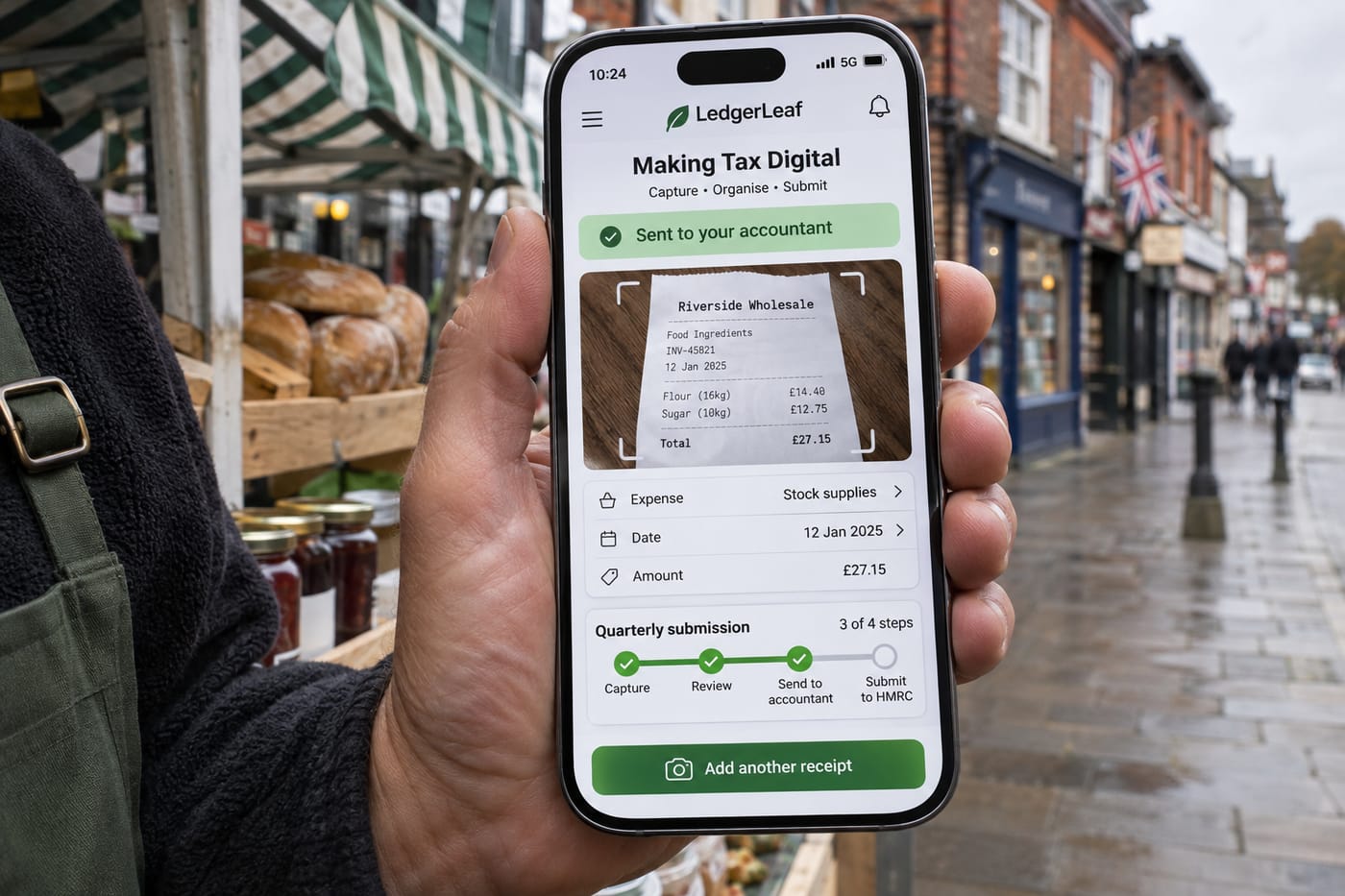
The off-the-shelf answer is to push every client into FreeAgent, Xero, or QuickBooks. For clients who already keep records digitally, fine. The problem is the other 60% — the sole trader with a shoebox of receipts and a current account. They will not learn bookkeeping software for a £50,000 turnover business. They need a WhatsApp or SMS workflow: snap the receipt, forward the bank CSV once a month, answer three questions a quarter.
What to build:
- A WhatsApp Business ingestion channel that accepts receipt photos, parses them with a vision model, and posts them to the client's ledger (Xero, QuickBooks, or an internal store). GimBooks took a comparable approach for Indian micro-businesses who would not open a laptop to do accounting.
- Bank-feed reconciliation that auto-categorises 80%+ of transactions using the client's own history, with a review queue for your team on the rest.
- A quarterly submission dashboard that shows which clients are ready, which are chasing, and which have not responded — so your team works a queue instead of a mailbox.
What it is bad at: it will not help clients who want handholding or who have genuinely complex affairs. Those still need a human. The build is for the long tail, and the ROI is the ability to serve twice as many quarterly submissions without hiring.
Third build: advisory triggers from the data you already hold
Only after the first two are working. Advisory does not sell because partners do not have time to prospect it and because nobody systematically scans the client base for the moments when advice is actually needed.

A thin build here is high-leverage: a rules engine that runs over your client ledgers weekly and flags situations — a limited company approaching the VAT threshold, a sole trader whose profits now justify incorporation, a client with persistent director's loan balances, a landlord whose income just crossed a Section 24 inflection point. Each flag becomes a draft email to the partner with the numbers already pulled.
You are not replacing the partner's judgement. You are replacing the partner's scan.
What it is bad at: this build only works if your client ledger data is clean. If half your clients are on spreadsheets, fix that first. This is why it is the third build, not the first.
What not to build (yet)
- A bespoke practice management system. The global market for this software was $3.5bn in 2024 and growing at 8.2% CAGR. Karbon, Senta, Iris, and BrightManager cover the general case well. Build around them, not instead of them.
- A client portal as a standalone project. Most clients will not log in. Meet them in email and WhatsApp, which they already use.
- A branded mobile app. Unless your firm is 100+ people with a specific niche, the download-and-install friction kills adoption.
- AI chat for clients. Accurate tax advice from a chatbot is a liability exposure no partner should accept in 2026. Use AI internally for triage and drafting, not externally for answers.
What this costs and how long it takes — the shape, not the number
A custom AML and onboarding workflow is a smaller build than people assume, because most of the heavy lifting (identity verification, sanctions screening, Companies House data) is bought as API calls, not built. What drives the number is: how many KYC providers you want to connect; whether your risk matrix is simple or branched; whether the evidence vault has to integrate with your existing DMS (iManage, SharePoint, Virtual Cabinet) or can stand alone; and whether the engagement letter sits in a third-party tool (GoProposal, Ignition) that exposes an API.
The MTD data-capture layer is driven by the number of client-facing channels (WhatsApp alone, or WhatsApp plus SMS plus email), the accounting platforms you need to post back into, and the volume of transactions you are parsing monthly — vision-model API costs scale with receipt volume and are the main recurring line.
The advisory trigger engine is the cheapest of the three to build and the most dependent on the quality of your underlying ledger data.
Timelines move with the same levers. A single-integration AML MVP with a stand-alone evidence vault is a different calendar from one that has to write back into Karbon and trigger DocuSign. To turn any of this into a real quote, three things need to be on the table: the KYC and verification providers you already pay for or want to use, the practice-management and engagement-letter tools the workflow has to touch, and a rough client-count-by-type (sole trader, limited company, landlord, trust) so the risk matrix can be scoped. A scoping conversation with a team that has built in this space — CodeNicely's offerings page covers the shape of that engagement — is where ranges turn into numbers.
Sequencing: what to do in what order
- Months 1–3: AML and onboarding workflow. Defensive, measurable, and the most likely to pay back in staff hours within a year. HMRC's own AML supervision cost £26.5m in 2024/25 — this is not a function the regulators are stepping back from.
- Months 3–6: MTD data-capture layer. Starts generating value before the April 2026 wave and scales into the 2027 and 2028 threshold drops.
- Months 6–9: Advisory trigger engine. Only once client data is clean and the compliance team has been given time back.
- Months 9–12: Reassess. By now you will know whether the real next build is a niche vertical offering (property, e-commerce, contractors) or a deeper integration into the practice-management tool you already use.
None of this requires replacing your existing stack. The highest-return builds for a UK accounting firm right now are the connective tissue between the regulator, the client's phone, and the ledger — not another dashboard.
This article is editorial guidance, not legal, tax, or regulatory advice. AML obligations and MTD rules change, and specific compliance decisions should be reviewed with your supervisory body and a qualified adviser.
Frequently Asked Questions
Should a 10-person UK accounting firm build custom software or buy a practice management suite?
Buy the general practice-management layer (Karbon, Senta, Iris) and build only the pieces that off-the-shelf tools do poorly — AML evidence trails tied to your specific risk matrix, MTD data capture from non-digital clients, and advisory triggers on your ledger data. Trying to replace the whole suite with custom software at this size is a waste of capital and a distraction from fee-earning work.
How much does a custom AML onboarding workflow for a UK accounting firm cost to build?
The cost is driven by the KYC providers you connect, whether the evidence vault integrates with your existing DMS or stands alone, and whether it writes back into your engagement-letter tool. A narrow MVP with one verification provider and a stand-alone vault is a very different project from a full integration into Karbon plus GoProposal plus SharePoint. Any realistic number needs those three decisions made first — a scoping conversation with a development team is the right next step, not a price list.
Does HMRC or ICAEW require accounting firms to use specific AML software?
No. They require that you perform the checks, document them, and produce the evidence on request. You can use any provider or combination, including manual processes, provided the audit trail is intact. The practical reason to automate is that reconstructing manual AML evidence for a supervisory visit can consume a partner-weekend per client file reviewed.
What is the fastest way to prepare a UK accounting practice for MTD for Income Tax?
Segment your clients by whether they already use digital bookkeeping. For the ones who do, migrate them to an MTD-compatible tool (Xero, QuickBooks, FreeAgent) now. For the ones who do not — usually sole traders and landlords near the threshold — you need a low-friction capture channel like WhatsApp receipt ingestion, because they will not learn bookkeeping software before April 2026. The 864,000 mandated clients and the sub-30% sign-up rate indicate the bottleneck will be client behaviour, not software availability.
Is it worth building a client portal for a small UK accounting firm?
Usually not as a first project. Most SME clients will not log in to a portal — they respond to email and WhatsApp. If you already have Karbon or Senta, use its portal. Spend the custom-build budget on the AML and MTD layers, where the time savings are internal and therefore guaranteed, rather than on a portal whose value depends on client adoption you cannot control.
Sources & further reading
- Fewer than 3 in 10 register for HMRC's Making Tax Digital — The Register
- Up to 3 million individuals may need to comply with MTD — ICAEW
- Making Tax Digital for Income Tax first quarter statistics published — Somerset Accountancy
- Client Onboarding Automation for UK Accounting Firms — IhsanOps.ai
- ICAEW publishes AML Supervision Report 2024/25 — ICAEW (official)
- ICAEW AML Supervision Report 2024/25 — Mercia Group analysis
- HMRC Increases AML Supervision Fees by 33% from December 2025 — FigsFlow
- Practice Management Software for Accountants & Bookkeepers Market — Verified Market Reports
Get one practical guide a week
Costs, AI tools, partner selection — written for people who make the decision. No spam, unsubscribe anytime.
Thanks — you're on the list. One practical guide a week, nothing else.
That didn't work — please check the email address and try again.
Building something in Accounting?
CodeNicely partners with founders and tech teams to ship AI-native products that move metrics. Tell us about the problem you're solving.
Talk to our team Book a 30-min call