
What a UK Contractor Should Build Before CIS Kills Cash Flow

 Published by CodeNicely, the product studio founded by Meghal Agrawal and Ujjwal Agrawal in 2017
For: Owner or COO of a UK main contractor or specialist subcontractor turning over £2M–£20M, who is managing CIS deductions, retentions, and variation orders across five or more live sites using a mix of spreadsheets, WhatsApp, and an off-the-shelf package that does not talk to their quantity surveyor's files
In this guide
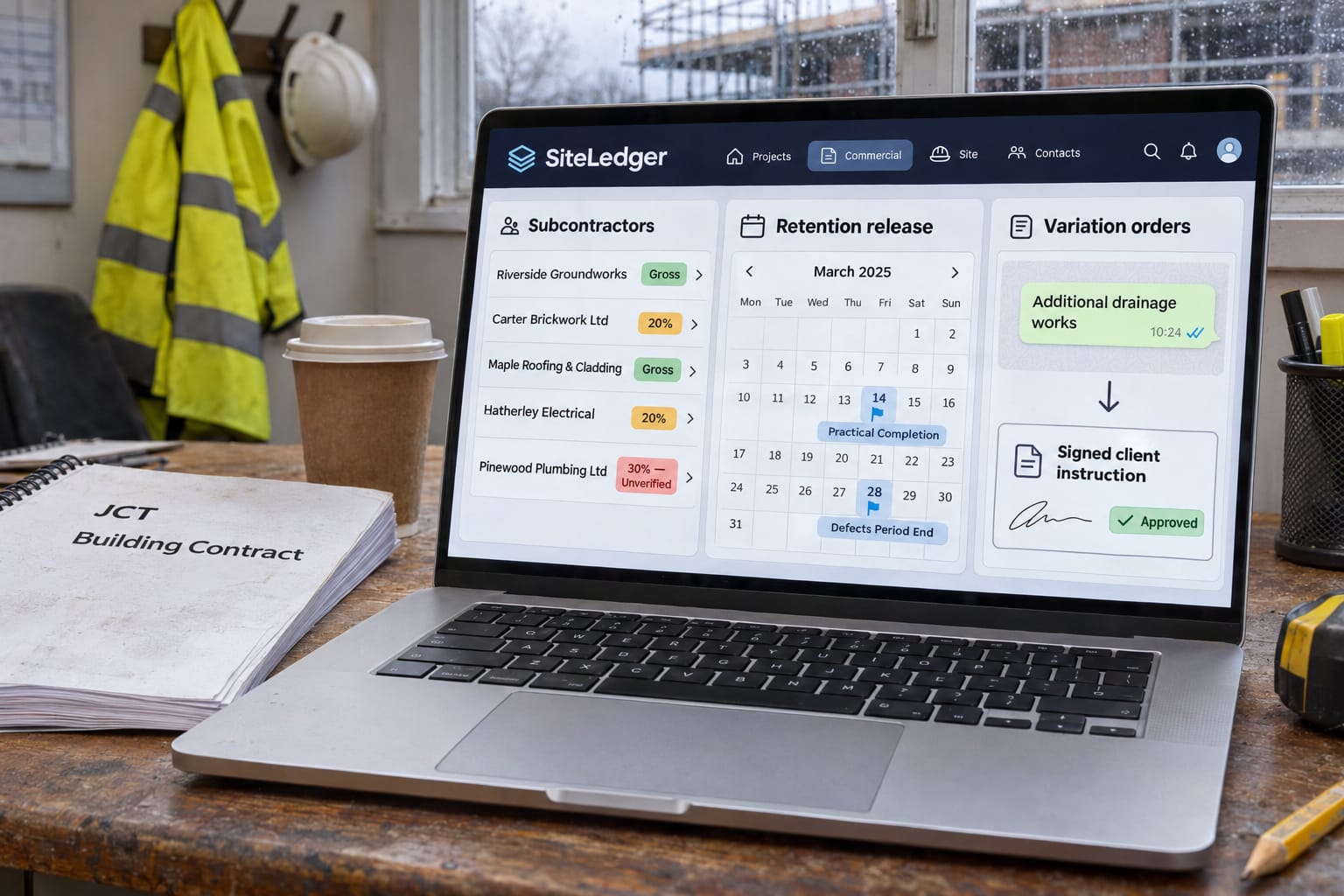
If you run a UK contractor between £2M and £20M turnover and you're trying to decide what software to build or buy next, build three narrow document workflows in this order: a CIS verification and deduction tracker, a retention release calendar tied to practical completion dates, and a variation order log that turns a site WhatsApp message into a client-signed instruction. Skip the full ERP. The margin you're leaking sits in records HMRC and your JCT contract already define — you just don't have a system that forces them to exist.
The reason this matters: UK construction logged 4,032 insolvencies in the 12 months to April 2025 — 17% of all UK business insolvency cases, more than any other industry, against a sector that produces roughly 6–7% of gross value added. The firms going under are not losing money on bricks. They're losing it on paperwork that was never issued, deductions that were wrong, and retentions no one chased.
The three operational problems that actually cost you money
1. CIS deductions you're calculating against stale verification data
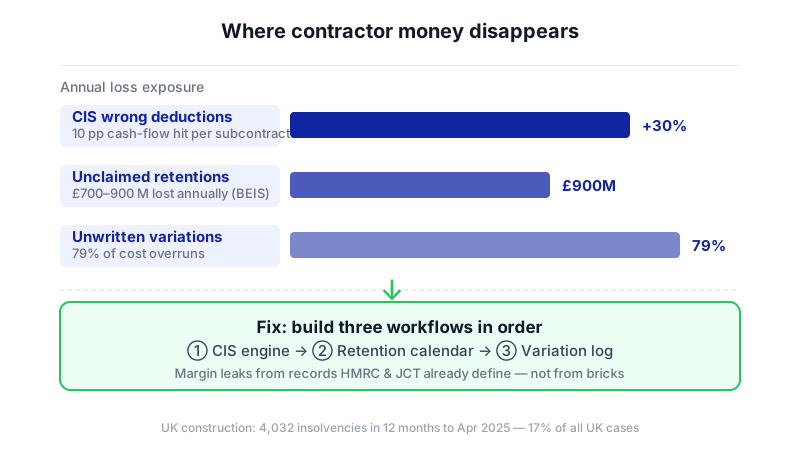
Every month you file a CIS return. Every subcontractor on that return has a verification status — gross, 20%, or 30% — and that status changes. HMRC updates it. Subcontractors register, deregister, lose gross status after a compliance failure. If your QS is pulling verification status from a spreadsheet that was last reconciled two months ago, you're either over-deducting (a 10-percentage-point cash-flow hit on the subcontractor, because unverified pays 30% not 20%) or under-deducting, which lands on you.

The penalty regime is unforgiving. HMRC charges an automatic £100 the day a return is late, escalating to 5% of the CIS deductions on that return at six months, and up to 100% for deliberate failure. Each monthly return is a separate filing. Miss three in a row across a group structure with two trading entities and the numbers are no longer theoretical.
2. Retentions no one owns
Across UK construction at any moment, between £4.5 billion and £5.9 billion is held in retentions, and more than 70% of contractors have experienced delayed or withheld releases. BEIS research referenced by industry bodies estimates £700–900 million is lost every year through delayed release and upstream insolvency. A further 44% of contractors have lost retentions entirely to insolvency up the chain.
The reason contractors lose this money is not fraud. It's that the first half of retention (practical completion) and the second half (end of defects liability, typically 12 months later) are tracked nowhere specific. Your QS knows. Your finance director assumes the QS knows. The client's QS is waiting to be asked. Twelve months pass. The client goes into administration. You find out you had £180,000 held against a project you finished in 2023.
3. Variations agreed on site, never issued in writing
This is the biggest one. Variations account for around 79% of project cost overruns and 52% of construction claims. Research from King's College London and the Adjudication Society found more than 20% of UK construction adjudication claims relate directly to variation disputes, and 73% of payment disputes potentially hide unresolved variation differences.
Here is the pattern. The client's PM walks the site, asks the foreman to move a wall, change a spec, add a run of conduit. The foreman says yes. The work gets done. It never becomes a formal variation instruction under the JCT contract. When you try to invoice for it, the client's QS says they have no record. You've already paid your subcontractor for the labour. The margin is gone.
What to build, in what order
Build one: CIS verification and deduction engine
What it is: A lightweight workflow that holds every subcontractor's current CIS verification status, re-verifies via HMRC's API on a schedule (monthly minimum, weekly for high-value trades), applies the correct deduction rate automatically to each payment application, and produces the CIS300 return as an output rather than as a separate exercise.

What changes once it exists: Your QS stops asking the finance team "what rate are we on for Patel Electrical this month". Deductions are correct on the first run. The monthly return is a review-and-submit, not a reconstruction. You stop over-deducting from gross-status subbies (which is the single fastest way to lose a good specialist trade). And you have a defensible audit trail if HMRC opens a compliance review.
Rough shape of the effort: This is the smallest of the three builds. It is a database of subcontractors, a scheduled job that hits HMRC's verification endpoint, a calculation layer, and a return generator. The work is dominated by two things: integrating with whatever accounting package you already run (Sage, Xero, Access, COINS) so you're not double-keying payment applications, and handling the edge cases — new subcontractors mid-month, status changes mid-return, CIS-registered but VAT-unregistered trades under reverse charge.
Build two: retention register tied to contract milestones
What it is: A register, one row per contract (both as main contractor to your client and as employer to your subcontractors), that records retention percentage, retention cap, practical completion date, defects liability period, first release trigger, and second release trigger. Automated reminders fire at PC minus 30 days, PC, DLP end minus 60 days, and DLP end. Each release generates a drafted application for payment with the supporting certificate references attached.
What changes: You stop discovering lost retentions at year-end audit. You start chasing clients 60 days before the money is due, which is when it is easiest to collect. On the subcontractor side, you stop holding retention past the point your contract requires — which is both a compliance issue and a reputation one. If a client up the chain starts showing distress signals, you have a dashboard view of your total exposure in their retention pot, which lets you make a call on accelerating applications or seeking a bond substitute.
Rough shape: Larger than the CIS build because the contract data entry is real work — someone has to read every live contract and extract the retention terms, PC dates, DLP lengths. That's a one-off cost. The software itself is a register, a scheduler, and a document generator. The hard part is organisational: deciding who owns each release and making the reminder go to a human who can act, not into a shared inbox.
Build three: variation order workflow
What it is: A mobile-first capture tool the site team actually uses, because it replaces the WhatsApp message they're already sending. Site manager photographs the instruction, tags the client representative who gave it, dictates a two-line scope, flags whether it is a confirmed instruction, a change to the contract sum, or a provisional sum adjustment. The record routes to the QS, who adds the cost and time impact and issues a formal variation instruction under the relevant JCT clause. The client's named representative gets an email with a signable link. Nothing moves to production until status is confirmed instruction.
What changes: This is where the margin recovery lives. Given that variations drive 79% of cost overruns, even a 20% reduction in unclaimed variations across a £10M turnover is a material number. You also reduce adjudication exposure, because the contemporaneous record is exactly what an adjudicator wants to see.
Rough shape: The technology is not difficult. The adoption is. A variation tool nobody uses is worse than the WhatsApp group, because now you have two systems and neither is complete. The build cost is medium. The change management cost is high and worth budgeting for explicitly — site manager training, two weeks of shadowing, a weekly review of captured-but-not-issued variations until the habit sticks.
What is honestly not worth building yet
A few things vendors will pitch you that are not the first problem to solve at £2M–£20M turnover:
- A full ERP replacement. If your accounting package produces statutory accounts and your QS can live with exporting to Excel, the ROI on replacing it is years out. The three workflows above sit on top of what you already have.
- BIM integration. Valuable on large design-led schemes. Not where margin is leaking on a fit-out or refurb-heavy book.
- AI-driven cost forecasting. Useful, but it needs clean historical cost data per work package. You do not have that yet. Build it as a byproduct of the variation and CIS systems, then forecast in year two.
- A bespoke project management tool. Procore, Fieldwire, and the rest are fine for what they do. Do not reinvent them. Build the three workflows above, and use them alongside an off-the-shelf PM tool if you need one.
What drives the cost and timeline of a build like this
Every contractor asks this early and it is a fair question. The honest answer is that the range is wide, and what moves it is specific to you. The biggest drivers:
- How many systems already need to talk to each other. A single accounting package with a clean API is a week. Three legacy systems where the QS files are in a shared drive is a different conversation.
- Whether you have clean subcontractor and contract master data. If someone has to extract retention terms from 80 live contracts manually before the retention register has any value, that is real effort — and it is yours to do or to pay someone else to do.
- How many trading entities and VAT numbers sit in the group. CIS returns are per-entity. The build complexity scales with the structure.
- Whether the variation tool needs offline mobile capture. Half of UK construction sites have unreliable signal. Offline-first is a different build from online-only.
- The adoption plan. Software that nobody uses is the single most expensive mistake in this category. Budget for training and for two months of handholding, not just for the code.
A sensible sequence is CIS first (smallest, protects you from HMRC first), retentions second (biggest single cash number), variations third (biggest margin recovery, hardest adoption). You can start seeing value from the CIS workflow inside the first return cycle once it is live. The retention register pays back the first time a release reminder catches a payment you would have missed. The variation tool pays back on the first disputed instruction where you have a photo, a timestamp, and a signed confirmation.
To turn any of this into a real number rather than a shape, the three specifics that matter are: your current accounting and QS tooling and whether their APIs are usable, how many live contracts and active subcontractors you have today, and how your site teams actually communicate right now. Those three answers move the estimate more than anything else. A conversation with the CodeNicely team can scope it properly.
How CodeNicely can help
The closest parallel in our work is GimBooks, a YC-backed accounting SaaS where we built the compliance and document-generation layer for Indian GST — a regime that, like CIS, has monthly return filings, penalty escalation for late submission, and a verification step tied to a counterparty's registration status. The engineering pattern is the same: capture the transaction at source, apply the right tax or deduction based on live verification data, generate the return as an output. We've also done the field-to-office data capture problem on Vahak, where lorry drivers across rural India needed an offline-capable mobile workflow that a head-office team could act on in real time — which is the same problem a site manager in Birmingham has with a variation instruction.
You own the IP. No vendor lock-in. If you later decide to move to a full ERP, the workflows sit alongside it rather than fighting it. More on how we approach this kind of work on our offerings page.
Frequently Asked Questions
Is CIS compliance software something we can buy off the shelf instead?
Partly. Sage, Xero, and specialist tools like Planyard handle CIS deduction calculation and return filing if your workflow fits their model. The gap is usually integration with your QS's payment application process and handling verification status changes mid-cycle. If your QS exports to Excel and re-keys into the accounting package, an off-the-shelf tool does not solve that — a thin custom layer connecting the two does.
How long before a retention register pays for itself?
It depends on your retention exposure. Industry data suggests £700–900 million is lost annually across UK construction through delayed release and upstream insolvency. For a £10M turnover contractor with 3% retention held across typical contract terms, the exposure at any moment is likely in six figures. Catching one release that would otherwise have slipped past DLP end usually covers the build.
Will my site managers actually use a variation capture tool?
Only if it is faster than WhatsApp and only if someone enforces it for the first two months. The tool has to let a site manager photograph, dictate, and submit in under 30 seconds. If it needs more than that, it will not survive contact with a wet February. Budget for training and a weekly QS review of captured-but-not-issued items until the habit is established.
Does this need to integrate with our accounting package, or can it run alongside?
CIS has to integrate — the whole point is removing double-entry and the error it introduces. The retention register can start as a standalone register and integrate later. The variation workflow needs to feed agreed variations into the valuation process, which is usually a push into the QS's working file rather than a deep accounting integration.
Should we talk to a solicitor or auditor before building any of this?
Yes. The CIS workflow should be reviewed by your tax advisor for your specific group structure, the retention logic should be reviewed by a construction solicitor against your actual contract suite (JCT, NEC, bespoke), and the variation workflow should be checked against the notice provisions in your standard form. We can build the tooling, but the contractual and tax specifics are a conversation for your professional advisors.
Sources & further reading
- Why builders run into cashflow trouble – and how to avoid it (FMB, citing Insolvency Service, June 2025)
- Construction Retentions Reform: The UK Retention Deposit Scheme (Legal Futures / UKRDS)
- Retention Payments: What Contractors Need To Know (Squote, citing BEIS 2017)
- Stop Leaving Money On The Table (Part 1): Variations – The Importance of Understanding the Contract (Lindford Consulting, citing KCL/Adjudication Society)
- For a Few Dollars More: A Brief Guide to Variations (Coniston Associates)
- Preventive Approach to Unsubstantiated Claims and Disputes in the UK Construction Industry (ResearchGate)
- CIS Penalties for Late Filing & Payment (GoFile)
- CIS Monthly Return: What It Is and How to File with HMRC (Planyard)
Get one practical guide a week
Costs, AI tools, partner selection — written for people who make the decision. No spam, unsubscribe anytime.
Thanks — you're on the list. One practical guide a week, nothing else.
That didn't work — please check the email address and try again.
Building something in Construction?
CodeNicely partners with founders and tech teams to ship AI-native products that move metrics. Tell us about the problem you're solving.
Talk to our team Book a 30-min call