
What to Build for Construction and Contracting Businesses in India

 Published by CodeNicely, the product studio founded by Meghal Agrawal and Ujjwal Agrawal in 2017
For: Owner or COO of a mid-sized Indian contracting firm — residential, commercial, or infrastructure — managing 10–50 active sites, still running project tracking on WhatsApp groups and Excel, and losing 8–12% of project margin to billing disputes, material leakage, and subcontractor payment chaos they cannot reconstruct after the fact
In this guide
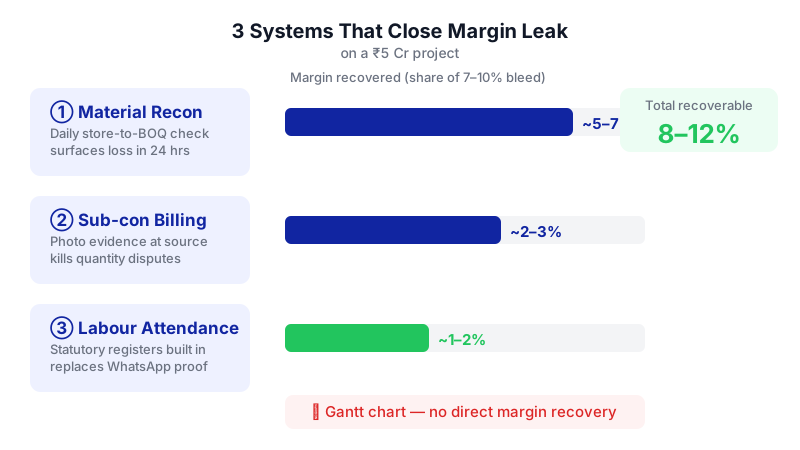
If you run a mid-sized contracting firm in India and you're trying to decide what software to commission first, don't start with the Gantt chart. Start with the gap between material issued from store and material certified in the running account bill. That single reconciliation — done daily, on a phone, by the store keeper and the site engineer — closes more margin leak than any scheduling tool you will ever buy. Subcontractor billing with photo evidence comes second. Digital labour attendance with statutory registers comes third. Everything else, including the ERP every vendor wants to sell you, can wait.
This post is for owners and COOs running 10–50 active sites on WhatsApp groups and Excel, watching 8–12% of project margin disappear into disputes they cannot reconstruct. The pitch you keep hearing — "integrated construction ERP" — is not wrong, it's just sequenced wrong. Here is the order that actually matches where the money bleeds.
Why the Gantt chart is the wrong starting point
Scheduling software assumes your problem is sequencing. It isn't. Your problem is that on a ₹5 crore project, 7–10% of material cost quietly walks off site — that's ₹35–50 lakhs on a single job, per SiteSetu's industry benchmarks. Rebar wastage alone on Indian residential projects runs 7–12% against a BOQ allowance of 3–5%, and the gap only surfaces at closeout, per InfraLens using the CPWD DSR methodology. By then, the margin is gone and nobody can tell you where.
Meanwhile, roughly ₹3 lakh crore of contractor payments are stuck in Indian public-sector projects, much of it disputed because the contractor cannot produce site-level evidence of what was done and when. A WhatsApp screenshot of your supervisor saying "8 labour today sir" is not evidence in an arbitration.
The construction sector contributes around 9.1% of India's GDP and the India construction and design software market is only $585.2 million as of 2024, against a global ERP market of $4.57 billion. The under-penetration is not because contractors don't want software. It's because they've been sold the wrong software.
The three systems that actually move margin
1. Material reconciliation, not material tracking
Every vendor sells "inventory tracking." What you need is daily reconciliation: for every item issued from store, what was consumed, what is on site unused, and what is unaccounted. The reconciliation has to happen before the next day's issue, not at month-end, and definitely not at project closeout.
What to build:
- A phone-first store module where the store keeper logs issues against a work order, with the trade (steel fixing, shuttering, concreting) tagged at issue time
- A site engineer app that records daily consumption against BOQ line items, with a photo of the work completed
- A nightly variance report that flags any SKU where issued-minus-consumed exceeds the BOQ wastage allowance by more than a threshold you set (say, 2%)
- A link from consumption back into the Running Account bill worksheet so the quantity certified by the client's engineer is the same quantity you drew from store
What changes: variance surfaces in 24 hours, not 6 months. The conversation with the site supervisor happens while the material is still physically locatable. Rebar off-cuts get weighed and logged instead of walking out as scrap.
What it does not solve: this will not stop a determined collusion between site and supplier. It will stop drift, double-counting, and the slow bleed that accounts for most of the loss. Fraud needs a separate audit layer.
2. Subcontractor billing with evidence attached at source
Most disputes between a main contractor and a petty subcontractor are not about rate — they're about quantity and date. The supervisor says the shuttering carpenter did 420 sqm this week. The carpenter says 510. Neither of them has a photo, a measurement sheet, or a GPS-stamped record. You pay somewhere in between and absorb the difference.
What to build:
- A subcontractor work-order module that breaks the contract into measurable units (sqm shuttered, MT of steel tied, cum of concrete poured) with agreed rates frozen at PO time
- A daily progress entry by the site engineer, with 3–5 geo-tagged, timestamped photos per entry, and a joint sign-off from the subcontractor's foreman on the phone
- Auto-generated weekly or fortnightly running bills that pull from the daily entries, with the retention, advance recovery, and TDS deductions pre-calculated
- An audit trail that survives a dispute — every photo, every sign-off, every rate variation — exportable as a PDF annexure
What changes: the subcontractor sees their running bill in real time and stops over-claiming at month-end because they've already agreed to it daily. Your supervisors stop being the single point of truth. When a client disputes your RA bill, you have the sub-level evidence to back the quantity you claimed.
3. Digital labour attendance with statutory registers built in
This is the one most owners under-weight because it feels like an HR problem. It isn't. It's a compliance and payroll fraud problem, and it got sharper with the Occupational Safety, Health and Working Conditions (OSH) Code, 2020 coming into force on 21 November 2025, which absorbed the Contract Labour (Regulation and Abolition) Act. Repeat offenders under the new Labour Codes can face fines up to ₹4.8 lakh per the published compliance guidance.
What to build:
- Biometric or face-recognition attendance at the site gate, with the device working offline and syncing when the site gets connectivity
- A worker master that captures Aadhaar (with consent), PF/ESI numbers where applicable, skill grade, and the labour contractor they report to
- Auto-generated statutory registers — Form XIII (register of workmen), Form XIV (employment card), muster roll, wage register — in the formats your labour commissioner actually accepts
- A payroll export that reconciles attendance against the labour contractor's weekly bill, so you don't pay for 340 mandays when the gate recorded 290
What changes: ghost workers stop appearing on payroll. The labour contractor's bill matches the gate record, or the conversation happens before you cut the cheque. During an inspection, you produce registers in minutes instead of scrambling for a week.
What it does not solve: none of this is a substitute for a labour lawyer reviewing your contractor agreements and your PF/ESI exposure under the new codes. Build the system, but get the legal review separately — a competent labour law advocate or your statutory auditor should sign off on the register formats and the deduction logic before you go live.
What to deprioritise (even though the vendor will push it)
- Gantt-based scheduling. Buy MS Project or Primavera for your planning engineer if you need it. Don't build it. Site supervisors will not update it.
- BIM integration. Unless you're doing design-build on commercial or infrastructure work above ₹100 crore, the ROI is not there yet for a mid-sized contractor.
- Equipment telematics. Useful if you own a large fleet of earthmoving equipment. Skip if most of your plant is hired.
- Client-facing dashboards. Nice to have. Build after the three core systems are adopted internally, not before.
- Full financial ERP. Tally or Zoho Books plus a well-designed project cost module that feeds them is faster, cheaper, and gets adopted. A ground-up ERP for a ₹50–500 crore turnover contractor is a two-year distraction.
How to sequence the build
Treat this as three releases, not one project. Each release has to be live, adopted, and generating data before the next one starts. If you try to build all three in parallel, site adoption collapses because you're asking supervisors to change three workflows at once.
- Release 1 — Material reconciliation. Start with your two highest-material-cost sites. Get the store keeper and site engineer onto the phone app. Run it for 60–90 days until the daily variance report is being read by a project manager, not just generated.
- Release 2 — Subcontractor billing with evidence. Roll out to the same two sites first, then expand. The subcontractors will resist initially; the ones who adopt get paid faster, which is the carrot.
- Release 3 — Labour attendance and statutory registers. This is the one where the hardware (biometric devices, rugged tablets at the gate) matters, so plan procurement in parallel with the first two releases.
Once these three are stable, the integrations that create the ERP effect — material consumption flowing into project P&L, subcontractor bills flowing into payables, labour cost flowing into project cost — are straightforward. You've built the ERP from the site up, which is the only way it gets used.
What this costs and how long it takes — the shape of the number
The honest answer is that the range is wide and the drivers are knowable. What moves the number for a construction software build of this scope:
- Number of active sites and users at launch. Ten sites with 3 users each is a different deployment from 40 sites with 10 users each. Field training and device rollout is often the biggest hidden cost.
- Connectivity at your sites. If half your sites are in locations with patchy data, the offline-first engineering is more work — but non-negotiable.
- Existing systems you need to integrate. Tally, Zoho Books, SAP B1, a payroll system, an HRMS — each integration is scoped separately.
- Hardware. Biometric gate devices, rugged tablets for store keepers, barcode scanners for high-value material. This is a capex line that vendors often hide.
- Statutory register formats. These vary by state and by labour commissioner. Scoping which forms, in which states, matters.
- Change management. Site adoption is 60% of the real cost of making this work, and it rarely sits in the software line item. Budget for a full-time implementation lead on your side.
Illustrative only: a build covering the three core modules above, for a contractor running 15 active sites, two state jurisdictions for labour compliance, integration with Tally and an existing payroll system, and no migration from a legacy construction ERP — would typically be scoped as a phased engagement over three releases, with the first release (material reconciliation) live in a smaller window than the full rollout. Every assumption in that sentence moves the number.
Per the Future Market Insights 2026 outlook, India's construction ERP adoption is growing at 9.6% CAGR — the fastest globally — and Deloitte/Autodesk's 2024 digital adoption work associates each additional digital technology with a 1.4% revenue uplift and 1% profitability improvement annually. The payback math usually clears inside the first full project cycle if the material reconciliation module alone is adopted.
To turn the range into a real quote, three things need to be scoped: the number of sites and users at go-live, the list of integrations and the state jurisdictions for labour compliance, and whether you want to own the hardware procurement or have it bundled. That is a 60–90 minute conversation, not a form.
How CodeNicely can help
We build field-first operational software for businesses where the users are not sitting at desks. The closest analogue in our portfolio to a contracting firm is Vahak — a logistics marketplace where the core users are truck owners and transporters operating from phones, often with patchy connectivity, where every transaction has to survive a dispute between two parties who rarely trust each other. The engineering patterns that matter there — offline-first mobile, evidence captured at source, audit trails that hold up in a disagreement, workflows that a non-literate user can complete in under 30 seconds — are the same patterns a construction material reconciliation or subcontractor billing system needs.
We work with full IP transfer and no vendor lock-in, which matters for a contractor who does not want their operational data trapped in a vendor's cloud. If you want to see how we approach digitising operations for established businesses, or the broader India-market engagement model, those pages cover the shape of the work.
Frequently Asked Questions
What software does a mid-sized Indian contractor actually need first?
Three systems, in this order: daily material reconciliation against BOQ, subcontractor billing with photo and GPS evidence captured at source, and digital labour attendance with statutory registers built in. Scheduling, BIM, and full financial ERP come later. The first three close the margin leaks that account for most of the 8–12% loss on a typical project.
Should I buy a ready-made construction ERP or build custom software?
If your operation fits the assumptions of a packaged ERP — standard trades, standard BOQ formats, one or two sites, a single state for labour compliance — buy. If you have non-standard workflows, multi-state labour compliance, existing Tally or SAP that you won't replace, or specific disputes you need the evidence trail to address, custom usually pays back faster because adoption is higher. Hybrid is common: packaged accounting plus custom field operations.
How do I get site supervisors to actually use the software?
Build the first release for one workflow they already care about — usually material issue, because the store keeper is accountable for shortages. Keep the daily entry under 60 seconds. Make the output (variance report, running bill, payment release) visible to the supervisor so they see the value. Rolling out three modules on day one guarantees non-adoption.
How long before we see margin improvement?
Material reconciliation typically surfaces variance within the first 30–60 days of a site being live on the system, which is also when the behavioural correction starts. The subcontractor billing module shows up in reduced disputes over the next 2–3 billing cycles. Labour compliance is a step-change — the risk exposure drops the day the biometric gate goes live. Full project-level margin improvement is usually visible in the first full project cycle after rollout, but the qualifier is adoption, not software.
What about compliance under the new Labour Codes?
The OSH Code, 2020 came into force on 21 November 2025 and absorbed the Contract Labour (Regulation and Abolition) Act, with penalties under the new Codes reaching ₹4.8 lakh for repeat offenders per published compliance guidance. The software can generate the registers and the audit trail, but your labour law advocate or statutory auditor must review the specific register formats for your states and sign off on the deduction logic. Do not treat software output as legal compliance on its own.
Sources & further reading
- Report on Indian Construction Industry — March 2025 (CII / Goel Construction)
- Construction ERP Software Market Report 2025 — The Business Research Company
- India Construction and Design Software Market Size & Outlook — Grand View Research
- Construction ERP Software Market — Future Market Insights (India CAGR 9.6%)
- How to Reduce Material Wastage on Construction Sites — SiteSetu.in
- Construction Material Wastage Factors — InfraLens (CPWD DSR basis)
- Responsible Causes of Payment Delays in Indian Construction Industry — ResearchGate
- Construction Disputes: The Hidden Cost of Building India's Infrastructure — NBM&CW
Get one practical guide a week
Costs, AI tools, partner selection — written for people who make the decision. No spam, unsubscribe anytime.
Thanks — you're on the list. One practical guide a week, nothing else.
That didn't work — please check the email address and try again.
Building something in Construction?
CodeNicely partners with founders and tech teams to ship AI-native products that move metrics. Tell us about the problem you're solving.
Talk to our team Book a 30-min call